India US Relations 1947 to 2026: From Cold War Distance to Quad Partners and the Tariff Test
The world's largest democracy and its oldest modern democracy took fifty years to trust each other. Then came the nuclear deal, defence pacts and the Quad, followed in 2025 by the steepest tariffs the US had put on any major partner. After US Secretary of State Marco Rubio's talks in Mumbai on 20 October 2026, here is the whole story in simple words.
Where India US Relations Stand in October 2026
US Secretary of State Marco Rubio held talks with External Affairs Minister S. Jaishankar in Mumbai on 20 October 2026, during his official visit of 20-21 October (part of a regional tour of 17-22 October that includes Jamnagar), his second India trip this year after the Quad Foreign Ministers' meeting in New Delhi in May. According to the MEA, the two sides welcomed progress on the Bilateral Trade Agreement (BTA) and reaffirmed their commitment to its early conclusion, and discussed defence, technology and energy security along with regional and global developments. Rubio said the two sides were close on trade, with a small number of items left. He and Jaishankar also met UAE Foreign Minister Sheikh Abdullah bin Zayed, whose own India visit overlapped, with the focus on regional energy security. No new agreement was signed.
Two developments came just before the visit. On 15 October, Commerce Minister Piyush Goyal said the first tranche of the India-US trade agreement is finalised and under legal drafting, though not yet signed. On 16 October, President Trump signed an executive order suspending tariff provisions of the new US sanctions law on buyers of Russian energy that could have meant duties of up to 100 percent; it is not an India-specific exemption and can be reversed. The relationship is recovering from the 2025 tariff shock, but trade, Russian oil and visas remain sore points.
79 Years at a GlanceIndia US Relations Timeline: Six Phases from 1947 to 2026
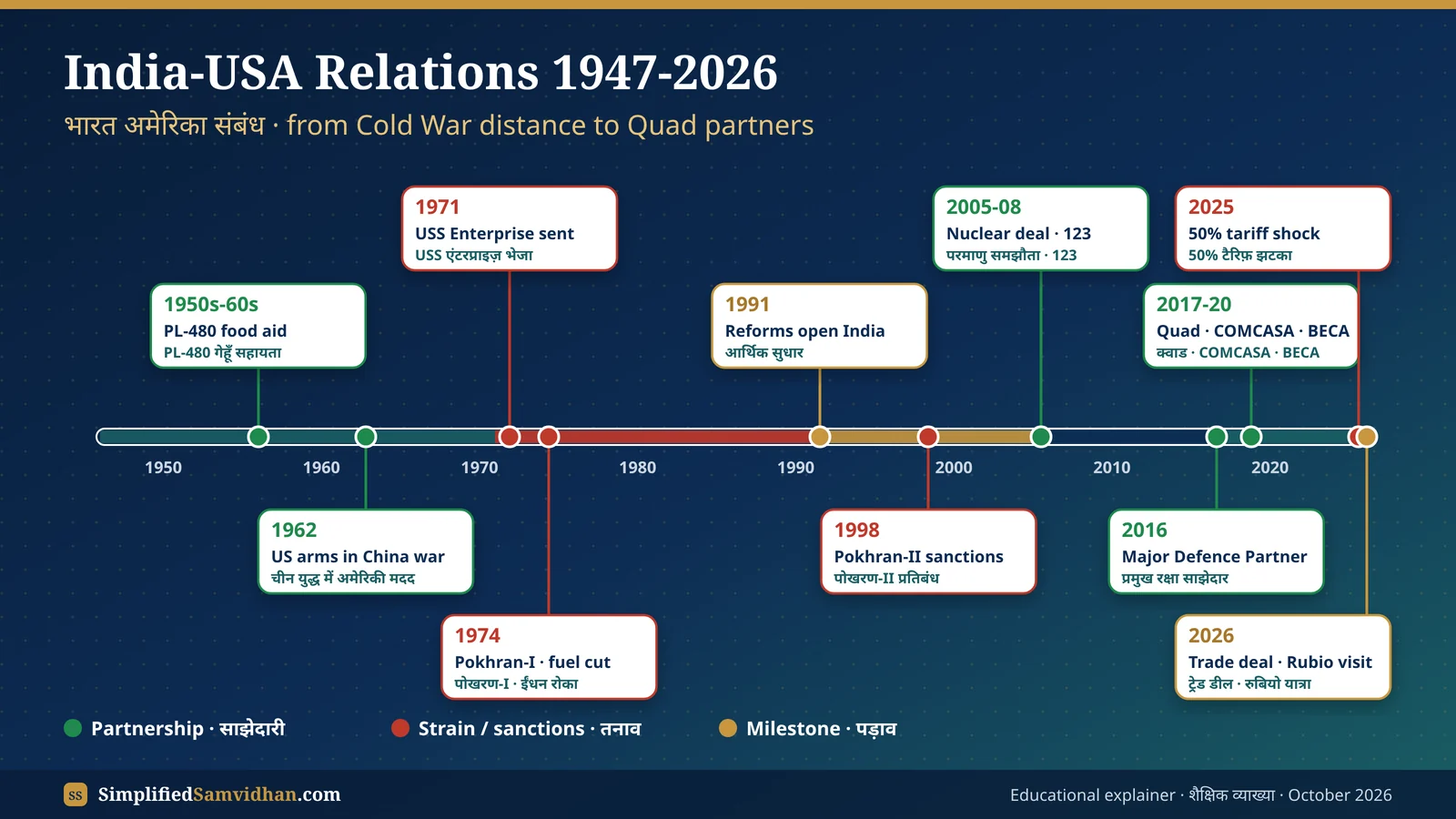
India-US ties are a story of "estranged democracies" becoming partners. The turning points were wars, nuclear tests and, later, China's rise.
- 1947-1970Friendly but distant
Nehru chooses non-alignment; the US backs Pakistan through military pacts. Yet US wheat under PL-480 feeds India, and the US sends arms in the 1962 war with China.
- 1971-1990The cold years
Nixon tilts to Pakistan in 1971 and sends the USS Enterprise to the Bay of Bengal; India signs a treaty with the Soviet Union. After Pokhran-I (1974) the US cuts nuclear fuel aid.
- 1991-2004The thaw
Economic reforms open India. Pokhran-II (1998) brings US sanctions, but the Jaswant Singh-Strobe Talbott talks and Clinton's visit (2000) reset ties; the US presses Pakistan to quit Kargil (1999).
- 2005-2016The nuclear deal era
The July 2005 joint statement leads to the 123 Agreement (2008) and an NSG waiver. The US names India a Major Defence Partner (2016) and LEMOA is signed.
- 2017-2024Quad and defence
The Quad is revived (2017); COMCASA (2018) and BECA (2020) complete the defence pacts; 2+2 dialogues begin (2018); a Comprehensive Global Strategic Partnership is announced (2020).
- 2025-2026The tariff test
The US raises tariffs on Indian goods to 50 percent (August 2025) over trade and Russian oil, then cuts them in February 2026 under an interim deal. A 10-year defence framework (2025) and a trade deal tranche (2026) follow.
Think of India and the US as two neighbours who once sat in rival groups at the colony meeting. One was friendly with the other's rival (Pakistan), the other with the first's friend (the Soviet Union). When a common worry arrived, a powerful new neighbour (China), they started walking to the meeting together. They still argue loudly about money (tariffs), but they need each other.
🏠 Everyday analogy
Two shopkeepers in a market can compete on prices and still stand together when a much bigger mall opens next door.
🇮🇳 Real Indian example
In 1971 the US Seventh Fleet sailed towards the Bay of Bengal to pressure India; fifty years later, Indian and US navies sail together in the Malabar exercise with Japan and Australia.
Turning PointIndia US Nuclear Deal (123 Agreement): Why It Changed Everything
- The problem: India never signed the Nuclear Non-Proliferation Treaty (NPT). After the 1974 and 1998 tests it was cut off from nuclear fuel and technology by the Nuclear Suppliers Group (NSG).
- 18 July 2005: Prime Minister Manmohan Singh and President George W. Bush agreed that the US would treat India as a responsible state with advanced nuclear technology.
- Separation plan: India agreed to separate civilian and military reactors and put civilian ones under IAEA safeguards.
- 6 September 2008: the NSG gave India a unique waiver, the only non-NPT country to get one. The 123 Agreement (named after Section 123 of the US Atomic Energy Act, 1954) was signed in October 2008.
- Politics at home: the Left parties withdrew support over the deal and the UPA government won a trust vote in the Lok Sabha in July 2008.
- Hurdle since: India's Civil Liability for Nuclear Damage Act, 2010 made suppliers liable for accidents, which slowed US reactor projects.
The deal was like a club that had banned India for years finally saying: "You did not sign our rule book, but you have behaved well, so you can buy from our shops." It ended India's nuclear isolation and opened the door to defence and technology cooperation.
DefenceIndia US Defence Agreements: GSOMIA, LEMOA, COMCASA and BECA Explained
| Agreement | Year | What it does in simple words |
|---|---|---|
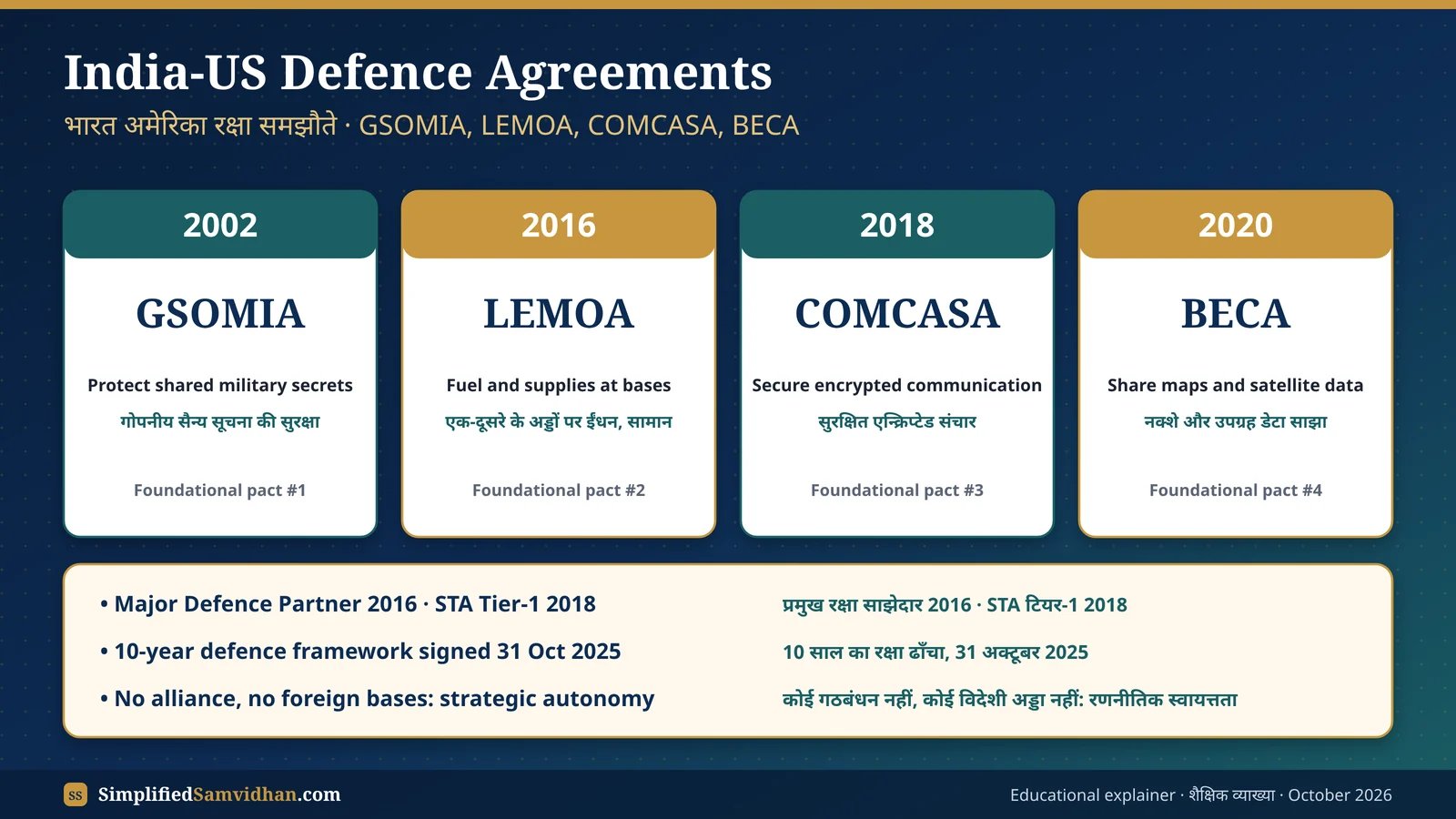
| GSOMIA (General Security of Military Information Agreement) | 2002 | Rules for sharing and protecting classified military information |
| LEMOA (Logistics Exchange Memorandum of Agreement) | 2016 | Ships and aircraft can refuel and get supplies at each other's bases, paid for later |
| COMCASA (Communications Compatibility and Security Agreement) | 2018 | India can use secure, encrypted US communication systems on US-made platforms |
| BECA (Basic Exchange and Cooperation Agreement) | 2020 | Sharing of geospatial maps and satellite data for accurate navigation and targeting |
- Major Defence Partner (2016) and Strategic Trade Authorization Tier-1 (2018): India gets easier access to sensitive US technology, a status the US gives only to close allies.
- Big platforms: C-17 and C-130J transport aircraft, P-8I patrol aircraft, Apache and Chinook helicopters, MQ-9B drones; GE F414 jet engines to be co-produced for the Tejas Mk2.
- 31 October 2025: a new 10-year framework for the India-US Major Defence Partnership was signed.
- India's red line: no military alliance and no foreign bases. India still buys from Russia (for example the S-400) under strategic autonomy.
TradeUS Tariff on India 2025-2026 and the India US Trade Deal Explained
| When | What happened |
|---|---|
| February 2025 | Modi-Trump meeting sets "Mission 500": USD 500 billion bilateral trade by 2030, and talks on a trade agreement |
| August 2025 | US puts a 25 percent "reciprocal" tariff on Indian goods, then another 25 percent penalty over Russian oil purchases: 50 percent in all |
| September 2025 | US imposes a USD 100,000 fee on new H-1B visa petitions, hitting Indian IT professionals |
| February 2026 | Interim trade framework; the Russian-oil penalty is removed and the reciprocal rate cut to 18 percent |
| 2026 | After a US Supreme Court ruling against the emergency-powers tariffs, the US moves to other legal routes; trade trackers report a duty of about 10 percent on most Indian goods |
| 15-16 October 2026 | First tranche of the trade deal finalised (not yet signed); US suspends Russia-energy tariff provisions of its new sanctions law |
Note: US tariff rules changed many times in 2025-26 and some exemptions apply product by product. Rates above are as reported by the sources listed below; check the latest official notice before any business decision.
What the US wants
- Lower Indian duties on farm goods, dairy, cars and medical devices
- India to buy more US energy and defence equipment
- India to reduce Russian oil imports
What India wants
- Lower US tariffs than competitor countries
- Protection for farmers and dairy (food security, livelihoods)
- Easier visas for professionals; freedom to buy energy where it is cheapest
A tariff is a tax at the border. If the US adds 50 percent on an Indian shirt, a USD 10 shirt costs USD 15 in an American shop, and buyers switch to Vietnam or Bangladesh. That is why exporters in Tiruppur, Surat and Moradabad follow these talks so closely.
🏠 Everyday analogy
If your housing society suddenly charges outsiders a big entry fee, the vegetable seller will start going to the next society instead.
🇮🇳 Real Indian example
Shrimp exporters in Andhra Pradesh and garment units in Tiruppur reported cancelled US orders after the August 2025 tariffs.
ConstitutionWho Makes India's Foreign Policy and Trade Deals: Articles 73 and 253
Article 253. Legislation for giving effect to international agreements.
Notwithstanding anything in the foregoing provisions of this Chapter, Parliament has power to make any law for the whole or any part of the territory of India for implementing any treaty, agreement or convention with any other country or countries or any decision made at any international conference, association or other body.
Article 73. Extent of executive power of the Union.
(1) Subject to the provisions of this Constitution, the executive power of the Union shall extend— (a) to the matters with respect to which Parliament has power to make laws; and (b) to the exercise of such rights, authority and jurisdiction as are exercisable by the Government of India by virtue of any treaty or agreement:
Seventh Schedule, List I (Union List): Entry 10. Foreign affairs; all matters which bring the Union into relation with any foreign country. Entry 14. Entering into treaties and agreements with foreign countries and implementing of treaties, agreements and conventions with foreign countries. Entry 41. Trade and commerce with foreign countries.
Foreign affairs and treaties are in the Union List, so only the Centre handles them. Under Article 73 the Union Government can sign an agreement like the 123 Agreement or a trade deal by its executive power, without a vote in Parliament. But if a treaty needs a change in Indian law, Parliament must pass that law under Article 253, even on State subjects. Article 51 (a Directive Principle) asks the State to promote international peace and respect treaty obligations.
🏠 Everyday analogy
A family head can sign a rent agreement for the family, but if it needs the house to be rebuilt, the whole family must agree.
🇮🇳 Real Indian example
The Civil Liability for Nuclear Damage Act, 2010 was a law Parliament made after the nuclear deal, and it shaped how the deal works.
UPSC CornerIndia US Relations for UPSC Prelims and Mains
- Prelims fact: The 123 Agreement is named after Section 123 of the US Atomic Energy Act, 1954; the NSG waiver for India came on 6 September 2008.
- Prelims fact: Order of the four foundational agreements: GSOMIA (2002), LEMOA (2016), COMCASA (2018), BECA (2020).
- Prelims fact: The Quad members are India, the USA, Japan and Australia; the Malabar naval exercise includes all four.
- Prelims fact: India was named a Major Defence Partner in 2016 and moved to STA Tier-1 in 2018.
- Prelims fact: Treaties and foreign trade are Entries 14 and 41 of the Union List; Article 253 lets Parliament legislate to implement treaties.
- Mains (250 words): "Strategic convergence, economic divergence." Examine India-US relations in the light of the 2025 tariffs and the 2026 trade talks.
- Mains (150 words): How does strategic autonomy shape India's ties with both the US and Russia?
Practice MCQTest Yourself: India-USA Relations 1947-2026: Nuclear Deal, Quad and Tariffs
Arrange the following India-US defence agreements in chronological order of signing: (1) COMCASA (2) LEMOA (3) BECA (4) GSOMIA. Select the correct answer using the code given below.
Doubts ClearedFrequently Asked Questions
What happened during Marco Rubio's India visit in October 2026?
US Secretary of State Marco Rubio met External Affairs Minister S. Jaishankar in Mumbai on 20 October 2026. They welcomed progress on the India-US Bilateral Trade Agreement and committed to concluding it early, and discussed defence, technology and energy security. They also met the UAE Foreign Minister together. No new agreement was signed.
What is the India-US trade deal of 2026?
On 15 October 2026 Commerce Minister Piyush Goyal said the first tranche of the India-US bilateral trade agreement had been finalised and was under legal drafting. It has not been signed yet; signing depends partly on the US completing its tariff framework.
Why did the US raise tariffs on India in 2025?
In August 2025 the US imposed a 25 percent reciprocal tariff and an additional 25 percent penalty linked to India's purchases of Russian oil, taking the total to 50 percent. The penalty was removed and the rate cut in February 2026 under an interim trade framework.
What is the India-US 123 Agreement?
It is the civil nuclear cooperation agreement signed in October 2008, named after Section 123 of the US Atomic Energy Act, 1954. Together with the NSG waiver of September 2008 it ended India's nuclear isolation.
Is India a US ally?
No. India is a strategic partner and a Major Defence Partner of the US, and a member of the Quad, but it has no military alliance with the US and follows a policy of strategic autonomy.
Sources and further readingSources We Checked
Historical facts are from official texts and standard references; news facts for 2025-26 were checked against the reports below on 18 October 2026. US tariff rates change often; check the latest official notification.
- AP, 20 Oct 2026: Rubio and India's foreign minister hold talks in Mumbai as both sides aim to finalize a trade deal
- ANI, 21 Oct 2026: India, US review strategic roadmap; push for early trade deal during Rubio's visit in Mumbai
- Business Standard, 14 Oct 2026: US Secretary of State Marco Rubio to visit Jamnagar, Mumbai from Oct 17-22
- Business Today, 16 Oct 2026: Jaishankar, Marco Rubio to hold talks in Mumbai on October 20
- Outlook India, 17 Oct 2026: Trump suspends Russia-linked tariffs, offering relief to India
- ANI, 15 Oct 2026: First tranche of India-US trade deal finalised, undergoing legal drafting, says Piyush Goyal
- KPMG, Feb 2026: United States removes additional tariffs on imports from India
- India Briefing: US-India interim trade deal, tariffs cut to 18%
- Ministry of External Affairs: India-US Joint Statement, 18 July 2005
- Ministry of External Affairs: India-United States bilateral brief
- Legislative Department: The Constitution of India (Articles 51, 73, 253; Seventh Schedule List I)