Political Clearance for Foreign Visit: Punjab CM Case, MEA Powers and Cooperative Federalism
Can the Union Government stop a Chief Minister from travelling abroad to sell his State's farm produce? On 16 October 2026 the Punjab and Haryana High Court set aside the Centre's denial of political clearance for Punjab Chief Minister Bhagwant Mann's visit to France. Here is how MEA political clearance works, which Articles of the Constitution are involved, and what it means for cooperative federalism.
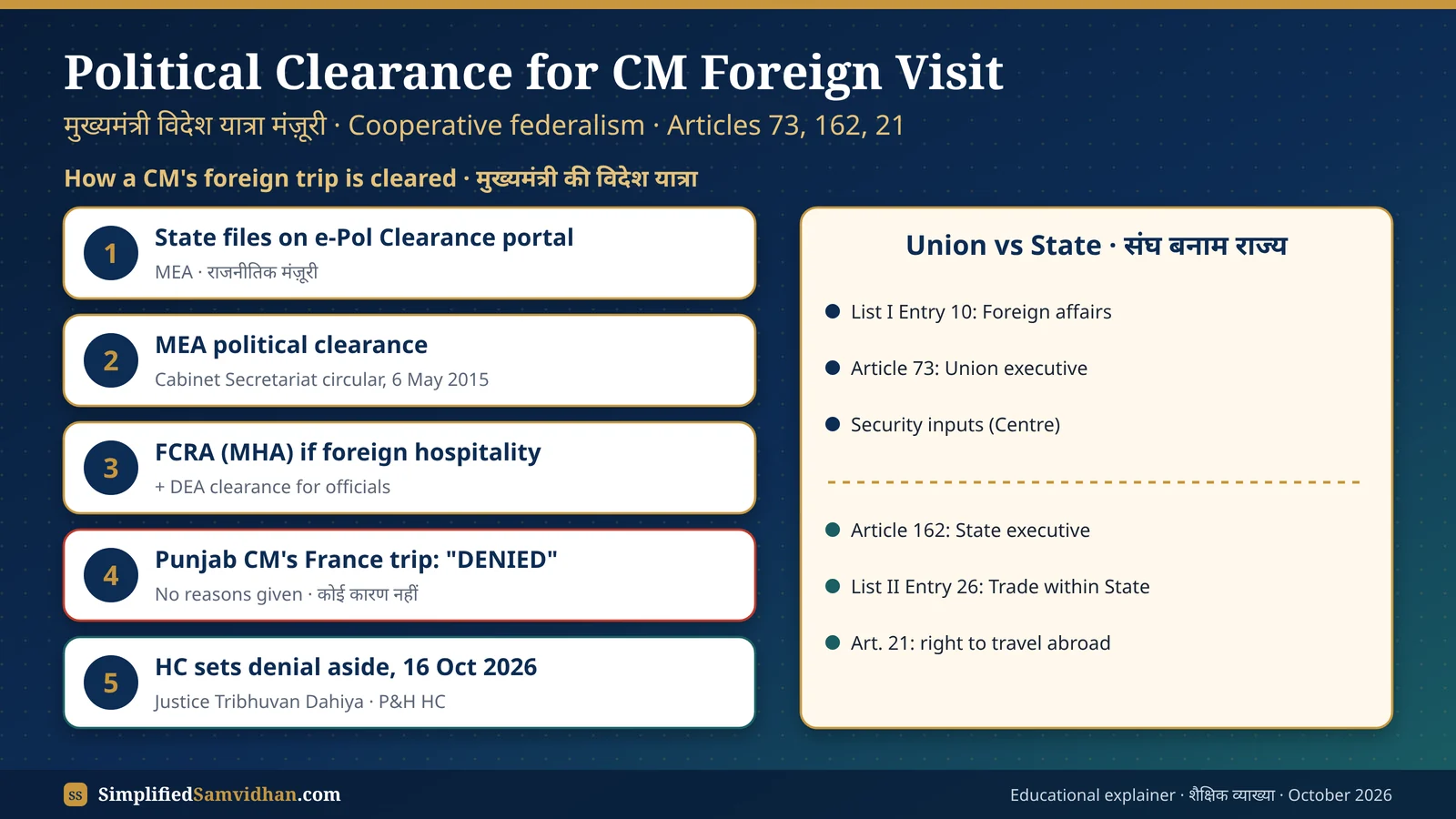
What happened on 16 October 2026
On Friday, 16 October 2026, Justice Tribhuvan Dahiya of the Punjab and Haryana High Court, sitting as a single judge, allowed the Punjab Government's petition and set aside the Centre's denial of political clearance for Chief Minister Bhagwant Mann's visit to France. The detailed order and the reasons were awaited at the time of reporting, so the exact legal grounds on which the Court ruled are not yet known.
The trip (15 to 21 October 2026) was a trade-promotion visit built around SIAL Paris 2026, a food trade exhibition held from 17 to 21 October at Paris Nord Villepinte. MARKFED, Punjab's apex cooperative marketing federation, had a stall in the India Pavilion run by APEDA (a statutory body under the Union Commerce Ministry), with MARKFED bearing the cost. The delegation was to include the CM, Chief Secretary K.A.P. Sinha and Principal Secretary to the CM Ravi Bhagat, with meetings planned with the diaspora, trade bodies, importers, investors and the Indian Ambassador. The application on MEA's e-Pol Clearance portal was simply marked "DENIED", with no reasons and no clarification sought.
BackgroundChief Minister Foreign Visit: Timeline of the Punjab Political Clearance Case
| Date | What happened |
|---|---|
| 2 Sep 2026 | Cadre clearance granted for the officers who were to accompany the Chief Minister. |
| 3 Sep 2026 | APEDA confirmed MARKFED's stall in the India Pavilion at SIAL Paris 2026. |
| 3 and 8 Sep 2026 | Punjab's Cooperation Department wrote to the Ministry of External Affairs (MEA) about the visit. |
| 9 Sep 2026 | Online application filed on MEA's e-Pol Clearance portal, 36 days before the planned departure. |
| After 9 Sep 2026 | The portal showed the status "DENIED". No reasons were given and no clarification was sought from the State. |
| Oct 2026 | Punjab moved the Punjab and Haryana High Court. The Centre filed an affidavit citing inputs about security threats to the CM. |
| 15 to 21 Oct 2026 | Planned dates of the France visit (SIAL Paris: 17 to 21 October). |
| 16 Oct 2026 | Justice Tribhuvan Dahiya allowed the petition and set aside the denial. Detailed order awaited. |
Not the first time: Political clearance for Chief Minister foreign visits has been denied before. Telangana CM A. Revanth Reddy's US trip was cancelled on 21 August 2026 after MEA said "clearance from a political angle was denied". Delhi CM Arvind Kejriwal was denied clearance for the C-40 Climate Summit in Copenhagen (October 2019) and the World Cities Summit in Singapore (July 2022). West Bengal CM Mamata Banerjee was denied for a 2018 China trip and a World Peace Conference in Rome in September 2021. Earlier cases include Assam CM Tarun Gogoi (US, 2012) and Jharkhand CM Arjun Munda (Thailand, 2011). The Punjab case is notable because a court has now set such a denial aside.
The ProcessHow MEA Political Clearance for Foreign Visit Works
There is no Act of Parliament on political clearance. It is an executive mechanism built on government circulars. The Ministry of External Affairs grants political clearance for foreign travel by public servants, and a Chief Minister is a public servant (the Supreme Court said so in M. Karunanidhi v. Union of India, 1979). The main steps are:
- 1Inform the Centre
A Cabinet Secretariat circular of 6 May 2015 requires the Cabinet Secretariat and MEA to be informed of any foreign visit, official or private, by Chief Ministers and State ministers.
- 2Apply online
Since 2016 applications go through the e-Pol Clearance portal (epolclearance.gov.in) and are processed by MEA's Coordination Division.
- 3MEA examines
Factors considered include the nature of the event, the level of foreign participation, whether there is an invitation, and India's relations with the host country.
- 4Other clearances
FCRA clearance from the Ministry of Home Affairs is needed when hospitality is offered by non-UN foreign entities. State officials also need Department of Economic Affairs clearance.
- 5Decision
The portal shows the result. In the Punjab case it showed only "DENIED", without reasons.
| Who is travelling | Clearance needed |
|---|---|
| Chief Minister / State minister | MEA political clearance (plus FCRA clearance where foreign hospitality is involved) |
| State government officials | MEA political clearance plus Department of Economic Affairs clearance |
| Union minister | MEA political clearance plus the Prime Minister's clearance |
| Lok Sabha MP | MEA political clearance plus the Speaker's permission |
| Rajya Sabha MP | MEA political clearance plus the Chairman's permission |
Political clearance is like a "no-objection" from the Foreign Ministry. When a senior public figure from India goes abroad, foreign governments see them as representing India. So MEA checks whether the visit fits India's foreign policy and whether there is any risk. The problem in the Punjab case was not that a check exists, but that the answer was a one-word "DENIED" with no reason, no hearing, no time limit and no appeal.
🏠 Everyday analogy
A school captain wants to take the team to an inter-school match in another city. The principal's permission is needed, because the team represents the school. But if the principal just writes "No" on the form without explaining why, and there is no one to appeal to, the captain will naturally feel it is unfair.
🇮🇳 Real Indian example
Punjab says the CM's earlier visit to Japan attracted around ₹2,000 crore of investment (the State's claim). States today send CMs abroad to attract investors, just as Union ministers lead trade delegations.
Official TextArticle 162 and Article 73: Executive Power of the State and the Union
1. Name and territory of the Union.
(1) India, that is Bharat, shall be a Union of States.
73. Extent of executive power of the Union.
(1) Subject to the provisions of this Constitution, the executive power of the Union shall extend—
(a) to the matters with respect to which Parliament has power to make laws; and
(b) to the exercise of such rights, authority and jurisdiction as are exercisable by the Government of India by virtue of any treaty or agreement:
Provided that the executive power referred to in sub-clause (a) shall not, save as expressly provided in this Constitution or in any law made by Parliament, extend in any State to matters with respect to which the Legislature of the State has also power to make laws.
162. Extent of executive power of State.
Subject to the provisions of this Constitution, the executive power of a State shall extend to the matters with respect to which the Legislature of the State has power to make laws:
Provided that in any matter with respect to which the Legislature of a State and Parliament have power to make laws, the executive power of the State shall be subject to, and limited by, the executive power expressly conferred by this Constitution or by any law made by Parliament upon the Union or authorities thereof.
Article 1 calls India a "Union of States". Article 73 says the Union Government's executive power covers everything Parliament can make laws on, and also rights under treaties. Article 162 says a State Government's executive power covers everything the State Legislature can make laws on. So the executive power follows the legislative power. Agriculture and trade within the State are State subjects, so promoting Punjab's farm produce is squarely within Punjab's executive power. Foreign affairs, however, is a Union subject.
The legal question is: when a State uses its own executive power (marketing its farmers' produce) in a foreign country, can the Union, using its foreign-affairs power, stop it completely, and on what terms?
🏠 Everyday analogy
In a joint family, each brother runs his own shop, but the eldest brother handles all dealings with the bank. If one brother wants to sell his goods at a fair in another city, the eldest brother may ask to be informed, but should he be able to forbid it without giving a reason?
🇮🇳 Real Indian example
Punjab's MARKFED was to sell produce at SIAL Paris inside the India Pavilion run by APEDA, a Union body. Punjab argues this is cooperation with the Union, not a rival foreign policy.
Official TextForeign Affairs (List I Entry 10) vs State Subjects: Who Controls a Chief Minister Foreign Visit
Seventh Schedule, List I (Union List)
10. Foreign affairs; all matters which bring the Union into relation with any foreign country.
14. Entering into treaties and agreements with foreign countries and implementing of treaties, agreements and conventions with foreign countries.
19. Admission into, and emigration and expulsion from, India; passports and visas.
41. Trade and commerce with foreign countries; import and export across customs frontiers; definition of customs frontiers.
Seventh Schedule, List II (State List)
14. Agriculture, including agricultural education and research, protection against pests and prevention of plant diseases.
26. Trade and commerce within the State subject to the provisions of entry 33 of List III.
Under Article 246, subjects are divided among the Union List, State List and Concurrent List. Foreign affairs, treaties, passports and visas, and foreign trade are Union subjects, so India speaks to the world with one voice. Parliament can also make laws to implement treaties under Article 253. But agriculture and trade within the State are State subjects. A CM's trade trip abroad sits at the meeting point of these lists.
🏠 Everyday analogy
A cricket team has one captain who talks to the umpire and the opposing captain (foreign affairs). But each bowler decides his own field and run-up (State subjects). The captain can guide the bowler, but if he refuses to let him bowl at all without explaining why, the team suffers.
🇮🇳 Real Indian example
Many States sign MoUs with foreign companies and hold global investor summits. MEA created a States Division in 2014 to help States with their foreign outreach, which shows the Union itself accepts a role for States in economic diplomacy.
🇮🇳 Union: Foreign Affairs Power
- List I Entry 10: all matters which bring the Union into relation with any foreign country.
- Article 73 extends Union executive power to these matters and to treaty rights.
- A CM abroad is seen by foreign governments as an Indian public figure; MEA must manage protocol and security.
- India must speak with one voice on sensitive relations and on security threats.
- State of West Bengal v. Union of India (1962): the Indian Union has a strong Centre.
🏛️ State: Executive Power under Article 162
- Article 162: State executive power extends to all State List subjects, such as agriculture (Entry 14) and trade within the State (Entry 26).
- Promoting farm produce and attracting investment are core State functions.
- S.R. Bommai (1994): federalism is part of the basic structure.
- Govt. of NCT of Delhi (2023): the federal principle applies with even greater force to a full State.
- A coordination tool should not become a veto over State executive power.
Key JudgmentsArticle 21, Reasons and Fair Hearing: Supreme Court Cases on Denial of Clearance
21. Protection of life and personal liberty.
No person shall be deprived of his life or personal liberty except according to procedure established by law.
The Supreme Court has held that the right to travel abroad is part of "personal liberty" under Article 21. It can be restricted only by a procedure that is just, fair and reasonable. That usually means giving reasons and a chance to be heard (the principle audi alteram partem, "hear the other side"). Article 14 adds that State action must not be arbitrary.
🏠 Everyday analogy
If a railway clerk refuses to issue you a ticket, you expect to be told why: the train is full, or your ID is missing. A refusal with no reason leaves you unable to fix the problem or challenge it.
🇮🇳 Real Indian example
Punjab told the High Court that the portal simply showed "DENIED". The Centre's reasons (security inputs) came only later, in an affidavit filed in court.
- Satwant Singh Sawhney v. D. Ramarathnam (1967): the right to travel abroad is part of personal liberty under Article 21; a passport cannot be refused at the government's absolute discretion.
- Maneka Gandhi v. Union of India (1978): the "procedure established by law" must be just, fair and reasonable; reasons should ordinarily be given and the person should be heard.
- E.P. Royappa v. State of Tamil Nadu (1974): arbitrariness is the opposite of equality under Article 14.
- M. Karunanidhi v. Union of India (1979): a Chief Minister is a public servant, which is why the clearance rules for public servants apply to CMs.
- S.R. Bommai v. Union of India (1994): federalism is a basic feature of the Constitution; States are not mere appendages of the Centre.
- Government of NCT of Delhi v. Union of India (2023, Constitution Bench): in a federal Constitution the elected State government's executive power must be respected; Punjab relied on the Court's remark that this applies with greater force to a full State.
Note: Punjab cited these judgments. Since the High Court's detailed reasons were not available at the time of reporting, it is not yet known which of these arguments the Court accepted.
The DebateMEA Political Clearance: Arguments of Punjab and the Centre
🌾 Punjab Government (Sr. Adv. Chanchal Singla, Addl. AG)
- No reasons were given and no hearing was offered before denial.
- The mechanism has no statutory basis; its instructions set no criteria, no time limit and no appeal.
- A coordination tool has been turned into a veto over the State's executive power under Article 162.
- A colourable exercise of the foreign-affairs power to stop a State marketing its farmers' produce.
- Discrimination: Haryana's CM was recently allowed to go abroad.
- The trip was linked to a Union body (APEDA's India Pavilion), planned well in advance.
🛡️ Union Government (ASG Satya Pal Jain)
- Affidavit cited inputs about security threats to the Chief Minister.
- "We don't want anything happens to CM abroad": the Centre presented the denial as protective.
- Without a formal invitation, the host country cannot make security arrangements for a visiting CM.
- Foreign affairs is a Union subject, and visits by high public officials affect India's relations abroad.
- Security inputs are sensitive and cannot always be disclosed publicly.
Both sides raise genuine concerns. The Centre must protect a sitting CM and keep foreign policy coherent. The State must be able to do its job of helping farmers and attracting investment. The middle path in law is usually: if there is a security risk, say so (even confidentially), discuss it, and impose conditions rather than a blanket "no".
🏠 Everyday analogy
A parent worried about a child's safety on a school trip can ask for a teacher to accompany, a phone check-in, or a safer route. Simply saying "you cannot go" without explanation is the harshest option.
🇮🇳 Real Indian example
SIAL Paris is a major food fair where MARKFED was already booked in the India Pavilion. A denial meant the State's stall would go ahead without its political leadership.
ReformsCooperative Federalism: Way Forward on Political Clearance for Foreign Visits
The case shows the tension between national security and a uniform foreign policy on one side and State autonomy and economic diplomacy on the other. In an age of competitive federalism, where States compete for investment, and paradiplomacy, where States reach out abroad, the rules need to be clear. Possible reforms:
- 1Codified guidelines
Publish clear criteria for granting or refusing political clearance, preferably with a statutory or at least a formal rule-based basis.
- 2Time-bound decisions
Fix a time limit for deciding applications, so that States can plan trade fairs and investor meetings.
- 3Reasoned orders
Give reasons for refusal; where security inputs are sensitive, share them confidentially with the Chief Secretary.
- 4Review mechanism
Provide an internal review or appeal before a senior authority, so that courts are the last resort.
- 5Conditions, not bans
Where there is a security threat, impose conditions (security arrangements, changed itinerary, formal invitation) instead of a blanket denial.
- 6Use cooperative forums
Discuss a common protocol in the Inter-State Council (Article 263) and NITI Aayog's Governing Council, and strengthen MEA's States Division.
Cooperative federalism means the Union and States work as partners, not as boss and subordinate. The Sarkaria Commission (1988) and the Punchhi Commission (2010) on Centre-State relations both stressed greater consultation with States and cooperative federalism in general terms. A transparent, reasoned and time-bound clearance system would put that spirit into practice.
🏠 Everyday analogy
A housing society may require residents to inform the secretary before hosting a big event in the clubhouse. That is coordination. If the secretary can refuse any event without reasons, it becomes control.
🇮🇳 Real Indian example
MEA's States Division (2014) and State investor summits show that the Union and States already cooperate on outreach abroad. Clear clearance rules would reduce disputes like those involving Punjab, Telangana, Delhi and West Bengal.
UPSC CornerPolitical Clearance and Cooperative Federalism for UPSC Prelims and Mains
- Prelims fact: "Foreign affairs; all matters which bring the Union into relation with any foreign country" is Entry 10 of List I. Treaties: Entry 14. Passports and visas: Entry 19. Foreign trade: Entry 41.
- Prelims fact: Agriculture is List II Entry 14; trade and commerce within the State is List II Entry 26.
- Prelims fact: Article 162 makes State executive power co-extensive with State legislative power; Article 73 does the same for the Union.
- Prelims fact: Political clearance is granted by the Ministry of External Affairs through the e-Pol Clearance portal (since 2016); it is based on executive instructions, not an Act.
- Prelims fact: Right to travel abroad is part of Article 21: Satwant Singh Sawhney (1967), Maneka Gandhi (1978).
- Mains (250 words): "The requirement of political clearance for foreign visits of Chief Ministers balances national interest with State autonomy, but its opacity strains cooperative federalism." Critically examine in the light of recent denials and the Punjab and Haryana High Court's October 2026 decision.
- Ethics angle: A reasoned decision is a mark of accountable governance. Is a one-word "DENIED" consistent with transparency and fairness in public administration?
- Essay angle: "One voice abroad, many voices at home: federalism in India's economic diplomacy."
Practice MCQTest Yourself: Political Clearance for CM Foreign Visit
With reference to the Constitution of India, consider the following statements: (1) "Foreign affairs; all matters which bring the Union into relation with any foreign country" is an entry in the Union List. (2) Under Article 162, the executive power of a State extends to matters with respect to which the State Legislature has power to make laws. (3) Political clearance by the Ministry of External Affairs for foreign visits of Chief Ministers is provided for in an Act of Parliament. Which of the statements given above is/are correct?
Doubts ClearedFrequently Asked Questions
What is political clearance for a foreign visit?
It is permission from the Ministry of External Affairs that public servants, including Chief Ministers, State ministers and officials, must obtain before travelling abroad. Applications are made on the e-Pol Clearance portal and MEA considers the event, foreign participation, invitation and India's relations with the host country.
Does a Chief Minister need Centre's permission to go abroad?
Yes. Under a Cabinet Secretariat circular of 6 May 2015, the Cabinet Secretariat and MEA must be informed of any foreign visit, official or private, by Chief Ministers and State ministers, and prior political clearance from MEA is mandatory. FCRA clearance is also needed if hospitality comes from non-UN foreign entities.
Why did the High Court set aside the denial for Punjab CM Bhagwant Mann?
On 16 October 2026 Justice Tribhuvan Dahiya of the Punjab and Haryana High Court allowed Punjab's petition and set aside the denial of clearance for the CM's France trip. The detailed reasons were awaited at the time of reporting. Punjab had argued that the denial gave no reasons, no hearing and amounted to a veto over the State's executive power; the Centre cited security threats.
Which Chief Ministers were denied political clearance earlier?
Reported cases include Telangana CM A. Revanth Reddy (US, August 2026), Delhi CM Arvind Kejriwal (Copenhagen 2019 and Singapore 2022), West Bengal CM Mamata Banerjee (China 2018 and Rome 2021), Assam CM Tarun Gogoi (US, 2012) and Jharkhand CM Arjun Munda (Thailand, 2011).
What is cooperative federalism?
Cooperative federalism means the Union and the States work together as partners to achieve common goals, through consultation and forums like the Inter-State Council under Article 263 and NITI Aayog, instead of one side simply overruling the other.
Sources and further readingSources We Checked
News facts on this page were checked against the reports below on 16 October 2026. The High Court's detailed order was awaited, and the decision may be challenged or clarified later.
- LiveLaw, 16 Oct 2026: High Court sets aside Centre's denial of political clearance for Punjab CM Bhagwant Mann's France visit
- LawChakra: Punjab and Haryana HC allows plea against denial of political clearance for CM Mann's France visit
- Business Standard, Aug 2026: Revanth Reddy's US trip cancelled: how CMs get approval for foreign trips
- Outlook: MEA denies political clearance to Arvind Kejriwal for climate meet in Denmark (2019)
- Legislative Department, Government of India: The Constitution of India