🌏 International Relations · South Asia⚖️ SimplifiedSamvidhan.com
India Pakistan Relations: Complete History from Partition 1947 to 2026, Every War and Who Won
Two countries born on the same night in August 1947, four wars, a dozen peace agreements and a ceasefire that keeps breaking. This is the full story of India-Pakistan relations in simple words: Partition, Kashmir, the wars of 1947-48, 1965, 1971 and 1999 (and who won each one), the Simla Agreement, the Indus Waters Treaty, terror attacks, surgical strikes, Balakot and Operation Sindoor, up to October 2026.
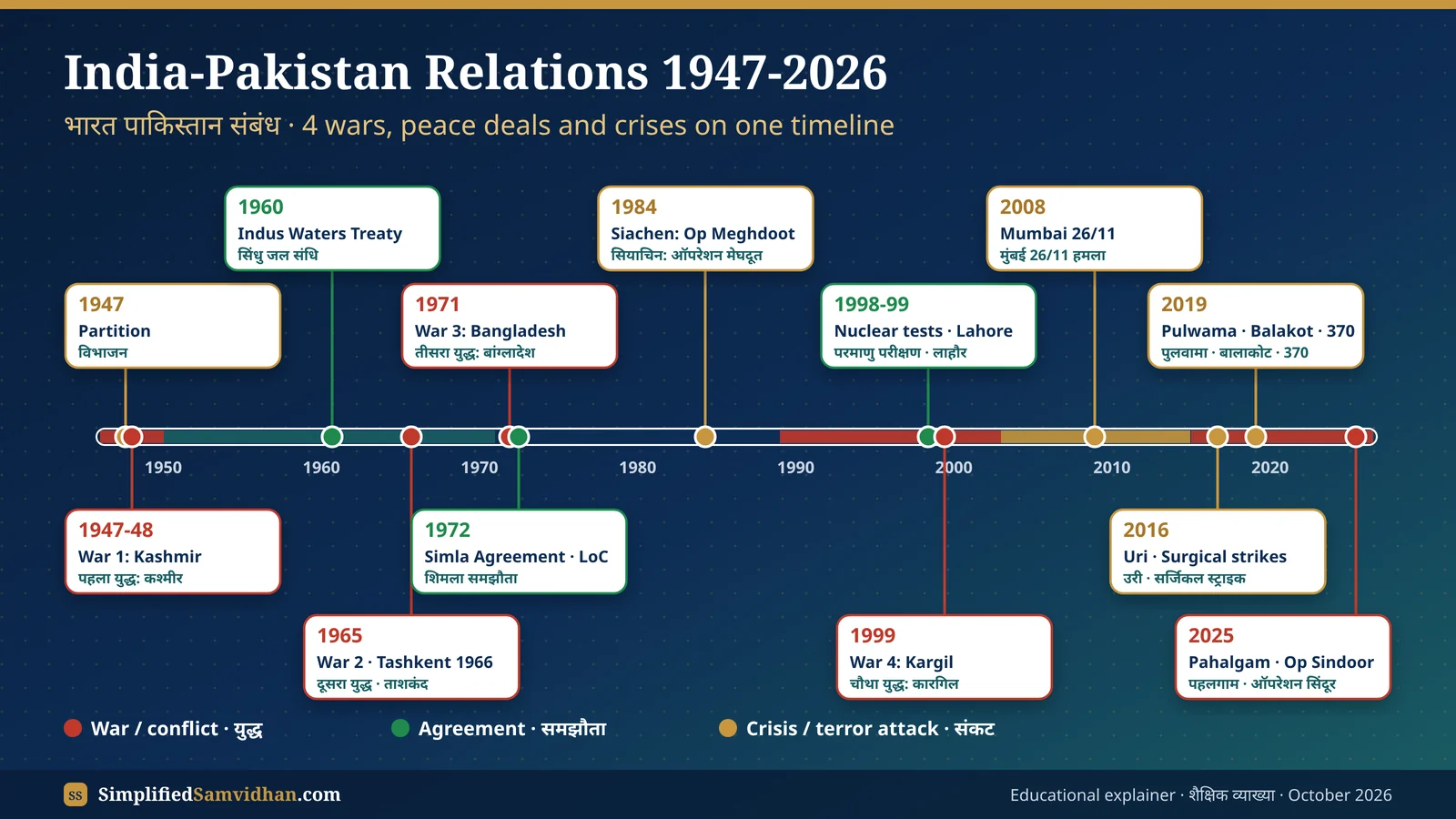
India-Pakistan relations from 1947 to 2026: wars, peace agreements and crises on one timeline.
📅 Last updated:
Latest status
Where India Pakistan Relations Stand in October 2026
Relations are at their lowest point in decades. After the Pahalgam terror attack of 22 April 2025 (26 civilians killed) India put the Indus Waters Treaty in abeyance, and after Operation Sindoor (7 to 10 May 2025) the guns fell silent under a DGMO-level understanding of 10 May 2025. That understanding has broadly held, but almost every other link is cut:
No trade, no regular flights, no visas: the Attari-Wagah land route is shut, and both countries keep their airspace closed to each other's airlines. Pakistan has renewed its ban every month since April 2025; the latest notice runs to 24 October 2026.
Diplomats downgraded: both High Commissions are run by chargés d'affaires with reduced staff. On 2 October 2026 BSF firing in the Bedian sector killed two Pakistanis; Pakistan called it unprovoked, India said they were infiltrators, and each side summoned the other's envoy.
Water dispute in court: a Court of Arbitration at The Hague ruled on 31 August 2026 that the treaty cannot be put "in abeyance" by one side. India "categorically rejects" the award, says the court has no jurisdiction, and keeps the treaty in abeyance.
Kartarpur Corridor closed from India's side since 7 May 2025 (the Home Ministry says security does not yet allow reopening).
Only small signals: External Affairs Minister S. Jaishankar shook hands with Pakistan's National Assembly Speaker Ayaz Sadiq at Khaleda Zia's funeral in Dhaka on 31 December 2025, but India called it a courtesy, not talks.
✔ Fact-checked · 17 October 2026⏳ Situation evolving
📥
Digital LibraryGet This Topic as PDF Notes
PDF NOTES · SIMPLIFIEDSAMVIDHAN🇮🇳🇵🇰India-Pakistan Relations: Complete PDF Notes₹5
India-Pakistan Relations PDF Notes: Hindi and English Editions
Everything about India and Pakistan from 1947 to 2026 on a few dense, beautifully designed pages: Partition, the four wars and who won, every treaty, Indus Waters, trade, people-to-people ties, myths vs facts, memory tricks, a Mains answer and MCQs.
What's inside:
Partition 1947 and the Kashmir dispute in simple words
5 pages each · Hindi + English editions both included · link by email · your name printed on every page · See all PDF notes · Refund policy
🗓️
79 Years at a GlanceIndia Pakistan Relations Timeline: Six Phases from 1947 to 2026
India-Pakistan relations swing like a pendulum: war, then a peace agreement, then a terror attack that breaks the trust again. Seeing the phases first makes every later detail easier to remember.
1947-1949Partition and the first war
Two Dominions are created on 14-15 August 1947. Pakistan-backed raiders attack Kashmir; the first war ends in a UN ceasefire on 1 January 1949.
1950-1966Treaties and the 1965 war
Nehru-Liaquat Pact (1950) on minorities, Indus Waters Treaty (1960), then war in 1965 ending in the Tashkent Declaration.
1971-1988Bangladesh and the Simla order
India's decisive 1971 victory creates Bangladesh; the Simla Agreement (1972) makes ties bilateral and creates the LoC. India takes Siachen (1984).
1989-2002Proxy war, nukes and Kargil
Insurgency in Kashmir, nuclear tests (1998), the Lahore bus peace (1999) and then the Kargil War; the Parliament attack (2001).
2003-2014Ceasefire, dialogue and 26/11
LoC ceasefire (2003) and the Composite Dialogue bring buses and trade, until the Mumbai attacks (2008) freeze talks.
2015-2026The new normal: strike back
Uri leads to surgical strikes (2016), Pulwama to Balakot (2019), Pahalgam to Operation Sindoor (2025). Article 370 ends (2019), the Indus Treaty is held in abeyance (2025).
In Simple Words / आसान शब्दों में
Think of India and Pakistan as two brothers who divided the family house in a hurry and in anger. The biggest quarrel is over one room (Kashmir). Every few years they fight, an elder (the UN, the Soviet Union, the US) or their own good sense brings a ceasefire, they sign a paper promising peace, and then someone from one side throws a stone through the other's window (a terror attack) and the trust is gone again.
🏠 Everyday analogy
In a joint-family property split, if the boundary line is drawn in a rush by an outsider who has never seen the land, fights over the field boundary can go on for generations. The Radcliffe Line was drawn in about five weeks.
🇮🇳 Real Indian example
The famous Samjhauta Express ("agreement" train) started in 1976 after the Simla Agreement and stopped in 2019. Its story, like the relationship, is one of hope and suspension.
✂️
1947Partition of India 1947: How India and Pakistan Were Created
📜 Official text · Indian Independence Act, 1947 (UK Parliament), Section 1
Indian Independence Act, 1947: Section 1. The new Dominions.
(1) As from the fifteenth day of August, nineteen hundred and forty-seven, two independent Dominions shall be set up in India, to be known respectively as India and Pakistan.
(2) The said Dominions are hereafter in this Act referred to as "the new Dominions", and the said fifteenth day of August is hereafter in this Act referred to as "the appointed day".
Date
What happened
3 June 1947
Mountbatten Plan announced: British India to be partitioned into two Dominions.
18 July 1947
Indian Independence Act, 1947 receives Royal Assent.
14 August 1947
Pakistan becomes independent (Pakistan celebrates its Independence Day on 14 August).
15 August 1947
India becomes independent. Punjab and Bengal are divided.
17 August 1947
The Radcliffe Line (the new border drawn by Sir Cyril Radcliffe) is made public, two days after independence.
1947-1948
Roughly 1 to 1.5 crore people cross the new border; estimates of deaths range from about 2 lakh to 20 lakh.
Princely States: More than 560 princely states had to choose India or Pakistan. Three created trouble: Junagadh (Muslim ruler, Hindu majority) acceded to Pakistan but joined India after a plebiscite in February 1948; Hyderabad joined India after Operation Polo (September 1948); and Jammu and Kashmir (Hindu ruler, Muslim majority) hesitated, which became the root of the Kashmir dispute.
In Simple Words / आसान शब्दों में
The British left by cutting one country into two: India and Pakistan (with East Pakistan more than 1,500 km away, which later became Bangladesh). The line was drawn so fast that villages, canals and even houses were split, and millions had to leave homes their families had lived in for centuries. The pain and mistrust of Partition is the starting point of every later India-Pakistan problem.
🏠 Everyday analogy
Imagine your school is split overnight into two schools and you are told on the morning after the split which side of the playground your house now belongs to. That is what the Radcliffe Line did, announced on 17 August, after the flags had already been raised.
🇮🇳 Real Indian example
Families in Amritsar and Lahore, only about 50 km apart, became citizens of two different countries. Many Punjabi and Sindhi families in Delhi, Mumbai and Ahmedabad trace their roots to towns now in Pakistan.
📜
Official TextPartition in the Indian Constitution: Article 7, Article 51 and Foreign Policy
📜 Official text · Article 7, Constitution of India
7. Rights of citizenship of certain migrants to Pakistan.—
Notwithstanding anything in articles 5 and 6, a person who has after the first day of March, 1947, migrated from the territory of India to the territory now included in Pakistan shall not be deemed to be a citizen of India:
Provided that nothing in this article shall apply to a person who, after having so migrated to the territory now included in Pakistan, has returned to the territory of India under a permit for resettlement or permanent return issued by or under the authority of any law and every such person shall for the purposes of clause (b) of article 6 be deemed to have migrated to the territory of India after the nineteenth day of July, 1948.
📜 Official text · Article 51 (Directive Principles), Constitution of India
51. Promotion of international peace and security.
The State shall endeavour to—
(a) promote international peace and security;
(b) maintain just and honourable relations between nations;
(c) foster respect for international law and treaty obligations in the dealings of organised peoples with one another; and
(d) encourage settlement of international disputes by arbitration.
In Simple Words / आसान शब्दों में
Our Constitution remembers Partition directly. Article 6 made people who migrated from Pakistan to India citizens, and Article 7 says that people who migrated to Pakistan after 1 March 1947 are not Indian citizens (unless they came back with a resettlement permit). Article 51 tells the State to work for international peace, keep just and honourable relations with other nations, respect treaties and encourage arbitration. Foreign affairs and treaties are Union subjects (List I, Entries 10 and 14) and Parliament can make laws to implement treaties under Article 253.
🏠 Everyday analogy
Article 51 is like the school rule that says "try to settle fights by talking to the teacher". It is a guiding principle (a Directive Principle), so no court can force it, but every government is expected to follow its spirit.
🇮🇳 Real Indian example
In 2019 Parliament ended the special status of Jammu and Kashmir under Article 370 and made two Union Territories, Jammu and Kashmir and Ladakh. The Supreme Court upheld this on 11 December 2023 (In Re: Article 370). Pakistan reacted by downgrading ties and suspending trade.
ScorecardIndia Pakistan Wars: Who Won Each War (1947-48, 1965, 1971, 1999)
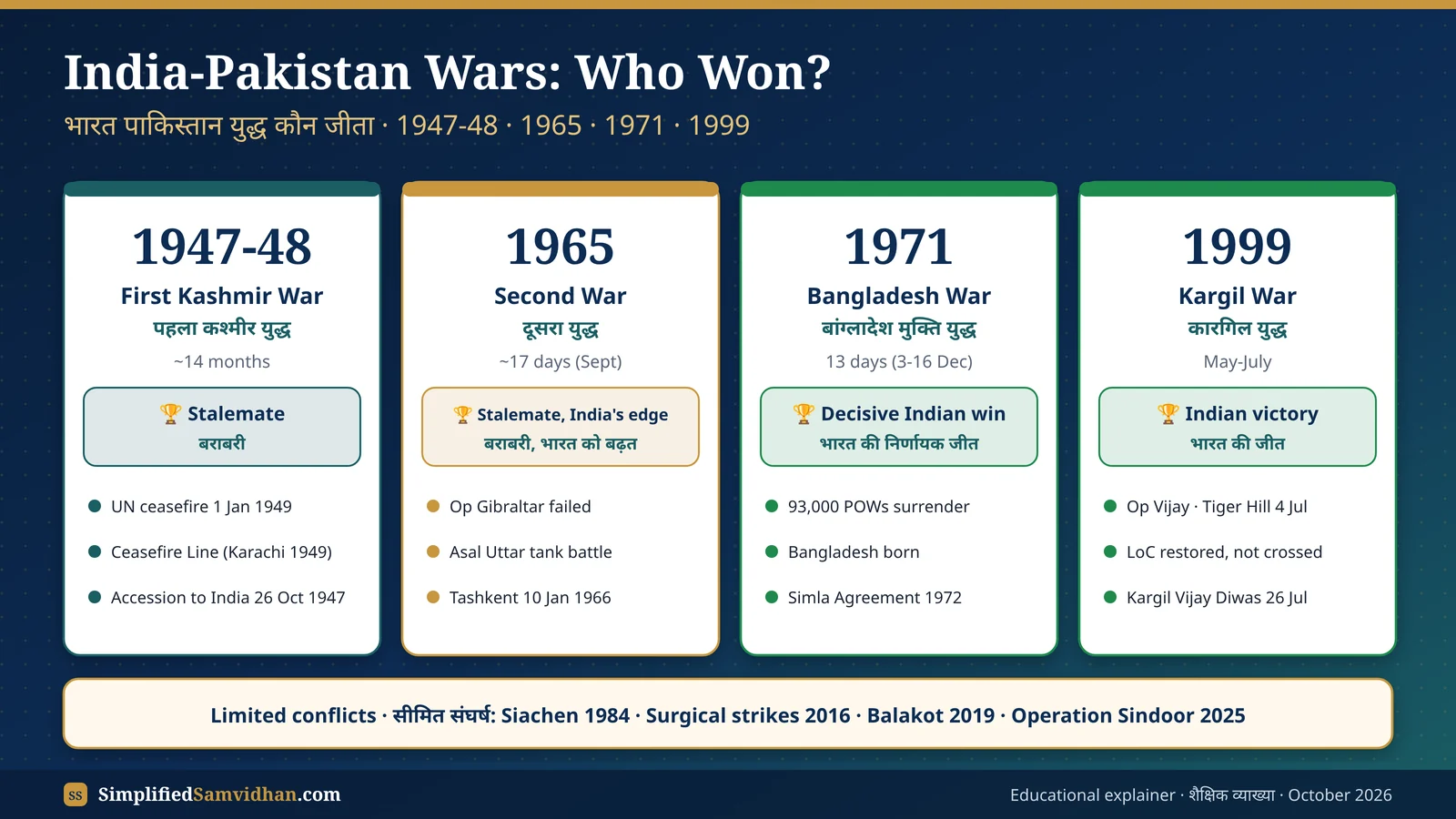
India-Pakistan wars at a glance: four full wars, one decisive victory, one clear victory and two stalemates.
1947-48Stalemate
First Kashmir War
Trigger: Pakistan-backed tribal raiders, later the Pakistani Army, attack Jammu and Kashmir (22 October 1947).
Result: UN ceasefire on 1 January 1949. India kept the Kashmir Valley, Jammu and Ladakh; Pakistan kept the area now called PoK and Gilgit-Baltistan.
1965Stalemate · India's edge
Second Kashmir War
Trigger: Operation Gibraltar: Pakistani infiltrators sent into Kashmir (August 1965), then Operation Grand Slam at Chhamb.
Result: Ceasefire on 23 September 1965. Pakistan failed to take Kashmir; India held more land at the ceasefire but returned it at Tashkent.
1971Decisive Indian victory
Bangladesh Liberation War
Trigger: Pakistan's crackdown in East Pakistan, about 1 crore refugees enter India, and Pakistan's air strikes on Indian bases (3 December 1971).
Result: About 93,000 Pakistani troops surrender in Dhaka on 16 December 1971 after 13 days. Bangladesh is born.
1999Indian victory
Kargil War
Trigger: Pakistani soldiers disguised as militants occupy heights on the Indian side of the LoC in Kargil.
Result: Operation Vijay recaptures the peaks, including Tiger Hill (4 July). India declares victory on 26 July 1999 without crossing the LoC.
In Simple Words / आसान शब्दों में
India and Pakistan have fought four full wars. Pakistan started three of them by trying to take Kashmir by force (1947, 1965, 1999), and in 1971 the war grew out of Pakistan's own crisis in East Pakistan. 1971 is the only war with a knockout result: Pakistan lost half its population and territory when Bangladesh became free. Kargil was a clear Indian win. 1947-48 and 1965 ended in stalemates, though Pakistan's goal of seizing Kashmir failed every time.
🏠 Everyday analogy
A cricket series of four matches: two drawn (1948, 1965), one won by an innings (1971) and one won comfortably (1999). The opponent who kept declaring the match never got the trophy it wanted: Kashmir.
🇮🇳 Real Indian example
16 December is celebrated as Vijay Diwas (1971) and 26 July as Kargil Vijay Diwas (1999).
⚔️
War 1India Pakistan War 1947-48: Kashmir, Accession and the UN Ceasefire
Date
Event
22 Oct 1947
Thousands of armed tribesmen from Pakistan's North-West Frontier (Operation Gulmarg) invade Jammu and Kashmir.
26 Oct 1947
Maharaja Hari Singh signs the Instrument of Accession to India; Governor-General Mountbatten accepts it on 27 October.
27 Oct 1947
Indian troops are airlifted to Srinagar and save the city and its airfield.
3 Nov 1947
Battle of Badgam: Major Somnath Sharma becomes the first recipient of the Param Vir Chakra (posthumous).
1 Jan 1948
India takes the matter to the UN Security Council.
21 Apr 1948
UNSC Resolution 47: Pakistan to withdraw first, India then to reduce forces, then a plebiscite. Step one never happened.
May 1948
The regular Pakistani Army openly joins the fighting.
1 Jan 1949
Ceasefire. The Karachi Agreement (27 July 1949) fixes the Ceasefire Line, watched by UN observers (UNMOGIP).
In Simple Words / आसान शब्दों में
Kashmir's ruler first wanted to stay independent. When raiders from Pakistan looted their way towards Srinagar, he asked India for help and signed the Instrument of Accession, which legally made Jammu and Kashmir part of India. India's army pushed the raiders back, but the war stopped with Pakistan still holding part of the state. That ceasefire line, renamed the Line of Control in 1972, is still the frontier today.
Who won? Neither side fully. India saved most of the state and its legal claim; Pakistan kept the territory it had grabbed. India's view: the whole of Jammu and Kashmir, including PoK, is an integral part of India.
🏠 Everyday analogy
A neighbour breaks into one wing of your house. You call the police (India's army), who throw him out of most rooms, but the matter goes to court (the UN) while he still sits in one wing, and the case is never finally decided.
🇮🇳 Real Indian example
The plebiscite promised in 1948 was conditional on Pakistan first withdrawing its forces. It never withdrew, which is why India says the plebiscite question is dead, and why the Simla Agreement later made Kashmir a bilateral matter.
🛡️
War 2India Pakistan War 1965: Operation Gibraltar, Asal Uttar and the Tashkent Declaration
Date
Event
Apr-Jun 1965
Clashes in the Rann of Kutch; British mediation, and a tribunal later (1968) gives Pakistan about a tenth of the area claimed.
5 Aug 1965
Operation Gibraltar: armed infiltrators are sent into Kashmir to start a revolt. Locals do not rise; many inform the Army.
28 Aug 1965
India captures the strategic Haji Pir Pass.
1 Sep 1965
Operation Grand Slam: Pakistani armour attacks Chhamb-Akhnoor.
6 Sep 1965
India opens a front across the international border in Punjab, towards Lahore and Sialkot.
8-10 Sep 1965
Battle of Asal Uttar near Khem Karan: Pakistani Patton tanks are destroyed ("Patton Nagar"); CQMH Abdul Hamid wins the Param Vir Chakra.
23 Sep 1965
Ceasefire after UN Security Council Resolution 211.
10 Jan 1966
Tashkent Declaration, signed with Soviet mediation; Prime Minister Lal Bahadur Shastri dies in Tashkent the next night.
📜 Treaty text · Tashkent Declaration, 1966
Tashkent Declaration, 10 January 1966 (extract)
The Prime Minister of India and the President of Pakistan agree that all armed personnel of the two countries shall be withdrawn not later than 25 February 1966 to the positions they held prior to 5 August 1965, and both sides shall observe the cease-fire terms on the cease-fire line.
In Simple Words / आसान शब्दों में
Pakistan thought India was weak after the 1962 war with China and that Kashmiris would revolt. Both guesses were wrong. The war ended in a military stalemate, but Pakistan's political aim (taking Kashmir) failed, and India held more territory when the fighting stopped. At Tashkent both sides agreed to go back to their pre-war positions, so India even returned the Haji Pir Pass.
🏠 Everyday analogy
Two wrestlers fight until the referee stops the bout. Neither is pinned, but the one who started the fight to grab the prize (Kashmir) walks away without it.
🇮🇳 Real Indian example
Shastri's slogan "Jai Jawan, Jai Kisan" was born during the 1965 war, honouring soldiers at the border and farmers feeding a hungry country.
🇧🇩
War 3India Pakistan War 1971: Bangladesh Liberation and the Surrender of 93,000 Soldiers
Date
Event
Dec 1970
Sheikh Mujibur Rahman's Awami League (East Pakistan) wins an outright majority in Pakistan's election, but power is not handed over.
25 Mar 1971
Operation Searchlight: the Pakistani Army's brutal crackdown in East Pakistan begins.
1971
About 1 crore (10 million) refugees pour into India, mainly West Bengal, Tripura, Assam and Meghalaya.
9 Aug 1971
India-Soviet Treaty of Peace, Friendship and Cooperation gives India diplomatic and military backing.
3 Dec 1971
Pakistan's air force strikes Indian airfields; India enters the war, alongside the Mukti Bahini.
4-5 Dec 1971
Operation Trident: the Indian Navy strikes Karachi port (4 December is Navy Day). Battle of Longewala in Rajasthan.
16 Dec 1971
Lt Gen A.A.K. Niazi surrenders to Lt Gen J.S. Aurora in Dhaka: about 93,000 prisoners of war. Bangladesh is free.
17 Dec 1971
Ceasefire on the western front. This ceasefire line becomes the Line of Control.
In Simple Words / आसान शब्दों में
East Pakistan had more people than West Pakistan but was treated like a colony: its language, Bengali, its votes and its money were ignored. When the army cracked down, crores fled to India. India first tried diplomacy across the world; when Pakistan attacked Indian airbases on 3 December, India fought a 13-day war and Pakistan's army in the east surrendered. It was the largest military surrender since the Second World War.
Who won? A decisive Indian victory on both fronts, and a new country, Bangladesh.
🏠 Everyday analogy
If a neighbour's family is being beaten and they all run into your house for shelter, you can't feed a whole colony forever. You first ask everyone else to help; when the bully attacks your house too, you end the problem at its source.
🇮🇳 Real Indian example
Field Marshal Sam Manekshaw led the Army; the Navy's attack on Karachi and the IAF's control of the skies over Dhaka were key. Flying Officer Nirmal Jit Singh Sekhon received the IAF's only Param Vir Chakra.
🏔️
War 4Kargil War 1999: Operation Vijay and the Victory on 26 July
Date
Event
21 Feb 1999
Lahore Declaration: PM Vajpayee travels to Lahore by bus to meet PM Nawaz Sharif.
Early May 1999
Shepherds alert the Army: Pakistani soldiers have occupied heights on India's side of the LoC in Kargil, Drass and Batalik.
26 May 1999
IAF launches Operation Safed Sagar to support ground troops.
13 Jun 1999
Tololing recaptured.
4 Jul 1999
Tiger Hill recaptured. Same day in Washington, US President Clinton presses Nawaz Sharif to pull back.
26 Jul 1999
Operation Vijay completed: all posts cleared. 527 Indian soldiers made the supreme sacrifice.
In Simple Words / आसान शब्दों में
Just months after the Lahore peace bus, Pakistan's army quietly sent soldiers to occupy empty winter posts on the Indian side of the LoC, hoping to cut the Srinagar-Leh highway. India fought uphill at heights of up to 18,000 feet and won the peaks back. India showed restraint by not crossing the LoC, which won it worldwide support, while Pakistan was told by its friends to withdraw.
Who won?India: every intrusion was cleared and the LoC was restored.
🏠 Everyday analogy
Someone sneaks onto your terrace while you are away for winter and plans to block your staircase. You climb up, under fire, and push them off, without stepping onto their terrace even once.
🇮🇳 Real Indian example
Captain Vikram Batra ("Yeh Dil Maange More!"), Lt Manoj Kumar Pandey, Grenadier Yogendra Singh Yadav and Rifleman Sanjay Kumar received the Param Vir Chakra. The Kargil Review Committee's reforms later led to the post of Chief of Defence Staff (2020).
🤝
Peace EffortsIndia Pakistan Treaties and Agreements: From Karachi 1949 to Kartarpur 2019
Year
Agreement
What it did
Status in 2026
1949
Karachi Agreement
Drew the Ceasefire Line in Jammu and Kashmir after the first war.
Replaced by the LoC (1972)
1950
Nehru-Liaquat Pact (Delhi Pact)
Protection of minorities on both sides after Partition riots.
Historic
1960
Indus Waters Treaty
Divided six rivers: eastern three to India, western three mostly to Pakistan.
Held in abeyance by India since 23 April 2025
1966
Tashkent Declaration
Ended the 1965 war; troops back to pre-5 August 1965 positions.
Historic
1972
Simla Agreement
Bilateral settlement of disputes; created the Line of Control; POWs and land returned.
India's base for bilateralism; Pakistan said in April 2025 it may hold bilateral agreements, including Simla, in abeyance
1988
Non-attack on nuclear installations
Neither side attacks the other's nuclear facilities; lists exchanged every 1 January.
Lists still exchanged
1991
Military exercises and airspace agreements
Advance notice of exercises; prevention of air-space violations.
In force on paper
1999
Lahore Declaration
Nuclear confidence building after the 1998 tests; Vajpayee's bus yatra.
Broken by Kargil
2003
LoC ceasefire
Ended daily shelling; renewed by a DGMO joint statement on 25 February 2021.
Overtaken by the May 2025 fighting; DGMO understanding of 10 May 2025
2007
Nuclear accidents agreement
Reducing risk from accidents relating to nuclear weapons.
Extended periodically
2019
Kartarpur Corridor Agreement
Visa-free visits for Indian pilgrims to Gurdwara Darbar Sahib, Kartarpur; renewed for 5 years in Oct 2024.
Suspended by India since 7 May 2025
📜 Treaty text · Simla Agreement, 1972
Simla Agreement, 2 July 1972 (extracts)
(ii) That the two countries are resolved to settle their differences by peaceful means through bilateral negotiations or by any other peaceful means mutually agreed upon between them. Pending the final settlement of any of the problems between the two countries, neither side shall unilaterally alter the situation and both shall prevent the organization, assistance or encouragement of any acts detrimental to the maintenance of peaceful and harmonious relations;
4. (ii) In Jammu and Kashmir, the line of control resulting from the cease-fire of December 17, 1971 shall be respected by both sides without prejudice to the recognized position of either side. Neither side shall seek to alter it unilaterally, irrespective of mutual differences and legal interpretations. Both sides further undertake to refrain from the threat or the use of force in violation of this Line.
In Simple Words / आसान शब्दों में
The Simla Agreement is the most important document for India. Signed by Indira Gandhi and Zulfikar Ali Bhutto after the 1971 war, it says India and Pakistan will solve problems bilaterally (between themselves) and that the LoC must not be changed by force. That is why India rejects third-party mediation on Kashmir. Pakistan broke its spirit in Kargil, and in April 2025 threatened to hold it in abeyance.
🏠 Everyday analogy
Two shopkeepers sign a written deal: "we will sort out our quarrels between ourselves, not drag the whole market in, and nobody moves the boundary wall". If one of them later moves the wall at night, the paper still exists but trust does not.
🇮🇳 Real Indian example
Every 1 January, India and Pakistan still exchange lists of their nuclear installations under the 1988 agreement. It has happened every year since 1992, even in the worst years.
💧
Water DiplomacyIndus Waters Treaty 1960: Rivers, Abeyance in 2025 and the 2026 Court Ruling
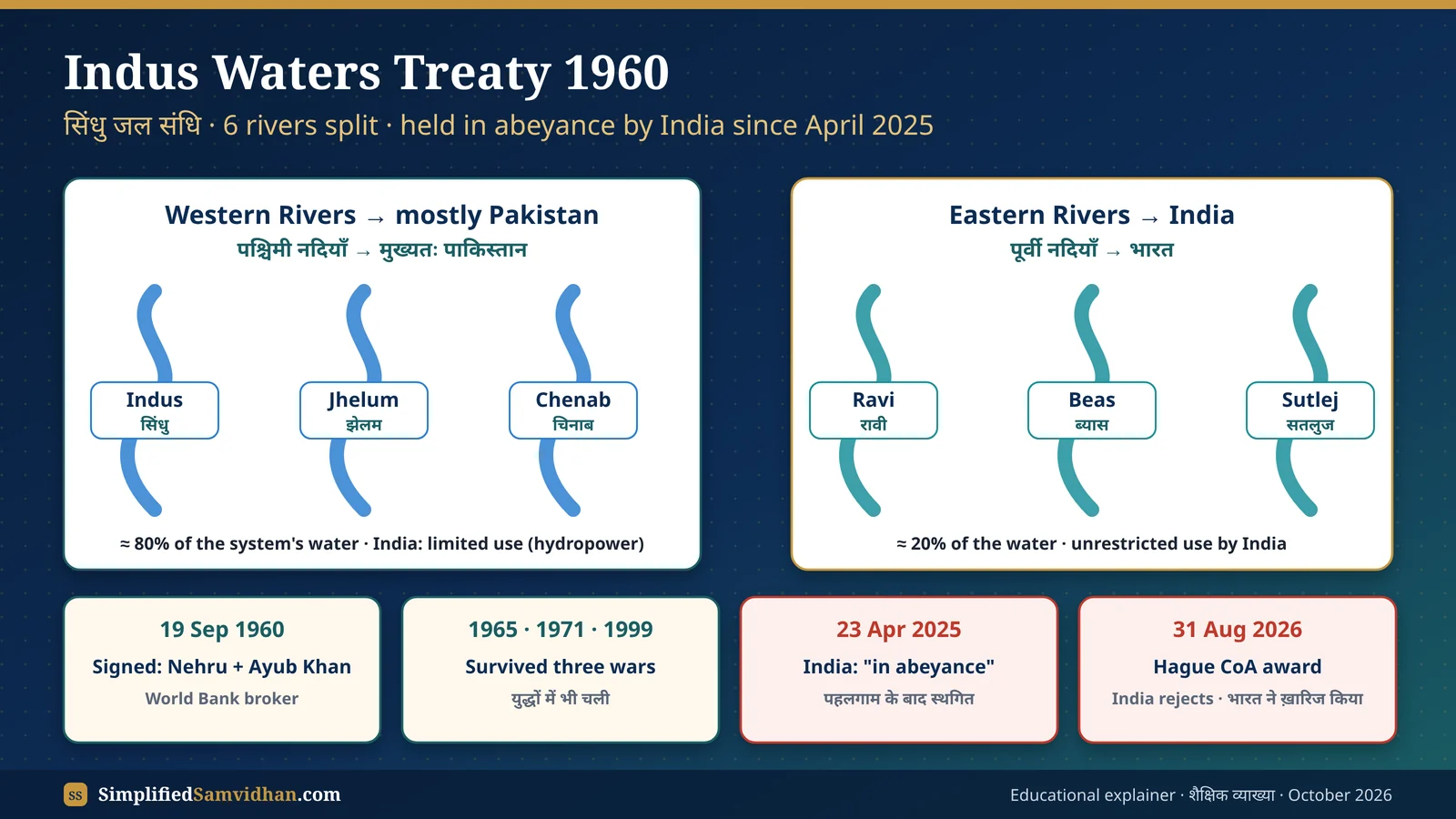
Indus Waters Treaty: India gets the eastern rivers; Pakistan gets most of the western rivers' water, with limited uses allowed to India.
📜 Treaty text · Indus Waters Treaty, 1960
Indus Waters Treaty, 19 September 1960 (extracts)
Article II (1). All the waters of the Eastern Rivers shall be available for the unrestricted use of India, except as otherwise expressly provided in this Article.
Article III (1). Pakistan shall receive for unrestricted use all those waters of the Western Rivers which India is under obligation to let flow under the provisions of Paragraph (2).
Article XII (4). The provisions of this Treaty, or the provisions of this Treaty as modified under the provisions of Paragraph (3), shall continue in force until terminated by a duly ratified treaty concluded for that purpose between the two Governments.
Date
Development
19 Sep 1960
Signed in Karachi by PM Jawaharlal Nehru and President Ayub Khan, with the World Bank as broker and signatory.
1960-2024
Survived the wars of 1965, 1971 and 1999. A Permanent Indus Commission meets to share data.
2016-2023
Disputes over India's Kishenganga and Ratle hydro projects; Pakistan seeks a Court of Arbitration, India a Neutral Expert. India sends notices (Jan 2023, Aug 2024) seeking to modify the treaty.
23 Apr 2025
After Pahalgam, India holds the treaty "in abeyance" until Pakistan "credibly and irrevocably abjures its support for cross-border terrorism".
May 2026
Court of Arbitration rules on reservoir storage; India calls it "null and void".
31 Aug 2026
Court of Arbitration (The Hague) unanimously says one-sided "abeyance" has no basis in the treaty, which stays in force until both sides end it (Article XII(4)), and restricts some Ratle dam work. India rejects the award and says the court is illegally constituted.
🇮🇳 India's position
The treaty was signed in good faith; Pakistan's cross-border terrorism is a fundamental change of circumstances.
"Blood and water cannot flow together."
The Court of Arbitration was set up in breach of the treaty's own step-by-step dispute process, so its awards are void.
India is only using its rightful share; most eastern-river water is now used at home.
💧
🇵🇰 Pakistan's position
About 80 percent of its farming depends on the Indus system; stopping water would be an "act of war".
The treaty has no exit clause: Article XII(4) says only a new ratified treaty can end it.
The Court of Arbitration's awards are binding.
Wants the World Bank and the international community to step in.
In Simple Words / आसान शब्दों में
Six rivers flow from India into Pakistan. In 1960 they were shared: the eastern rivers (Ravi, Beas, Sutlej) for India and the western rivers (Indus, Jhelum, Chenab) mostly for Pakistan, with India allowed limited use such as run-of-the-river hydropower. Pakistan received about four-fifths of the total water. For 65 years even wars did not stop the treaty. In 2025 India put it on hold, which means India no longer shares flood data on schedule or follows the treaty's limits on its projects. India cannot stop the western rivers overnight, as it lacks big dams there, so the real effect is long-term pressure.
🏠 Everyday analogy
Two farmers share a canal. The upstream farmer agreed to let most of the water pass. If the downstream farmer keeps sending people to burn his crops, the upstream farmer says: "our water deal is on hold until you stop".
🇮🇳 Real Indian example
India is speeding up projects like Pakal Dul and Ratle on the Chenab and the Shahpurkandi barrage on the Ravi so that its own share stops flowing to Pakistan unused.
🗻
The Core DisputeKashmir Dispute, LoC and Siachen: Why the Border Is Still Disputed
🇮🇳 India's view
Jammu and Kashmir acceded to India legally on 26 October 1947; the whole of it, including PoK and Gilgit-Baltistan, is India's.
The only issue left is Pakistan vacating PoK and ending terrorism.
Under Simla (1972) any talks are strictly bilateral; no third-party mediation.
Article 370 was an internal constitutional matter (upheld by the Supreme Court, 2023).
⚖️
🇵🇰 Pakistan's view
Calls Kashmir the "unfinished agenda of Partition".
Wants a plebiscite under the 1948 UN resolutions (ignoring that its own withdrawal was the first step).
Seeks international mediation and raises Kashmir at the UN and OIC.
Rejected India's 2019 changes and downgraded ties.
Line / area
What it is
Radcliffe Line / International Border
The Partition border in Punjab, Rajasthan and Gujarat; accepted by both sides (except Sir Creek, still disputed).
Line of Control (LoC)
About 740 km line in Jammu and Kashmir, based on the 17 December 1971 ceasefire (Simla Agreement).
Actual Ground Position Line (AGPL)
Beyond the LoC's end-point NJ9842 on the Siachen Glacier; India holds the Saltoro Ridge since Operation Meghdoot (13 April 1984).
Sir Creek
A 96 km tidal estuary in the Rann of Kutch; dispute over where the sea boundary starts.
Shaksgam Valley
Part of Jammu and Kashmir that Pakistan handed to China in 1963; India does not recognise this.
In Simple Words / आसान शब्दों में
Kashmir is the core of the quarrel. India says the issue is settled by law (the Instrument of Accession) and that the only question is Pakistan's illegal occupation of PoK. Pakistan says it is still open. Since 1989 Pakistan has backed militant groups to fight what scholars call a proxy war, because it cannot win a full war. Siachen, the world's highest battlefield (around 6,000 m), has been held by India since 1984.
🏠 Everyday analogy
A property has a registered sale deed in your name (Instrument of Accession), but a neighbour has occupied part of it and keeps telling the village it is "disputed". You say: the paper is clear; vacate the part you took.
🇮🇳 Real Indian example
Naib Subedar Bana Singh won the Param Vir Chakra in 1987 for capturing a Pakistani post at about 21,000 feet on Siachen; it was renamed Bana Top.
🎯
Cross-Border TerrorismTerror Attacks and India's Response: Parliament, 26/11, Uri, Pulwama and Pahalgam
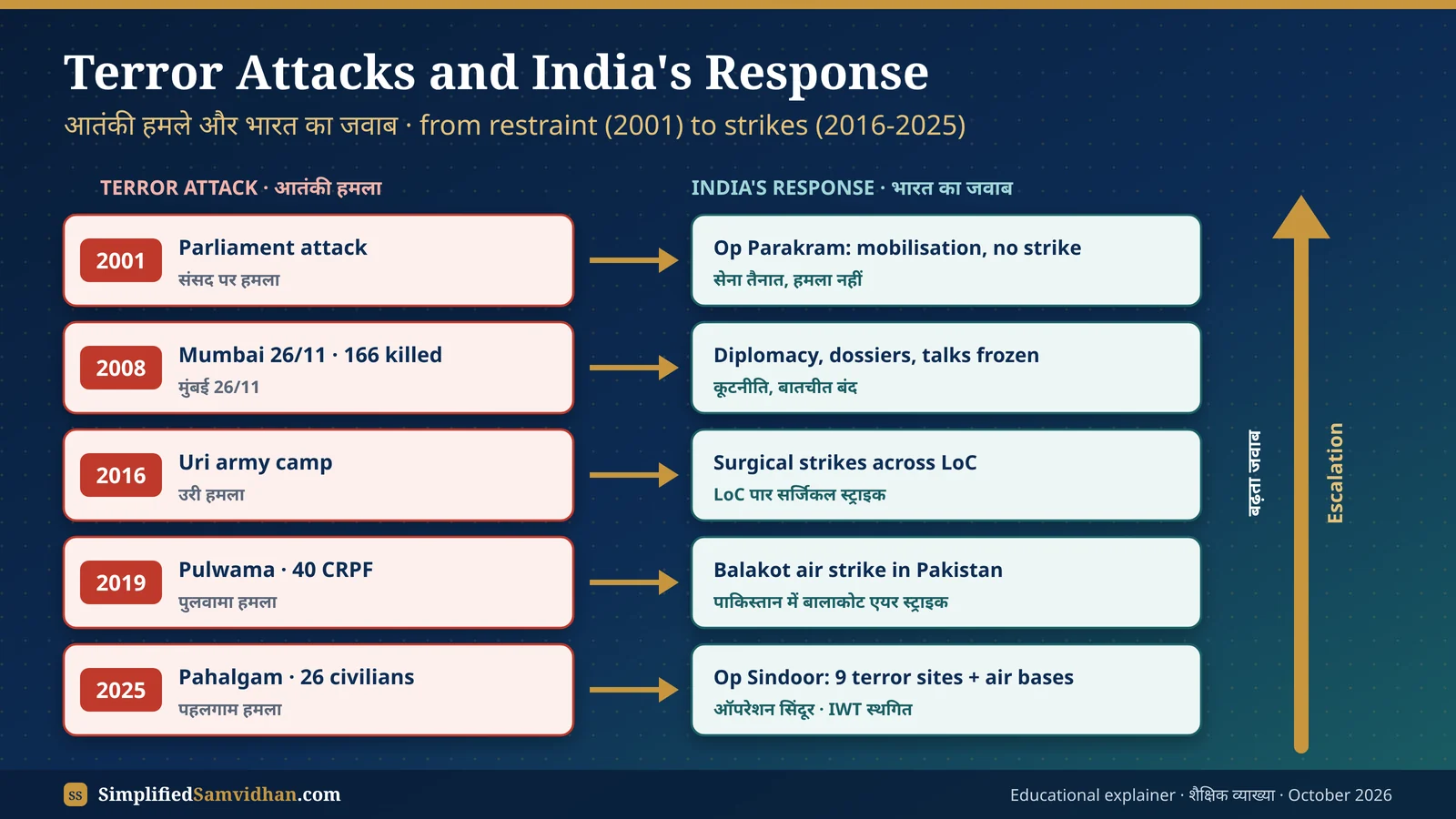
From restraint to retaliation: how India's response to major terror attacks changed between 2001 and 2025.
AttackIndia's response
13 Dec 2001 · Parliament attack (JeM, LeT)
➜
Operation Parakram: troops mobilised on the border for 10 months; no strike.
26-29 Nov 2008 · Mumbai 26/11 (LeT), 166 killed
➜
Diplomatic pressure, dossier to the world; Ajmal Kasab tried and hanged (2012); dialogue frozen.
2 Jan 2016 · Pathankot air base
➜
Joint investigation team allowed to visit; trust collapses.
18 Sep 2016 · Uri army camp, 19 soldiers killed
➜
Surgical strikes across the LoC on the night of 28-29 September 2016.
14 Feb 2019 · Pulwama (JeM), 40 CRPF personnel killed
➜
MFN status withdrawn (15 Feb); Balakot air strike inside Pakistan (26 Feb); Wg Cdr Abhinandan returned (1 Mar).
22 Apr 2025 · Pahalgam, 26 civilians killed
➜
Indus Waters Treaty in abeyance; Operation Sindoor on 9 terror sites (7 May) and Pakistani air bases (10 May).
In Simple Words / आसान शब्दों में
For decades India answered terror with restraint and diplomacy. Since 2016 the answer has become military strikes, each one going deeper: across the LoC (2016), into Pakistan proper (2019), and in 2025 against both terror headquarters and Pakistani military air bases. The message: the cost of terror will be paid by its sponsors.
🏠 Everyday analogy
If a bully's friends keep breaking your windows and the bully says "not my friends", at first you complain to the principal. After the fourth broken window, you go and break the bully's slingshot yourself.
🇮🇳 Real Indian example
Groups such as Lashkar-e-Taiba and Jaish-e-Mohammed are banned by India and listed by the UN. Pakistan was on the FATF "grey list" for terror financing from June 2018 to October 2022.
🎖️
2025 ConflictOperation Sindoor 2025: What Happened and Who Won
Date (2025)
Event
22 Apr
Terrorists kill 26 people, mostly tourists, at Baisaran meadow near Pahalgam.
23 Apr
Cabinet Committee on Security: Indus Waters Treaty in abeyance, Attari check-post closed, visas for Pakistanis cancelled, defence advisers expelled, High Commission staff cut from 55 to 30.
24 Apr
Pakistan closes its airspace and the Wagah border, suspends all trade, and says it may hold the Simla Agreement and other bilateral agreements in abeyance.
7 May
Operation Sindoor: precision strikes after midnight on 9 terror sites in Pakistan and PoK, including JeM's base in Bahawalpur and LeT's in Muridke.
7-9 May
Pakistani shelling of Poonch and other areas; waves of Pakistani drones and missiles intercepted by India's air defence.
10 May
India strikes Pakistani air bases, including Nur Khan (Rawalpindi). Pakistan's DGMO calls India's DGMO; firing stops from 5 pm IST.
12 May
PM Modi: a terror attack will get a response on India's terms; no tolerance for nuclear blackmail; no difference between terrorists and their sponsors.
In Simple Words / आसान शब्दों में
Operation Sindoor was named after the sindoor of the women whose husbands were killed in front of them at Pahalgam. It was India's biggest strike on Pakistan since 1971. India says it met every goal: terror headquarters destroyed (about 100 terrorists killed, as per the DGMO briefing) and Pakistan's air bases hit until Pakistan asked for a halt. Pakistan also claimed success and said it shot down Indian jets; India's Chief of Defence Staff later acknowledged losses without giving numbers.
Who won? India achieved its stated military aims and set a new doctrine, but this was a short, limited conflict, not a full war: no territory changed hands, and each side tells its own story. India says the halt was agreed directly between the two DGMOs, with no third-party mediation.
🏠 Everyday analogy
Like a boxer who lands precise blows on the exact spots where the bully's gang trains, then on the bully's own gym when he hits back, and stops when the bully asks for time out. Both walk out claiming they were not hurt, but the gym needs repairs.
🇮🇳 Real Indian example
Colonel Sofiya Qureshi and Wing Commander Vyomika Singh briefed the nation alongside Foreign Secretary Vikram Misri, a powerful image of women officers telling the story of an operation named for women.
🎓
Exam CornerIndia Pakistan Relations for UPSC: Key Issues, Way Forward and Mains Points
Issue
Why it matters (GS Paper 2 / 3)
Cross-border terrorism
Core of India's stand: "terror and talks cannot go together"; FATF, UN 1267 sanctions listings.
Kashmir and LoC
Bilateralism under Simla vs Pakistan's internationalisation; Article 370 and the 2019 reorganisation.
Water security
Indus Waters Treaty in abeyance; Court of Arbitration vs Neutral Expert; climate stress on glaciers.
Nuclear deterrence
Both nuclear-armed since 1998; India's no-first-use doctrine; risk of escalation in short wars.
China-Pakistan axis
CPEC through PoK (India objects on sovereignty), Chinese weapons, two-front challenge.
Regional bodies
SAARC paralysed since the 2016 Islamabad summit was cancelled; India prefers BIMSTEC; both are in the SCO.
Trade and people
Trade suspended since 2019 (formally by Pakistan); Kartarpur and Samjhauta-type links show the value of people-to-people ties.
Way forward (India's stated approach): talks only on terrorism and PoK; dismantling of terror infrastructure is the precondition.
Keep military deterrence credible (the post-2016 "new normal") while avoiding full-scale war between nuclear powers.
Use diplomacy to keep the world focused on terror sponsorship (all-party delegations to 33 countries after Sindoor in 2025).
Keep humanitarian channels (prisoner lists, fishermen releases, nuclear-installation lists) alive even when politics is frozen.
Mains tip: always balance the answer with Article 51 (peace) and national security (Article 355 duty of the Union to protect States against external aggression).
In Simple Words / आसान शब्दों में
For the exam, remember the pattern: Partition and Kashmir are the roots, war and terror are the symptoms, and treaties (Tashkent, Simla, Lahore, Indus) are the medicines that work only while trust lasts. India's present policy is zero tolerance for terror, strictly bilateral talks, and strong deterrence.
🏠 Everyday analogy
A doctor treats a recurring fever (terror attacks) but knows the infection (support for terror groups) must be removed first, otherwise the fever keeps coming back.
🇮🇳 Real Indian example
UPSC Mains 2026-type question: "Critically examine India's decision to hold the Indus Waters Treaty in abeyance in the light of international law and national security."
📝
Practice MCQTest Yourself: India-Pakistan Relations 1947-2026: Wars, Treaties and Who Won
Which agreement between India and Pakistan converted the 1971 ceasefire line in Jammu and Kashmir into the Line of Control and committed both sides to settle differences bilaterally?
Answer: (b) Simla Agreement, 1972. Signed by Indira Gandhi and Z.A. Bhutto on 2 July 1972, it said the line of control resulting from the ceasefire of 17 December 1971 shall be respected by both sides, and that differences will be settled through bilateral negotiations. The Karachi Agreement (1949) drew the earlier Ceasefire Line, the Tashkent Declaration (1966) ended the 1965 war, and the Lahore Declaration (1999) focused on nuclear confidence building.
❓
Doubts ClearedFrequently Asked Questions
How many wars have India and Pakistan fought, and who won?
Four full wars. 1947-48 (First Kashmir War) ended in a UN ceasefire and stalemate; 1965 ended in a stalemate with an Indian edge and the Tashkent Declaration; 1971 was a decisive Indian victory that created Bangladesh with about 93,000 Pakistani soldiers surrendering; and the 1999 Kargil War was an Indian victory. There were also limited conflicts such as Siachen (1984), the 2016 surgical strikes, Balakot (2019) and Operation Sindoor (2025).
Why did Partition happen in 1947?
The demand for a separate Muslim homeland (the Muslim League's Lahore Resolution of 1940), failed power-sharing plans such as the Cabinet Mission (1946), communal violence and Britain's hurried exit led to the Mountbatten Plan of 3 June 1947 and the Indian Independence Act, 1947, which created India and Pakistan from 15 August 1947.
What is the Simla Agreement?
Signed on 2 July 1972 by Indira Gandhi and Zulfikar Ali Bhutto after the 1971 war, it commits both countries to settle differences peacefully through bilateral negotiations, turns the 17 December 1971 ceasefire line in Jammu and Kashmir into the Line of Control, and led to the return of prisoners of war and captured land.
What is the current status of the Indus Waters Treaty?
India has held the 1960 treaty in abeyance since 23 April 2025, after the Pahalgam attack. On 31 August 2026 a Court of Arbitration at The Hague said one-sided abeyance has no basis in the treaty; India rejected the award, saying the court has no jurisdiction, and the treaty remains in abeyance from India's side.
What was Operation Sindoor?
India's military operation of 7 to 10 May 2025 after the Pahalgam terror attack. India struck 9 terror sites in Pakistan and Pakistan-occupied Kashmir on 7 May and then Pakistani air bases on 10 May, after which both sides agreed through their DGMOs to stop firing from 5 pm IST on 10 May 2025.
Are India and Pakistan trading or talking in 2026?
No regular trade or structured dialogue exists. The land border at Attari-Wagah is closed, both countries ban each other's airlines from their airspace, visas are suspended and diplomatic missions are downgraded. India's position is that talks can happen only on terrorism and Pakistan-occupied Kashmir.
🔎
Sources and further readingSources We Checked
Historical facts are from official texts and standard references; news facts for 2025-26 were checked against the reports below on 17 October 2026. Casualty figures for Partition are scholarly estimates. Fast-moving issues (Indus Waters Treaty, airspace bans, the ceasefire) may change; we will update this page.