How to File RTI Against Sarpanch (RTI Kaise Lagaye): Free Format and 7 Steps
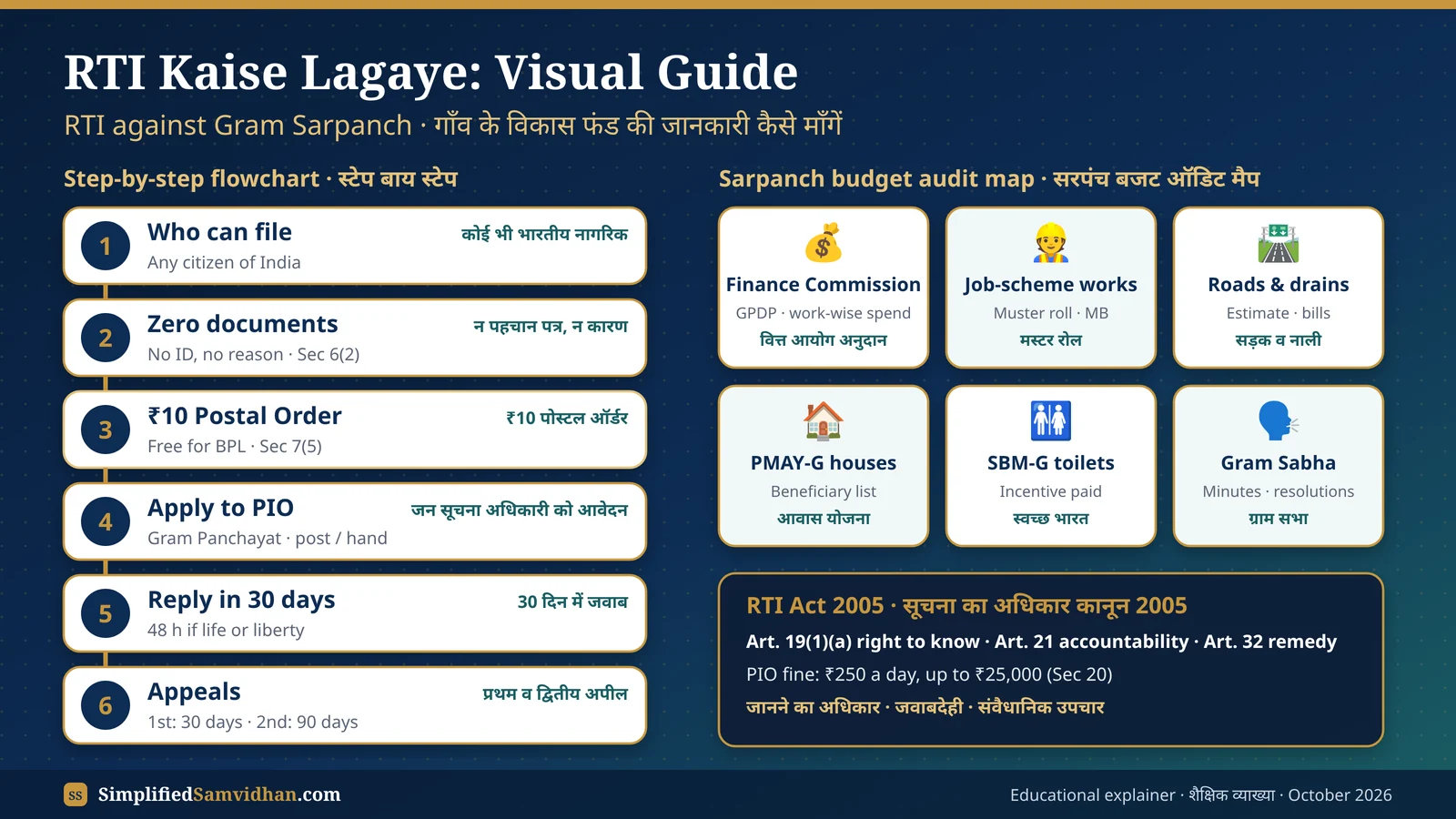
RTI Kaise Lagaye? This visual guide shows any citizen how to file an RTI against a Gram Sarpanch (in Hindi or English) and how to file RTI for village development funds under the Right to Information Act 2005 (सूचना का अधिकार कानून 2005): ₹10, one sheet of paper, no documents and no reason needed.
Step by stepRTI Kaise Lagaye: The 7-Step Visual Timeline
- 1
👤 Who can file?
Any citizen of IndiaFarmer, student, homemaker, workerYou need not live in that villageBPL families pay no feeNot needed: being a voter thereNot needed: a lawyer or agent - 2
📂 Zero documents rule
Aadhaar or ID proofReason for askingAffidavit or stamp paper✔ Your name✔ An address for the replySection 6(2): only details needed to contact you. A BPL card copy is needed only if you claim the fee waiver.
- 3
📮 Buy the ₹10 Indian Postal Order
INDIAN POSTAL ORDER№ 12F 345678₹ 10Pay to: PIO, Gram Panchayat ____Payable at: ____________✂ CounterfoilKeep this with you- Go to any post office and ask for an Indian Postal Order (IPO) of ₹10. A small commission is added.
- Write the payee as the office named in your state's RTI rules (for example "Public Information Officer, Gram Panchayat ____" or its Accounts Officer). If unsure, ask at the Panchayat office.
- Write the IPO number and date in your application. Keep the counterfoil (the small stub) safely.
Other ways to pay, depending on your state: demand draft, banker's cheque, cash against a receipt, court-fee stamp, or online.
- 4
✍️ Write the application
One page, in Hindi, English or your state language, addressed to the PIO. Use the free draft below.
- 5
📮 Send it and keep proof
Hand it in and take a dated receipt, or send by Speed Post or Registered Post and keep the slip.
- 6
⏳ Wait 30 days
The PIO must reply within 30 days (35 if given to an Assistant PIO). Late reply = information free of cost, Section 7(6).
- 7
⚖️ No reply? Appeal
First appeal within 30 days to the officer senior to the PIO. Second appeal within 90 days to the State Information Commission.
Address it rightRTI Against Gram Sarpanch: Who Receives Your Application?
An RTI is not filed against a person. You ask the Gram Panchayat, which is a public authority under Section 2(h) because it is an institution of self-government set up under your state's Panchayati Raj law (Part IX of the Constitution). The Sarpanch's decisions, spending and records are what you ask about.
Address it to
The Public Information Officer (PIO) of the Gram Panchayat. In most states this is the Panchayat Secretary, Gram Sevak or Village Development Officer.
If no PIO is named
Send it to the PIO at the Block (Panchayat Samiti) office. The law requires them to transfer it within 5 days, Section 6(3).
Online?
rtionline.gov.in covers only Central Government offices. Some states run their own RTI portals; for a Panchayat, post or hand delivery is the safe route.
Official law textसूचना का अधिकार कानून 2005: The Sections You Need
Section 3. Right to information. Subject to the provisions of this Act, all citizens shall have the right to information.
Section 6(1). Request for obtaining information. A person, who desires to obtain any information under this Act, shall make a request in writing or through electronic means in English or Hindi or in the official language of the area in which the application is being made, accompanying such fee as may be prescribed, to the Central Public Information Officer or State Public Information Officer, as the case may be, of the concerned public authority…
Section 6(2). An applicant making request for information shall not be required to give any reason for requesting the information or any other personal details except those that may be necessary for contacting him.
Section 7(1). … the Central Public Information Officer or State Public Information Officer, as the case may be, on receipt of a request under section 6 shall, as expeditiously as possible, and in any case within thirty days of the receipt of the request, either provide the information on payment of such fee as may be prescribed or reject the request for any of the reasons specified in sections 8 and 9:
Provided that where the information sought for concerns the life or liberty of a person, the same shall be provided within forty-eight hours of the receipt of the request.
Your village's roads, wells and toilets are built with your tax money. RTI is the receipt you are allowed to ask for. The PIO cannot ask you why you want it, and must answer in 30 days.
🏠 Everyday analogy
When you pay a shopkeeper, you can ask for the bill. The Panchayat spends public money, so every citizen can ask for its bills, measurement books and muster rolls, even if they never vote in that village.
🇮🇳 Real Indian example
A farmer in Bihar sees that a hand pump shown as "installed" in his ward does not exist. With one ₹10 RTI he gets the bill, the payment voucher and the completion certificate, and takes them to the Gram Sabha.
Core legal philosophyWhy the Right to Information Is a Constitutional Right
The RTI Act 2005 gives a procedure, but the right itself flows from the Constitution. The Supreme Court read the right to know into our Fundamental Rights long before Parliament passed the Act.
Right to Know under Art 19(1)(a)
Freedom of speech includes the right to receive information. In State of U.P. v. Raj Narain (1975) and S.P. Gupta v. Union of India (1981) the Court said people have a right to know every public act of those who govern them.
Right to Accountability under Art 21
In Reliance Petrochemicals v. Indian Express (1988) the Court called the right to know basic to life in a democracy under Article 21. Open records keep the people who spend public money answerable.
Remedies under Art 32
Article 32 lets you go straight to the Supreme Court when a Fundamental Right is violated. In Anjali Bhardwaj v. Union of India (2019) a petition of this kind made the Court order governments to fill Information Commission posts. For one unanswered RTI, use the Act's appeals first.
Interactive dashboardHow to File RTI for Village Development Funds: Gram Panchayat Audit Grid
Tap the money streams you want to check. Each one adds a ready question to your RTI draft below.
Welfare beneficiary lists are usually public. If a PIO refuses them as "personal information" under Section 8(1)(j), ask again for names, amounts and dates only, without phone or Aadhaar numbers.
Real-world case breakdownFrom Muster Roll to Gram Sabha: How Villagers Exposed Fake Spending
The real story that started RTI. In 1994-95 the Mazdoor Kisan Shakti Sangathan (MKSS) held public hearings (jan sunwai) in villages of central Rajasthan. They read out muster rolls and bills aloud. Villagers found wages paid to people who never worked and works that existed only on paper. That movement led to Rajasthan's RTI law in 2000 and helped shape the national RTI Act, 2005.
📊 How to read the records: a worked example
Illustrative example with made-up numbers, to show the method.
⚠ Gap to explain: about ₹1.8 lakh (300 m of road that is not there)Deadlines chartRTI Timeline: Reply, First Appeal and Second Appeal
One-click templateRTI Application Format for Gram Panchayat (Hindi + English Draft)
Fill the blanks, print on plain paper and sign. The questions you picked in the audit grid are already inside.
=== English application ===

To,
The Public Information Officer (PIO),
Gram Panchayat ______________, Block ______________,
District ______________, State ______________

Subject: Application for information under Section 6(1) of the Right to Information Act, 2005

Sir / Madam,
Please provide the following information about Gram Panchayat ______________ as certified copies:
1. A list of all works sanctioned by the Gram Panchayat in financial year ______, with the estimated cost, amount released, amount spent and present status of each work.
2. Certified copies of the Gram Panchayat cash book and the bank passbook or statement of all its accounts for financial year ______.
3. I also wish to inspect the above records under Section 2(j)(i). Please tell me a date and time for the inspection.

Fee: An Indian Postal Order of ₹10, number ______________, dated __________, is attached.
(OR: I belong to a Below Poverty Line family. A copy of my BPL card is attached, so no fee is payable under Section 7(5).)
Please tell me the cost of copies, if any. If any part of this information is held by another public authority, please transfer that part to it within 5 days under Section 6(3) and inform me.

Name of applicant: ______________
Address for reply: ______________
Mobile / Email (optional): ______________
Date: __________          Signature: ______________


=== हिंदी आवेदन ===

सेवा में,
जन सूचना अधिकारी (PIO),
ग्राम पंचायत ______________, विकास खंड ______________,
ज़िला ______________, राज्य ______________

विषय: सूचना का अधिकार अधिनियम, 2005 की धारा 6(1) के अंतर्गत सूचना हेतु आवेदन

महोदय / महोदया,
कृपया ग्राम पंचायत ______________ से संबंधित निम्नलिखित सूचना प्रमाणित प्रतियों में उपलब्ध कराएँ:
1. वित्तीय वर्ष ______ में ग्राम पंचायत द्वारा स्वीकृत सभी कामों की सूची, हर काम की अनुमानित लागत, जारी राशि, ख़र्च राशि और वर्तमान स्थिति सहित।
2. वित्तीय वर्ष ______ के लिए ग्राम पंचायत की रोकड़ बही (कैश बुक) और उसके सभी खातों की बैंक पासबुक या स्टेटमेंट की प्रमाणित प्रतियाँ।
3. मैं धारा 2(j)(i) के अंतर्गत उपरोक्त अभिलेखों का निरीक्षण भी करना चाहता/चाहती हूँ। कृपया निरीक्षण की तारीख़ और समय बताएँ।

शुल्क: ₹10 का भारतीय पोस्टल ऑर्डर, संख्या ______________, दिनांक __________, संलग्न है।
(अथवा: मैं गरीबी रेखा से नीचे (BPL) परिवार से हूँ। BPL कार्ड की प्रति संलग्न है, अतः धारा 7(5) के अंतर्गत कोई शुल्क देय नहीं है।)
प्रतियों का शुल्क, यदि कोई हो, कृपया बताएँ। यदि इस सूचना का कोई भाग किसी अन्य लोक प्राधिकारी के पास है, तो धारा 6(3) के अंतर्गत वह भाग 5 दिनों के भीतर उसे स्थानांतरित करें और मुझे सूचित करें।

आवेदक का नाम: ______________
उत्तर के लिए पता: ______________
मोबाइल / ईमेल (वैकल्पिक): ______________
दिनांक: __________          हस्ताक्षर: ______________
Practice MCQTest Yourself: RTI Act 2005
Ramesh files an RTI with the Gram Panchayat asking for the muster rolls of a village pond work. The Panchayat Secretary refuses to accept it until Ramesh writes why he wants the records and attaches his Aadhaar. Is the Secretary right?
Doubts ClearedFrequently Asked Questions
Can I file an RTI directly against the Sarpanch?
You file it with the Public Information Officer of the Gram Panchayat (often the Panchayat Secretary), asking about the Panchayat's works and spending. That covers the Sarpanch's decisions and payments.
Is the RTI fee always ₹10 for a Gram Panchayat?
Each state makes its own RTI fee rules for state and Panchayat offices. ₹10 is the fee in most states, BPL applicants pay nothing, and copies usually cost about ₹2 a page. Check your state's rules if the office asks for more.
What if I get no reply in 30 days?
File a first appeal within 30 days to the officer senior to the PIO (often the Block Development Officer or a district officer). If that fails too, file a second appeal or complaint with the State Information Commission within 90 days.
Do I need a lawyer to file RTI?
No. RTI is designed for ordinary citizens. If you cannot write, Section 6(1) says the PIO must help you put your request in writing.
What if someone threatens me for filing an RTI?
File a written police complaint, keep copies of your RTI papers, and inform the Information Commission and the District Collector in writing. Raising the matter openly in the Gram Sabha with other villagers also protects you.
Sources and further readingSources We Checked
Fees, payment modes and who acts as PIO differ slightly from state to state; check your state's RTI rules before filing.