Bare ActOfficial Text of Article 19
19. Protection of certain rights regarding freedom of speech, etc.—
(1) All citizens shall have the right—
(a) to freedom of speech and expression;
(b) to assemble peaceably and without arms;
(c) to form associations or unions or co-operative societies;
(d) to move freely throughout the territory of India;
(e) to reside and settle in any part of the territory of India; and
(f) [* * *]
(g) to practise any profession, or to carry on any occupation, trade or business.
(2) Nothing in sub-clause (a) of clause (1) shall affect the operation of any existing law, or prevent the State from making any law, in so far as such law imposes reasonable restrictions on the exercise of the right conferred by the said sub-clause in the interests of the sovereignty and integrity of India, the security of the State, friendly relations with foreign States, public order, decency or morality, or in relation to contempt of court, defamation or incitement to an offence.
(3) Nothing in sub-clause (b) of the said clause shall affect the operation of any existing law in so far as it imposes, or prevent the State from making any law imposing, in the interests of the sovereignty and integrity of India or public order, reasonable restrictions on the exercise of the right conferred by the said sub-clause.
(4) Nothing in sub-clause (c) of the said clause shall affect the operation of any existing law in so far as it imposes, or prevent the State from making any law imposing, in the interests of the sovereignty and integrity of India or public order or morality, reasonable restrictions on the exercise of the right conferred by the said sub-clause.
(5) Nothing in sub-clauses (d) and (e) of the said clause shall affect the operation of any existing law in so far as it imposes, or prevent the State from making any law imposing, reasonable restrictions on the exercise of any of the rights conferred by the said sub-clauses either in the interests of the general public or for the protection of the interests of any Scheduled Tribe.
(6) Nothing in sub-clause (g) of the said clause shall affect the operation of any existing law in so far as it imposes, or prevent the State from making any law imposing, in the interests of the general public, reasonable restrictions on the exercise of the right conferred by the said sub-clause, and, in particular, nothing in the said sub-clause shall affect the operation of any existing law in so far as it relates to, or prevent the State from making any law relating to,—
(i) the professional or technical qualifications necessary for practising any profession or carrying on any occupation, trade or business, or
(ii) the carrying on by the State, or by a corporation owned or controlled by the State, of any trade, business, industry or service, whether to the exclusion, complete or partial, of citizens or otherwise.
Article 19 gives six freedoms to citizens only. A foreigner living in India cannot claim them.
19(1)(a) Speech and expression is the biggest one. It covers speaking, writing, printing, films, posters, social media posts and even the right to stay silent.
The other five: peaceful assembly without arms, forming associations (and co-operatives), moving anywhere in India, settling anywhere in India, and choosing any profession or business.
The seventh, property (19(1)(f)), was removed in 1978. Property is now a legal right under Article 300A.
Each freedom has its own list of reasonable restrictions in clauses (2) to (6). The State cannot invent new grounds; a court checks whether a restriction is fair and not excessive.
🏠 Everyday Analogy
Think of Article 19 as a driving licence. It lets you drive anywhere (freedom), but traffic rules still apply (restrictions). The rules must be written in advance, apply to everyone, and be sensible: a rule that bans all cars to stop one rash driver would be struck down as unreasonable.
🇮🇳 Real Indian Example
Riya from Patna writes a blog criticising her city's garbage problem, moves to Pune for a job, joins a residents' welfare association and opens a small bakery on weekends. Each step uses a different part of Article 19: (a), (d) and (e), (c) and (g). If she needs a food licence for the bakery, that is a reasonable restriction under 19(6), not a violation.
Meaning of LibertyWhat is Liberty? Liberty vs Freedom and Positive vs Negative Liberty
- The word liberty comes from the Latin libertas (from liber, "free"): the state of being free.
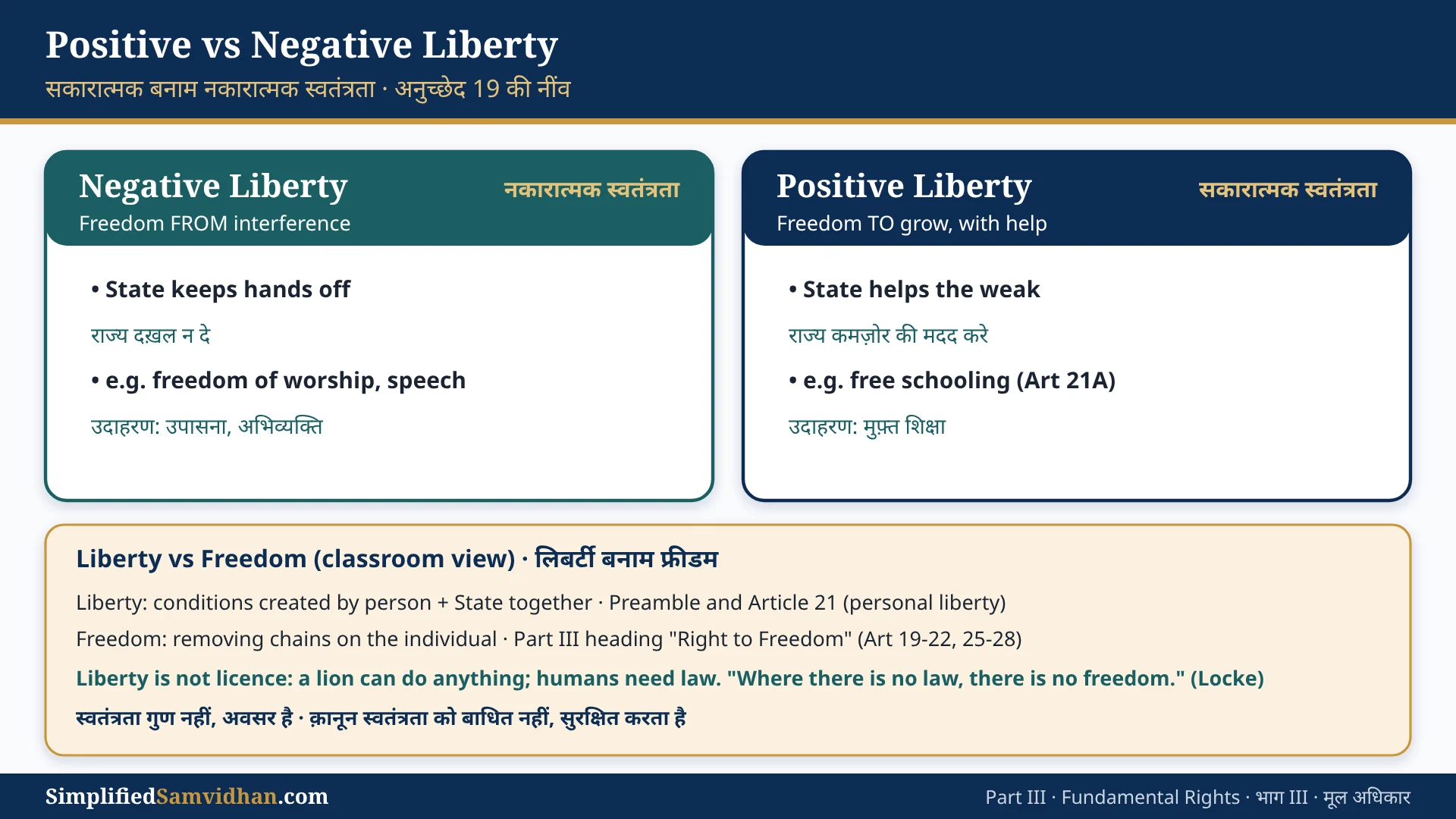
- Liberty for humans is not "do whatever you like". A lion in the jungle can do anything; that is licence, not liberty. For people, liberty means having the conditions and opportunities to grow as a person.
- Law and liberty go together. As John Locke put it, where there is no law there is no freedom: without traffic rules, nobody can drive safely.
Positive vs negative liberty
- Negative liberty (freedom from): the State should not interfere when a person can manage on their own. Example: freedom of worship, freedom of speech.
- Positive liberty (freedom to): the State should help people who cannot develop on their own. Example: free schooling under Article 21A, support for weaker sections.
- The terms were made famous by philosopher Isaiah Berlin ("Two Concepts of Liberty", 1958). Article 19 is mostly negative liberty; the Directive Principles add the positive side.
Liberty vs Freedom: a classroom view
- The Preamble promises "liberty of thought, expression, belief, faith and worship", and Article 21 protects "personal liberty".
- The Part III heading for Articles 19 to 22 is "Right to Freedom", and Articles 25 to 28 speak of freedom of religion.
- Many teachers explain it so: freedom is about removing chains from the individual; liberty is about the conditions that the person and the State together create. In law, both words are used almost alike, and both come with limits.
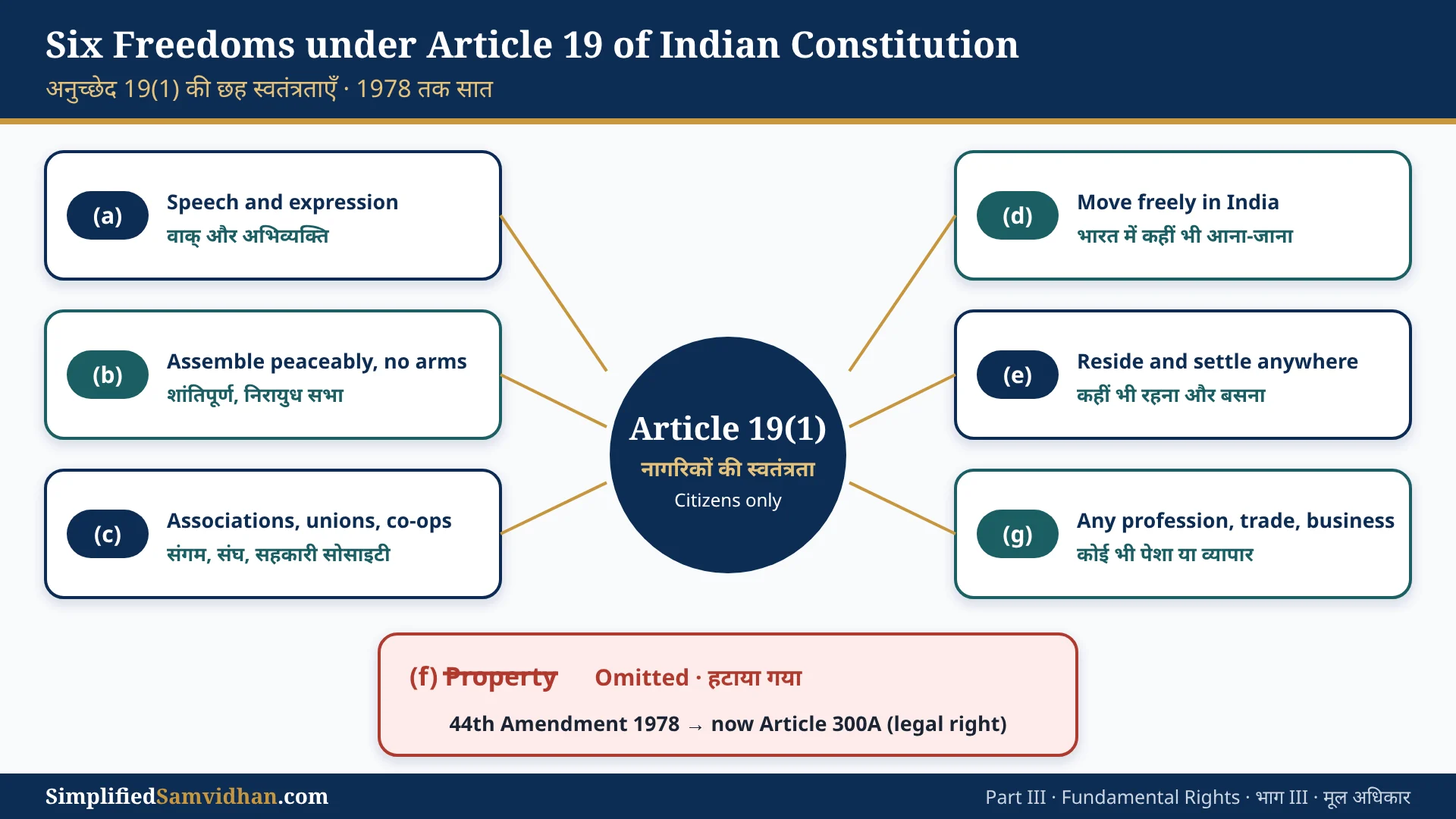
Six FreedomsSix Freedoms under Article 19(1)(a) to (g) of Indian Constitution
| Clause | Freedom | Simple meaning |
|---|---|---|
| 19(1)(a) | Speech and expression | Say, write, print, post or show your views |
| 19(1)(b) | Assemble peaceably and without arms | Meet, hold a rally or protest peacefully, with no weapons |
| 19(1)(c) | Form associations, unions or co-operative societies | Start a club, trade union, party or co-operative |
| 19(1)(d) | Move freely throughout India | Travel anywhere in India without a pass |
| 19(1)(e) | Reside and settle in any part of India | Live and make your home in any State |
| Omitted by the 44th Amendment 1978; now a legal right in Article 300A | ||
| 19(1)(g) | Any profession, occupation, trade or business | Choose your work: job, shop, farming, start-up |
- Among the rights to freedom (Articles 19 to 22), Article 19 comes first and is the most used in courts.
- Citizens only: foreigners cannot claim Article 19. A company is not a citizen, but its shareholders can challenge a law that hurts the company's freedom (Bennett Coleman, 1973).
- Originally seven freedoms. The 44th Amendment 1978 omitted 19(1)(f) (property) and Article 31; property is now a constitutional (legal) right under Article 300A, not a fundamental right.
- Co-operatives: the 97th Amendment 2011 added co-operative societies to 19(1)(c) and created Part IXB. In Union of India v. Rajendra N. Shah (20 July 2021) the Supreme Court struck down most of Part IXB for State co-operatives because half the States had not ratified it; the right in 19(1)(c) remains.
- Assembly in practice: peaceful protest is protected, but public roads cannot be blocked indefinitely (Amit Sahni, 2020, the Shaheen Bagh case). Police may fix places and times for protests, as at Jantar Mantar (Mazdoor Kisan Shakti Sangathan, 2018).
- Profession in practice: there is no right to carry on a trade that is illegal or harmful, such as trade in liquor, which the State can regulate or ban (Khoday Distilleries, 1995).
- Emergency: when a National Emergency is declared on the ground of war or external aggression, Article 19 is suspended automatically (Article 358).
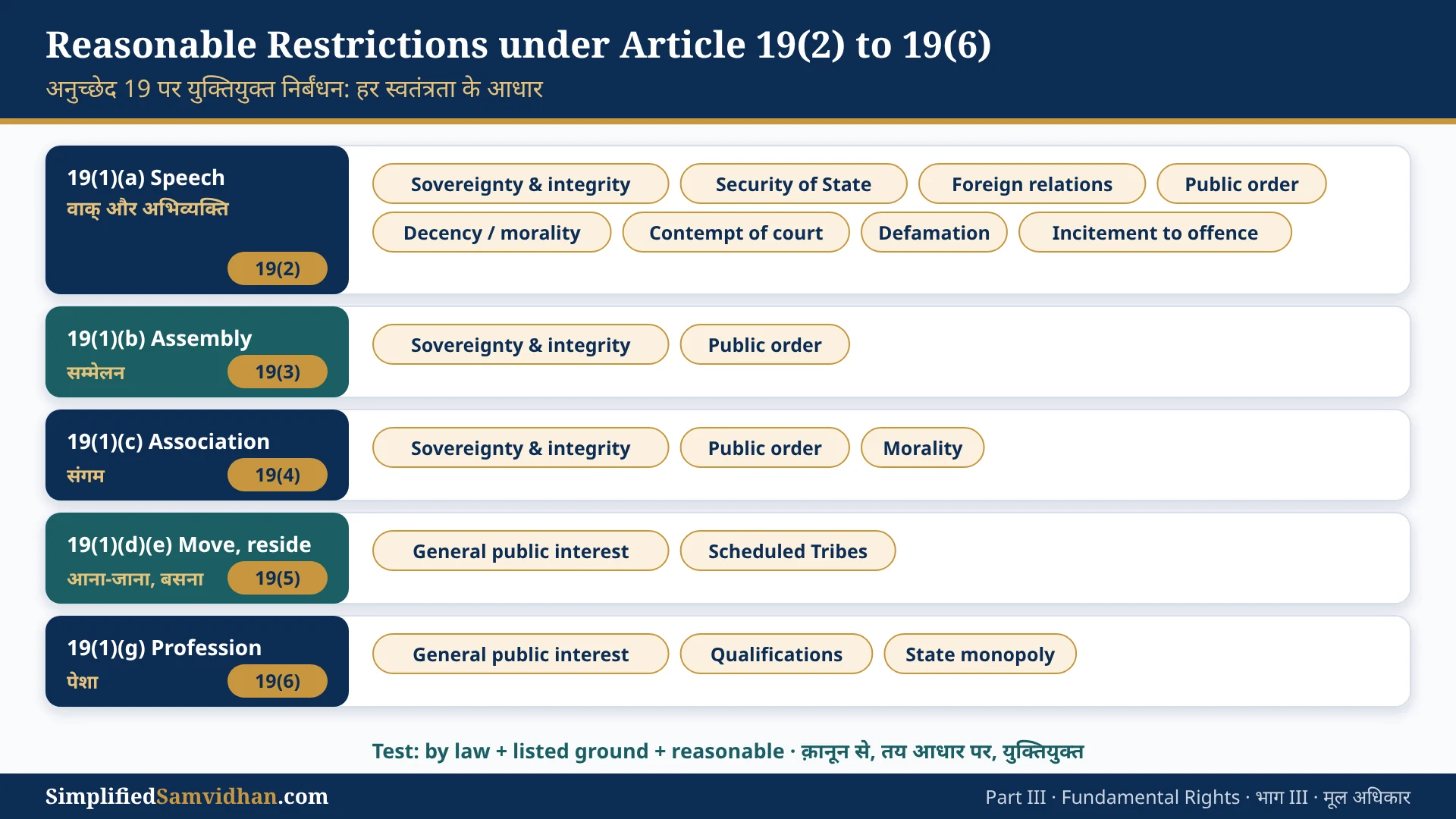
Reasonable RestrictionsReasonable Restrictions on Article 19: Clauses 19(2) to 19(6)
| Freedom | Clause | Grounds for reasonable restrictions |
|---|---|---|
| Speech and expression (a) | 19(2) | 1. Sovereignty and integrity of India 2. Security of the State 3. Friendly relations with foreign States 4. Public order 5. Decency or morality 6. Contempt of court 7. Defamation 8. Incitement to an offence |
| Assembly (b) | 19(3) | Sovereignty and integrity of India; public order |
| Association (c) | 19(4) | Sovereignty and integrity of India; public order; morality |
| Movement (d) and residence (e) | 19(5) | Interests of the general public; protection of Scheduled Tribes |
| Profession (g) | 19(6) | Interests of the general public; professional or technical qualifications; State monopoly in any trade, business, industry or service |
- Article 19 is a relative right, not an absolute one. But every restriction must pass three tests: it must be made by a law (not a mere order), it must fit one of the listed grounds, and it must be reasonable.
- "Reasonable" means the restriction is not arbitrary or excessive, and the court decides this (State of Madras v. V.G. Row, 1952). Today courts use the proportionality test: is there a legitimate aim, a link to it, no milder option, and a fair balance?
- "Public order" means serious disturbance of public peace, not every small law and order problem (Ram Manohar Lohia, 1960).
- In Kaushal Kishor v. State of U.P. (2023) a five-judge bench said the grounds in 19(2) are exhaustive: no extra restriction can be added, even on ministers' speech.
Speech and ExpressionFreedom of Speech and Expression under Article 19(1)(a): What It Includes
- Right to know and right to information: voters have a right to know about the government (State of U.P. v. Raj Narain, 1975); the RTI Act 2005 builds on it. In ADR v. Union of India (15 February 2024) the electoral bonds scheme was struck down because secret political donations violated voters' right to information under 19(1)(a).
- Right to silence: three students who stood respectfully but did not sing the national anthem could not be expelled (Bijoe Emmanuel v. State of Kerala, 1986).
- Flying the national flag with respect is part of expression (Union of India v. Naveen Jindal, 2004).
- Broadcasting: airwaves are public property and must serve free speech (Cricket Association of Bengal, 1995). Commercial advertisements are also protected speech (Tata Press, 1995).
- Internet: speech and business through the internet are protected; internet shutdowns must be temporary, necessary and reviewed (Anuradha Bhasin, 10 January 2020).
- Dress and identity: expressing one's gender identity through dress and behaviour is protected (NALSA, 2014).
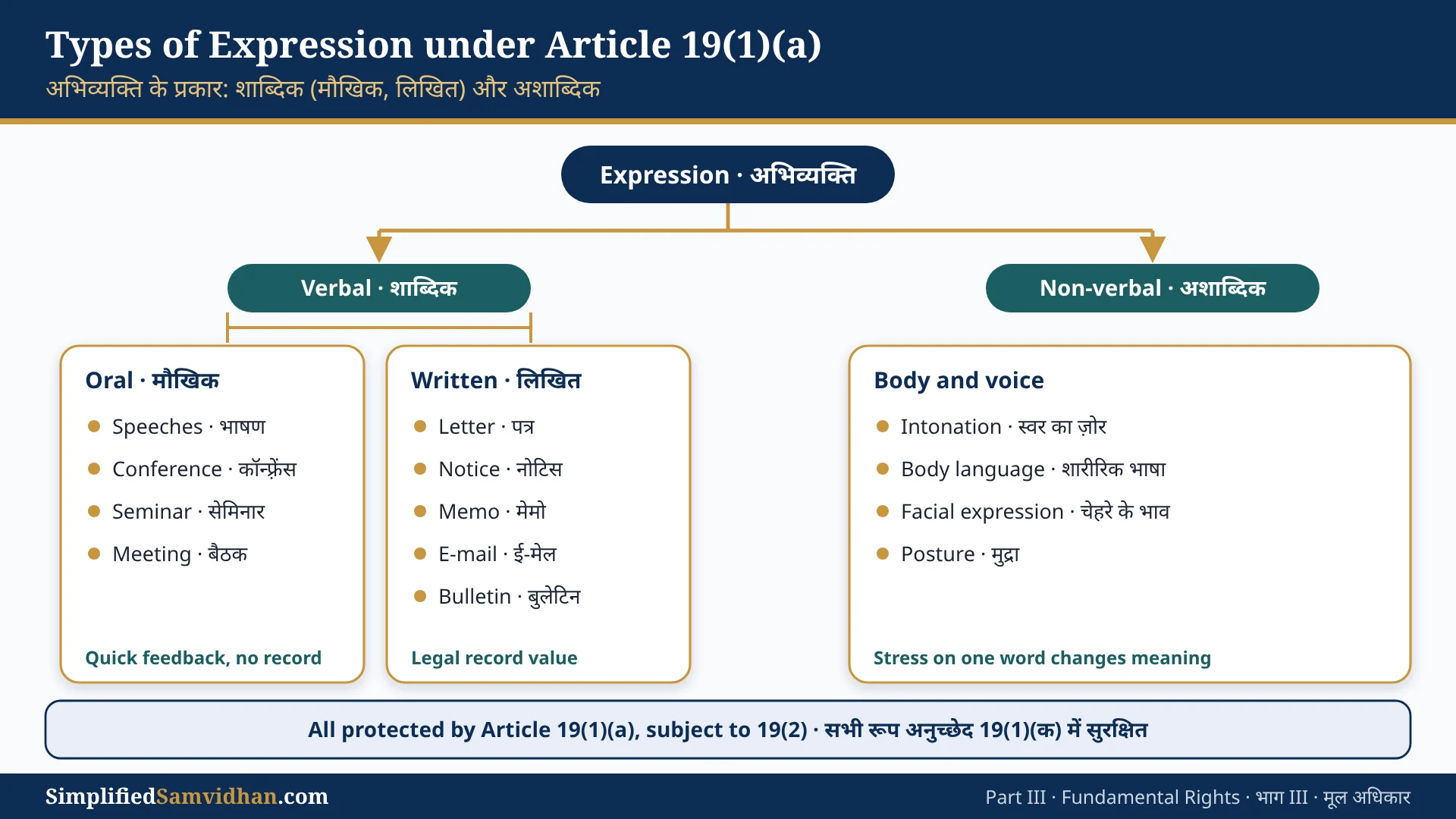
Types of expression
- Verbal: oral (speeches, conferences, seminars, meetings) and written (letters, notices, memos, e-mail, bulletins).
- Non-verbal: intonation (stress on a word changes the meaning), body language, facial expressions and posture.
- Oral communication gives instant feedback but is harder to prove later; written communication is slower but has legal value as a record.
- A conference spreads information; a seminar discusses critical views and ideas; a meeting is held to take decisions; a notice informs everyone; a memo gives a task to a person; a bulletin updates people on one topic step by step.
IT Act vs Free SpeechSection 66A IT Act and the Shreya Singhal Case: Article 19(1)(a) Online
- The Information Technology Act, 2000 was made to give legal recognition to electronic records and digital signatures, support e-commerce and e-governance, and amend the Indian Evidence Act 1872 to accept digital evidence (that Act is now replaced by the Bharatiya Sakshya Adhiniyam 2023).
- Section 66A was added later by the IT (Amendment) Act 2008. It punished sending online messages that were "grossly offensive", "menacing" or caused "annoyance" or "inconvenience", with up to 3 years in jail.
- Because these words were vague, police used it to arrest people for ordinary posts. In November 2012 two young women in Palghar, Maharashtra were arrested over a Facebook post and a "like".
- Shreya Singhal v. Union of India (24 March 2015): Justices J. Chelameswar and R.F. Nariman struck down Section 66A entirely. Reasons: its words were vague and overbroad; it did not fit any ground in Article 19(2); and it had a chilling effect (people stop speaking out of fear).
- The Court drew a key line: discussion and advocacy of even unpopular views are protected; only incitement that is close to causing disorder can be restricted. Section 69A (website blocking, with safeguards) was upheld, and the rest of the IT Act survived.
- Even after 2015, cases under 66A kept being filed. In 2021 and 2022 (PUCL v. Union of India) the Supreme Court ordered that no one may be prosecuted under 66A and pending cases must be dropped.
Press and MediaFreedom of Press in India under Article 19(1)(a)
- The Constitution has no separate clause for the press. The press gets its freedom from the same Article 19(1)(a) as every citizen, and is bound by the same 19(2) limits.
- Courts have read press freedom into 19(1)(a) again and again: Romesh Thappar (1950, ban on a journal's entry struck down), Sakal Papers (1962, price-page control struck down) and Bennett Coleman (1973, newsprint quota struck down).
- Indian Express Newspapers v. Union of India (decided December 1984, reported 1985): a tax on newsprint that burdens newspapers excessively can be challenged under 19(1)(a), because the press is essential to democracy.
- Why the press matters: it is called the fourth pillar of democracy after the legislature, executive and judiciary; it spreads awareness, checks the work of governments, and brings the problems of weaker sections to bodies like human rights and women's commissions.
- Limits and concerns: commercial pressure, "media trials" that declare someone guilty before the court does, and sensational or paid news. The media's job is to report facts, not to deliver verdicts.
- Should media be controlled? Reasonable limits under 19(2) apply, but full control of the media is not acceptable in any democracy. Self-regulation (Press Council of India, News Broadcasting Standards Authority) and courts are the balance.
Hate Speech LawIs Hate Speech Protected by Article 19? Law Commission 267th Report, Films and OTT
- No definition: the Constitution does not define hate speech. Broadly, it means speech that targets a group by religion, caste, language or similar identity in a way that can lead to hostility or violence.
- Not protected: such speech can be restricted under 19(2) on grounds like public order and incitement to an offence. Under the Bharatiya Nyaya Sanhita 2023 the main provisions are Section 196 (promoting enmity between groups), 197, 299 and 353 (earlier IPC 153A, 153B, 295A and 505).
- Law Commission 267th Report (March 2017): made after the Supreme Court's request in Pravasi Bhalai Sangathan (2014). It recommended two new offences, Section 153C (incitement to hatred) and Section 505A (causing fear, alarm or provocation of violence).
- Why films are treated differently: a film reaches huge audiences and moves emotions strongly, so pre-certification by the CBFC under the Cinematograph Act 1952 was upheld in K.A. Abbas v. Union of India (1970). But a film cannot be stopped merely because some people may protest (S. Rangarajan, 1989).
- OTT platforms: there is no censor board, but the IT (Intermediary Guidelines and Digital Media Ethics Code) Rules 2021 require age ratings (U, U/A 7+, 13+, 16+, A), content descriptors and a three-tier grievance system (publisher, self-regulatory body, Ministry oversight).
- Balance: the Shreya Singhal line still applies: discussion and criticism are free, only incitement can be punished.
Article 19 vs 105Article 19 vs Article 105: Free Speech of Citizens and MPs
| Point | Article 19(1)(a) | Article 105 (MPs) / 194 (MLAs) |
|---|---|---|
| Who | Every citizen | Members of Parliament or a State Legislature |
| Where | Anywhere | Inside the House and its committees |
| Nature | Relative: subject to 19(2) | Near absolute: no court case for anything said or any vote given in the House |
| Limits | Eight grounds in 19(2) | Rules of the House and the Speaker; Article 121 bars discussing a judge's conduct |
- Why such strong protection? So that elected members can raise the real problems of people without fear of defamation cases.
- Sita Soren v. Union of India (4 March 2024, seven judges): taking a bribe to speak or vote is not protected by Article 105 or 194; this overruled P.V. Narasimha Rao (1998).
Quick RevisionKey Points to Remember
- Six freedoms, for citizens only: speech, assembly, association, movement, residence, profession.
- 19(1)(f) property was omitted by the 44th Amendment 1978; property is now in Article 300A.
- Restrictions must be by law, on a listed ground, and reasonable; 19(2) has eight grounds.
- 19(1)(a) includes press freedom, right to know, right to silence, flag hoisting and internet speech.
- Shreya Singhal (2015) struck down Section 66A: discussion and advocacy are free, incitement is not.
- Article 19 is suspended automatically in a war or external-aggression emergency (Article 358).
Landmark CasesArticle 19 Landmark Cases: Key Dates
| Year | Case and ruling |
|---|---|
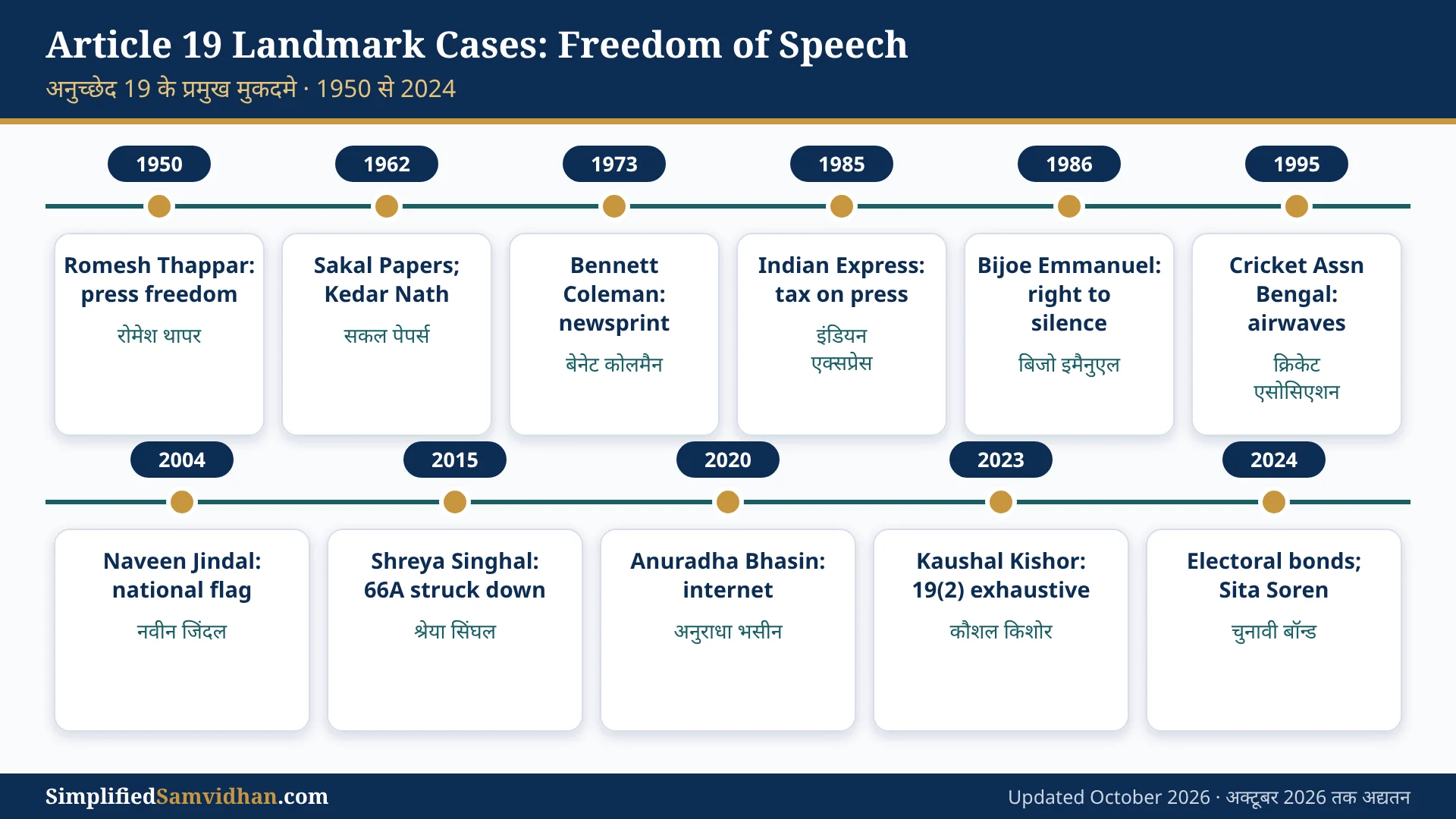
| 1950 | Romesh Thappar: press freedom is part of 19(1)(a); led to the 1st Amendment. |
| 1962 | Sakal Papers: no control on newspaper pages and price. Kedar Nath: sedition only for incitement to violence. |
| 1973 | Bennett Coleman: newsprint quota struck down. |
| 1985 | Indian Express: excessive tax on newsprint can violate 19(1)(a). |
| 1986 | Bijoe Emmanuel: right to remain silent; no one forced to sing the anthem. |
| 1995 | Cricket Association of Bengal: airwaves are public property. |
| 2004 | Naveen Jindal: flying the national flag is expression. |
| 2015 | Shreya Singhal (24 Mar): Section 66A IT Act struck down. |
| 2020 | Anuradha Bhasin: internet speech protected; shutdowns must be reviewed. |
| 2023 | Kaushal Kishor: 19(2) grounds are exhaustive. |
| 2024 | Electoral bonds (15 Feb) struck down; Sita Soren (4 Mar): no immunity for bribes. |
UPSC · State PSC · JudiciaryArticle 19: UPSC Exam Corner
- Prelims trap: "Article 19 is available to foreigners too." False. Citizens only.
- Prelims trap: "The right to property was removed by the 42nd Amendment." False. 44th Amendment, 1978.
- Prelims trap: "Freedom of the press is a separate right in Article 19." False. It is part of 19(1)(a).
- Mains PYQ 2013: Discuss Section 66A of the IT Act, with reference to its alleged violation of Article 19 of the Constitution.
- Mains PYQ 2014: What do you understand by freedom of speech and expression? Does it cover hate speech also? Why do films in India stand on a slightly different plane from other forms of expression?
- Practice (250 words): Distinguish free speech from hate speech. What steps can regulate harmful content on OTT platforms without hurting free expression?
Practice MCQTest Yourself: Article 19
On which of these grounds can the State restrict the right to assemble peaceably under Article 19(3)? 1. Sovereignty and integrity of India 2. Public order 3. Defamation
Doubts ClearedFrequently Asked Questions
What is Article 19 of Indian Constitution?
Article 19 gives every citizen six freedoms: speech and expression, peaceful assembly, forming associations, moving freely and settling anywhere in India, and any profession or business. Clauses (2) to (6) allow reasonable restrictions on listed grounds.
How many freedoms are there in Article 19?
Six today. Originally there were seven; 19(1)(f), the right to property, was omitted by the 44th Amendment 1978 and property is now a legal right under Article 300A.
Is freedom of speech absolute in India?
No. Under Article 19(2) it can be limited by law on eight grounds: sovereignty and integrity of India, security of the State, friendly relations with foreign States, public order, decency or morality, contempt of court, defamation and incitement to an offence.
Why was Section 66A of the IT Act struck down?
In Shreya Singhal v. Union of India (24 March 2015) the Supreme Court held that Section 66A used vague, overbroad words like "annoying" and "grossly offensive", was not covered by any ground in Article 19(2), and chilled free speech.