Bare ActOfficial Text of Article 21
21. Protection of life and personal liberty.—
No person shall be deprived of his life or personal liberty except according to procedure established by law.
The State cannot take away anyone's life or personal liberty unless a valid law allows it and the right procedure is followed.
After Maneka Gandhi (1978), that law and procedure must also be fair, just and reasonable, not arbitrary.
"Life" means more than breathing. It means a life with dignity: food, shelter, health, clean environment, livelihood, privacy and education.
It protects every person, citizen or foreigner, and it cannot be suspended even in an Emergency.
🏠 Everyday Analogy
Article 21 is like the foundation of a house. In 1950 people saw only a bare slab: "you will not be killed or jailed without a law". Over the years the Supreme Court built rooms on it: a kitchen (food), a bedroom (sleep, privacy), windows (clean air), a study (education). The slab is the same; the house has grown.
🇮🇳 Real Indian Example
In 1977 Maneka Gandhi's passport was impounded "in the public interest" without giving her any reason or a hearing. The Supreme Court held in 1978 that travelling abroad is part of personal liberty, and a law that takes it away without a fair hearing is not valid. Today, if a passport office refuses a passport, it must give reasons, and the person can challenge the order.
Life vs LibertyArticle 21 of Indian Constitution: Right to Life vs Personal Liberty
| Point | Life | Personal liberty |
|---|---|---|
| What it covers | What a person needs to stay alive: the most basic natural right | What a person needs for a life of dignity: freedom of body, movement and choices |
| Priority | Comes first: without life there is no liberty | A natural right too, but second in order |
| How far expanded | Expanded less; includes the right to die with dignity (passive euthanasia) in special cases | Expanded the most by the Supreme Court |
| Aim | Protect existence and bodily safety | Do not block individual initiative and growth |
Both are linked
- Without life there is no liberty, and a life without liberty is not a life of dignity. Courts read the two together.
- Article 21 is available to every person: citizens and foreigners alike. It is a negative command to the State ("shall not deprive"), but courts have also drawn positive duties from it, such as providing legal aid and emergency medical care.
- It is enforceable against the State. Some parts, such as the right against bonded labour or a clean environment, are also enforced against private persons through laws and court orders.
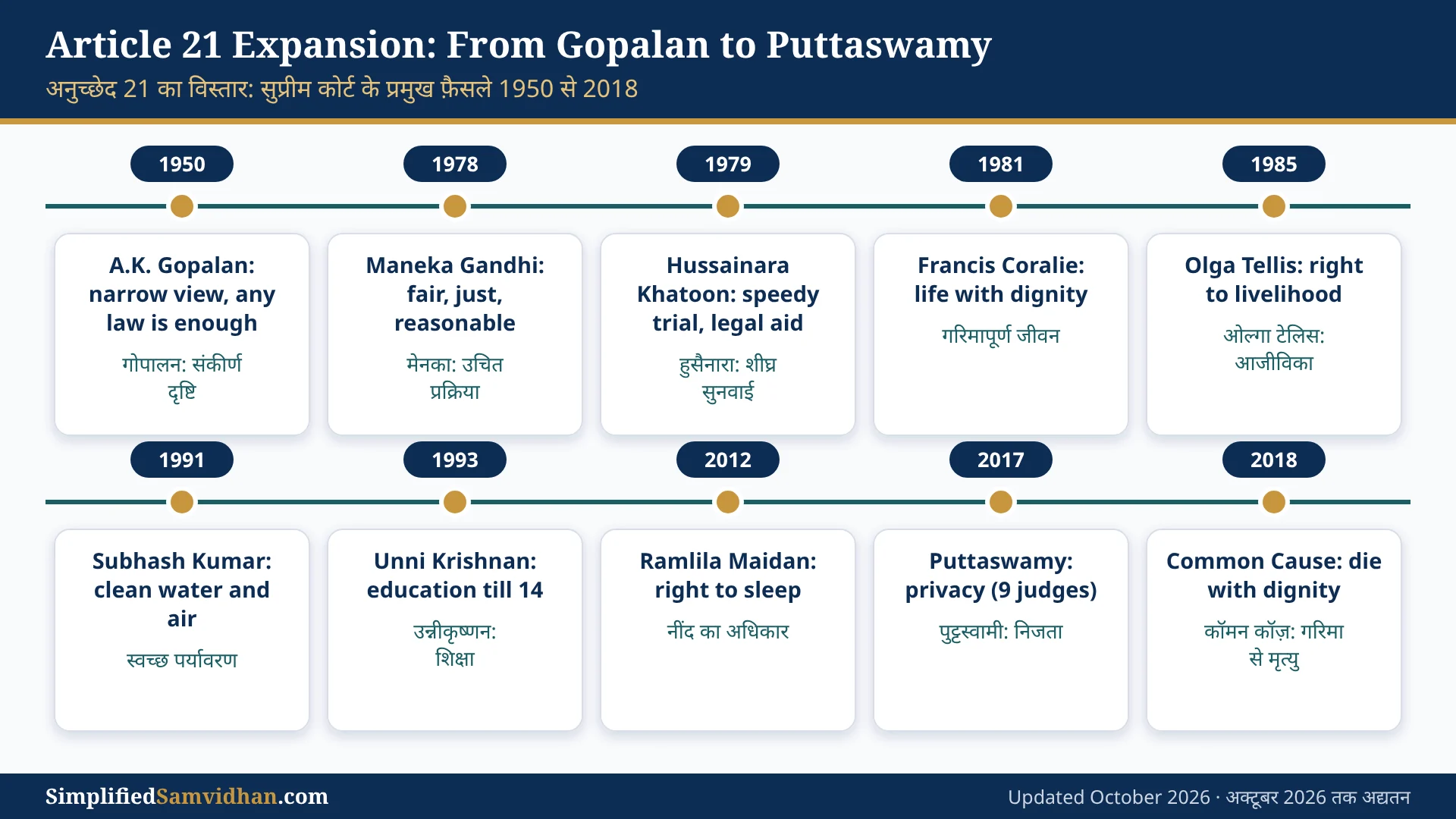
Gopalan to ManekaExpansion of Article 21 of Indian Constitution: From A.K. Gopalan to Maneka Gandhi
- A.K. Gopalan v. State of Madras (1950), narrow view: a communist leader challenged his preventive detention. The Court read each Fundamental Right as a separate box. "Life" meant mere physical existence, and "procedure established by law" meant any procedure in a law made by the legislature, however unfair.
- Kharak Singh v. State of U.P. (1962): night-time police visits to a person's home were struck down as a breach of personal liberty; the minority opinion spoke of privacy.
- Maneka Gandhi v. Union of India (25 January 1978, 7 judges), broad view: Articles 14, 19 and 21 form a "golden triangle" and must be read together. The procedure must be fair, just and reasonable. Life means a life with dignity, and personal liberty includes the right to travel abroad (already recognised in Satwant Singh Sawhney, 1967).
After Maneka: the flood of new rights
- Your notes link clean water, food and free movement to Maneka. More precisely, these came in later cases built on Maneka: Francis Coralie Mullin (1981) on dignity, Subhash Kumar (1991) on pollution-free water and air, and the PUCL right to food orders from 2001.
- Hussainara Khatoon (1979) was not just about arbitrary detention: it made speedy trial part of Article 21, led to the release of thousands of undertrials in Bihar, and stressed free legal aid (Article 39A).
- Mohini Jain (1992) and Unni Krishnan (1993) found a right to education; this led to the 86th Amendment 2002 and Article 21A (free education for ages 6 to 14).
- K.S. Puttaswamy: the privacy judgment came on 24 August 2017 (9 judges, unanimous); the separate Aadhaar judgment came on 26 September 2018 (5 judges, 4:1).
| Right read into Article 21 | Key case |
|---|---|
| Life with human dignity | Francis Coralie Mullin v. Administrator, Delhi (1981) |
| Livelihood | Olga Tellis v. Bombay Municipal Corporation (1985): pavement dwellers |
| Speedy trial, free legal aid | Hussainara Khatoon v. State of Bihar (1979); M.H. Hoskot (1978) |
| Clean environment, water and air | M.C. Mehta cases; Subhash Kumar v. State of Bihar (1991) |
| Emergency medical care and health | Parmanand Katara (1989); Paschim Banga Khet Mazdoor Samity (1996) |
| Food | PUCL v. Union of India (orders from 2001; led to mid-day meals and the Food Security Act 2013) |
| Shelter | Chameli Singh v. State of U.P. (1996) |
| Travel abroad | Satwant Singh Sawhney (1967); Maneka Gandhi (1978) |
| Against custodial torture | D.K. Basu v. State of West Bengal (1997) |
| Education (till 14) | Mohini Jain (1992); Unni Krishnan (1993): led to Article 21A |
| Sleep | In re Ramlila Maidan Incident (2012): midnight police action on sleeping protesters |
| Privacy | K.S. Puttaswamy v. Union of India (24 August 2017, 9 judges) |
| Marry a person of one's choice | Shafin Jahan (2018); Shakti Vahini v. Union of India (2018) |
| Die with dignity | Common Cause v. Union of India (9 March 2018, 5 judges) |
| Against adverse effects of climate change | M.K. Ranjitsinh v. Union of India (2024), with Article 14 |
Internet and education
- Courts have linked internet access with education and expression: the Kerala High Court in Faheema Shirin (2019), and the Supreme Court in Anuradha Bhasin (2020) under Article 19. Questions on access for schoolchildren keep coming up; see our explainer linked below.
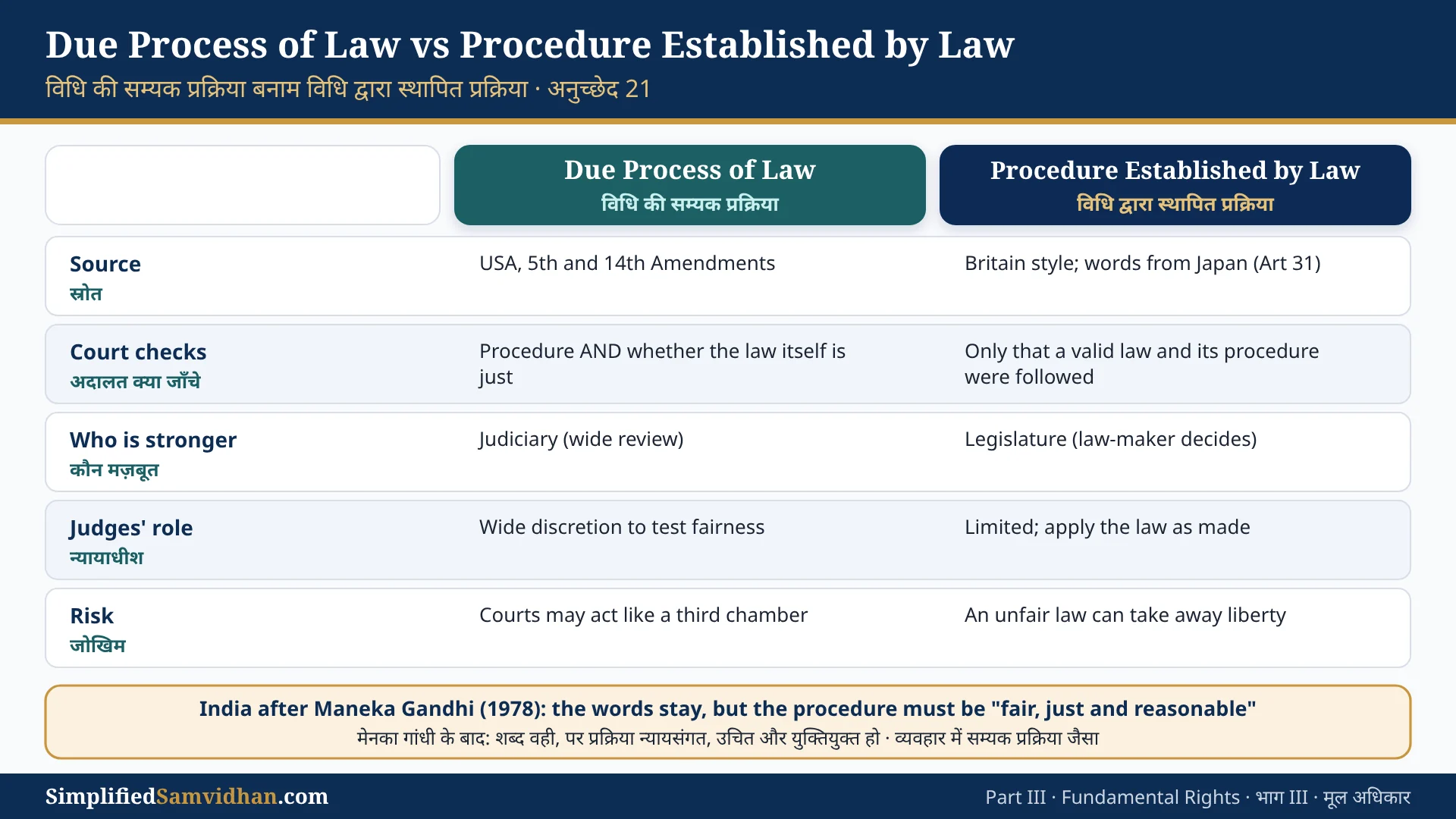
Due ProcessArticle 21 of Indian Constitution: Due Process of Law vs Procedure Established by Law
| Point | Due process of law | Procedure established by law |
|---|---|---|
| Where from | USA (5th and 14th Amendments) | British idea of parliamentary sovereignty; India took the words from Article 31 of the Japanese Constitution |
| What the court checks | Whether the procedure was followed and whether the law itself is fair and just | Only whether a valid law exists and its procedure was followed |
| Who is stronger | Judiciary | Legislature |
| Judges' discretion | Wide | Limited |
| Weakness | Courts can become a "third chamber" that second-guesses policy | An unjust law, properly passed, can still take away life or liberty |
Why India chose "procedure established by law"
- The draft first said "due process of law". The Constituent Assembly changed it to "procedure established by law", the words of Article 31 of the Japanese Constitution (1946), so that courts would not strike down social and land-reform laws as in the US. B.N. Rau had discussed this with US Justice Felix Frankfurter.
- Britain has parliamentary sovereignty: courts cannot strike down an Act of Parliament. India has parliamentary supremacy limited by a written Constitution and judicial review (Articles 13, 32 and 226), so even the Indian model was never pure British.
What changed after Maneka Gandhi
- Since 1978 the procedure must be fair, just and reasonable, and the law must pass the tests of Articles 14 and 19 as well. In practice Indian courts now apply a due-process-like test while keeping the original words.
- Example: in Mithu v. State of Punjab (1983) the Court struck down the mandatory death sentence in section 303 IPC, because a law that leaves the judge no choice is unfair.
- Points often made in exam answers: this gives citizens strong protection; critics say it gives judges too much room. Both views are part of the debate on judicial activism.
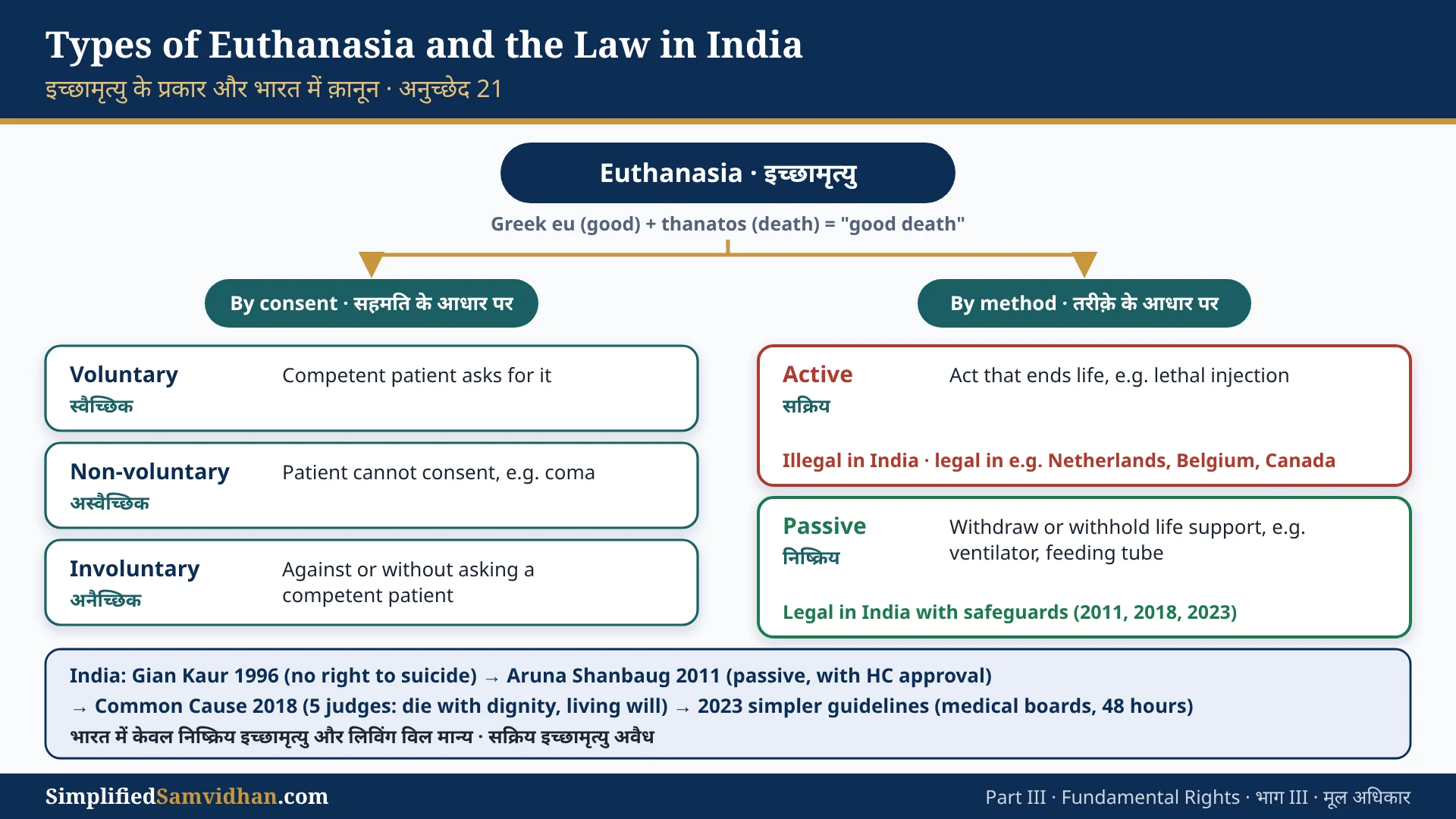
EuthanasiaArticle 21 of Indian Constitution and Euthanasia: Right to Die with Dignity
- Euthanasia comes from the Greek eu (good) and thanatos (death): a "good death". It means ending the life of a person with an incurable illness to end suffering.
Types of euthanasia
| Basis | Type | Meaning |
|---|---|---|
| Consent | Voluntary | A competent patient asks for it |
| Consent | Non-voluntary | The patient cannot give consent, e.g. in a coma; family or doctors decide |
| Consent | Involuntary | Against the wishes of, or without asking, a patient who could consent; treated as homicide almost everywhere |
| Method | Active | A positive act ends life, e.g. a lethal injection. Legal in places such as the Netherlands, Belgium and Canada; several US states allow physician-assisted dying. Not legal in India. |
| Method | Passive | Withdrawing or withholding life support, e.g. switching off a ventilator or stopping a feeding tube. Allowed in India under strict safeguards. |
How the law developed in India
- Gian Kaur v. State of Punjab (1996, 5 judges): Article 21 does not include a right to die by suicide; it overruled P. Rathinam (1994). But the Court noted that dignity in the process of dying is a different matter.
- Aruna Shanbaug v. Union of India (7 March 2011): Aruna, a nurse in Mumbai, had been in a vegetative state since 1973. The Court refused euthanasia for her but allowed passive euthanasia in general, with the approval of the High Court.
- Common Cause v. Union of India (9 March 2018, 5 judges): the right to die with dignity is part of Article 21. Passive euthanasia and the living will (advance medical directive) were recognised, with medical boards to decide.
- 24 January 2023: the Court simplified the guidelines: a living will can be signed before a notary or gazetted officer with two witnesses (no magistrate countersignature); a primary board at the hospital and a secondary board must decide within 48 hours; experts need 5 years' experience instead of 20.
- September 2024: the Union Health Ministry released draft guidelines on withdrawal of life support for terminally ill patients for public comments.
- The Court asked Parliament to make a law. There is still no Act of Parliament on euthanasia; the court guidelines hold the field.
ChallengesEuthanasia under Article 21 of Indian Constitution: Challenges and Way Forward
- Arguments for passive euthanasia and living wills: respect for a patient's own choice (autonomy), ending prolonged suffering, avoiding futile treatment that drains family savings, and dignity at the end of life.
- Arguments for caution: life is valued in most faiths and in medical ethics; palliative care can reduce suffering; a vulnerable person may feel like a burden; and decisions are hard to reverse.
Challenges noted in your class notes
- Poverty and hunger may push families or patients towards it for economic reasons.
- Risk of misuse, for example to hide a crime or for property.
- Low literacy and awareness make living wills hard for most people to write.
- It is not always clear when and how to withdraw life support.
- How to check that consent is truly voluntary is not spelt out in detail.
- It is a sensitive subject touching religion, family and medical ethics.
Way forward (exam view)
- A clear law by Parliament, as the Court suggested, with safeguards against misuse.
- Better palliative care so that no one chooses death for lack of pain relief.
- Simple, local-language living will forms, a record system in hospitals, and training of doctors and medical boards.
- Public awareness, keeping the debate respectful of all views.
Quick RevisionKey Points to Remember
- No person can be deprived of life or personal liberty except according to procedure established by law.
- Gopalan (1950) read it narrowly; Maneka Gandhi (1978) made the procedure "fair, just and reasonable".
- Life means a life with dignity: livelihood, health, environment, privacy, speedy trial, education and more.
- Common Cause (2018): right to die with dignity; passive euthanasia and living wills allowed; active euthanasia is not.
- Protects every person; cannot be suspended in Emergency (44th Amendment 1978).
TimelineArticle 21: Key Cases and Dates
| Year | Event |
|---|---|
| 1950 | A.K. Gopalan: narrow reading of life and procedure. |
| 1976 | ADM Jabalpur: no habeas corpus during Emergency (later overruled). |
| 1978 | Maneka Gandhi (25 Jan): fair, just and reasonable procedure; 44th Amendment protects Art 21 in Emergency. |
| 1979 | Hussainara Khatoon: speedy trial and legal aid. |
| 1985 | Olga Tellis: right to livelihood. |
| 1996 | Gian Kaur: no right to die by suicide. |
| 2011 | Aruna Shanbaug (7 Mar): passive euthanasia with High Court approval. |
| 2017 | Puttaswamy (24 Aug): privacy is a Fundamental Right. |
| 2018 | Common Cause (9 Mar): die with dignity, living will; Aadhaar judgment (26 Sep). |
| 2023 | Living will guidelines simplified (24 Jan). |
| 2024 | Climate change case (Ranjitsinh); draft Health Ministry guidelines on life support (Sep). |
UPSC · State PSC · JudiciaryArticle 21: UPSC Exam Corner
- Prelims trap: "India follows due process of law under Article 21." The text says "procedure established by law"; after Maneka Gandhi courts apply a due-process-like fairness test.
- Prelims trap: "Article 21 includes the right to commit suicide." False (Gian Kaur, 1996). The right to die with dignity (Common Cause, 2018) is different.
- Prelims fact: The phrase "procedure established by law" comes from the Japanese Constitution.
- Mains (from Gaurav's notes): Distinguish between the right to life and personal liberty, and explain how the judiciary has expanded them.
- Practice (250 words): Examine the legal position of euthanasia in India and the challenges in implementing living wills.
Practice MCQTest Yourself: Article 21
Consider the following statements about Article 21: 1. The phrase "procedure established by law" was taken from the Japanese Constitution. 2. In Maneka Gandhi (1978) the Court held that the procedure must be fair, just and reasonable. 3. Active euthanasia is permitted in India under the Common Cause judgment. Which are correct?
Doubts ClearedFrequently Asked Questions
What is Article 21 of Indian Constitution?
Article 21 says no person shall be deprived of life or personal liberty except according to procedure established by law. The Supreme Court has read it to mean a right to live with dignity.
What is the difference between due process of law and procedure established by law?
Under due process (USA), courts check both the procedure and whether the law itself is fair. Under procedure established by law (India's text, from Japan), courts check that a valid law and its procedure were followed. Since Maneka Gandhi (1978), Indian courts also require the procedure to be fair, just and reasonable.
Is euthanasia legal in India?
Passive euthanasia (withdrawing life support) and living wills are legal under Common Cause v. Union of India (2018), with simpler guidelines from 24 January 2023. Active euthanasia, such as a lethal injection, is not legal.
Is the right to privacy a Fundamental Right?
Yes. In K.S. Puttaswamy v. Union of India (24 August 2017) a nine-judge bench unanimously held that privacy is a Fundamental Right, mainly under Article 21 and also Part III as a whole.
Is Article 21 available to foreigners?
Yes. It uses the word "person", so it protects citizens and foreigners alike.