Bare ActOfficial Text of Article 12
12. Definition.—
In this Part, unless the context otherwise requires, "the State" includes the Government and Parliament of India and the Government and the Legislature of each of the States and all local or other authorities within the territory of India or under the control of the Government of India.
In everyday talk, "state" means a State like Bihar or Kerala. But for Fundamental Rights, the word "State" has a special, much wider meaning. Article 12 gives that meaning.
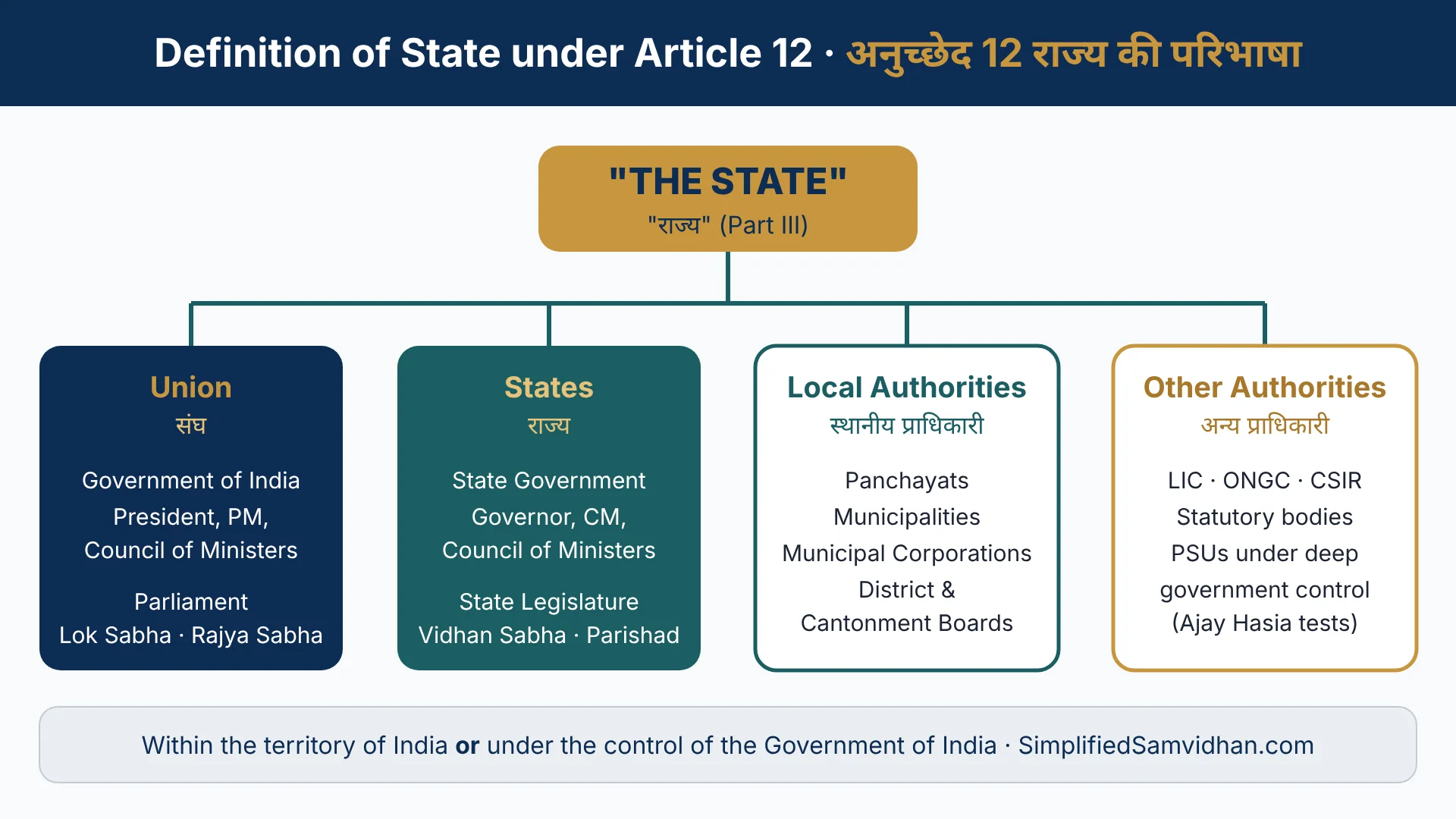
Under Article 12, the State includes every body that uses government power, at the Centre, in the States and at the local level: the Government of India, Parliament, every State Government, every State Legislature, panchayats, municipalities and "other authorities" such as LIC or ONGC.
Why does this matter? Most Fundamental Rights (like equality in Article 14) can be enforced only against the State. So before you go to court, the first question is: is the body that hurt me "State" under Article 12?
The word "includes" means the list is not closed. That is why the Supreme Court could later decide that public sector companies and government-controlled bodies are also State.
🏠 Everyday Analogy
Think of a school. The school rulebook says "students may not be punished unfairly". Article 12 is the line that says who must follow this rule: not only the Principal, but also every teacher, the hostel warden and the canteen run by the school. A shopkeeper outside the gate is not covered, because he is not part of the school's power.
🇮🇳 Real Indian Example
Riya is refused a job at LIC only because she is a woman. LIC is a statutory corporation owned by the Government, so it is "State" under Article 12, and she can go to the High Court under Article 226 for breach of Articles 14 and 16. If a private company does the same, she must use ordinary labour and anti-discrimination laws instead, because a purely private company is not State.
Who Is IncludedWhat is State under Article 12?
Read Article 12 in four blocks. Everything in these blocks is "State" for Fundamental Rights:
- Union Executive: President, Prime Minister, Union Council of Ministers and all Union departments.
- Union Legislature: Parliament, that is the Lok Sabha and the Rajya Sabha.
- State Executive and Legislature: Governor, Chief Minister, State Council of Ministers, and the Vidhan Sabha (and Vidhan Parishad where it exists).
- Local authorities: Panchayati Raj institutions, municipalities, municipal corporations, district boards, cantonment boards.
- Other authorities: any body that exercises government power, such as statutory corporations (LIC, ONGC), public sector companies, and officials who carry out government power (for example the CAG, a District Magistrate or a Chief Secretary).
Supreme Court Tests"Other Authorities" under Article 12: Is LIC, BCCI or the Judiciary State?
The Constitution does not define "other authorities". The Supreme Court filled the gap step by step:
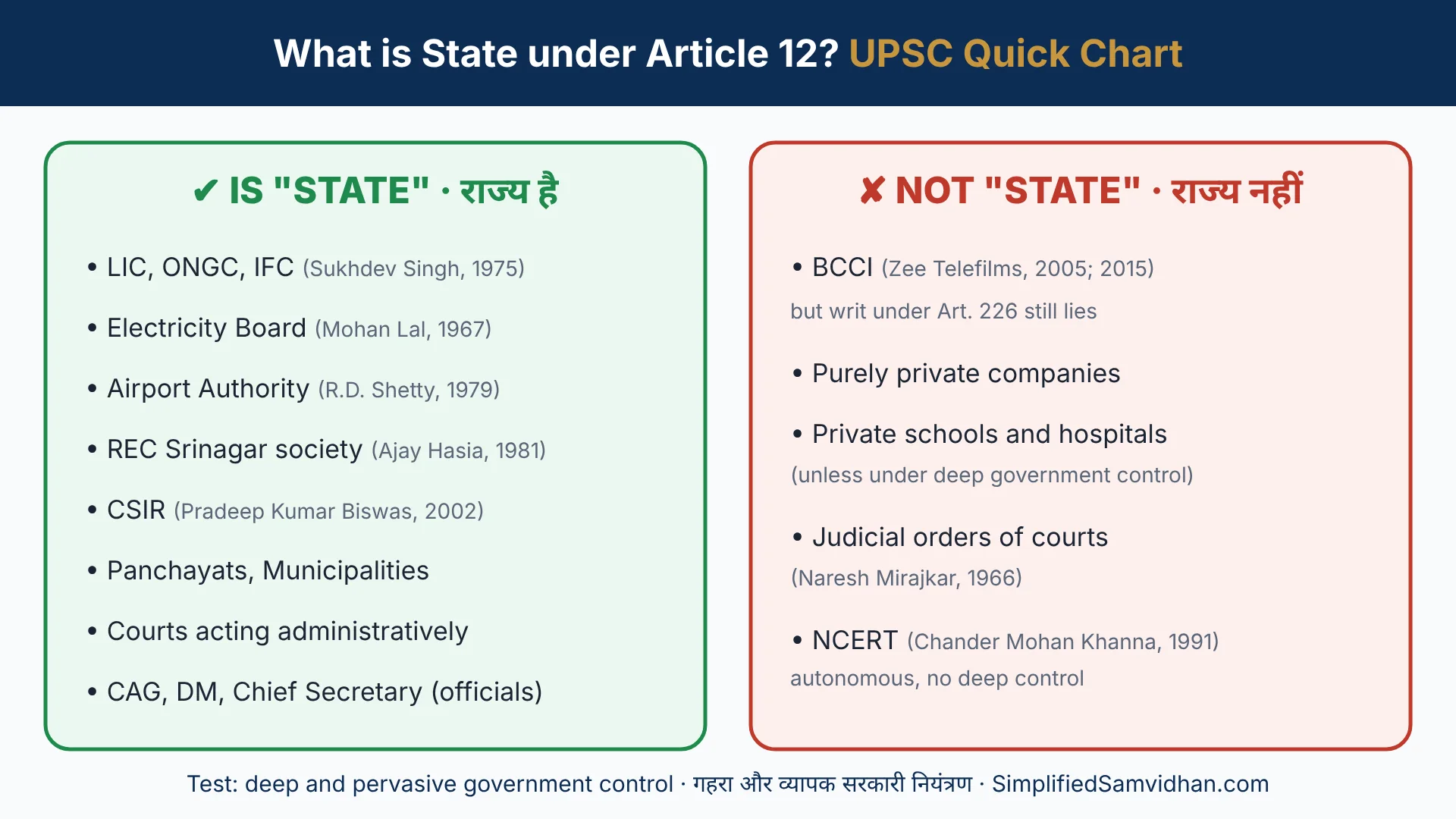
- Rajasthan SEB v. Mohan Lal (1967): any authority created by a law and given power to make binding rules is "other authority". The Electricity Board was State.
- Sukhdev Singh v. Bhagatram (1975): statutory corporations like ONGC, LIC and the Industrial Finance Corporation are State.
- R.D. Shetty v. International Airport Authority (1979): a body that is an instrumentality or agency of the Government is State.
- Ajay Hasia v. Khalid Mujib (1981): gave six tests (below). Even a society registered under the Societies Registration Act can be State.
- Pradeep Kumar Biswas v. IICB (2002): the real test is whether the Government has deep and pervasive control (financial, functional and administrative). CSIR was held to be State.
- Zee Telefilms v. Union of India (2005) and BCCI v. Cricket Association of Bihar (2015): BCCI is not State under Article 12, because the Government neither funds nor controls it. But since it does public functions, a writ can still go to the High Court under Article 226.
The Ajay Hasia tests (any strong mix of these makes a body State)
- The Government holds the entire share capital.
- Government money meets almost all of its expenses.
- It enjoys a monopoly given or protected by the State.
- The State has deep and pervasive control over it.
- Its work is of public importance and closely linked to government functions.
- A government department was transferred to it.
Quick RevisionKey Points to Remember
- Article 12 defines "the State" only for Part III (and Part IV via Article 36).
- It covers the Union and State Governments and Legislatures, local authorities and other authorities.
- "Includes" makes the list open-ended; courts decide new cases.
- Test today: deep and pervasive government control (Pradeep Kumar Biswas, 2002).
- LIC, ONGC, CSIR are State; BCCI and purely private companies are not.
- Judiciary is State only in its administrative role, not for its judgments.
Case Law TimelineHow the Meaning of "State" Grew
| Year | Judgment and holding |
|---|---|
| 1967 | Rajasthan SEB v. Mohan Lal: statutory bodies with rule-making power are "other authorities". |
| 1975 | Sukhdev Singh v. Bhagatram: ONGC, LIC and IFC are State. |
| 1979 | R.D. Shetty: "instrumentality or agency of the Government" test. |
| 1981 | Ajay Hasia: six tests; a registered society can be State. |
| 2002 | Pradeep Kumar Biswas: "deep and pervasive control"; CSIR is State. |
| 2005 | Zee Telefilms: BCCI is not State (confirmed in 2015, BCCI v. Cricket Association of Bihar). |
| 2023 | Kaushal Kishor v. State of U.P.: some rights (Articles 19 and 21) can be enforced even against private persons. |
UPSC · State PSC · JudiciaryArticle 12 of Indian Constitution: UPSC Exam Corner
- Prelims trap: "Judiciary is expressly included in Article 12". False. It is not named; its status depends on the function.
- Mains angle: privatisation shrinks the "State". Courts answer with the public function test and Article 226 writs (e.g. against BCCI).
- Some rights work even against private persons: Articles 15(2), 17, 23 and 24. In Kaushal Kishor (2023) the Court said Articles 19 and 21 can also apply horizontally.
- Article 12 also matters for Article 32: a writ for Fundamental Rights normally lies only against the State.
- Same definition is borrowed by Article 36 for the Directive Principles (Part IV).
Practice MCQTest Yourself: Article 12
Which of the following is NOT included in the definition of "State" under Article 12?
Doubts ClearedFrequently Asked Questions
What is the definition of State under Article 12?
For Part III, "the State" includes the Government and Parliament of India, the Government and Legislature of each State, and all local or other authorities within India or under the control of the Government of India.
Is BCCI State under Article 12?
No. In Zee Telefilms v. Union of India (2005) the Supreme Court held BCCI is not State, as it is not funded or controlled by the Government. In 2015 the Court added that BCCI performs public functions, so it can be challenged by writ under Article 226.
Is the judiciary included in the definition of State?
Not by name. Courts are treated as State when acting administratively (rules, appointments), but their judicial decisions cannot be challenged as violating Fundamental Rights.
Is a private school or private company State?
Usually not. A purely private body is not State. It becomes State only if the Government has deep and pervasive control over it. Some rights, like the ban on untouchability (Article 17), apply to private persons too.