Bare ActOfficial Text of Article 32
Right to Constitutional Remedies
32. Remedies for enforcement of rights conferred by this Part.—(1) The right to move the Supreme Court by appropriate proceedings for the enforcement of the rights conferred by this Part is guaranteed.
(2) The Supreme Court shall have power to issue directions or orders or writs, including writs in the nature of habeas corpus, mandamus, prohibition, quo warranto and certiorari, whichever may be appropriate, for the enforcement of any of the rights conferred by this Part.
(3) Without prejudice to the powers conferred on the Supreme Court by clauses (1) and (2), Parliament may by law empower any other court to exercise within the local limits of its jurisdiction all or any of the powers exercisable by the Supreme Court under clause (2).
(4) The right guaranteed by this article shall not be suspended except as otherwise provided for by this Constitution.
32A. [Constitutional validity of State laws not to be considered in proceedings under article 32.] Omitted by the Constitution (Forty-third Amendment) Act, 1977, s. 3 (w.e.f. 13-4-1978).
A right to protect all rights: Articles 14 to 30 give rights; Article 32 gives the remedy. Without it, rights would be only promises on paper.
Direct entry: you do not have to go to a lower court first. A writ petition can be filed straight in the Supreme Court in Delhi.
Only for Fundamental Rights: for an ordinary legal right (like a contract or a property dispute under Article 300A), Article 32 does not apply; go to the High Court under Article 226.
Five writs: habeas corpus (produce the detained person), mandamus (do your public duty), prohibition (stop a lower court from exceeding its power), certiorari (quash a lower court's order) and quo warranto (by what authority do you hold this public office?). Full details are on our Types of Writs page.
Basic structure: judicial review under Articles 32 and 226 cannot be taken away even by an amendment (L. Chandra Kumar, 1997).
Suspension: only under Article 359 during a National Emergency; never for Articles 20 and 21 since the 44th Amendment 1978.
🏠 Everyday Analogy
Fundamental Rights are like the locks on your house. Article 32 is the emergency number that brings help when someone breaks a lock. A lock without a helpline is not much use; that is why Ambedkar called Article 32 the heart and soul of the Constitution.
🇮🇳 Real Indian Example
In 1979 lawyer Kapila Hingorani read newspaper reports of undertrial prisoners in Bihar who had spent more years in jail than the maximum punishment for their offence. She filed a habeas corpus petition under Article 32 (Hussainara Khatoon v State of Bihar). The Supreme Court ordered the release of thousands of undertrials and declared speedy trial part of Article 21. This case is seen as the start of Public Interest Litigation in India.
How It CameArticle 32 History: Why Ambedkar Called It the Heart and Soul of the Constitution
- In the Draft Constitution it was Article 25. On 9 December 1948 Dr. Ambedkar told the Constituent Assembly: "If I was asked to name any particular article in this Constitution as the most important ... I could not refer to any other article except this one. It is the very soul of the Constitution and the very heart of it."
- The idea of writs came from English law, where courts issued "prerogative writs" in the King's name.
- 1950: in Romesh Thappar v State of Madras the Supreme Court called itself the "protector and guarantor" of Fundamental Rights, a "sentinel on the qui vive" (always on guard).
- 1976, the dark chapter: during the Emergency, in ADM Jabalpur v Shivkant Shukla (4:1), the Court held that no one could file habeas corpus while Article 21 was suspended. Justice H.R. Khanna dissented alone. The 44th Amendment 1978 made Articles 20 and 21 non-suspendable, and the nine-judge Puttaswamy Bench (2017) declared ADM Jabalpur wrong.
- 1980s: letters and postcards to judges were treated as writ petitions, and S.P. Gupta (1981) allowed any public-spirited person to file for those who cannot approach the Court: this became PIL.
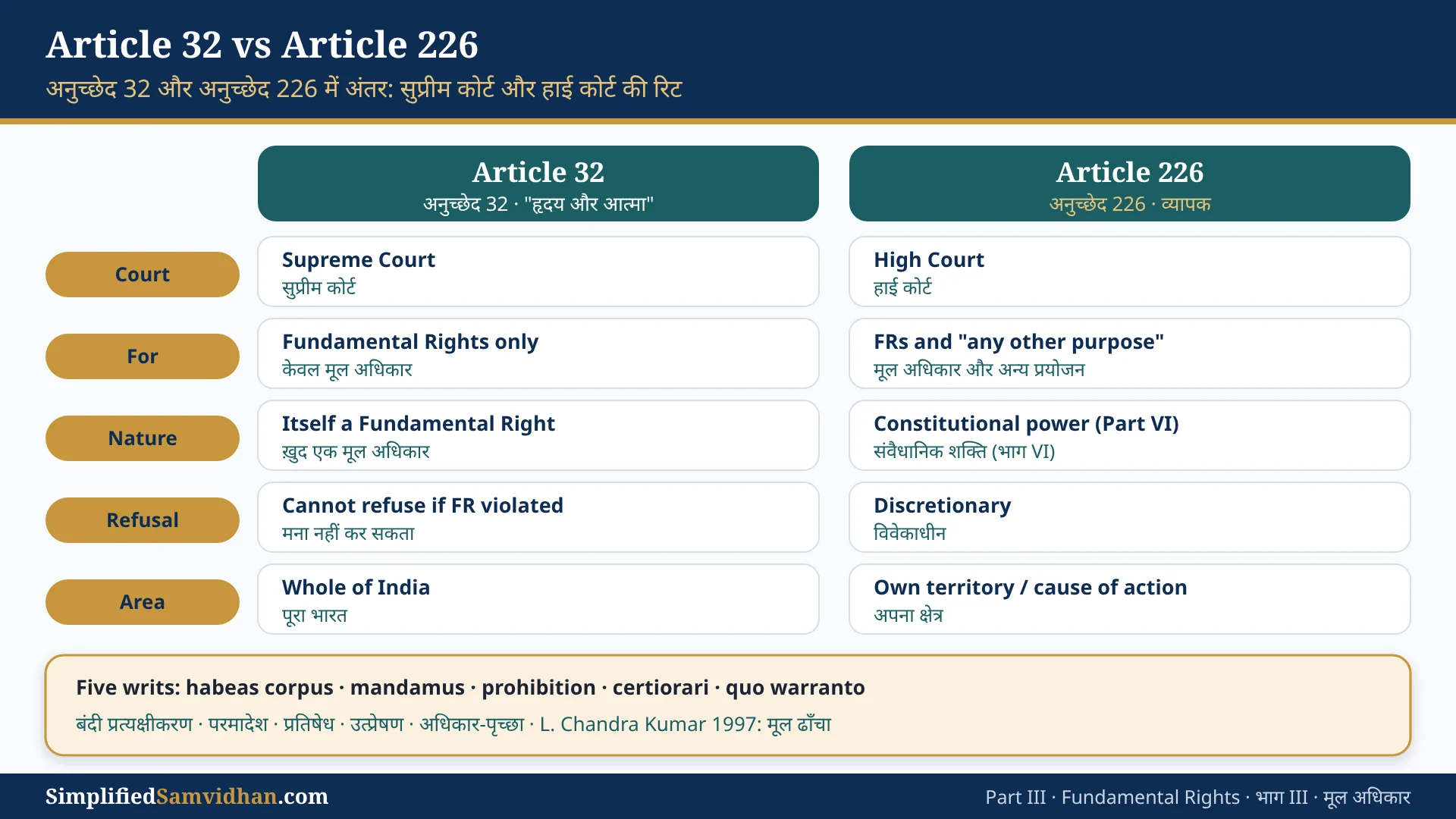
Article 32 vs 226Difference Between Article 32 and Article 226 of Indian Constitution
| Point | Article 32 | Article 226 |
|---|---|---|
| Court | Supreme Court | High Court |
| For what | Only Fundamental Rights | Fundamental Rights and any other purpose (legal rights) |
| Is it a Fundamental Right? | Yes, itself in Part III | No, a constitutional power in Part VI |
| Can the court refuse? | Should not refuse if a Fundamental Right is violated | Discretionary; can refuse |
| Territory | Whole of India | Within its territory or where the cause of action arises |
| In an Emergency (Art 359) | Suspended for the named Fundamental Rights | Same bar for those rights, but still open for other legal rights |
Key CasesArticle 32 Landmark Cases You Should Know
- Rudul Sah v State of Bihar (1983): a man kept in jail 14 years after acquittal got monetary compensation under Article 32; Nilabati Behera (1993) confirmed compensation for custodial death.
- Vishaka v State of Rajasthan (1997): under Article 32 the Court framed guidelines against sexual harassment at work until Parliament passed the POSH Act, 2013.
- L. Chandra Kumar v Union of India (1997): the power of judicial review under Articles 32 and 226 is part of the basic structure.
- Rupa Ashok Hurra v Ashok Hurra (2002): created the curative petition, a last remedy after a review petition fails.
- Practical rule: the Supreme Court often asks petitioners to go to the High Court first, as Article 226 is wider and closer, but it cannot refuse merely because another remedy exists when a Fundamental Right is clearly violated.
Quick RevisionKey Points to Remember
- Article 32 is itself a Fundamental Right: the right to move the Supreme Court.
- Five writs: habeas corpus, mandamus, prohibition, quo warranto, certiorari.
- Ambedkar: "the very soul of the Constitution and the very heart of it".
- 32(3): Parliament may empower other courts; no such law has been made.
- Suspension only under Article 359; never for Articles 20 and 21.
- Article 32A (42nd Amendment) was omitted by the 43rd Amendment 1977.
TimelineArticle 32: Key Dates and Cases
| Year | Event |
|---|---|
| 1948 | Ambedkar calls draft Article 25 the "heart and soul" of the Constitution (9 December). |
| 1950 | Romesh Thappar: Supreme Court the "sentinel on the qui vive". |
| 1976 | ADM Jabalpur (no habeas corpus in Emergency); 42nd Amendment adds Article 32A. |
| 1978 | 43rd Amendment omits 32A (13 April); 44th makes Articles 20 and 21 non-suspendable. |
| 1979-81 | Hussainara Khatoon and S.P. Gupta: birth of PIL. |
| 1997 | L. Chandra Kumar: judicial review under 32 and 226 is basic structure. |
| 2017 | Puttaswamy (9 judges) declares ADM Jabalpur wrong. |
UPSC · State PSC · JudiciaryArticle 32: UPSC Exam Corner
- Prelims fact: Ambedkar called Article 32 (not the Preamble or Article 21) the heart and soul of the Constitution.
- Prelims trap: "The writ jurisdiction of the Supreme Court is wider than that of High Courts." False. Article 226 is wider ("any other purpose").
- Mains (150 words): "A right without a remedy is meaningless." Explain the role of Article 32 and PIL in protecting Fundamental Rights.
Practice MCQTest Yourself: Article 32
Consider: 1. Article 32 can be used to enforce any legal right. 2. The High Courts' writ jurisdiction under Article 226 is wider than that of the Supreme Court under Article 32. 3. Article 32 cannot be suspended for Articles 20 and 21 even during an Emergency. Which are correct?
Doubts ClearedFrequently Asked Questions
What is Article 32 of Indian Constitution?
Article 32 guarantees the right to move the Supreme Court for enforcing Fundamental Rights. The Court can issue directions, orders and writs such as habeas corpus and mandamus. It is itself a Fundamental Right.
Who called Article 32 the heart and soul of the Constitution?
Dr. B.R. Ambedkar, in the Constituent Assembly on 9 December 1948, while discussing draft Article 25.
What was Article 32A?
Article 32A, added by the 42nd Amendment 1976, barred the Supreme Court from deciding the validity of State laws in Article 32 cases. It was omitted by the 43rd Amendment 1977 from 13 April 1978.