Jantar Mantar Protest Ban: Right to Protest Under Article 19 and Section 163 BNSS
On 11 October 2026 the Delhi Police removed Jantar Mantar from the list of official protest venues. Can the government decide where citizens protest? Here is the balance between the right to assemble and public order, in plain language.
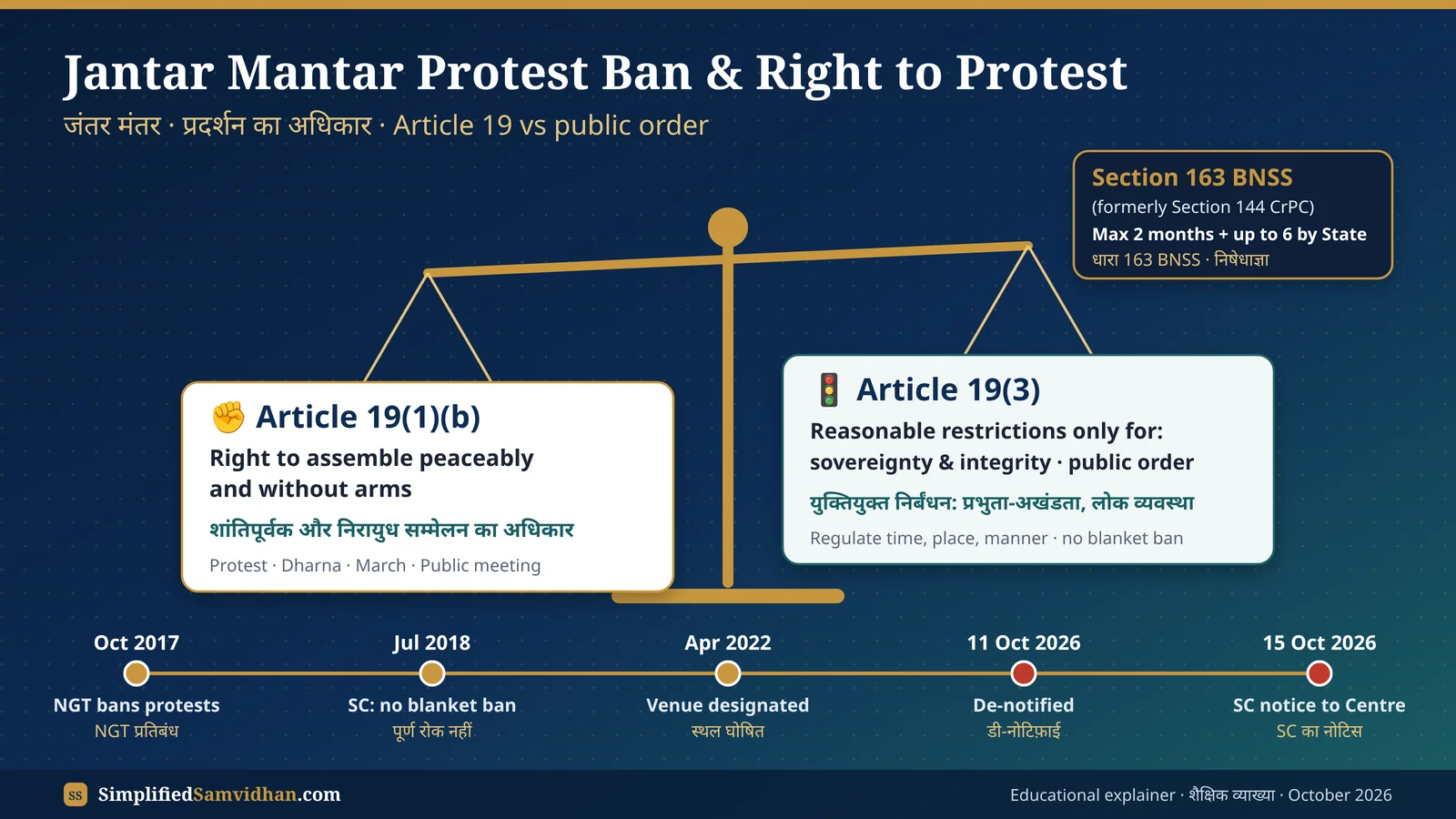
What happened in October 2026
Through a standing order dated 11 October 2026, signed by Delhi Police Commissioner Anurag Kumar, Jantar Mantar was de-notified as a designated protest venue. The order partly modifies an April 2022 order and was based on recommendations of a committee set up by the Union Ministry of Home Affairs. Three venues were designated instead: Ramlila Ground (Old Delhi), CBD Ground (East Delhi) and Burari Ground (North Delhi); revised SOPs are to be issued separately.
The decision came amid daily protests by a youth group (the Cockroach Janta Party) and opposition parties demanding the resignation of the Chief Election Commissioner over electoral-roll revisions. Permission for a 10 October protest at Jantar Mantar was refused and a Section 163 BNSS order was in force around the area. On 9 October a Supreme Court bench led by CJI Surya Kant had remarked that it was "high time" another place with amenities be identified for peaceful protesters. On 15 October 2026 the Supreme Court issued notice to the Centre, asking whether the de-notification was based on the Court's remarks or on an independent application of mind; the Solicitor General said the Court's order was not the basis. The matter is pending.
BackgroundJantar Mantar: How It Became Delhi's Protest Address
| Year | What happened |
|---|---|
| 1990s | Large rallies at the Boat Club lawns near Parliament were stopped; Jantar Mantar Road became the main protest venue in New Delhi. |
| Oct 2017 | The National Green Tribunal banned protests on Jantar Mantar Road over noise, sanitation and use of public space, and asked that protesters be shifted to Ramlila Maidan. |
| 23 Jul 2018 | Supreme Court, Mazdoor Kisan Shakti Sangathan v. Union of India: a blanket ban is not allowed; Delhi Police must frame guidelines for regulated use of Jantar Mantar and the Boat Club. |
| 28 Apr 2022 | Delhi Police order designating Jantar Mantar as a protest venue (now partly modified). |
| 9 Oct 2026 | Supreme Court (CJI Surya Kant, Justices Bagchi and Mohana) says another place with amenities for peaceful protesters should be identified. |
| 11 Oct 2026 | Standing order de-notifies Jantar Mantar; Ramlila, CBD and Burari Grounds designated. Same day, special Supreme Court sitting bars detention except by procedure established by law. |
| 13 Oct 2026 | Delhi Police tell the Delhi High Court the decision followed the Supreme Court's order; protest leaders who crossed barricades at Jantar Mantar are detained. |
| 15 Oct 2026 | Supreme Court issues notice to the Centre on the basis of the de-notification. Pending. |
Official TextRight to Protest: Article 19(1)(b) and Article 19(3)
19. Protection of certain rights regarding freedom of speech, etc.
(1) All citizens shall have the right—
(b) to assemble peaceably and without arms;
(3) Nothing in sub-clause (b) of the said clause shall affect the operation of any existing law in so far as it imposes, or prevent the State from making any law imposing, in the interests of the sovereignty and integrity of India or public order, reasonable restrictions on the exercise of the right conferred by the said sub-clause.
Every citizen can gather with others to protest, march or hold a meeting, as long as it is peaceful and without arms. But the right is not unlimited: the State may make laws placing reasonable restrictions on it, and only for two reasons, the sovereignty and integrity of India or public order. "Reasonable" means the restriction must be fair, necessary and no more than needed.
🏠 Everyday analogy
A housing society cannot ban residents from holding a meeting in the community hall. It can fix timings, limit loudspeakers and keep the gate clear for ambulances. Regulating is fine; abolishing is not.
🇮🇳 Real Indian example
Farmers, students and teachers have used Jantar Mantar for decades to raise demands before Parliament. In 2018 the Supreme Court held that the police may regulate such protests but cannot ban them altogether.
The Comparative SplitArticle 19(1)(b) vs Article 19(3): Balancing Liberty and Public Order
✊ Article 19(1)(b): The Right
- Right to assemble peaceably and without arms.
- Covers protests, dharnas, marches, public meetings and candle-light vigils.
- Linked with free speech: a demonstration is a form of expression (Kameshwar Prasad v. State of Bihar, 1962).
- The State cannot impose a total ban on meetings in public streets (Himat Lal K. Shah, 1973).
- Protesters' rights include dignity and safety; a midnight crackdown on sleeping protesters was held unlawful (Ramlila Maidan Incident, 2012).
🚦 Article 19(3): The Limits
- Only two grounds: sovereignty and integrity of India or public order.
- Restrictions must be reasonable: necessary, proportionate and the least restrictive option.
- Public roads cannot be occupied indefinitely; protests can be confined to designated places (Amit Sahni v. Commissioner of Police, 2020, Shaheen Bagh).
- No right to violence, blocking ambulances or damaging property.
- Police may fix time, place and manner, but cannot use regulation as a disguised ban (Mazdoor Kisan Shakti Sangathan, 2018).
Think of a cricket match. Article 19(1)(b) is the batsman's right to play his shots. Article 19(3) is the boundary rope and the rules. The umpire (the State) can stop dangerous play, but cannot simply take away the bat. And the third umpire (the courts) checks whether the decision was fair.
🏠 Everyday analogy
A school allows a students' assembly in the ground, but not on the main road outside the gate during school bus hours. Same right, different place and time.
🇮🇳 Real Indian example
In the Shaheen Bagh case (2020), the Supreme Court said protests are welcome but a public road cannot be blocked indefinitely; the administration must keep roads clear while allowing protest at designated sites.
Official TextSection 163 BNSS (Formerly Section 144 CrPC): Prohibitory Orders
163. Power to issue order in urgent cases of nuisance or apprehended danger.
(1) In cases where, in the opinion of a District Magistrate, a Sub-divisional Magistrate or any other Executive Magistrate specially empowered by the State Government in this behalf, there is sufficient ground for proceeding under this section and immediate prevention or speedy remedy is desirable, such Magistrate may, by a written order stating the material facts of the case and served in the manner provided by section 153, direct any person to abstain from a certain act or to take certain order with respect to certain property in his possession or under his management, if such Magistrate considers that such direction is likely to prevent, or tends to prevent, obstruction, annoyance or injury to any person lawfully employed, or danger to human life, health or safety, or a disturbance of the public tranquillity, or a riot, or an affray.
(3) An order under this section may be directed to a particular individual, or to persons residing in a particular place or area, or to the public generally when frequenting or visiting a particular place or area.
(4) No order under this section shall remain in force for more than two months from the making thereof:
Provided that, if the State Government considers it necessary so to do for preventing danger to human life, health or safety or for preventing a riot or any affray, it may, by notification, direct that an order made by a Magistrate under this section shall remain in force for such further period not exceeding six months from the date on which the order made by the Magistrate would have, but for such order, expired, as it may specify in the said notification.
The old Section 144 CrPC is now Section 163 of the Bharatiya Nagarik Suraksha Sanhita (BNSS), in force since 1 July 2024. It lets a District Magistrate, Sub-divisional Magistrate or a specially empowered Executive Magistrate issue an urgent written order to prevent danger, riots or disturbance of public peace, for example banning gatherings of people in an area. The order must state the material facts, can last at most two months, and the State Government can extend it by up to six more months only to prevent danger to life or a riot.
Disobeying such an order is an offence under Section 223 of the Bharatiya Nyaya Sanhita (old Section 188 IPC). In Delhi, which has a Police Commissioner system, senior police officers act as Executive Magistrates, so these orders are usually issued by the police.
🏠 Everyday analogy
When a building is on fire, the fire officer can stop everyone from entering the street at once, without waiting for a court. But he cannot keep the street closed for a year once the fire is out.
🇮🇳 Real Indian example
In Anuradha Bhasin v. Union of India (2020) the Supreme Court held that Section 144 orders must be reasoned, published, proportionate and open to court review, and cannot be used repeatedly to suppress legitimate expression. These tests now apply to Section 163 BNSS.
Correction to a common error: there is no "Section 144 BNSS" prohibitory order. In the new code, Section 144 BNSS deals with maintenance of wives, children and parents (old Section 125 CrPC). The prohibitory-order power is Section 163 BNSS.
Statutory PowersDelhi Police Act, 1978: Who Decides Where People Can Protest in Delhi
Besides BNSS, the Delhi Police draw power from Chapter IV of the Delhi Police Act, 1978:
- Section 28: power to make regulations for regulating traffic and preserving order in public places, including assemblies and processions.
- Section 29: power to give directions to the public.
- Section 30: power to prohibit certain acts for prevention of disorder.
- Section 31: police to provide against disorder at places of public amusement, public assembly or meeting.
- Section 32: power to stop music, sound or noise, which is why loudspeakers need permission.
Designating or de-notifying a protest venue is an executive decision taken under these powers through standing orders and SOPs. Because "police" and "public order" in Delhi are handled by the Centre through the Lieutenant Governor and the Ministry of Home Affairs, the MHA committee's role was significant. Like every executive action affecting a Fundamental Right, the decision is open to judicial review on the tests of reasonableness and proportionality, which is what the Supreme Court is now examining.
How Courts DecideIs the Jantar Mantar Ban Legal? The Proportionality Test
Courts test such restrictions with the four-step proportionality standard used in Anuradha Bhasin (2020) and earlier in Modern Dental College (2016):
- 1Legitimate aim
Is the restriction for public order or sovereignty and integrity, the only grounds in Article 19(3)?
- 2Suitable means
Does moving protests away from Jantar Mantar actually help achieve that aim?
- 3Necessity
Is there a less restrictive option, such as regulating numbers, timings or noise at Jantar Mantar itself?
- 4Balance
Do the new venues (distance, amenities, cost, visibility to Parliament) still allow a meaningful protest?
The legal question is not whether protests can be regulated (they can), but whether removing the most accessible site and offering places far from the seat of power is a reasonable regulation or a disguised ban. The Supreme Court's answer is awaited. Until then, the de-notification stands and protests need police permission at the designated venues.
🏠 Everyday analogy
If a market committee shifts the weekly bazaar from the town centre to a field outside the town, vendors can still sell, but far fewer buyers come. Whether that is fair depends on why it was done and what facilities the new field has.
🇮🇳 Real Indian example
Critics told the Court that the Ramlila Maidan option carries a booking cost, while the Supreme Court itself on 9 October listed toilets, drinking water, medical help and emergency access as minimum amenities for any protest site.
UPSC CornerRight to Protest for UPSC Prelims and Mains
- Prelims fact: Article 19(3) has only two grounds for restricting assembly: sovereignty and integrity of India (added by the 16th Amendment, 1963) and public order.
- Prelims fact: Section 163 BNSS order: max 2 months; State extension up to 6 more months.
- Prelims fact: The right under Article 19 is available only to citizens, not foreigners.
- Mains (250 words): "The right to protest is integral to democracy, but it cannot be exercised at any place and at any time." Examine with reference to Shaheen Bagh (2020), Mazdoor Kisan Shakti Sangathan (2018) and the Jantar Mantar de-notification (2026).
- Essay angle: Public space as a democratic commons: who owns the street?
Practice MCQTest Yourself: Jantar Mantar Protest Ban
With reference to the right to protest in India, consider the following statements: (1) Article 19(3) permits reasonable restrictions on the right to assemble only in the interests of the sovereignty and integrity of India or public order. (2) A magistrate's order under Section 163 of the BNSS cannot remain in force for more than two months unless the State Government extends it by notification. (3) In Mazdoor Kisan Shakti Sangathan v. Union of India (2018), the Supreme Court upheld a complete ban on protests in central Delhi. Which of the statements given above is/are correct?
Doubts ClearedFrequently Asked Questions
Why was Jantar Mantar de-notified as a protest site?
A Delhi Police standing order of 11 October 2026 de-notified Jantar Mantar on the recommendations of a committee set up by the Ministry of Home Affairs and designated Ramlila Ground, CBD Ground and Burari Ground instead. The Supreme Court has asked the Centre to explain the basis of the decision; the matter is pending.
Is protest a Fundamental Right in India?
Yes. Article 19(1)(a) and 19(1)(b) protect the right to protest peacefully and without arms. Under Article 19(3), the State can impose reasonable restrictions in the interests of the sovereignty and integrity of India or public order.
What is Section 163 BNSS?
Section 163 of the Bharatiya Nagarik Suraksha Sanhita, 2023 replaced Section 144 CrPC. It allows a District Magistrate, Sub-divisional Magistrate or a specially empowered Executive Magistrate to issue urgent prohibitory orders to prevent danger or disturbance, valid for up to two months, extendable by the State by six months.
Can the police ban all protests in Delhi?
No. In Mazdoor Kisan Shakti Sangathan v. Union of India (2018) the Supreme Court held that a blanket ban is impermissible; protests can be regulated by time, place and manner but not prohibited altogether.
Where can people protest in Delhi now?
After the 11 October 2026 order, the designated venues are Ramlila Ground, CBD Ground and Burari Ground, subject to police permission and SOPs to be issued separately.
Sources and further readingSources We Checked
News facts on this page were checked against the reports below on 15 October 2026. Court cases are pending and may change.
- Outlook, 12 Oct 2026: Jantar Mantar de-notified as protest site: who decides where people can protest?
- The Quint, 12 Oct 2026: Jantar Mantar de-notified after MHA committee recommendations
- LiveLaw, 11 Oct 2026: Supreme Court directs no illegal detention of peaceful protesters
- Bar & Bench, 15 Oct 2026: Was our order relied upon to de-notify Jantar Mantar? Supreme Court seeks Centre's response
- Al Jazeera, 13 Oct 2026: Police detain protest leaders at Jantar Mantar
- India Code: The Delhi Police Act, 1978