RTI Application Format: How to Write an RTI Application (Free Sample)
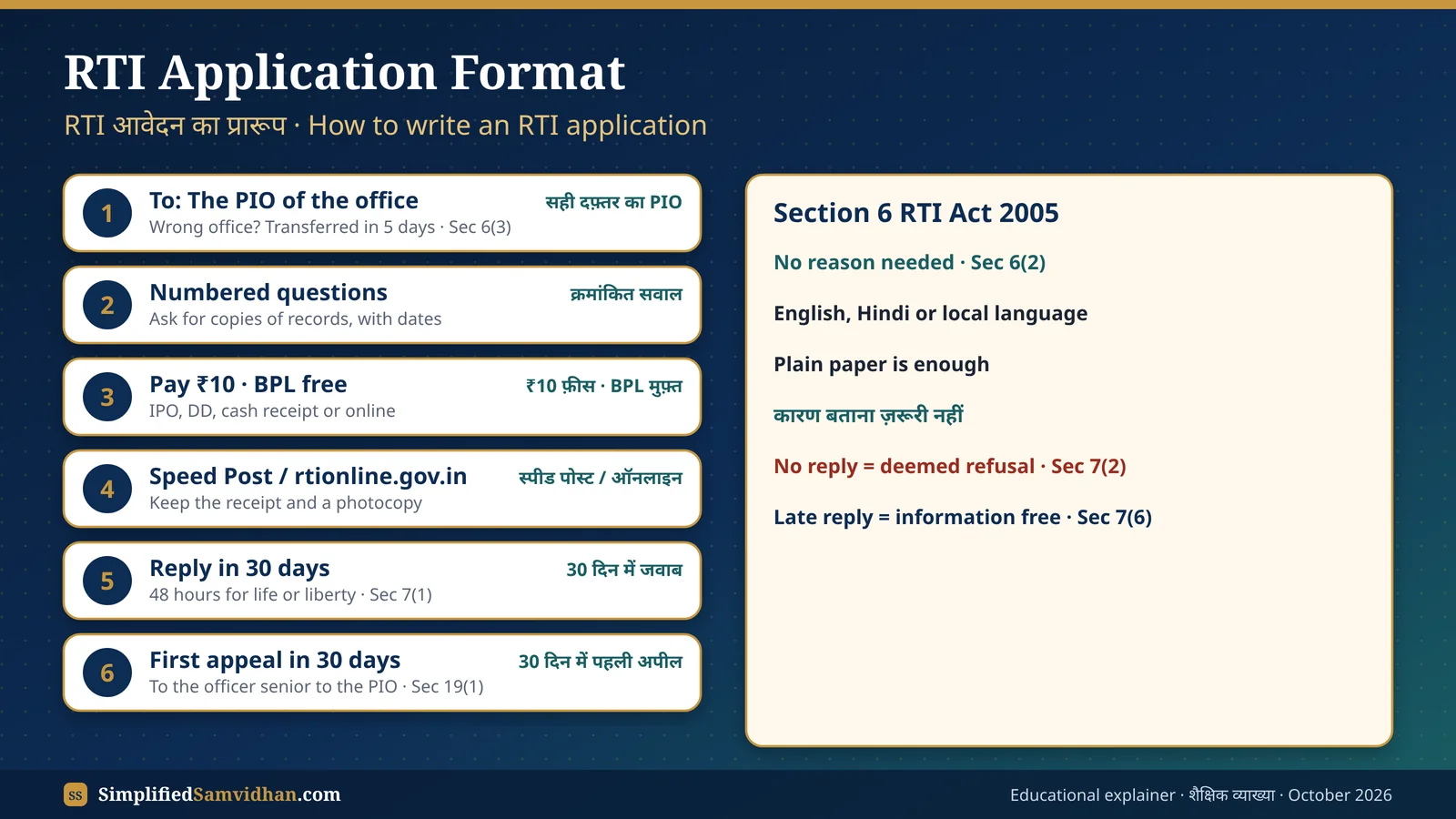
One page, ₹10 and the right address: that is all an RTI needs. Copy the format below, fill five blanks and get official records in 30 days.
Step by stepHow to Write an RTI Application: 6 Steps
- 1
🏢 Find the right office and its PIO
Every government office, panchayat, municipality, police station, government school and hospital has a Public Information Officer (PIO). Address the application to "The Public Information Officer" of that office. If you send it to the wrong office, the PIO must transfer it within 5 days (Section 6(3)).
- 2
✍️ Write short, numbered questions
Ask for documents and records (copies of bills, measurement books, attendance, file notings), not opinions or "why" questions. Give the period (for example 1 April 2024 to 31 March 2026). One subject per application works best.
- 3
💳 Pay the ₹10 fee (BPL free)
Under the Central RTI Rules, 2012 the fee is ₹10: Indian Postal Order, demand draft, cash with receipt, or online. Most States also charge ₹10. BPL card holders pay nothing; attach a copy of the card. Photocopies cost ₹2 a page.
- 4
📮 Send by Speed Post or file online
Hand it over and take a stamped receiving copy, or send by Speed Post / registered post and keep the receipt. For Central Government offices use rtionline.gov.in; many States run their own RTI portals.
- 5
⏱️ Count 30 days (48 hours for life or liberty)
The PIO must reply within 30 days (35 days if given to an Assistant PIO). If the information concerns someone's life or liberty, the limit is 48 hours. No reply in time is treated as refusal (Section 7(2)), and information given late must then be free (Section 7(6)).
- 6
⚖️ No reply? File the first appeal
Within 30 days appeal to the First Appellate Authority, the officer senior to the PIO in the same office. Our RTI first appeal guide has a ready format.
Free formatRTI Application Format (Sample to Copy)
Fill the blanks, sign it, attach the ₹10 postal order and keep a photocopy.
To,
The Public Information Officer,
Office of the __________________ (name of office)
__________________ (address)

Subject: Application under Section 6(1) of the Right to Information Act, 2005

Sir / Madam,
Please provide the following information for the period __/__/____ to __/__/____:
1. Certified copy of ______________________________________________
2. Certified copy of ______________________________________________
3. Details of ____________________________________ with dates and amounts.
4. Name and designation of the officer responsible for ____________________.

I am paying the application fee of Rs 10 by IPO / DD / online, No. __________, dated __________.
(OR: I belong to the BPL category; a copy of my BPL card is attached.)
I request that the information be sent by post to the address below. If any part of the
information is held by another public authority, kindly transfer this application under
Section 6(3) and inform me.

Name: __________________
Address: __________________________________________
Mobile / Email: __________________
Date: __/__/2026                         Signature: __________
ExamplesRTI Questions That Work: 5 Real Examples
| You want to know | Write this question | Send to the PIO of |
|---|---|---|
| Why your ration was cut | Copy of the order and file notings by which my ration card No. ___ was cancelled | District Supply Office |
| Status of your pension | Daily progress report on my pension application dated ___, with names of officers it went to | Social Welfare Department |
| Road work in your ward | Copies of estimate, measurement book and bills of the road work in ward ___ | Gram Panchayat / Municipality |
| Your FIR investigation | Copy of the action-taken report on FIR No. ___ dated ___ | Superintendent of Police office |
| Teacher vacancies in your school | Sanctioned and filled teacher posts in Government School ___ as on today | District Education Office |
The lawSection 6 and Section 7 of the RTI Act 2005
Right to Information Act, 2005 · Section 6(1). A person, who desires to obtain any information under this Act, shall make a request in writing or through electronic means in English or Hindi or in the official language of the area in which the application is being made, accompanying such fee as may be prescribed, to (a) the Central Public Information Officer or State Public Information Officer, as the case may be, of the concerned public authority; …
Section 6(2). An applicant making request for information shall not be required to give any reason for requesting the information or any other personal details except those that may be necessary for contacting him.
Section 7(1). … the Central Public Information Officer or State Public Information Officer, as the case may be, on receipt of a request under section 6 shall, as expeditiously as possible, and in any case within thirty days of the receipt of the request, either provide the information on payment of such fee as may be prescribed or reject the request for any of the reasons specified in sections 8 and 9: Provided that where the information sought for concerns the life or liberty of a person, the same shall be provided within forty-eight hours of the receipt of the request.
The law asks for very little: a written request, the right office, ₹10, and your address. You do not need a lawyer, a stamp paper, an affidavit or a reason. The officer must answer in 30 days, or in 48 hours if someone's life or freedom is at stake.
🏠 Everyday analogy
An RTI application is like a library slip. You write the book's name and hand it to the librarian; the librarian does not ask why you want to read it.
🇮🇳 Real Indian example
A farmer in Dausa writes one page asking the Tehsil office for copies of the crop-loss survey of his village for kharif 2025. In 30 days he gets the list and finds his field was left out.
ConstitutionRight to Information and the Constitution
RTI is a law of Parliament, but its roots are in the Constitution:
Article 19(1)(a): Right to know
The Supreme Court has held that freedom of speech includes the right to receive information (State of UP v. Raj Narain, 1975). The RTI Act puts that right into practice.
Article 21: Life with dignity
Information about rations, pensions, hospitals and police custody touches life and liberty, which is why such requests get a 48-hour limit.
Practice MCQTest Yourself: RTI Application
Under the RTI Act, 2005, which of the following is NOT required from a person seeking information?
Doubts ClearedFrequently Asked Questions
What is the format of an RTI application?
There is no fixed form under the Central Act. A plain paper addressed to the PIO, with numbered questions, the ₹10 fee and your address, is enough. Some States prescribe a simple form.
Can I write an RTI application in Hindi?
Yes. Section 6(1) allows English, Hindi or the official language of the area.
How much is the RTI fee?
₹10 for Central Government offices and in most States. BPL card holders pay no fee. Copies cost ₹2 per page under the Central rules.
How many days does the PIO have to reply?
30 days from receipt, 35 days if given to an Assistant PIO, and 48 hours where the information concerns life or liberty.
Can I file RTI online?
Yes, at rtionline.gov.in for Central Government offices. Many States have their own RTI portals.
Sources and further readingSources We Checked
Facts checked on 23 October 2026 against the RTI Act, 2005 and the RTI Rules, 2012. State fees and forms can differ; check your State's RTI rules.