Digital Arrest Scam: How to File a Cyber Fraud Complaint on 1930 and Get Your Money Back
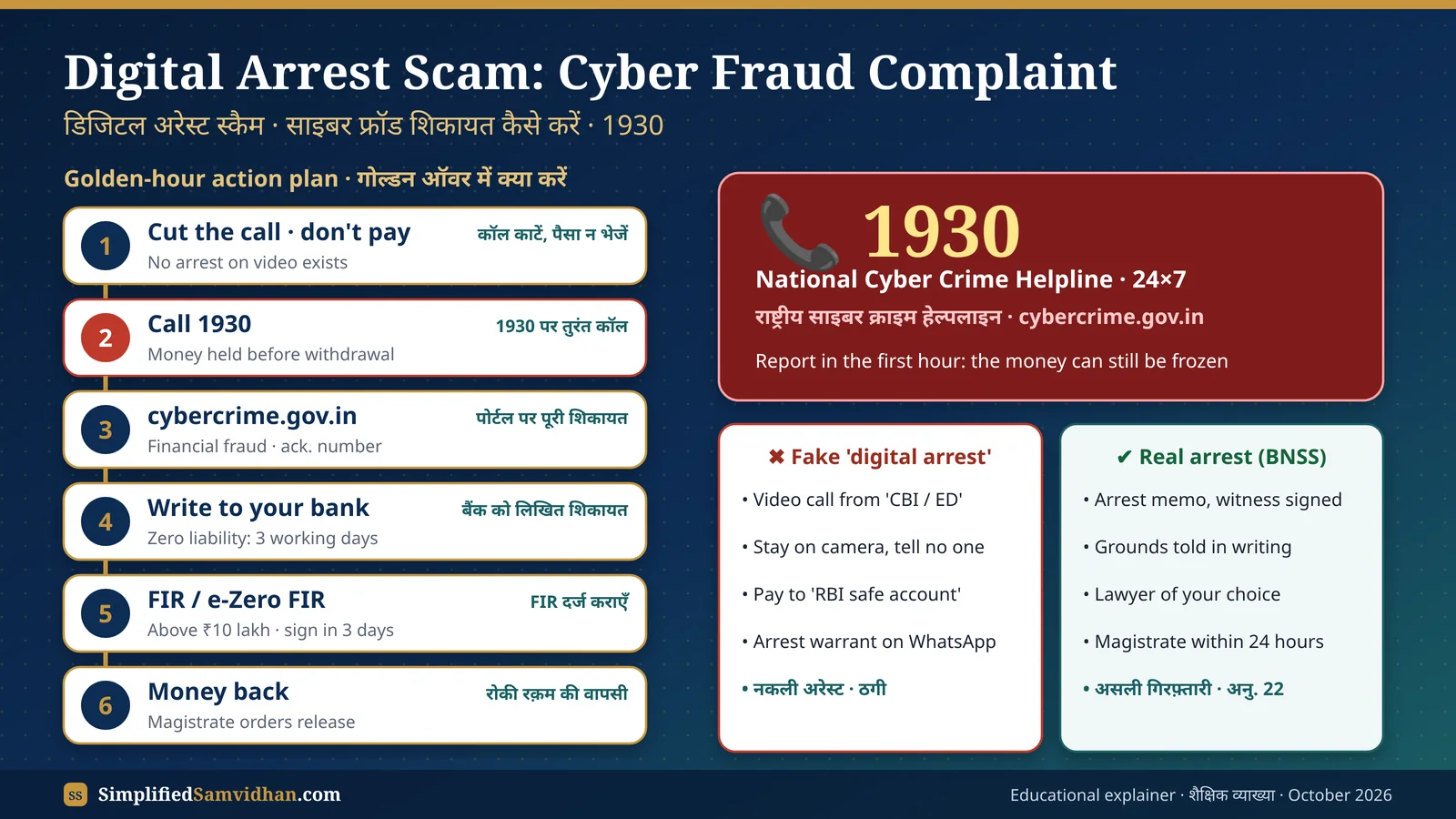
No police officer can arrest you on a video call. If a 'digital arrest' call has already taken your money, these steps in the first hours decide whether you get it back.
Step by stepCyber Fraud Complaint: 7 Steps After a Digital Arrest Scam
Lost money right now? Stop reading and call 1930, or report at cybercrime.gov.in. Every minute counts.
- 1
📵 Cut the call. Do not pay. Tell your family
Police, CBI, ED, customs and RBI never arrest anyone on a video callA real summons or notice can be checked at your local police stationYou are free to disconnect, step out and talk to anyoneNo agency asks you to move money to a 'safe' or 'RBI verification' accountNo officer orders you to stay on camera or keep it secret from familyNo court order or arrest warrant is sent on WhatsApp for payment - 2
☎️ Call 1930 within the golden hour
Call the National Cyber Crime Helpline 1930 as soon as money leaves your account, ideally within the first hour. The operator enters your complaint in the Citizen Financial Cyber Fraud Reporting system, which alerts the banks and wallets that received your money so they can put a hold on it before it is withdrawn. Keep your bank name, transaction ID (UTR) and time ready.
- 3
💻 File the full complaint on cybercrime.gov.in
On the National Cyber Crime Reporting Portal choose Report Cyber Crime → Financial Fraud, log in with your mobile OTP, and upload screenshots, the caller's numbers, the fake 'notice' and every transaction ID. Note the acknowledgement number: you will need it at the bank and the police station. If you already called 1930, give that number so both entries are linked.
- 4
🏦 Tell your bank in writing the same day
Block cards, UPI and net banking, and give the bank a written complaint (draft below) with the acknowledgement number. If money left without your authorisation (hacked account, cloned card), RBI rules give you zero liability when you report within 3 working days. If you were tricked into sending it yourself, recovery comes through the hold placed after your 1930 complaint.
- 5
🚓 Get the FIR (e-Zero FIR for big losses)
Digital arrest fraud is a cognizable offence, so the police must register an FIR, at any police station (Zero FIR, Section 173 BNSS). Where the loss is above ₹10 lakh, the e-Zero FIR system turns your 1930 or portal complaint into an FIR automatically in the states that run it; visit the cyber police station within 3 days to sign it.
- 6
💰 Ask the court to release the frozen money
Money put on hold stays in the receiving account until a Magistrate orders it returned. Apply to the Magistrate with the FIR, the acknowledgement number and the bank's hold letter (the application is usually made under Section 503 BNSS, earlier Section 457 CrPC). Free legal aid is available through your District Legal Services Authority (helpline 15100).
- 7
📲 Report the number so it is blocked for everyone
Report the fraud calls and WhatsApp numbers on Sanchar Saathi (Chakshu) of the Department of Telecommunications, and report the account inside WhatsApp. This helps cut the SIM and the mule accounts that trap the next person.
Spot the scamWhat Is a Digital Arrest Scam? The Script Fraudsters Use
A digital arrest scam is a video-call fraud. Someone poses as police, CBI, ED, customs, TRAI or RBI, says your Aadhaar, phone or a parcel is linked to a crime, and keeps you 'under arrest' on camera for hours or days until you transfer your savings. Indian law has no such thing as a digital arrest.
| What the caller says | The truth |
|---|---|
| 'A parcel in your name has drugs / fake passports.' | Courier firms do not hand you to 'Mumbai police' on a call. Hang up and call the courier's official number. |
| 'Your Aadhaar / SIM is linked to money laundering.' | Investigating agencies send written notices; they do not 'settle' a case over the phone. |
| 'You are under digital arrest. Stay on video.' | There is no 'digital arrest' in Indian law. An arrest needs a physical arrest memo, grounds in writing and a Magistrate within 24 hours. |
| 'Move your savings to an RBI account for verification. It will be refunded.' | RBI does not hold accounts for citizens. Any such account is a mule account of the gang. |
| 'Don't tell anyone, it's a secret national-security case.' | Isolation is the trick. The moment you talk to family or a friend, the scam usually breaks. |
The lawDigital Arrest Fraud Under BNS and the IT Act
Bharatiya Nyaya Sanhita, 2023 · Section 318(1). Cheating. Whoever, by deceiving any person, fraudulently or dishonestly induces the person so deceived to deliver any property to any person, or to consent that any person shall retain any property, or intentionally induces the person so deceived to do or omit to do anything which he would not do or omit if he were not so deceived, and which act or omission causes or is likely to cause damage or harm to that person in body, mind, reputation or property, is said to "cheat".
Section 318(4). Whoever cheats and thereby dishonestly induces the person deceived to deliver any property to any person, or to make, alter or destroy the whole or any part of a valuable security, or anything which is signed or sealed, and which is capable of being converted into a valuable security, shall be punished with imprisonment of either description for a term which may extend to seven years, and shall also be liable to fine.
Information Technology Act, 2000 · Section 66D. Punishment for cheating by personation by using computer resource. Whoever, by means of any communication device or computer resource cheats by personation, shall be punished with imprisonment of either description for a term which may extend to three years and shall also be liable to fine which may extend to one lakh rupees.
The gang commits two crimes at once: cheating (they make you hand over money by lying, up to 7 years in jail under Section 318(4) BNS) and cheating by personation through a phone or computer (pretending to be a police officer on a video call, up to 3 years and ₹1 lakh fine under Section 66D IT Act). Pretending to be a public servant is a separate offence too (Section 204 BNS), and when a whole network runs the scam it can be charged as organised crime (Section 111 BNS). You are the victim, not the accused: you have done nothing wrong by being fooled.
🏠 Everyday analogy
Think of a man in a borrowed police uniform at your door asking for 'fine money' in cash. The uniform does not make him police. A video call with a fake station background, a logo and a 'judge' is the same borrowed uniform, only on a screen.
🇮🇳 Real Indian example
In September 2025 an elderly couple in Ambala lost over ₹1 crore after fraudsters showed them forged Supreme Court, ED and arrest orders on video. Their letter to the Chief Justice is what led the Supreme Court to take up digital arrest scams across India.
Supreme Court 2026Supreme Court on Digital Arrest Scams: Directions and Numbers
The Supreme Court took up digital arrest scams on its own in In Re: Victims of Digital Arrest Related to Forged Documents. On 1 December 2025 it handed the investigation to the CBI across India and asked States to set up cybercrime coordination centres. On 4 August 2026 a Bench of Chief Justice Surya Kant and Justices Joymalya Bagchi and V. Mohana gave interim directions:
RBI SOP in 4 weeks
Rules for temporary debit holds on mule and fraud-linked accounts.
Money restoration
States to run the grievance and money-restoration modules of the MHA SOP of 2 January 2026.
Compensation framework
Government to consider a shared-liability and victim-compensation scheme.
Legal Services awareness
State Legal Services Authorities to run awareness and help victims recover money.
Call 'kill switch' study
MeitY, DoT and I4C to examine a time-based cut-off for audio and video calls.
CBI threshold
CBI to examine lowering its ₹10 crore threshold and clubbing cases of one network.
DeadlinesHow to Get Cyber Fraud Money Back: Deadlines That Matter
| Do this | By when | Why it matters |
|---|---|---|
| Call 1930 / report on the portal | Within the first hour if you can | Money moves through several mule accounts within hours; a hold works only before it is withdrawn. |
| Written complaint to your bank | Same day; at most 3 working days | Zero liability for unauthorised transactions reported within 3 working days (RBI, 2017). |
| Sign the e-Zero FIR at the cyber police station | Within 3 days | An FIR given electronically is taken on record once signed within 3 days (Section 173(1) BNSS). |
| Bank ombudsman complaint (if the bank does not reply) | After 30 days of the bank complaint | File free at cms.rbi.org.in under the RBI Integrated Ombudsman Scheme. |
ConstitutionYour Constitutional Shield Against Cyber Fraud
Cyber fraud is not just a police matter. It touches three promises of the Constitution:
Article 21: Life, liberty, dignity and privacy
Your savings, your peace of mind and your personal data are protected by the right to life with dignity; the Supreme Court read privacy into Article 21 in 2017 (Puttaswamy).
Article 22: What a real arrest looks like
A real arrest means grounds told to you, a lawyer of your choice and a Magistrate within 24 hours. A 'video arrest' with none of this is fake by definition.
Article 32: The Supreme Court as protector
The digital arrest directions came from the Supreme Court acting to protect citizens' fundamental rights across India.
Free draftCyber Fraud Complaint Letter to Bank (Copy and Use)
Print it or paste it in an email to your branch the same day. Keep the bank's receiving stamp or the email reply.
To,
The Branch Manager,
__________ Bank, __________ Branch

Subject: Cyber fraud: request to block my account services, hold the amount and refund (Account No. __________)

Sir / Madam,
1. On __/__/2026 at about __:__ I was cheated by a caller pretending to be a police / CBI / customs officer ("digital arrest" fraud).
2. The following transactions were made from my account under deception:
   - Amount ₹________  UTR / Ref. No. ____________  Date & time ____________
   - Amount ₹________  UTR / Ref. No. ____________  Date & time ____________
3. I reported this on the National Cyber Crime Helpline 1930 / cybercrime.gov.in.
   Acknowledgement No.: ____________________
4. Please (a) block my debit card, UPI and net banking at once, (b) coordinate with the beneficiary banks to hold the amounts,
   (c) give me a written acknowledgement of this complaint and a copy of my account statement, and
   (d) refund the amount as per RBI rules on customer liability.

Enclosed: screenshots, call details, transaction list, copy of the cyber complaint.

Name: ____________   Mobile: ____________   Signature: ____________
Date: __/__/2026Practice MCQTest Yourself: Digital Arrest
A caller on video says you are under 'digital arrest' and must transfer money for 'RBI verification'. Which statement is correct?
Doubts ClearedFrequently Asked Questions
What is a digital arrest scam?
A fraud in which callers pose as police, CBI, ED or customs on a video call, claim you are linked to a crime, keep you 'arrested' on camera and pressure you to transfer money. There is no digital arrest in Indian law.
How do I file a cyber fraud complaint?
Call 1930 immediately, then file the full complaint on cybercrime.gov.in under Financial Fraud, inform your bank in writing and get an FIR at any police station.
Can I get my money back after a cyber fraud?
Often, if you report fast. Money held after your 1930 complaint is returned on a Magistrate's order. Unauthorised debits reported within 3 working days carry zero liability under RBI rules.
What is the e-Zero FIR for cyber fraud?
A system run by I4C that turns 1930 or portal complaints of financial cyber fraud above ₹10 lakh into a Zero FIR automatically. You must visit the cyber police station within 3 days to sign it.
What did the Supreme Court order on digital arrest scams?
It ordered a pan-India CBI probe on 1 December 2025 and, on 4 August 2026, directed an RBI SOP for holding fraud money, money-restoration modules in every State and a study of a victim compensation framework.
Sources and further readingSources We Checked
Facts checked on 16 October 2026. Helpline numbers and portal menus can change; use only government websites ending in .gov.in.
- National Cyber Crime Reporting Portal (MHA)
- Sanchar Saathi: Chakshu, report suspected fraud communication (DoT)
- SCC Online: SC issues interim directions on digital arrest scams (4 Aug 2026 order)
- ThePrint: e-Zero FIR operational in 19 states, govt tells SC (4 Aug 2026)
- The Tribune: SC orders pan-India CBI probe into digital arrest scams (1 Dec 2025)
- RBI Integrated Ombudsman complaint portal