Bare ActOfficial Text of Article 22
22. Protection against arrest and detention in certain cases.—
(1) No person who is arrested shall be detained in custody without being informed, as soon as may be, of the grounds for such arrest nor shall he be denied the right to consult, and to be defended by, a legal practitioner of his choice.
(2) Every person who is arrested and detained in custody shall be produced before the nearest magistrate within a period of twenty-four hours of such arrest excluding the time necessary for the journey from the place of arrest to the court of the magistrate and no such person shall be detained in custody beyond the said period without the authority of a magistrate.
(3) Nothing in clauses (1) and (2) shall apply—
(a) to any person who for the time being is an enemy alien; or
(b) to any person who is arrested or detained under any law providing for preventive detention.
(4) No law providing for preventive detention shall authorise the detention of a person for a longer period than three months unless—
(a) an Advisory Board consisting of persons who are, or have been, or are qualified to be appointed as, Judges of a High Court has reported before the expiration of the said period of three months that there is in its opinion sufficient cause for such detention:
Provided that nothing in this sub-clause shall authorise the detention of any person beyond the maximum period prescribed by any law made by Parliament under sub-clause (b) of clause (7); or
(b) such person is detained in accordance with the provisions of any law made by Parliament under sub-clauses (a) and (b) of clause (7).
(5) When any person is detained in pursuance of an order made under any law providing for preventive detention, the authority making the order shall, as soon as may be, communicate to such person the grounds on which the order has been made and shall afford him the earliest opportunity of making a representation against the order.
(6) Nothing in clause (5) shall require the authority making any such order as is referred to in that clause to disclose facts which such authority considers to be against the public interest to disclose.
(7) Parliament may by law prescribe—
(a) the circumstances under which, and the class or classes of cases in which, a person may be detained for a period longer than three months under any law providing for preventive detention without obtaining the opinion of an Advisory Board in accordance with the provisions of sub-clause (a) of clause (4);
(b) the maximum period for which any person may in any class or classes of cases be detained under any law providing for preventive detention; and
(c) the procedure to be followed by an Advisory Board in an inquiry under sub-clause (a) of clause (4).
If the police arrest you, they must tell you why, and you can call and be defended by a lawyer of your choice.
You must be taken to the nearest magistrate within 24 hours (travel time not counted). Only the magistrate can allow more custody.
These two rules do not apply to an enemy alien or to a person held in preventive detention.
Preventive detention means holding someone before any crime, to stop a likely harm to security, public order or essential supplies. Beyond 3 months it needs an Advisory Board of High Court level judges, and the detainee must get the grounds and a chance to object.
🏠 Everyday Analogy
Think of a football match. A red card comes after a foul: the referee must say what the foul was, and the player can appeal. That is ordinary arrest. Preventive detention is like the organisers keeping a player off the field because they fear he will start a fight. Because no foul has happened yet, the rulebook adds extra checks: tell him the reason, let him object, and after a fixed time an independent panel must agree.
🇮🇳 Real Indian Example
In Banka Sneha Sheela v. State of Telangana (2021), a woman facing cheating cases was held under Telangana's preventive detention law because she kept getting bail. The Supreme Court set the order aside: cheating cases are a matter of law and order, to be handled by ordinary criminal law, not public order. If the State thinks bail was wrongly given, it should appeal against the bail, not use preventive detention.
Rights on ArrestArticle 22 of Indian Constitution: Rights of an Arrested Person
| Clause | What it says | Who gets it |
|---|---|---|
| 22(1) | Be told the grounds of arrest as soon as may be; right to consult and be defended by a lawyer of choice | Every arrested person |
| 22(2) | Be produced before the nearest magistrate within 24 hours (journey time excluded); no longer custody without the magistrate's order | Every arrested person |
| 22(3) | Clauses (1) and (2) do not apply to (a) an enemy alien, (b) a person held under a preventive detention law | Exceptions |
| 22(4) | No preventive detention beyond 3 months unless an Advisory Board finds sufficient cause, or a Parliament law under 22(7) allows it | Preventive detainees |
| 22(5) | Grounds of detention communicated as soon as may be; earliest opportunity to make a representation | Preventive detainees |
| 22(6) | Facts against the public interest need not be disclosed | Limit on 22(5) |
| 22(7) | Parliament may fix: cases of detention beyond 3 months without the Board, the maximum period, and the Board's procedure | Power of Parliament |
Clauses (1) to (3) in practice
- Grounds of arrest: the person must know why he is held, so he can seek bail and prepare a defence. In Pankaj Bansal v. Union of India (2023, PMLA) and Prabir Purkayastha v. State (NCT of Delhi) (15 May 2024, UAPA) the Supreme Court said the grounds must be given in writing; an arrest without this is invalid.
- Lawyer of choice: the right starts from arrest. Free legal aid for those who cannot pay comes from Article 39A and Article 21 (Hussainara Khatoon 1979, Khatri 1981).
- 24 hours: the clock runs from the arrest, not from the time the police record it. Travel time to the court is excluded. Further custody needs a magistrate's order.
- Enemy alien: a citizen of a country at war with India. A foreigner from a friendly country gets the full protection of clauses (1) and (2).
From the Constitution to the police station
- Bharatiya Nagarik Suraksha Sanhita (BNSS) 2023, in force from 1 July 2024, writes these rules into law: section 47 (tell the grounds of arrest and the right to bail), section 58 (no custody beyond 24 hours without a magistrate), section 38 (meet a lawyer during interrogation). They replace sections 50, 57 and 41D of the old CrPC.
- Joginder Kumar v. State of UP (1994): arrest is not automatic; the police must justify the need, and a friend or relative must be told.
- D.K. Basu v. State of West Bengal (1997): guidelines against custodial violence: police wear name tags, an arrest memo signed by a witness and the arrested person, a relative informed, medical check-ups, and a police control room note of the arrest.
- Arnesh Kumar v. State of Bihar (2014): for offences punishable up to seven years, no routine arrest; police follow a checklist and first issue a notice to appear.
Preventive DetentionArticle 22 of Indian Constitution: Preventive Detention and the Advisory Board
- What it is: detention of a person without trial, to stop him from doing something harmful in future. It rests on the subjective satisfaction of the detaining authority, not on proof of a crime.
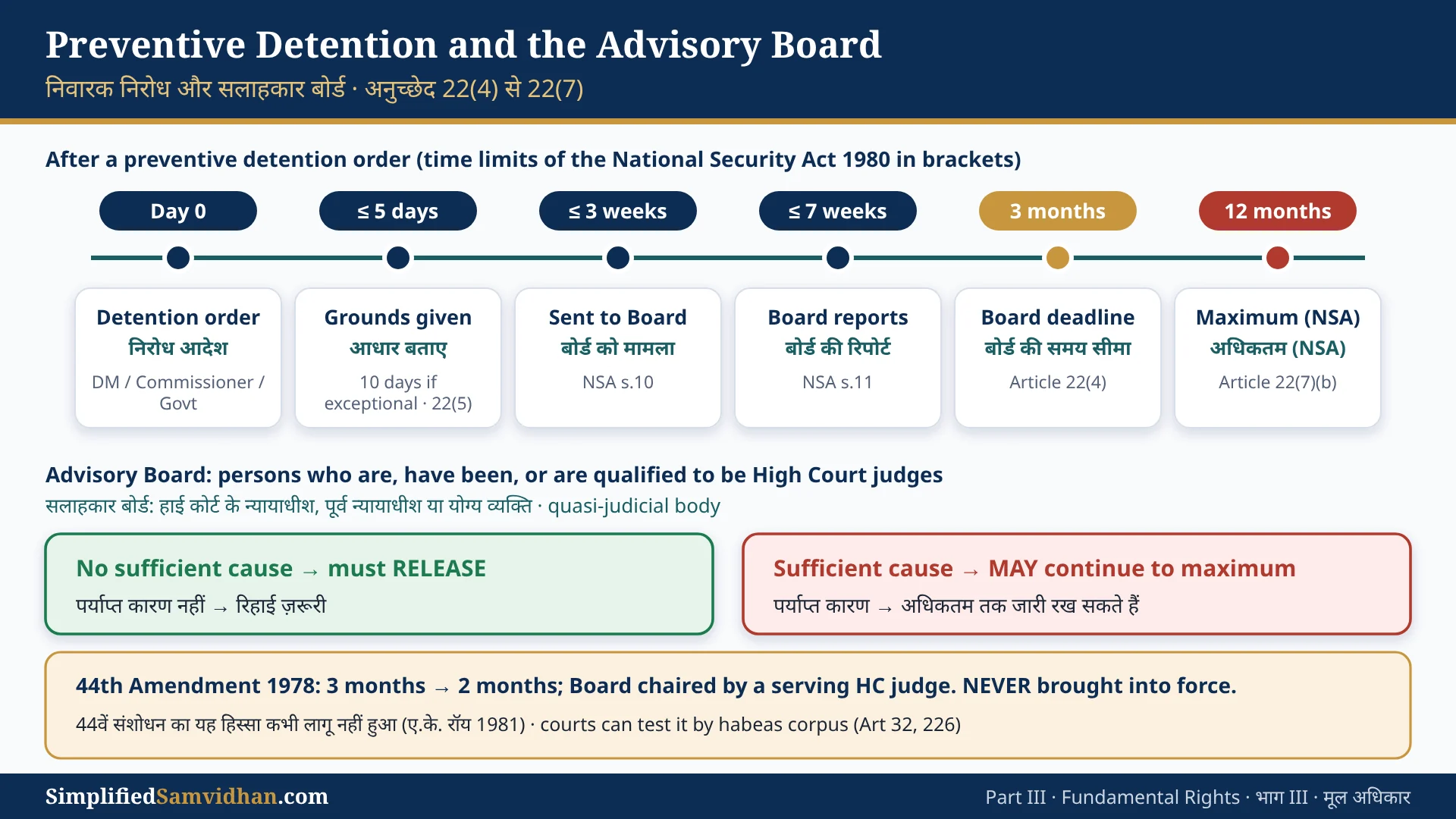
- 22(4): the 3-month limit. No PD law can allow detention beyond three months unless an Advisory Board reports, before the three months end, that there is sufficient cause. The Board is made of persons who are, have been, or are qualified to be High Court judges.
- 22(5): grounds and representation. The detainee must get the grounds "as soon as may be" and the earliest opportunity to object. Courts insist the grounds are in a language he understands and with the documents relied on.
- 22(6): facts the authority considers against the public interest need not be disclosed. The grounds themselves cannot be withheld.
- 22(7): Parliament may say when detention can go beyond three months without a Board, fix the maximum period, and lay down the Board's procedure. Under the NSA the maximum is 12 months.
The Advisory Board: a quasi-judicial check
- A quasi-judicial body is not a court, but it decides a question in a court-like way: it looks at the material and hears the person. The Advisory Board is one such body.
- If the Board finds no sufficient cause, the Government must release the detainee. If it finds cause, the Government may continue the detention up to the legal maximum.
- The detainee has no right to a lawyer before the Board under most PD laws, though he may take a friend's help; the Supreme Court upheld this in A.K. Roy (1981).
- Under the NSA 1980: grounds within 5 days (10 days in exceptional cases), reference to the Board within 3 weeks, Board report within 7 weeks of detention, maximum detention 12 months.
- Courts can still test every detention through habeas corpus under Articles 32 and 226.
Two Kinds of DetentionArticle 22 of Indian Constitution: Preventive vs Punitive Detention
| Point | Punitive detention (ordinary arrest) | Preventive detention |
|---|---|---|
| Purpose | To punish or try a person for an offence already committed | To prevent a possible future act harmful to security, public order or supplies |
| Basis | Specific offence; evidence | Suspicion and the subjective satisfaction of the executive |
| Who decides | Court, after trial | Executive (District Magistrate, Commissioner, Government); no trial |
| 24-hour production | Yes, before a magistrate (22(2)) | No (22(3)(b)) |
| Lawyer of choice | Yes (22(1)) | Not as a right before the Advisory Board |
| Time limit | Custody only as ordered by courts; sentence after conviction | 3 months; longer only with Advisory Board report or a Parliament law; maximum fixed by the law (12 months under NSA) |
| Safeguards | Article 22(1), (2); BNSS 2023; D.K. Basu guidelines | Article 22(4) to (7); habeas corpus; Advisory Board |
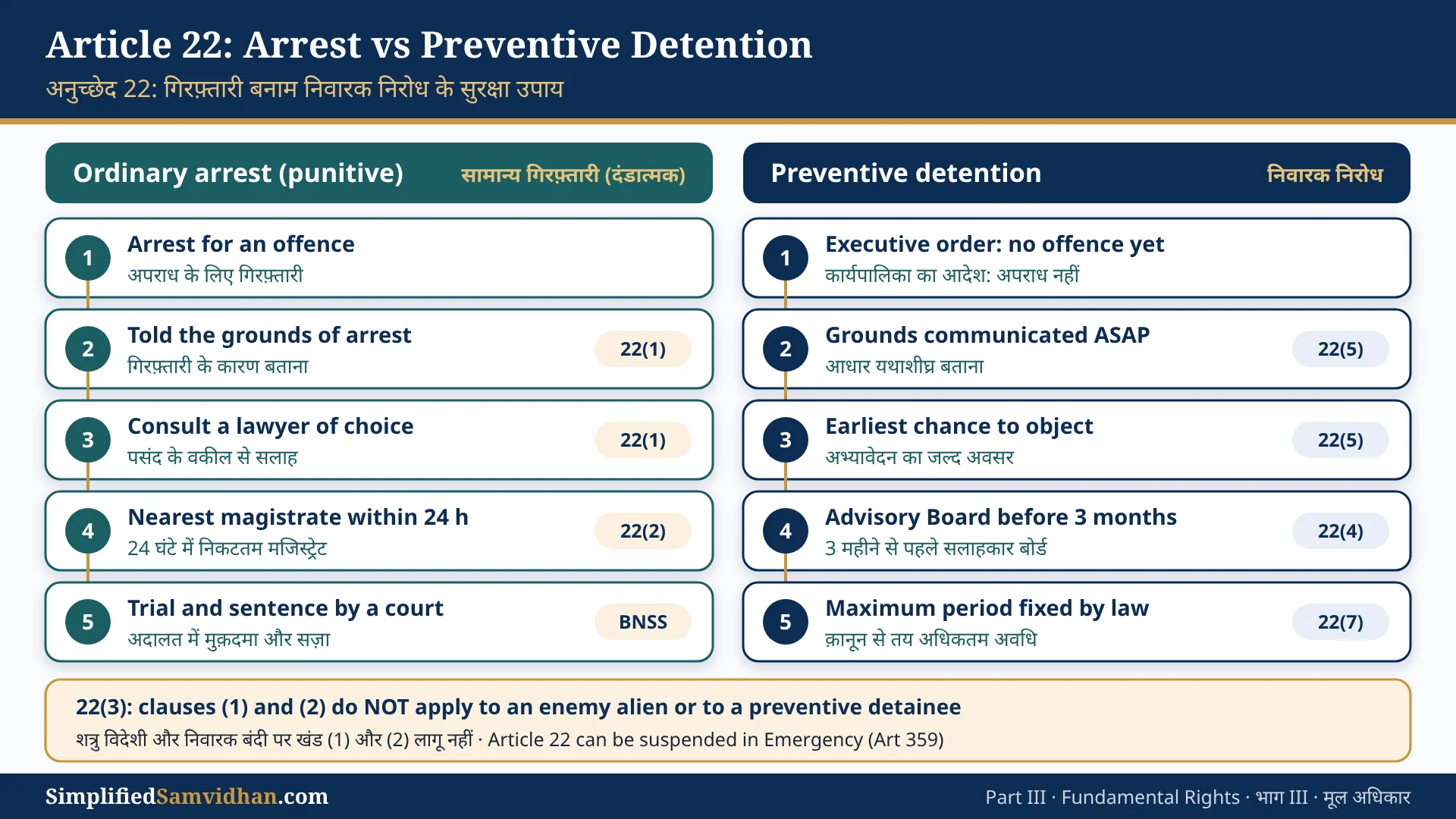
- Punitive detention looks back at a crime already done. Preventive detention looks forward at a harm that may happen.
- Because there is no trial, the Supreme Court calls preventive detention an exception to Article 21 that must be strictly construed (Rekha v. State of Tamil Nadu, 2011). If ordinary criminal law is enough, PD should not be used.
- Article 22 can be suspended during a National Emergency under Article 359; Articles 20 and 21 cannot (44th Amendment, 1978).
Who Makes PD LawsArticle 22 of Indian Constitution: Legislative Power and Preventive Detention Laws
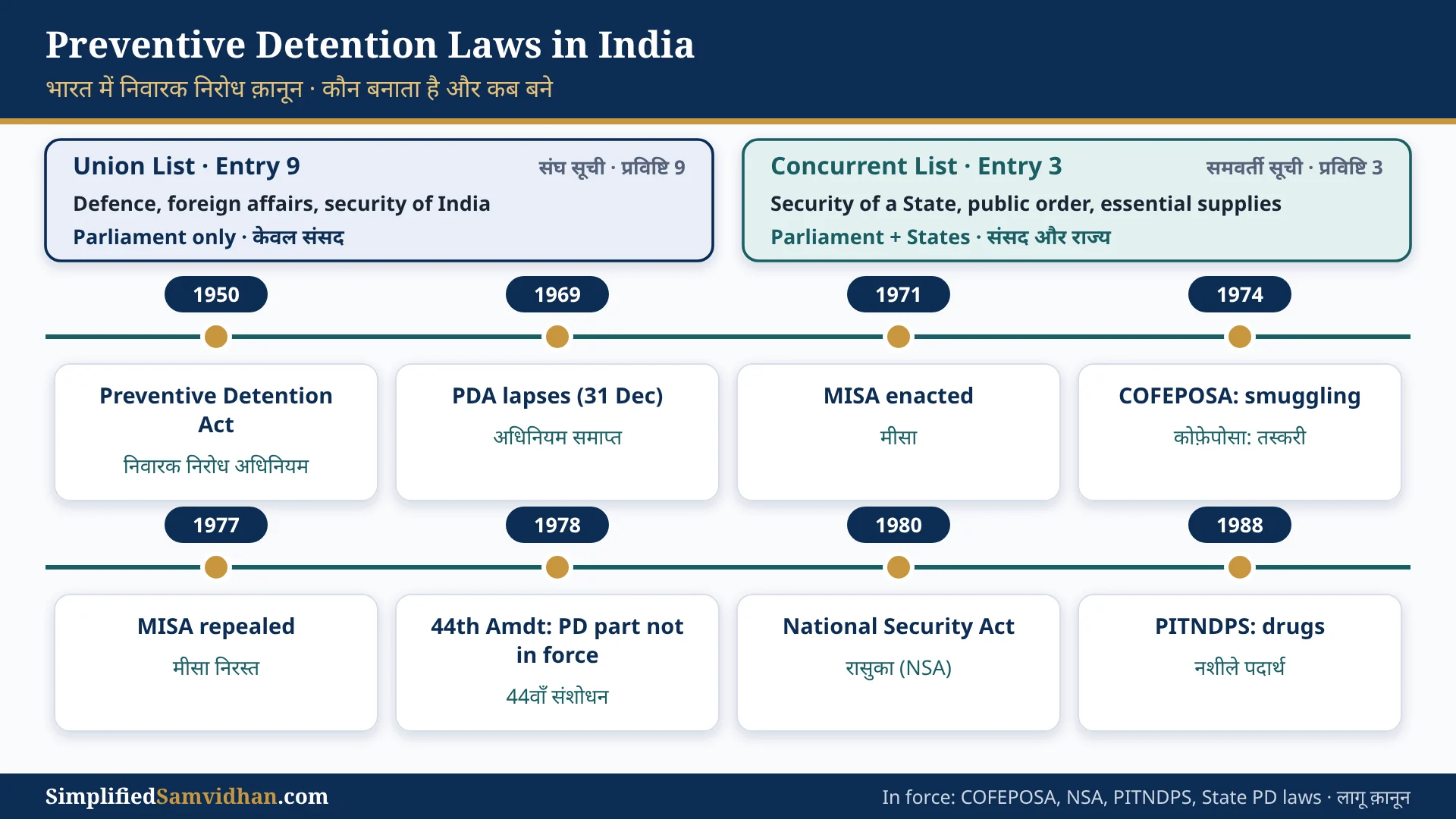
- Union List, entry 9: preventive detention for reasons connected with defence, foreign affairs or the security of India. Only Parliament.
- Concurrent List, entry 3: preventive detention for reasons connected with the security of a State, maintenance of public order, or maintenance of supplies and services essential to the community. Both Parliament and State Legislatures.
- So both the Centre and the States can make PD laws, but only Parliament can use clause (7) to allow detention beyond three months without an Advisory Board.
| Law | Type | Status |
|---|---|---|
| Preventive Detention Act, 1950 | First central PD law | Lapsed on 31 December 1969 |
| MISA (Maintenance of Internal Security Act), 1971 | PD law, widely used in the 1975 to 1977 Emergency | Repealed in 1977 |
| COFEPOSA, 1974 | PD for smuggling and foreign exchange violations | In force |
| National Security Act (NSA), 1980 | PD for security of India or a State, public order, essential supplies; up to 12 months | In force |
| PITNDPS Act, 1988 | PD for illicit traffic in narcotic drugs | In force |
| State laws (e.g. J&K Public Safety Act 1978, Tamil Nadu "Goondas" Act 1982) | PD laws made by States under Concurrent List entry 3 | In force |
| TADA 1985, POTA 2002, UAPA 1967, State organised-crime laws such as MCOCA 1999 | Anti-terror or organised-crime laws: arrest and trial, not PD as such | TADA lapsed 1995; POTA repealed 2004; UAPA and MCOCA in force |
Law and order, public order, security of the State
- In Ram Manohar Lohia v. State of Bihar (1966) the Court drew three concentric circles: law and order is the widest, public order is inside it, and security of the State is the smallest. An act that only disturbs law and order (one fight, one cheating case) does not justify PD for public order.
- This test is used again and again to quash detention orders, as in Banka Sneha Sheela (2021).
Landmark CasesArticle 22 of Indian Constitution: Landmark Supreme Court Cases
- A.K. Gopalan v. State of Madras (1950): the first big PD case, under the Preventive Detention Act 1950. The Court read Article 22 as a complete code and "procedure established by law" narrowly. This view was later given up (R.C. Cooper 1970, Maneka Gandhi 1978).
- Ram Manohar Lohia v. State of Bihar (1966): law and order vs public order vs security of the State.
- ADM Jabalpur v. Shivkant Shukla (1976): during the Emergency the Court (4:1, Justice H.R. Khanna dissenting) held that detainees under MISA could not move courts for habeas corpus. The nine-judge bench in K.S. Puttaswamy (2017) declared it wrong and overruled it.
- A.K. Roy v. Union of India (1981): upheld the National Security Act; refused to force the Government to notify the 44th Amendment's PD changes.
- Joginder Kumar (1994), D.K. Basu (1997), Arnesh Kumar (2014): limits on arrest and custodial safeguards.
- Rekha v. State of Tamil Nadu (2011) and Banka Sneha Sheela (2021): PD is an exception; not a shortcut where ordinary law works.
- Pankaj Bansal (2023) and Prabir Purkayastha (2024): written grounds of arrest under Article 22(1).
Debate and MythsArticle 22 of Indian Constitution: Can a Detainee Vote? The Debate on Preventive Detention
- Myth: "A person in preventive detention loses the right to vote." Fact: section 62(5) of the Representation of the People Act 1951 bars voting by persons in prison or in police custody, but its proviso exempts preventive detainees. They vote by postal ballot. Convicts serving a sentence and undertrials in jail cannot vote.
- Myth: "UAPA and POTA are preventive detention laws." Fact: they are anti-terror laws under which people are arrested and tried. They have stricter bail rules, but they are not PD laws as such.
Points often made in UPSC answers
- Arguments given in support: India faced partition violence, insurgency, terrorism, smuggling and hoarding; some threats cannot wait for a crime to happen; the framers built in limits (Advisory Board, grounds, representation); courts review every order.
- Arguments given against: few democracies keep PD in their Constitution in peacetime; it rests on suspicion, not proof; orders are often quashed by courts, which shows misuse; long detention without trial affects liberty and family life; the 44th Amendment safeguards remain unnotified.
- Way forward (exam view): notify the 44th Amendment changes, give detainees legal help before the Board, publish data on PD orders and quashing rates, and use PD only where ordinary law truly fails, as the Supreme Court has said in Rekha and Banka Sneha Sheela.
Quick RevisionKey Points to Remember
- An arrested person must be told the grounds and can consult a lawyer of choice (22(1)).
- Production before the nearest magistrate within 24 hours, journey time excluded (22(2)).
- Clauses (1) and (2) do not apply to enemy aliens and preventive detainees (22(3)).
- Preventive detention beyond 3 months needs an Advisory Board report or a Parliament law (22(4), 22(7)).
- PD laws: Union List entry 9 (Parliament) and Concurrent List entry 3 (both); NSA 1980 allows up to 12 months.
TimelineArticle 22 and Preventive Detention: Key Dates
| Year | Event |
|---|---|
| 1950 | Article 22 in force; Preventive Detention Act 1950; A.K. Gopalan case. |
| 1966 | Ram Manohar Lohia: law and order vs public order. |
| 1969 | Preventive Detention Act lapses (31 Dec). |
| 1971 | MISA enacted. |
| 1974 | COFEPOSA enacted. |
| 1976 | ADM Jabalpur: no habeas corpus in Emergency. |
| 1977 | MISA repealed. |
| 1978 | 44th Amendment: 2-month rule for PD (never brought into force). |
| 1980 | National Security Act enacted; A.K. Roy upholds it (1981). |
| 1988 | PITNDPS Act enacted. |
| 1997 | D.K. Basu arrest guidelines. |
| 2014 | Arnesh Kumar: no routine arrest for offences up to 7 years. |
| 2017 | Puttaswamy overrules ADM Jabalpur. |
| 2024 | BNSS in force (1 July); Prabir Purkayastha: written grounds of arrest. |
UPSC · State PSC · JudiciaryArticle 22: UPSC Exam Corner
- Prelims trap: "A preventive detainee must be produced before a magistrate within 24 hours." False (22(3)(b)).
- Prelims trap: "The 44th Amendment reduced the PD period without an Advisory Board to two months." The amendment was passed, but that part was never brought into force; three months still applies.
- Prelims trap: "A person under preventive detention cannot vote." False: he can vote by postal ballot (RPA 1951, s.62(5) proviso).
- Mains (250 words): "Preventive detention is often called a necessary evil in a democracy." Examine the constitutional safeguards under Article 22 and the role of the judiciary in preventing its misuse.
- Mains (150 words): Distinguish between preventive and punitive detention. How have the D.K. Basu guidelines and the BNSS 2023 strengthened the rights of an arrested person?
Practice MCQTest Yourself: Article 22
Consider the following statements about Article 22: 1. The 24-hour production rule applies to persons held under preventive detention. 2. Detention beyond three months under a preventive detention law generally needs an Advisory Board report. 3. Both Parliament and State Legislatures can make preventive detention laws. Which of the statements given above is/are correct?
Doubts ClearedFrequently Asked Questions
What is Article 22 of Indian Constitution?
Article 22 protects people against arbitrary arrest and detention. An arrested person must be told the grounds, can consult a lawyer of choice and must be produced before a magistrate within 24 hours. It also allows preventive detention with safeguards: an Advisory Board after three months, grounds and a chance to make a representation.
What is the difference between preventive and punitive detention?
Punitive detention follows an offence and leads to trial and punishment by a court. Preventive detention is ordered by the executive, without trial, to stop a likely future act against security, public order or essential supplies.
Can a person in preventive detention vote?
Yes. The proviso to section 62(5) of the Representation of the People Act 1951 allows preventive detainees to vote, by postal ballot. Convicts serving a sentence and undertrials in jail cannot vote.
Who sits on the Advisory Board under Article 22?
Persons who are, or have been, or are qualified to be appointed as Judges of a High Court. Under the National Security Act the Board has three such members, one of whom is the chairman.