Rights of Arrested Person in India: Your Arrest Rights Under BNSS and Article 22
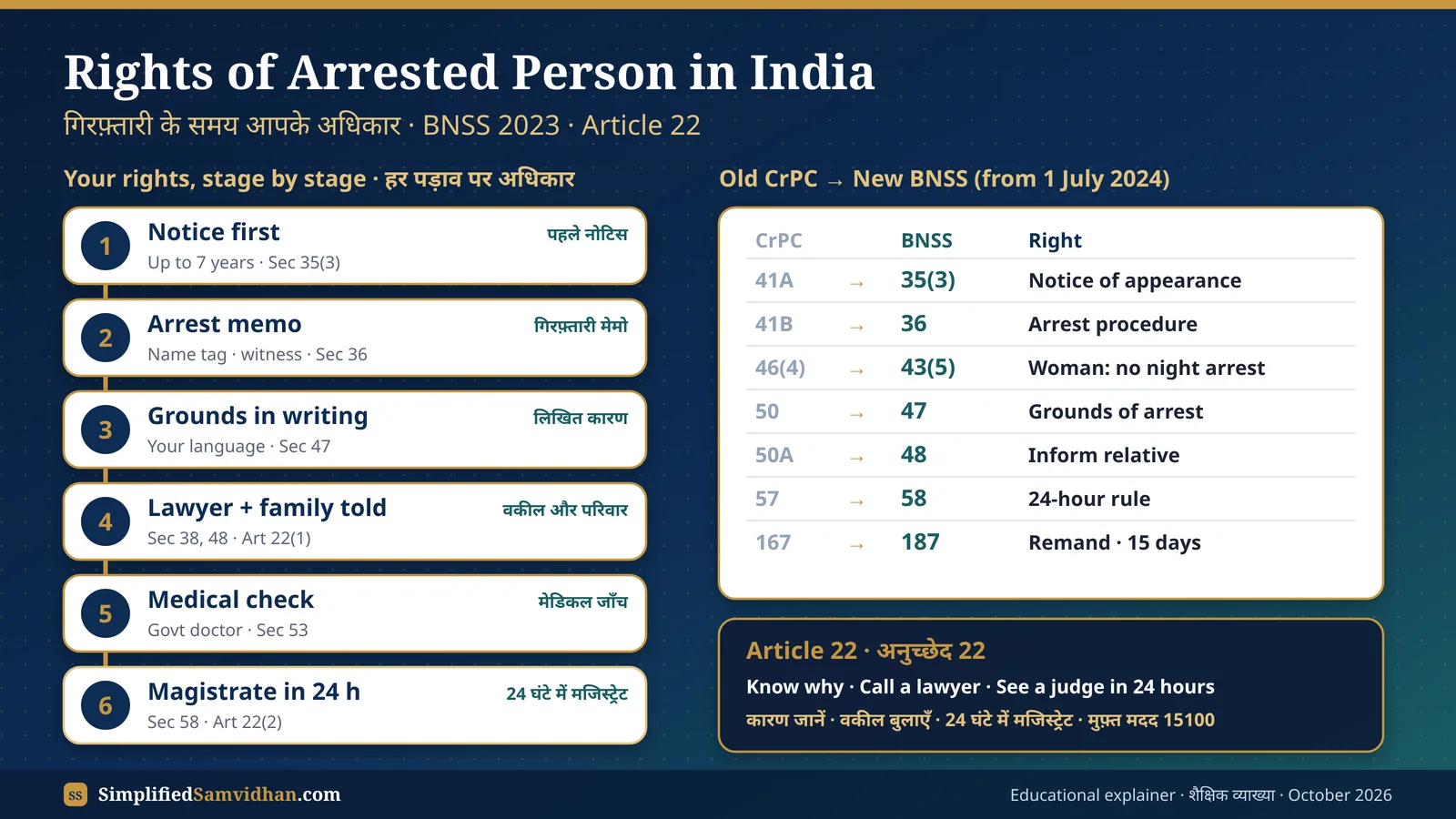
Police can arrest, but only by the rulebook. Here is that rulebook in plain words: what the police must do, what you can ask for, and the new BNSS section numbers.
Step by stepRights of Arrested Person in India: 7 Stages Under BNSS
- 1
📄 Before arrest: a notice, not handcuffs, for most offences
For offences punishable with up to 7 years, police should usually send a notice of appearance (Section 35(3) BNSS) instead of arresting. If you obey the notice and keep appearing, you shall not be arrested unless the officer records reasons. If you are above 60 or infirm and the offence carries less than 3 years, arrest needs the prior permission of an officer not below DSP rank (Section 35(7)).
BNSS 35 CrPC 41, 41A - 2
🪪 At arrest: identity, memo and someone told
The officer must wear a clear name tag, prepare an arrest memo signed by a witness (a family member or a respectable local person) and countersigned by you, and tell you that you may have a relative or friend informed (Section 36). The police must then actually inform your nominee and record it in a book (Section 48).
BNSS 36, 48 CrPC 41B, 50A - 3
📝 Grounds of arrest, in writing
You must be told the full particulars of the offence (Section 47, Article 22(1)). The Supreme Court in Mihir Rajesh Shah (November 2025) held that the grounds must be given in writing, in a language you understand, and at the latest 2 hours before you are produced for remand; otherwise the arrest and remand become illegal. In a bailable offence you must also be told you can get bail.
BNSS 47 CrPC 50 - 4
⚖️ A lawyer, and free legal aid
You may consult a lawyer of your choice (Article 22(1)) and meet your advocate during interrogation, though not throughout it (Section 38). If you cannot afford one, the State must give you a lawyer free of cost (Article 39A; Legal Services Authorities Act, 1987). Call NALSA 15100.
BNSS 38 CrPC 41D - 5
🩺 Medical check and safety in custody
You can be medically examined by a government doctor soon after arrest, and the report must be given to you or your nominee (Section 53). The police are responsible for your health and safety in custody (Section 56). A woman may be searched only by a woman (Section 49).
BNSS 49, 53, 56 CrPC 51, 54, 55A - 6
🏛️ Before a Magistrate within 24 hours
You cannot be kept in a police station for more than 24 hours (travel time excluded) without a Magistrate's order (Section 58, Article 22(2)). The Magistrate can order police custody for at most 15 days in total, which under BNSS may be taken in parts during the first 40 or 60 days of the case (Section 187).
BNSS 58, 187 CrPC 57, 167 - 7
🔓 Bail
In a bailable offence bail is your right, from the police station itself. In a non-bailable offence you apply to the court. An undertrial who has spent half the maximum sentence in jail (one-third for a first-time offender) must be released on bond (Section 479).
BNSS 478, 479 CrPC 436, 436A
The lawArticle 22 and Section 47 BNSS: Official Text
Article 22. Protection against arrest and detention in certain cases.
(1) No person who is arrested shall be detained in custody without being informed, as soon as may be, of the grounds for such arrest nor shall he be denied the right to consult, and to be defended by, a legal practitioner of his choice.
(2) Every person who is arrested and detained in custody shall be produced before the nearest magistrate within a period of twenty-four hours of such arrest excluding the time necessary for the journey from the place of arrest to the court of the magistrate and no such person shall be detained in custody beyond the said period without the authority of a magistrate.
Bharatiya Nagarik Suraksha Sanhita, 2023 · Section 47(1). Every police officer or other person arresting any person without warrant shall forthwith communicate to him full particulars of the offence for which he is arrested or other grounds for such arrest.
Article 22 gives every arrested person three promises: you will be told why, you can call a lawyer, and a judge will see you within a day. The police can hold you, but only for 24 hours on their own say-so. After that, only a Magistrate can decide whether you stay in custody. BNSS, which replaced the CrPC on 1 July 2024, turns these promises into a step-by-step rulebook for every police station.
🏠 Everyday analogy
A referee can stop the game and send a player off the field, but must show the card and say which rule was broken, and the match commissioner reviews it the same day. The arrest memo and written grounds are the card; the Magistrate is the commissioner.
🇮🇳 Real Indian example
In Arnesh Kumar v. State of Bihar (2014) the Supreme Court found people being arrested routinely in dowry complaints without checking the need. It ordered police to use a checklist and a notice of appearance first. That rule is now written into Section 35 BNSS.
Special protectionsArrest Rules for Women, Elderly and Handcuffs Under BNSS
No arrest after sunset
A woman is not arrested after sunset or before sunrise, except in exceptional cases with a Judicial Magistrate's prior permission, and then by a woman officer (Section 43(5)).
Woman officer
Searches of a woman only by a woman, with strict regard to decency (Section 49(2)); medical examination only by or under a female doctor (Section 53(2)).
Questioned at home
Women, men below 15 or above 60, and persons with a disability or serious illness need not go to the police station as witnesses; police question them where they live (Section 179).
Handcuffs only in listed cases
Handcuffs are allowed only for habitual or escaped offenders and grave crimes such as murder, rape, terrorism, organised crime or offences against the State (Section 43(3)).
Right to stay silent
No accused can be compelled to be a witness against himself (Article 20(3)). Forced confessions to police are not evidence.
Names on display
Every district and police station control room must display the names of arrested persons and the officer who arrested them (Section 37).
Old vs newArrest Sections: CrPC vs BNSS Table
The Bharatiya Nagarik Suraksha Sanhita, 2023 replaced the Code of Criminal Procedure, 1973 from 1 July 2024. Most arrest rights kept their wording but got new numbers. Arrests made before that date still follow the CrPC.
| Your right | New BNSS section | Old CrPC section |
|---|---|---|
| Notice of appearance instead of arrest | 35(3)–(6) | 41A |
| Senior citizen / infirm: DSP's permission | 35(7) | new |
| Arrest memo, name tag, witness | 36 | 41B |
| Names displayed in control room | 37 | 41C |
| Meet advocate during interrogation | 38 | 41D |
| Woman not arrested after sunset | 43(5) | 46(4) |
| Grounds of arrest, right to bail | 47 | 50 |
| Relative / friend informed | 48 | 50A |
| Medical examination | 53 | 54 |
| Magistrate within 24 hours | 58 | 57 |
| Police custody limit (15 days) | 187 | 167 |
| Release after half the maximum term | 479 | 436A |
Landmark casesSupreme Court Arrest Guidelines: D.K. Basu to 2026
| Case | What it says |
|---|---|
| Joginder Kumar v. State of UP (1994) | Power to arrest is not a licence to arrest; the officer must justify the need. |
| D.K. Basu v. State of West Bengal (1997) | Name tags, arrest memo, informing family, medical checks: the base of Sections 36 to 53 BNSS. |
| Arnesh Kumar v. State of Bihar (2014) | For offences up to 7 years, arrest only after a checklist; notice first. |
| Satender Kumar Antil v. CBI (2022) | Bail is the rule; courts must check whether the arrest followed the law. |
| Mihir Rajesh Shah v. State of Maharashtra (2025) | Grounds in writing, in a language understood, for every offence; at least 2 hours before remand. |
Do and don'tWhat to Do When Police Arrest You
ConstitutionConstitutional Rights of an Arrested Person
Arrest rights are not police favours. They come straight from Part III and Part IV of the Constitution:
Article 21: No one loses liberty except by fair procedure
Every arrest rule in BNSS is the 'procedure established by law' that Article 21 demands; after Maneka Gandhi (1978) it must also be just, fair and reasonable.
Article 22: Grounds, lawyer, Magistrate in 24 hours
The direct source of your arrest rights. Clauses (3) to (7) deal separately with preventive detention.
Article 20(3): Right against self-incrimination
You cannot be forced to be a witness against yourself, so silence is not a crime.
Article 39A: Free legal aid
Justice must not be denied for lack of money; this is why Legal Services Authorities give free lawyers.
Save thisArrest Rights Checklist for Your Phone
Copy this, fill in one family member and one lawyer, and send it to yourself on WhatsApp so it is always with you.
MY RIGHTS IF I AM ARRESTED (save on your phone)

1. Ask: Am I under arrest? For which offence? (Sec 47 BNSS, Art 22(1))
2. Grounds of arrest IN WRITING, in a language I understand (SC, Mihir Rajesh Shah, 2025)
3. Arrest memo signed by a witness; officer's name tag visible (Sec 36)
4. Inform: ______________ (name)  Mobile: ______________ (Sec 48)
5. My lawyer: ______________  Mobile: ______________ (Art 22(1), Sec 38)
   No money for a lawyer? Free legal aid: NALSA 15100 (Art 39A)
6. Medical examination by a government doctor; copy of report (Sec 53)
7. Before a Magistrate within 24 hours (Sec 58, Art 22(2))
8. Bailable offence = bail is my right (Sec 47(2), 478)
9. I may stay silent; no forced confession (Art 20(3))
10. Woman: no arrest after sunset without Magistrate's permission; woman officer (Sec 43(5))

Source: SimplifiedSamvidhan.com
Practice MCQTest Yourself: Arrest Rights
Under the Bharatiya Nagarik Suraksha Sanhita, 2023, which section requires the police to produce an arrested person before a Magistrate within 24 hours?
Doubts ClearedFrequently Asked Questions
What are the rights of an arrested person in India?
To know the grounds of arrest in writing, to consult a lawyer, to have a relative informed, to a medical examination, to be produced before a Magistrate within 24 hours, to bail in bailable offences and to stay silent.
Can police arrest without a warrant?
Yes, for cognizable offences under Section 35 BNSS, but for offences punishable up to 7 years they should first issue a notice of appearance and must record reasons for arresting.
Can a woman be arrested at night?
Not after sunset or before sunrise, except in exceptional circumstances with the prior permission of a Judicial Magistrate, and then by a woman police officer (Section 43(5) BNSS).
Is it compulsory to give the grounds of arrest in writing?
Yes. In Mihir Rajesh Shah (2025) the Supreme Court held written grounds, in a language the person understands, are needed in all cases, at least 2 hours before remand. A larger Bench may be asked to look at it again (July 2026).
What is the BNSS section for arrest in place of CrPC 41A?
Section 35(3) to 35(6) BNSS (notice of appearance). The other arrest sections: 36 (procedure), 47 (grounds), 48 (informing relatives), 58 (24 hours).
Sources and further readingSources We Checked
Facts checked on 16 October 2026. This is general legal information, not advice on a particular case; talk to a lawyer or call 15100.
- Constitution of India (Legislative Department, Government of India)
- Bharatiya Nagarik Suraksha Sanhita, 2023 (India Code)
- The Indian Lawyer: SC rules written grounds must be in a language the arrestee understands (Mihir Rajesh Shah, Nov 2025)
- Drishti IAS: SC to refer grounds of arrest issue to larger Bench (11 Jul 2026)
- National Legal Services Authority (free legal aid)