How to File FIR and Zero FIR: Your Right Under Section 173 BNSS
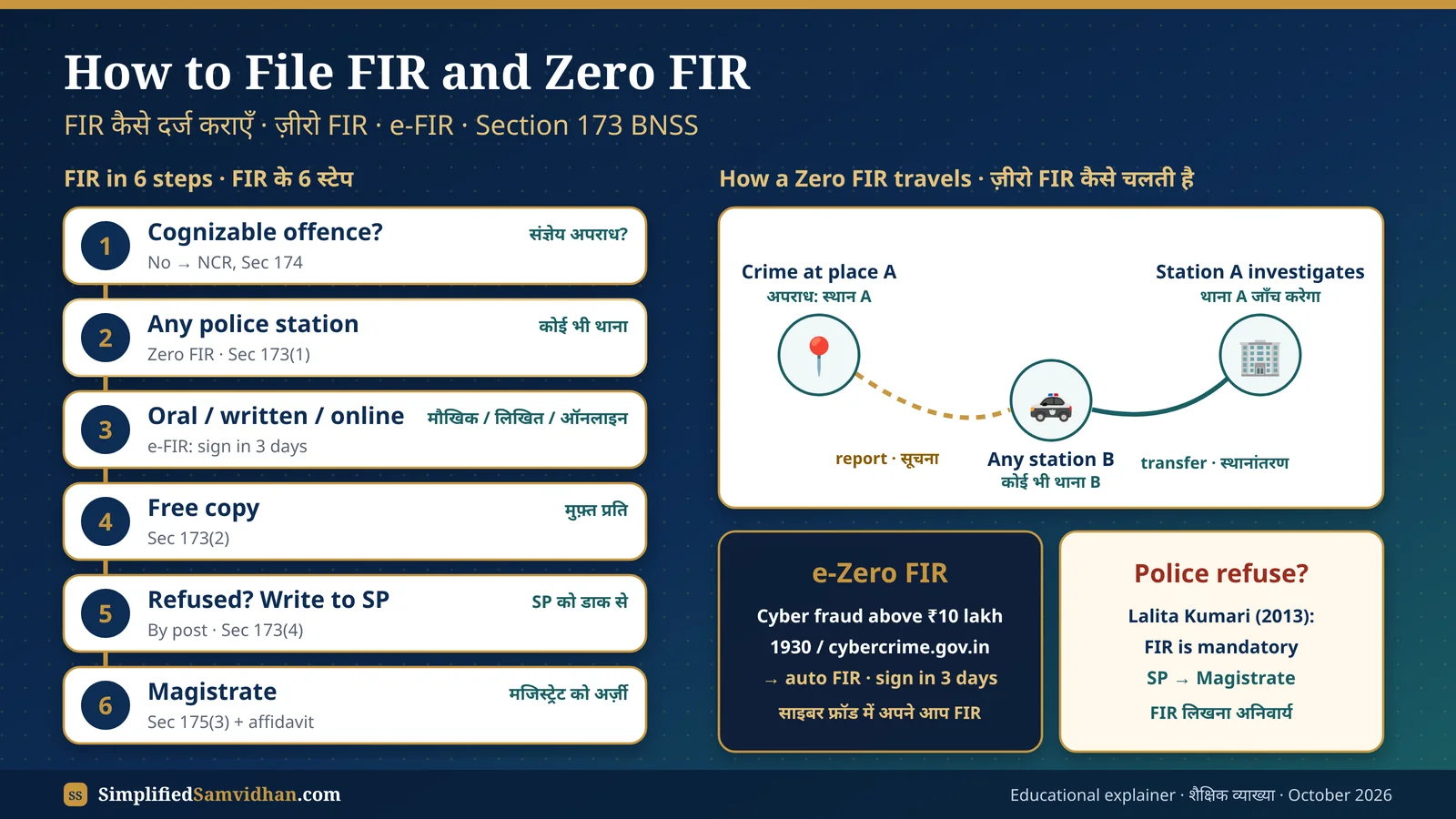
Any police station, any time, free of cost. Here is how to get an FIR or a Zero FIR registered, what to do if the police refuse, and a format you can print today.
Step by stepHow to File FIR in India: 7 Steps Under Section 173 BNSS
- 1
🔎 Check: is it a cognizable offence?
An FIR is for cognizable offences, where police can arrest without a warrant: theft, robbery, assault causing hurt, cheating, rape, kidnapping, murder, dowry death, cyber fraud. For minor, non-cognizable matters (simple insult, minor hurt) the police record a Non-Cognizable Report (NCR) and send you to the Magistrate (Section 174 BNSS).
- 2
🚓 Go to ANY police station: the Zero FIR
Section 173(1) says information can be given 'irrespective of the area where the offence is committed'. So the nearest station must register it, even if the crime happened elsewhere. This is a Zero FIR (it gets number 0 or a zero series). The station then transfers it to the police station that has jurisdiction, where it gets a regular number and is investigated.
- 3
🗣️ Tell it orally, in writing or online
Give the facts: what happened, when, where, who did it (or a description), witnesses and losses. If you speak, the officer must write it down and read it back to you; sign only when it is correct. You can also send it by electronic communication (e-FIR / email / state police portal); it is taken on record when you sign within 3 days. A woman victim of a sexual offence can have her statement recorded by a woman officer, and at her home if she is disabled.
- 4
📄 Take your free copy
You are entitled to a copy of the FIR immediately and free of cost (Section 173(2)). Check the FIR number, date, sections and police station. Most states also let you download FIRs from the state police website or the Citizen services of CCTNS.
- 5
📮 Police refuse? Write to the SP
If the station refuses, send the substance of your information in writing and by post to the Superintendent of Police (Section 173(4)). The SP must investigate personally or order an officer to do so. Keep the postal receipt. Use registered post or speed post.
- 6
⚖️ Still nothing? Go to the Magistrate
Apply to the Judicial Magistrate under Section 175(3) BNSS (old Section 156(3) CrPC), with an affidavit and proof that you approached the SP. The Magistrate can order the police to register the FIR and investigate. You can also file a private complaint (Section 223).
- 7
📲 Track the investigation
Under BNSS the police must inform you of the progress of the investigation within 90 days, including by electronic means (Section 193(3)). When the final report is filed, you are entitled to be told and to be heard before a case is closed.
Zero FIR and e-FIRWhat Is Zero FIR? Zero FIR vs e-FIR Explained
Zero FIR
- Filed at any police station, wherever the crime happened
- Station records it, then transfers it to the right station
- Stops delay in urgent cases: rape, accident, kidnapping, cyber fraud
- Now written into law: Section 173(1) BNSS
e-FIR / e-Zero FIR
- Information sent by electronic communication
- Becomes an FIR once you sign within 3 days
- e-Zero FIR: 1930 / cybercrime.gov.in complaints of fraud above ₹10 lakh turn into a Zero FIR automatically
- Launched in Delhi on 19 May 2025; running in 19 States by August 2026
The lawSection 173 BNSS: Official Text of the FIR Law
Bharatiya Nagarik Suraksha Sanhita, 2023 · Section 173(1). Information in cognizable cases. Every information relating to the commission of a cognizable offence, irrespective of the area where the offence is committed, may be given orally or by electronic communication to an officer in charge of a police station, and if given—
(i) orally, it shall be reduced to writing by him or under his direction, and be read over to the informant; and every such information, whether given in writing or reduced to writing as aforesaid, shall be signed by the person giving it;
(ii) by electronic communication, it shall be taken on record by him on being signed within three days by the person giving it,
and the substance thereof shall be entered in a book to be kept by such officer in such form as the State Government may prescribe in this behalf…
Section 173(2). A copy of the information as recorded under sub-section (1) shall be given forthwith, free of cost, to the informant or the victim.
The police station is like a hospital's emergency ward. It cannot say 'go to the hospital of your own area' when someone is bleeding. Section 173 makes three promises: any station will take your information, it will be written down and read back to you, and you get a free copy. The FIR is only the start: it sets the criminal law in motion. It does not prove anyone guilty.
🏠 Everyday analogy
A courier counter that accepts your parcel for any city and sends it on. It does not refuse because the address is not local.
🇮🇳 Real Indian example
A tourist from Bihar robbed on a train near Agra can walk into the GRP or police station at the next stop, say Mathura, and lodge a Zero FIR there. Mathura police record it and transfer it to the station with jurisdiction.
If police refuseCan Police Refuse to File an FIR? Lalita Kumari and BNSS
In Lalita Kumari v. Government of Uttar Pradesh (2013) a Constitution Bench held that police must register an FIR when the information discloses a cognizable offence; they cannot first 'check if it is true'. BNSS keeps this rule with one change: for offences punishable with 3 years or more but less than 7 years, the officer may, with the permission of a DSP-rank officer, hold a preliminary enquiry for up to 14 days to see whether there is a prima facie case (Section 173(3)).
Do and don'tFIR Tips: What to Write and What to Avoid
ConstitutionConstitutional Basis of the Right to File an FIR
The duty to register an FIR flows from the Constitution:
Article 21: Right to life includes access to justice
A victim's ability to set criminal law in motion is part of a life with dignity and security.
Article 14: Equal protection of the laws
A station cannot register FIRs for some and refuse others. Arbitrary refusal violates equality.
Article 226: High Court writ if all else fails
The High Court can issue a writ of mandamus directing police to act, though it usually expects you to use the SP and Magistrate route first.
Free draftFIR Application Format (Copy and Use)
Print two copies. Hand one to the SHO and get the second stamped 'received' with the date. If they refuse, post the same letter to the SP.
To,
The Station House Officer (SHO),
Police Station __________, District __________

Subject: Information about a cognizable offence; request to register FIR (Zero FIR if outside your jurisdiction) under Section 173 BNSS

Sir / Madam,
I, __________ (name), son/daughter/wife of __________, aged ___, resident of __________, mobile __________, report as follows:

1. Date and time of incident: __/__/2026 at about __:__
2. Place of incident: ______________________________
3. What happened: ______________________________
   ______________________________________________
4. Person(s) responsible / description: ______________
5. Witnesses (if any): ______________________________
6. Loss / injury: __________________________________

These facts disclose a cognizable offence. Please register an FIR under Section 173(1) BNSS
(as a Zero FIR and transfer it if the place is outside this station's area), give me a free copy
under Section 173(2), and take necessary action.

Enclosed: ______________ (photos / bills / medical report / screenshots)

Signature: ____________
Date: __/__/2026
Practice MCQTest Yourself: Zero FIR
Which provision of the Bharatiya Nagarik Suraksha Sanhita, 2023 gives statutory recognition to the 'Zero FIR'?
Doubts ClearedFrequently Asked Questions
What is a Zero FIR?
An FIR registered at any police station regardless of where the crime happened, later transferred to the station with jurisdiction. It is recognised in Section 173(1) BNSS.
Can I file an FIR online?
Yes. Section 173(1)(ii) BNSS accepts information by electronic communication; it is recorded once you sign within 3 days. Many state police portals offer e-FIR for theft and lost articles.
What if police refuse to register my FIR?
Send the information in writing by post to the Superintendent of Police (Section 173(4)). If that fails, apply to the Magistrate under Section 175(3) BNSS with an affidavit.
Is FIR registration free?
Yes. Registration is free and the copy of the FIR must be given free of cost (Section 173(2) BNSS).
Which section replaced CrPC 154 for FIR?
Section 173 of the Bharatiya Nagarik Suraksha Sanhita, 2023, in force from 1 July 2024.
Sources and further readingSources We Checked
Facts checked on 16 October 2026. Online FIR services differ from state to state; check your state police website.