Types of Writs in the Indian Constitution: Articles 32 and 226 Explained
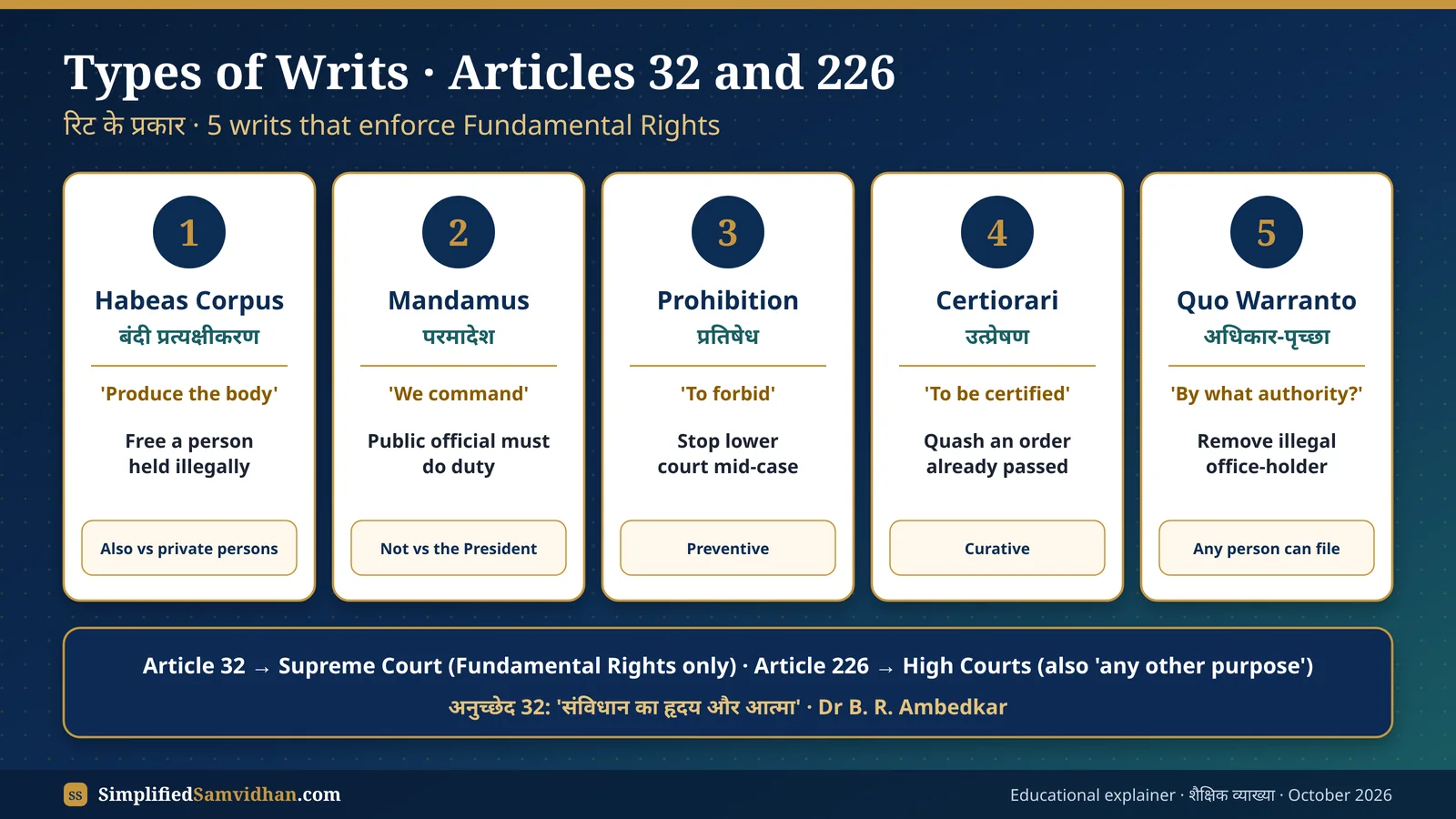
Five Latin words that protect every Indian's freedom. Read Article 32, what each writ means and against whom it runs, real examples, how Article 226 differs, and why ADM Jabalpur is called the darkest hour of the Supreme Court.
Official textArticle 32: Right to Constitutional Remedies, Full Text
32. Remedies for enforcement of rights conferred by this Part.
(1) The right to move the Supreme Court by appropriate proceedings for the enforcement of the rights conferred by this Part is guaranteed.
(2) The Supreme Court shall have power to issue directions or orders or writs, including writs in the nature of habeas corpus, mandamus, prohibition, quo warranto and certiorari, whichever may be appropriate, for the enforcement of any of the rights conferred by this Part.
(3) Without prejudice to the powers conferred on the Supreme Court by clauses (1) and (2), Parliament may by law empower any other court to exercise within the local limits of its jurisdiction all or any of the powers exercisable by the Supreme Court under clause (2).
(4) The right guaranteed by this article shall not be suspended except as otherwise provided for by this Constitution.
A writ is a written order from the Supreme Court or a High Court telling a person or authority to do something or stop doing something. Rights on paper are useless if nobody can enforce them; writs are the tools that enforce them. Article 32 makes the right to approach the Supreme Court itself a Fundamental Right, and names five writs. Article 226 gives the same tools, with a wider reach, to every High Court.
🏠 Everyday analogy
A warranty card is worthless if the shop refuses to repair your phone and there is no consumer court to go to. Article 32 is the 'service centre' of the Constitution: Fundamental Rights are the warranty, writs are the repair tools.
🇮🇳 Real Indian example
In Hussainara Khatoon (1979), a newspaper report on undertrials in Bihar jails who had spent longer inside than their maximum sentence led to a habeas corpus petition; the Supreme Court ordered the release of thousands.
The five writs5 Types of Writs in the Indian Constitution: Meaning and Scope
| Writ | Literal meaning | Purpose | Issued against | Not issued against / when |
|---|---|---|---|---|
| Habeas Corpus | 'You may have the body' | Produce a detained person before the court and free them if the detention is illegal | Both public authorities and private persons | Detention that is lawful, ordered by a court for contempt, or by a legislature; person outside the court's jurisdiction |
| Mandamus | 'We command' | Order a public official or body to perform a public duty it has failed or refused to do | Public officials, public corporations, inferior courts, tribunals, governments | Private persons; the President and Governors; a discretionary duty; a purely contractual duty; a Chief Justice acting judicially |
| Prohibition | 'To forbid' | A higher court stops a lower court or tribunal from going beyond its jurisdiction, while the case is still pending (preventive) | Only judicial and quasi-judicial bodies | Administrative authorities, legislatures, private persons |
| Certiorari | 'To be certified' or 'to be informed' | A higher court calls up the record and quashes an order already passed without jurisdiction or with an error of law (curative) | Judicial and quasi-judicial bodies, and administrative authorities whose orders affect individual rights | Legislatures and private persons |
| Quo Warranto | 'By what authority or warrant?' | Asks a person holding a public office to show by what right they hold it; ousts an illegal holder | Holder of a substantive public office created by the Constitution or a statute | Ministerial offices and private offices (e.g. a private club or company post) |
ExamplesTypes of Writs with Real Examples and Cases
| Writ | Real-life situation |
|---|---|
| Habeas Corpus | Police pick up a young man at night and do not produce him before a magistrate within 24 hours; his family files habeas corpus. In Kanu Sanyal (1973) the Court said the body need not even be produced for the petition to be heard. In Rudul Sah (1983) it ordered compensation for 14 years of illegal detention after acquittal. |
| Mandamus | A municipal body refuses to issue a building completion certificate though all conditions are met, or a Public Information Officer sits on a statutory duty: the High Court commands it to act. |
| Prohibition | A tax tribunal starts hearing a matter that the law places outside its power; the High Court stops the hearing midway. |
| Certiorari | A land acquisition order is passed without hearing the farmer; the High Court calls the file and quashes the order for violating natural justice. |
| Quo Warranto | In Centre for PIL v. Union of India (2011), the Supreme Court quashed the appointment of the Central Vigilance Commissioner. Petitions also challenge vice-chancellors appointed without the required qualifications. |
CompareArticle 32 vs Article 226: Writ Jurisdiction of Supreme Court and High Courts
| Point | Article 32 (Supreme Court) | Article 226 (High Courts) |
|---|---|---|
| Status | Itself a Fundamental Right (Part III) | A constitutional power, not a Fundamental Right (Part VI) |
| Purpose | Only Fundamental Rights | Fundamental Rights and 'any other purpose' (legal rights too) |
| Territory | Whole of India | Within the State, or where the cause of action arises (clause 2, 15th Amendment 1963) |
| Nature | A remedy the Court is duty-bound to consider | Discretionary: the High Court may refuse |
| During Emergency | Can be suspended under Article 359 (except for Articles 20 and 21) | Continues for purposes other than Fundamental Rights |
| Scope | Narrower purpose, wider territory | Wider purpose, narrower territory |
LandmarkADM Jabalpur Habeas Corpus Case and Its Overruling in Puttaswamy
ADM Jabalpur v. Shivkant Shukla (1976)
- Decided 28 April 1976, during the 1975-77 Emergency
- 4:1 majority: when Article 21 is suspended, no habeas corpus petition can be filed
- Lone dissent: Justice H. R. Khanna, who was later superseded for the post of Chief Justice
Correction: 44th Amendment and Puttaswamy
- 44th Amendment (1978): Articles 20 and 21 can never be suspended under Article 359
- K. S. Puttaswamy (24 Aug 2017), nine judges: ADM Jabalpur was 'seriously flawed' and is overruled
- Life and liberty are inherent; the Constitution only recognises them
People's toolWrits and Public Interest Litigation (PIL)
Writs became a people's tool through Public Interest Litigation (PIL). Normally only the person whose right is hurt can file; PIL relaxed this rule.
Letter petitions
The Court has treated letters and postcards as writ petitions (epistolary jurisdiction), as in Sunil Batra on prison torture.
Relaxed locus standi
S. P. Gupta (1981): any public-spirited person can approach the court for those too poor or weak to come themselves.
Bonded labour
Bandhua Mukti Morcha (1984): release and rehabilitation of bonded labourers in quarries.
Fathers of PIL
Justices P. N. Bhagwati and V. R. Krishna Iyer shaped Public Interest Litigation in the late 1970s and 1980s.
- In Romesh Thappar (1950) the Supreme Court called itself the 'sentinel on the qui vive' (an ever-alert guard) of Fundamental Rights.
- Courts now warn against 'publicity interest' or 'private interest' litigation and can impose costs on frivolous PILs.
- Writ powers are also used to punish disobedience of court orders: see contempt of court.
Connect the dotsHow Writs Connect to the Rest of the Constitution
- Writs enforce the rights listed in the Fundamental Rights overview, from Article 14 (equality) to Article 21 (life and liberty).
- Unlike rights, the Directive Principles and Fundamental Duties cannot be enforced by any writ.
- Habeas corpus is the first remedy against preventive detention and illegal arrest.
- Police refusing to register your complaint? Before a writ of mandamus, try the steps on how to file an FIR and Zero FIR.
- Why Article 21 survives even an Emergency: emergency provisions and Article 359.
Quick revisionOne-Line Revision Points (Exam Ready)
- Article 32: right to constitutional remedies; itself a Fundamental Right.
- 'Heart and soul of the Constitution': Dr B. R. Ambedkar.
- Habeas corpus: produce the body; also against private persons.
- Mandamus: 'we command'; not against the President or Governors.
- Prohibition is preventive; certiorari is curative.
- Quo warranto: 'by what authority'; any person can file it.
- Article 226 is wider in purpose ('any other purpose') than Article 32.
- ADM Jabalpur (1976): no habeas corpus in Emergency; overruled in Puttaswamy (2017).
- 44th Amendment (1978): Articles 20 and 21 cannot be suspended.
Practice MCQPractice MCQs (with Answers): Types of Writs
Which writ is issued to secure the release of a person who has been illegally detained?
Who described Article 32 as 'the very soul of the Constitution and the very heart of it'?
Which writ can be issued only against judicial and quasi-judicial authorities, and only while proceedings are pending?
How is the writ jurisdiction of High Courts (Article 226) wider than that of the Supreme Court (Article 32)?
The ADM Jabalpur (Habeas Corpus) judgment of 1976 was overruled in:
Doubts ClearedFrequently Asked Questions
What are the 5 types of writs in the Indian Constitution?
Habeas corpus, mandamus, prohibition, certiorari and quo warranto. They are named in Article 32(2) for the Supreme Court and Article 226 for High Courts.
Which writ can be issued against a private person?
Habeas corpus. For example, it can be used when a private person illegally confines someone. The other writs run against public authorities.
What is the difference between Article 32 and Article 226?
Article 32 lets you approach the Supreme Court only for Fundamental Rights and is itself a Fundamental Right. Article 226 lets High Courts issue writs for Fundamental Rights and any other legal right, but only within their territory and at their discretion.
Can the right under Article 32 be suspended?
Yes, during a National Emergency the President can suspend the right to move courts for chosen Fundamental Rights under Article 359, except Articles 20 and 21 (after the 44th Amendment, 1978).
What does rit ke prakar mean?
'Rit ke prakar' is Hindi for 'types of writs'. In Hindi the five writs are bandi pratyakshikaran, paramadesh, pratishedh, utpreshan and adhikar-prichha.
Sources and further readingSources We Checked
Text from the Constitution of India as on 2026 (Legislative Department). Facts checked on 18 October 2026.
- Constitution of India (Legislative Department, Govt of India)
- Constituent Assembly Debates, 9 December 1948 (draft Article 25, now Article 32)
- Article 32: Remedies for enforcement of rights (constitutionofindia.net)
- Justice K. S. Puttaswamy v. Union of India (2017), Supreme Court Observer
- Supreme Court of India: judgments