Bare ActOfficial Text of Article 14
Right to Equality
14. Equality before law.—The State shall not deny to any person equality before the law or the equal protection of the laws within the territory of India.
Article 14 has two halves. "Equality before the law" means the law does not bow to anyone: a Minister and a rickshaw puller face the same law and the same courts. "Equal protection of the laws" means equals must be treated equally, but unequals may be treated differently.
So Article 14 does not demand that everybody be treated identically. The State may make different rules for different groups (income tax slabs, senior citizen concessions, reservation) if the grouping is sensible and linked to the purpose of the law. This is called reasonable classification.
What Article 14 forbids is class legislation (favouring a group for no good reason) and arbitrariness. Since 1974 the Supreme Court has said that an arbitrary action is itself unequal, so any unfair, whimsical government act can be struck down under Article 14.
Article 14 applies to every person, not just citizens. A foreign tourist arrested in Goa is equally protected by it.
🏠 Everyday Analogy
Think of a cricket match. "Equality before law" is the rule that the umpire's decision binds the captain and the twelfth man alike. "Equal protection" is why a fast bowler and a spinner get different field placements: they are in different situations, so different rules make sense. But if the umpire gives LBW only to players from one city, that is arbitrary, and Article 14 calls foul.
🇮🇳 Real Indian Example
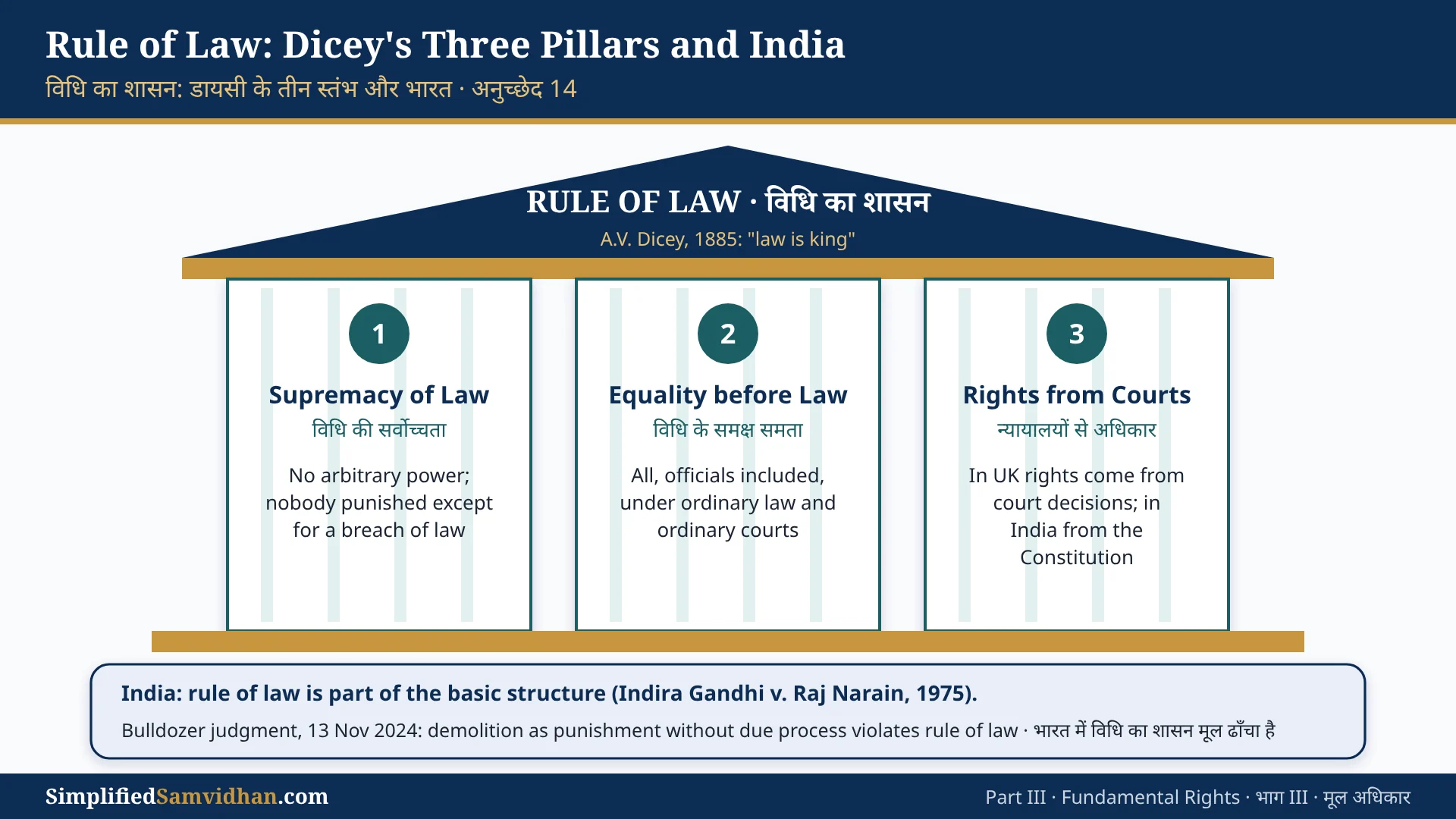
In November 2024 the Supreme Court stopped "bulldozer justice": a State cannot demolish a person's house just because he is accused of a crime. Punishing someone without trial, and picking only some accused for demolition, breaks the rule of law and Article 14. The Court laid down a 15-day notice and hearing before any demolition of an unauthorised structure.
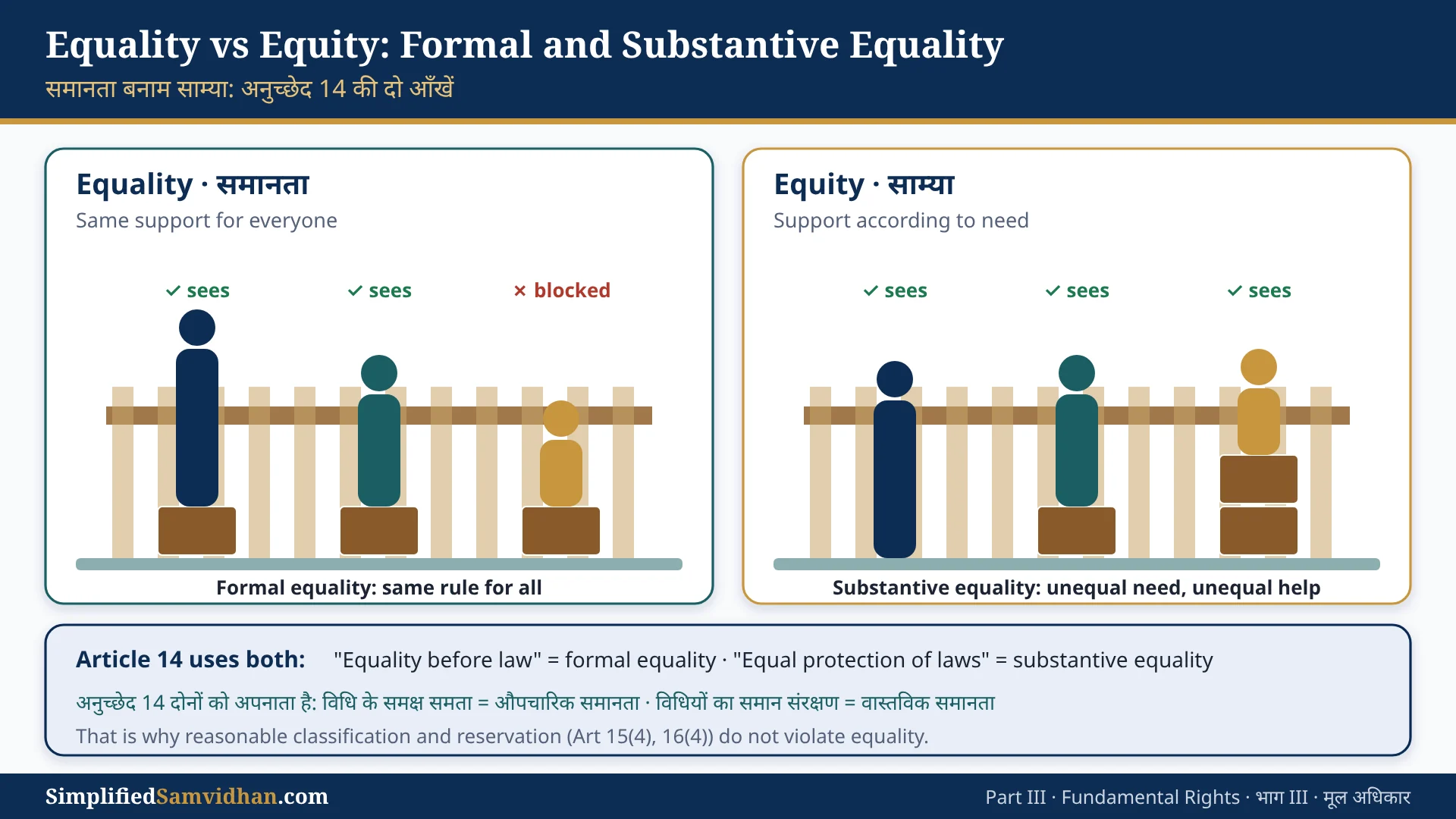
Meaning of EqualityEquality vs Equity: Formal and Substantive Equality under Article 14
Equality is about opportunities through which justice is established. It is not about making people identical: natural differences (tall and short, dark and fair) will always exist, and equality between them in that sense is not possible.
- Equality is linked to justice.
- It means the end of special privilege.
- It is a guarantee citizens hold against the State, a promise of justice against injustice.
- It is about opportunities through which social, economic and political equality can be secured.
- Through it, discrimination comes to an end.
Equity vs Equality
| Equity (साम्या) | Equality (समता) |
|---|---|
| Not written in the Constitution as a word; it is a goal of justice | Written in the Constitution (Articles 14 to 18) |
| A means: give each person what they need | An end: the same rights and rules for all |
| Seen more in the USA (affirmative action) | Seen more in the UK (same law for all) |
| Positive discrimination to lift the weak | Equal opportunity for everyone |
The picture in class notes says it best: three people of different heights watch a match over a wall. Equality gives each one the same box; the shortest still cannot see. Equity gives boxes by need, so all three can watch. The Indian Constitution accepts both.
Four kinds of equality
- Legal equality (formal): rights that come from law. Example: Article 14 itself.
- Political equality (formal): one person, one vote. Article 326 gives universal adult franchise and Section 62 of the Representation of the People Act, 1951 gives every elector on the roll the right to vote.
- Social equality (substantive): seen in Article 15 and Article 17. Law alone cannot fully create it; it also needs informal ways and better relations within society.
- Economic equality (substantive): seen in the reservation policy of Article 16 and in the Directive Principles. State effort alone cannot guarantee it.
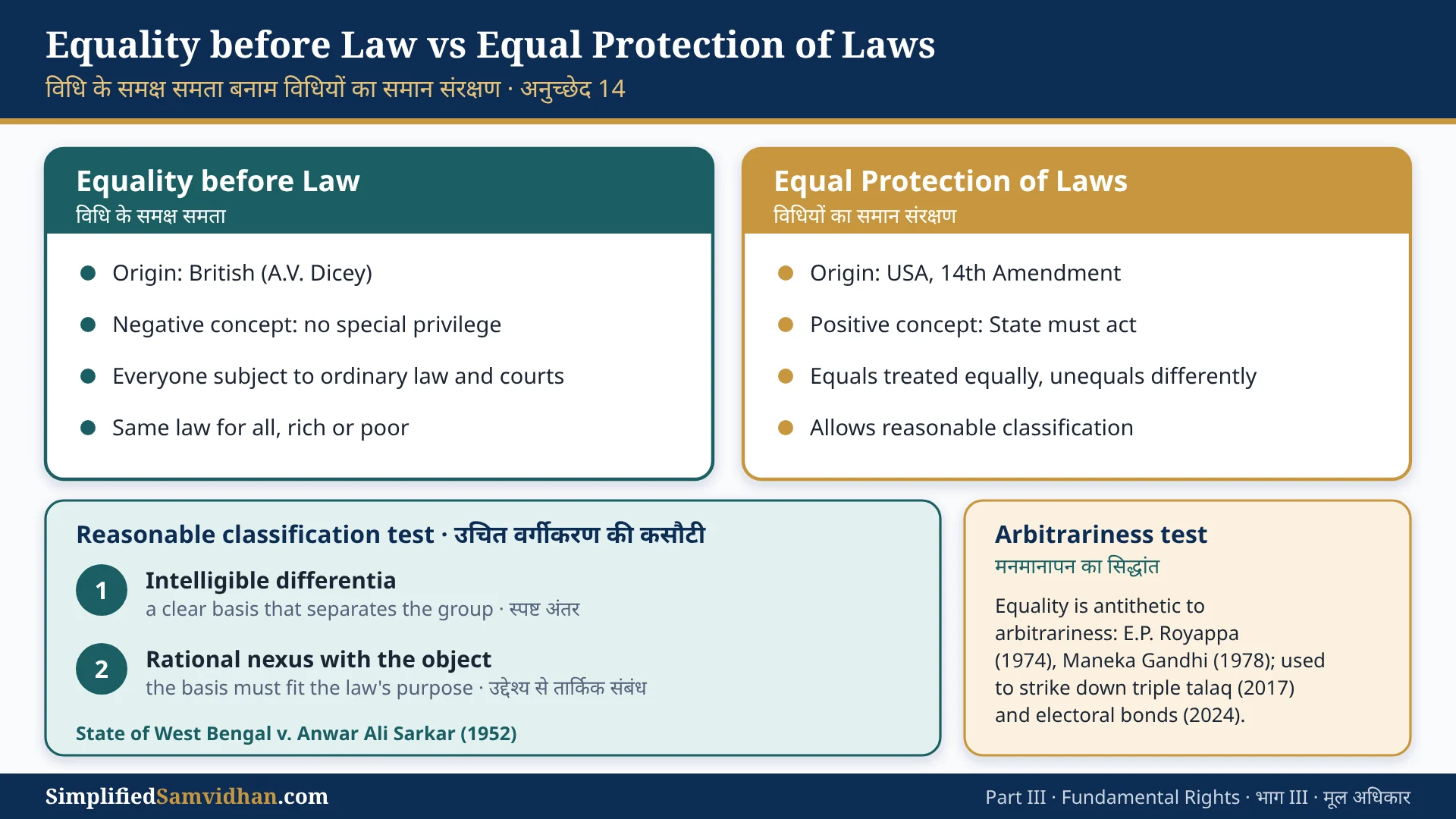
The Two HalvesEquality before Law vs Equal Protection of Laws, and the Reasonable Classification Test
The first half of Article 14 is borrowed from Britain, the second from the United States. (Your notes write "equal protection before law"; the exact words are "equal protection of the laws".)
| Equality before law (UK idea) | Equal protection of the laws (USA idea) |
|---|---|
| Treat everyone the same way before the law | Treat equals equally: same law for people in the same situation |
| Example: an SC, ST, OBC or general-category person all face the same criminal law | Example: within one class (say all OBC candidates) there is no discrimination |
| Negative concept: State gives an opportunity but does not actively equalise | Positive concept: State may make special laws to create real equality (reservation in India, affirmative action in the USA) |
| Comes from British constitutional practice (Dicey) | Comes from the US 14th Amendment (1868) |
| Same rules for all persons | Same rules for persons similarly placed; reasonable classification allowed |
| Aim: end privilege and discrimination in general | Aim: a fair, class-wise arrangement |
Reasonable classification: the twin test
Since State of West Bengal v. Anwar Ali Sarkar (1952) a law that treats groups differently is valid only if:
- Intelligible differentia: the group is separated from others on a clear, understandable basis (for example, "persons above 60").
- Rational nexus: that basis has a sensible link with the object of the law (cheaper rail tickets because seniors usually have less income).
In Anwar Ali Sarkar a Bengal law let the government send any case to special courts with a shortcut procedure, without saying which cases or why. That was arbitrary picking, so it was struck down. By contrast, in Chiranjit Lal Chowdhuri (1950) even a law for one company was upheld, because that company's special mismanagement was a real reason.
From classification to arbitrariness
- E.P. Royappa v. State of Tamil Nadu (1974): "equality and arbitrariness are sworn enemies". Any arbitrary State action violates Article 14.
- Maneka Gandhi v. Union of India (1978): Articles 14, 19 and 21 form a golden triangle; a procedure must be fair, just and reasonable.
- Shayara Bano v. Union of India (2017): even a law passed by a legislature can be struck down for manifest arbitrariness; instant triple talaq was set aside.
- Navtej Singh Johar (2018) and Joseph Shine (2018): Section 377 (as applied to consenting adults) and the adultery law fell partly on Article 14.
- ADR v. Union of India (15 February 2024): the Electoral Bond Scheme was struck down; unlimited anonymous corporate donations were held manifestly arbitrary.
- Anurag Krishna Sinha v. State of Bihar (10 March 2026): a 2015 Bihar Act taking over a 1924 trust library for one rupee was struck down as manifestly arbitrary under Article 14 and confiscatory under Article 300A.
Dicey and IndiaRule of Law: What is Law, Dicey's Concept and Administrative Law
What is law?
- The English word "law" is linked to the Latin idea of ligare, "to bind". The Hindi class notes put it neatly: law looks like a bond, but in reality law gives freedom.
- Law has some binding effects, but they exist to reform citizens' behaviour. Law also provides death penalty for crimes where reform seems impossible, but that is not its basic spirit.
- Nature of law: it is liberal and reformative; it has some rigidity; it is humanistic; and it has its own territorial jurisdiction (one country's laws do not apply in another).
- Law can promote morality, but law alone cannot create a moral society.
Dicey's rule of law vs administrative law
British jurist A.V. Dicey (1885) contrasted the English rule of law with French administrative law:
| Rule of Law (Dicey) | Administrative Law (droit administratif, France) |
|---|---|
| Law is supreme, not the ruler | Ordinary law for citizens, special law for officials |
| Equality before law: officials and citizens face the same ordinary courts | Disputes between citizen and administration go to special tribunals |
| Rights of citizens are the source of the constitution (judge-made) | The State pays for mistakes of its officials |
| Protects the citizen | Protects the administration |
Dicey's point: the rule of law protects citizens, administrative law protects the administration. So the rule of law should get priority.
Benefits of the rule of law
- Citizens' interests are secured as a priority.
- Citizens matter more than the administration.
- The goal of equality is achieved.
- It removes discrimination: no caste, religion or class is bigger than the law; law is supreme.
- Citizens' rights are protected.
- Democracy can be established and sustained.
Comparative PolityRule of Law in Britain vs India, and Right to Equality in the USA vs India
British and Indian concepts of the rule of law
| Britain (UK) | India |
|---|---|
| Law is supreme, but customs and conventions carry great weight | Law is supreme; customs count as "law" under Article 13, but matter less than in Britain |
| Stress on equality before law | Stress on both equality before law and equal protection of the laws |
| Citizens' rights are the source of the constitution (rights come first) | The Constitution is the source of rights, and it also carries social goals (Preamble, DPSP, reservation) |
| Many exceptions to the rule of law exist | Fewer exceptions, and courts can test them |
| Parliamentary sovereignty: Parliament has the last word | Judiciary has more weight: judicial review and the basic structure |
Right to equality: USA vs India
| United States | India |
|---|---|
| Not in the original 1787 Constitution; added by the 14th Amendment (1868) | Part of the original Constitution, in Part III, Articles 14 to 18 |
| Mainly formal equality (legal and political) | Formal and substantive equality (legal, political, social, economic) |
| Stress on equal protection of the laws | Both equality before law and equal protection of the laws |
| Affirmative action is narrow (race-based college admission ended in SFFA v. Harvard, 2023) | Strong positive discrimination: reservation for SC, ST, OBC and EWS |
| Specific anti-discrimination rules came mainly through laws such as the Civil Rights Act, 1964 | The Constitution itself bans discrimination directly in Articles 15, 16, 17 and 18 |
Conclusion for Mains: the Indian model is more comprehensive. It keeps Dicey's core (no one above the law), adds the American idea of equal protection, and goes further with social and economic justice through Articles 15 to 17, reservation and the Directive Principles, all guarded by an independent judiciary.
Not AbsoluteExceptions to Rule of Law and Article 14 in India
Even in India some people get special protection, so the rule of law has exceptions:
- President and Governors (Article 361): not answerable to any court for official acts; no criminal proceedings can be started or continued against them during their term; no court can issue a process for their arrest or imprisonment during the term.
- Civil cases for their personal acts can be filed during the term only after two months' written notice (Article 361(4)).
- MPs and MLAs (Articles 105 and 194): no court case for anything said or any vote given in the House, so no defamation suit for speeches in Parliament. Under Section 135A of the Code of Civil Procedure they cannot be arrested in a civil case during a session and 40 days before and after it. (Bribe-taking is not protected: Sita Soren, 2024.)
- Foreign rulers, ambassadors and diplomats enjoy immunity from Indian criminal and civil jurisdiction under international law (Vienna Convention, applied by the Diplomatic Relations Act, 1972).
- Public servants (IAS, IPS, police, forest officers) need prior government sanction before prosecution for acts done in official duty (Section 218 of the BNSS, formerly Section 197 CrPC).
- Article 31C: laws giving effect to Article 39(b) and (c) cannot be challenged under Article 14.
Quick RevisionKey Points to Remember
- Article 14 protects every person, citizen or not, against the State.
- Equality before law (British, negative) + equal protection of the laws (American, positive).
- Reasonable classification is allowed; class legislation is not (twin test, 1952).
- Arbitrariness itself violates Article 14 (Royappa 1974; manifest arbitrariness, Shayara Bano 2017).
- Dicey's rule of law: supremacy of law, equality before law, rights as the source of the constitution.
- Exceptions: Article 361, Articles 105/194, diplomats, sanction for public servants, Article 31C.
- The Constitution adopts both equality and equity: formal and substantive equality.
Case Law TimelineHow Article 14 Grew through the Courts
| Year | Judgment and holding |
|---|---|
| 1950 | Chiranjit Lal Chowdhuri: a law even for one company can be valid if there is a real reason. |
| 1952 | State of West Bengal v. Anwar Ali Sarkar: twin test of reasonable classification. |
| 1974 | E.P. Royappa: arbitrariness is the opposite of equality. |
| 1975 | Indira Nehru Gandhi v. Raj Narain: rule of law and equality are part of the basic structure. |
| 1978 | Maneka Gandhi: golden triangle of Articles 14, 19 and 21. |
| 2017 | Shayara Bano: manifest arbitrariness can strike down a law; instant triple talaq invalid. |
| 2024 | ADR (Electoral Bonds, 15 Feb) and the demolition judgment (13 Nov): Article 14 and rule of law applied. |
| 2026 | Anurag Krishna Sinha v. State of Bihar (10 Mar): takeover law for a trust library struck down as manifestly arbitrary. |
UPSC · State PSC · JudiciaryArticle 14 of Indian Constitution: UPSC Exam Corner
- Prelims trap: "Article 14 is available only to citizens." False. It covers any person, including foreigners and companies.
- Prelims trap: "Equal protection of laws" comes from the UK. False. It comes from the US Constitution; "equality before law" is the British idea.
- Mains (250 words): Present Dicey's concept of rule of law in the context of administrative law and analyse its Indian form.
- Mains (250 words): Compare the British and Indian models of the rule of law and show that the Indian model is more comprehensive.
- Mains (150 words): Distinguish equity and equality and explain how both shape the Indian Constitution.
- Linked topics: doctrine of eclipse and severability (Article 13), basic structure, and reservation (Article 16).
Practice MCQTest Yourself: Article 14
Consider the following statements about Article 14: 1. It is available to foreigners also. 2. "Equality before law" is a positive concept borrowed from the USA. 3. A classification is valid only if it has intelligible differentia and a rational nexus with the object of the law. Which are correct?
Doubts ClearedFrequently Asked Questions
What is Article 14 of Indian Constitution?
Article 14 says the State shall not deny to any person equality before the law or the equal protection of the laws within the territory of India. It is the first of the Right to Equality provisions (Articles 14 to 18).
What is the difference between equality before law and equal protection of laws?
Equality before law (from Britain) means no one is above the law and all face the same courts. Equal protection of the laws (from the USA) means equals are treated equally, so reasonable classification and special provisions for the weak are allowed.
Is Article 14 available to foreigners?
Yes. Article 14 uses the words "any person", so it protects foreigners and legal persons such as companies.
What is rule of law according to Dicey?
Dicey gave three ideas: supremacy of law (no arbitrary power), equality before law (officials and citizens in the same ordinary courts) and that citizens' rights, decided by courts, are the source of the constitution.
What are the exceptions to Article 14?
Immunity of the President and Governors (Article 361), parliamentary privileges (Articles 105 and 194), immunity of foreign diplomats, sanction for prosecuting public servants, and laws protected by Article 31C.