Gram Sabha Powers and Rights: What Every Villager Can Do
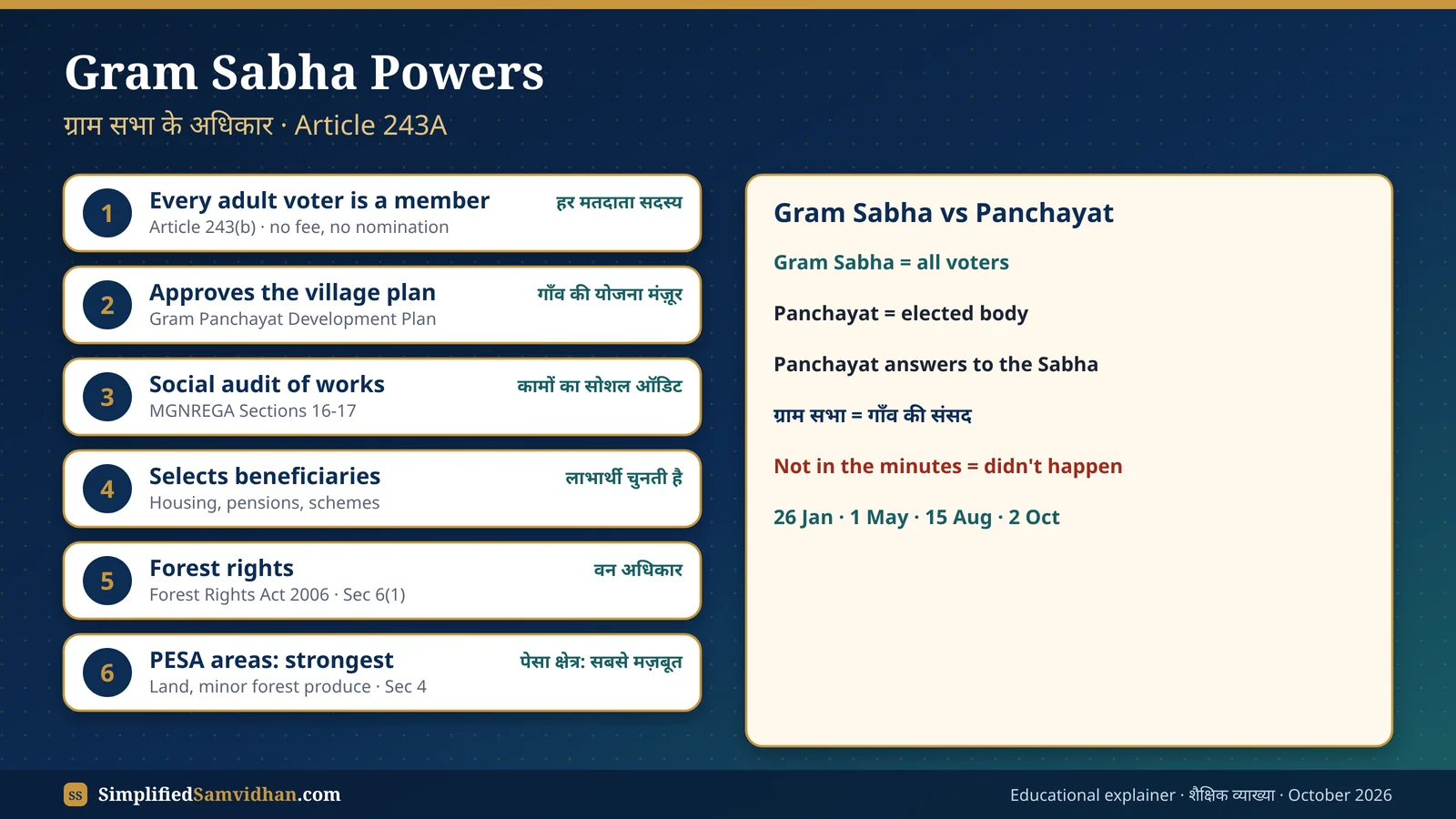
Every adult voter of a village is a member of the Gram Sabha. It approves plans, audits works and, in tribal areas, must be consulted before land is acquired. Here is how to use it.
MembersWho Is a Member of the Gram Sabha?
PowersPowers of the Gram Sabha: 6 Big Ones
| Power of the Gram Sabha | Where it comes from |
|---|---|
| Approve the village plan (Gram Panchayat Development Plan) and the list of works | State Panchayati Raj Act; MoPR guidelines |
| Recommend MGNREGA works and hold the social audit | MGNREGA 2005, Sections 16 and 17 |
| Select and verify beneficiaries of schemes (housing, pensions) | State Acts; PMAY-G guidelines |
| Consider the annual accounts and audit report of the Panchayat | State Panchayati Raj Act |
| Start the process to recognise forest rights | Forest Rights Act 2006, Section 6(1) |
| In Scheduled Areas: approve plans, certify use of funds, be consulted before land acquisition, own minor forest produce | PESA 1996, Section 4(e), 4(f), 4(i), 4(m) |
Step by stepHow to Use Your Gram Sabha Rights: 5 Steps
- 1
📅 Know the meeting dates
State Acts fix how many meetings a year (usually two to four) and the notice period. Many States hold special Gram Sabhas on 26 January, 1 May, 15 August and 2 October. The notice is put up at the Panchayat office and announced in the village.
- 2
🙋 Go, and bring others
Decisions need a quorum, often one-tenth of the voters (it differs by State). Low turnout is how fake meetings happen. Women's and SC/ST attendance rules apply in some States.
- 3
✍️ Put your issue on the agenda
Give a written request to the Sarpanch or Secretary before the meeting, signed by a few villagers. In most States a set share of voters can also demand a special meeting in writing.
- 4
📒 Get it written in the minutes
What is not in the minutes did not happen. Ask that your objection or resolution is written down, and later ask for a copy of the minutes by RTI.
- 5
📣 If meetings are not held, complain
Write to the Block Development Officer and the CEO of the Zila Parishad. Not holding Gram Sabha meetings is a ground for action against the Sarpanch in many State Acts; see how a Sarpanch can be removed.
The lawArticle 243A and PESA Section 4
Constitution of India · Article 243(b). "Gram Sabha" means a body consisting of persons registered in the electoral rolls relating to a village comprised within the area of Panchayat at the village level.
Article 243A. Gram Sabha. A Gram Sabha may exercise such powers and perform such functions at the village level as the Legislature of a State may, by law, provide.
Panchayats (Extension to the Scheduled Areas) Act, 1996 · Section 4(d). every Gram Sabha shall be competent to safeguard and preserve the traditions and customs of the people, their cultural identity, community resources and the customary mode of dispute resolution;
The Gram Sabha is India's only direct democracy: no representatives, every voter speaks for themselves. The Constitution names it, the State law gives it powers, and in tribal (Scheduled) areas PESA makes it the strongest body in the village.
🏠 Everyday analogy
If the Panchayat is the village's cabinet, the Gram Sabha is its parliament, where the cabinet must present its plans and accounts.
🇮🇳 Real Indian example
In the Niyamgiri case (Orissa Mining Corporation v. Ministry of Environment, 2013) the Supreme Court left it to the Gram Sabhas to decide whether mining affected their religious and forest rights. All twelve Gram Sabhas said no.
ConstitutionGram Sabha and the Constitution
Article 40: Village panchayats
The Directive Principle behind Part IX. The 73rd Amendment (1992, in force 24 April 1993, now Panchayati Raj Day) gave it constitutional teeth.
Article 46: Interests of weaker sections
PESA's strong Gram Sabha powers in Scheduled Areas carry forward the State's duty to protect Scheduled Tribes from exploitation.
Rajasthan Panchayat Chunav 2026All Rajasthan Panchayat Election 2026 Guides in One Place
Practice MCQTest Yourself: Gram Sabha
Which Article of the Constitution says that a Gram Sabha may exercise such powers as the State Legislature may by law provide?
Doubts ClearedFrequently Asked Questions
Who is a member of the Gram Sabha?
Every person registered in the electoral roll of the village (Article 243(b)). No separate membership is needed.
What is the difference between Gram Sabha and Gram Panchayat?
The Gram Sabha is all voters of the village; the Gram Panchayat is the elected body of Sarpanch and ward members that works under the Gram Sabha's watch.
How many Gram Sabha meetings must be held in a year?
It depends on the State Act, usually two to four. Many States hold them on 26 January, 1 May, 15 August and 2 October.
What extra powers does the Gram Sabha have under PESA?
In Fifth Schedule areas it approves plans, identifies beneficiaries, certifies use of funds, must be consulted before land acquisition and owns minor forest produce (PESA Section 4).
Sources and further readingSources We Checked
Facts checked on 23 October 2026 against Part IX of the Constitution, PESA 1996, the Forest Rights Act 2006 and MGNREGA 2005. Meeting and quorum rules differ by State.