Bare ActOfficial Text of Article 40
40. Organisation of village panchayats.—
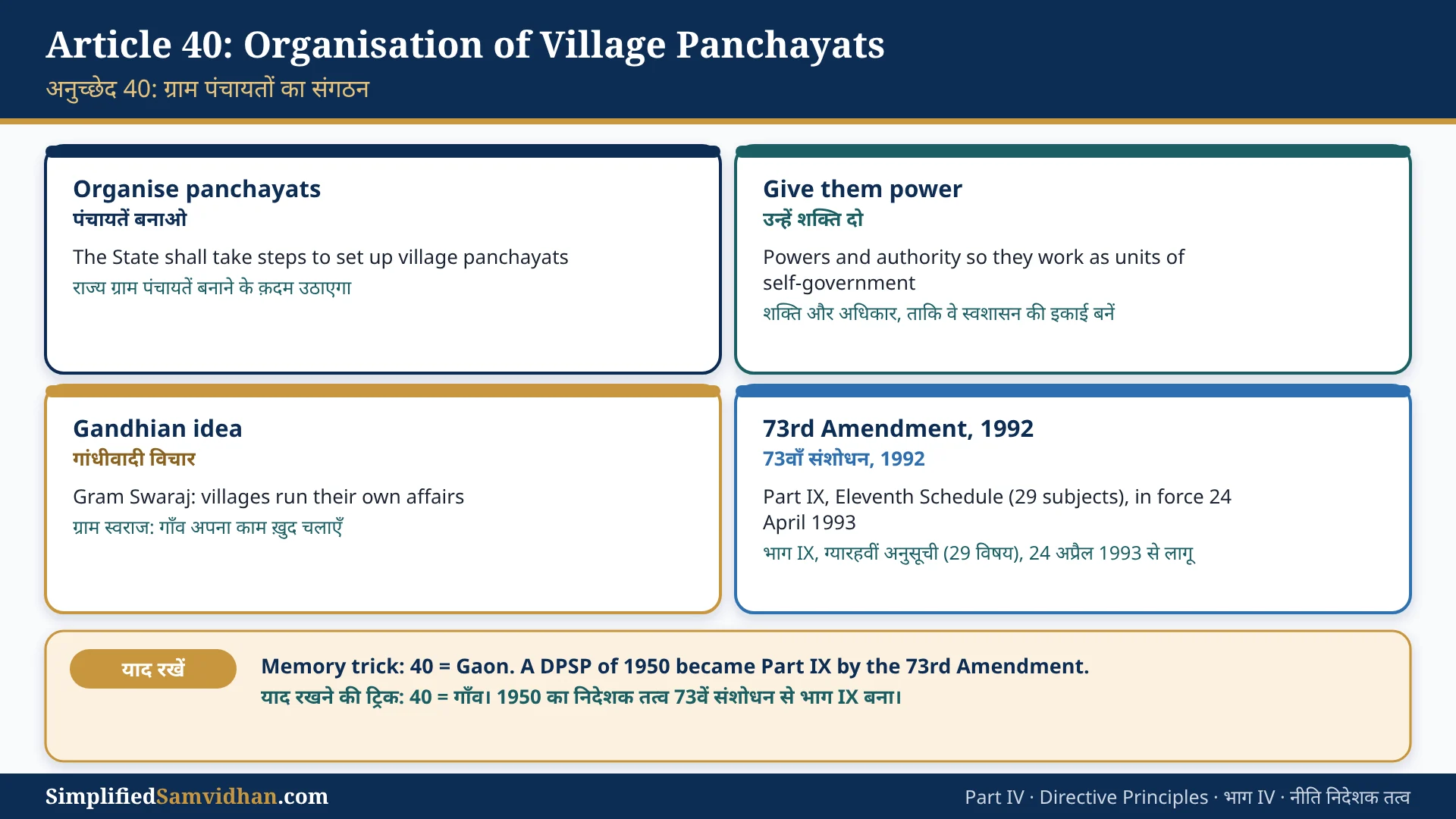
The State shall take steps to organise village panchayats and endow them with such powers and authority as may be necessary to enable them to function as units of self-government.
The State must set up village panchayats.
It must give them real powers, not just a name board.
Goal: panchayats work as units of self-government, so villagers run local matters.
It is a Gandhian principle (Gram Swaraj).
🏠 Everyday Analogy
A school is easier to run when each class has its own monitor who knows the students. A panchayat is the village's monitor: close to the people, so it knows their problems best.
🇮🇳 Real Indian Example
In a village in Maharashtra, the Gram Sabha meets and decides to repair the school's boundary wall and dig a new well. The elected sarpanch and panchayat members carry out the plan. That is self-government at the village level, as Article 40 wanted.
From DPSP to Part IXArticle 40 of Indian Constitution: From Village Panchayats to Panchayati Raj
| Year | Step |
|---|---|
| 1957 | Balwant Rai Mehta Committee suggests three-tier Panchayati Raj |
| 1959 | First Panchayati Raj starts in Nagaur, Rajasthan (2 October) |
| 1992 | 73rd Amendment adds Part IX (Articles 243 to 243O) and the Eleventh Schedule |
| 1993 | Comes into force on 24 April, now National Panchayati Raj Day |
What the 73rd Amendment gave panchayats
- A three-tier system: village, block (intermediate) and district levels.
- Regular elections every five years, run by a State Election Commission.
- At least one-third seats for women (Article 243D), and seats for SCs and STs.
- 29 subjects in the Eleventh Schedule, like drinking water, roads and primary schools.
Quick RevisionKey Points to Remember
- Article 40: State shall organise village panchayats as units of self-government.
- A Gandhian principle.
- Made real by the 73rd Amendment, 1992 (Part IX, Articles 243 to 243O).
- Eleventh Schedule: 29 subjects for panchayats.
- 24 April is National Panchayati Raj Day.
UPSC · State PSC · JudiciaryArticle 40: Exam Corner
- Prelims trap: "The 73rd Amendment changed the words of Article 40." False. Article 40 is unchanged; the amendment added a new Part IX.
- Fact (SSC/school): Panchayats are in the Eleventh Schedule (29 subjects); municipalities are in the Twelfth (74th Amendment).
- Mains (150 words): "Article 40 was a promise; the 73rd Amendment made it a duty." Discuss.
Practice MCQTest Yourself: Article 40
Consider: 1. Article 40 is a Gandhian principle. 2. The 73rd Amendment added Part IX on panchayats. 3. Article 40 can be enforced in a court. Which are correct?
Doubts ClearedFrequently Asked Questions
What is Article 40 of Indian Constitution?
Article 40 is a Directive Principle that asks the State to organise village panchayats and give them enough powers to work as units of self-government.
How was Article 40 implemented?
Mainly through the 73rd Amendment, 1992, in force from 24 April 1993. It added Part IX and the Eleventh Schedule, giving panchayats constitutional status, regular elections and reserved seats.
Why is Article 40 called Gandhian?
Gandhiji believed in Gram Swaraj: strong, self-reliant villages that manage their own affairs. Article 40 puts this idea into the Constitution.