Bare ActOfficial Text of Article 46
46. Promotion of educational and economic interests of Scheduled Castes, Scheduled Tribes and other weaker sections.—
The State shall promote with special care the educational and economic interests of the weaker sections of the people, and, in particular, of the Scheduled Castes and the Scheduled Tribes, and shall protect them from social injustice and all forms of exploitation.
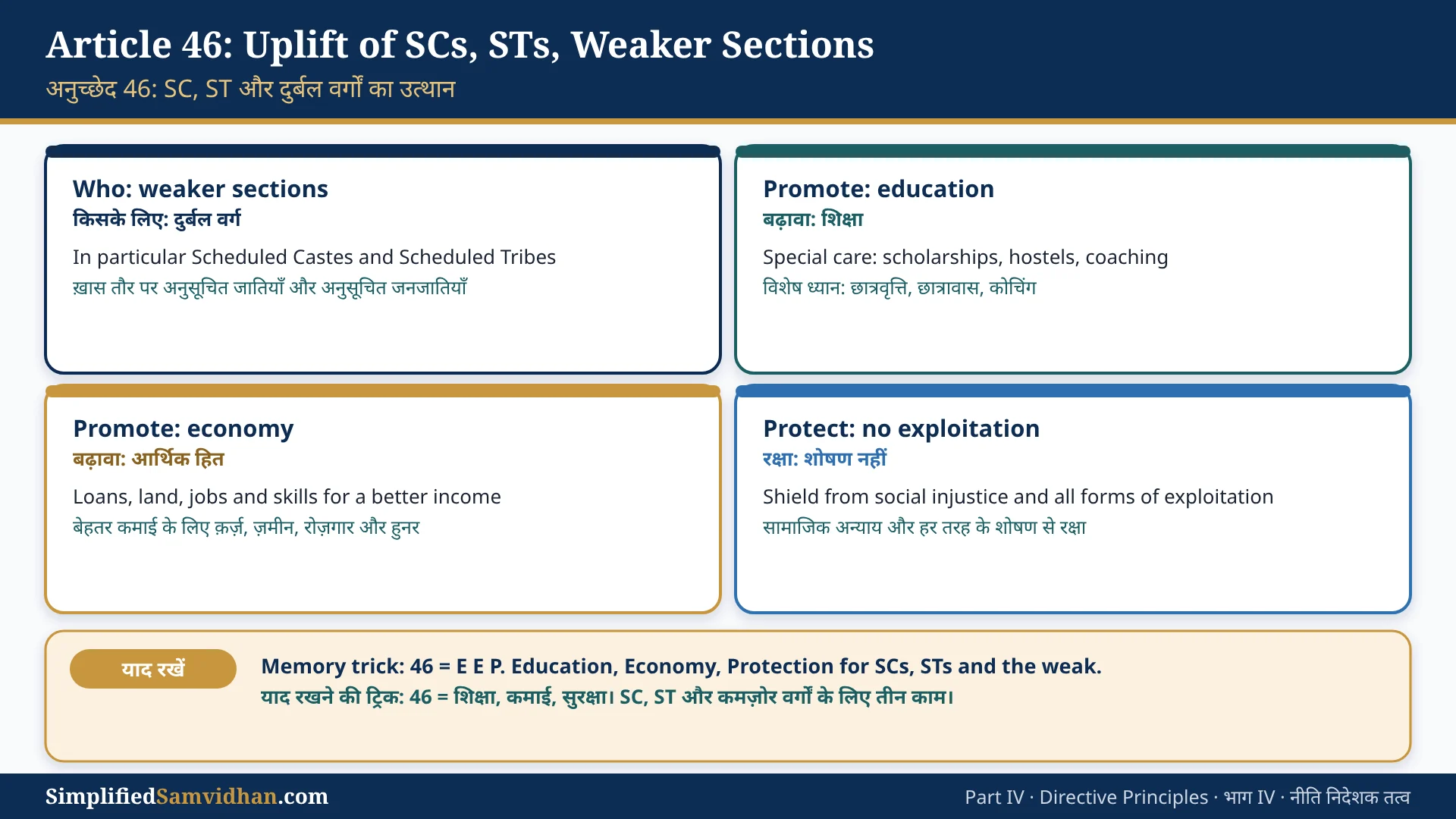
The State must take special care of the weaker sections, above all Scheduled Castes (SCs) and Scheduled Tribes (STs).
Two things to promote: their education and their economic interests.
One thing to prevent: social injustice and exploitation of any kind.
It is a DPSP, so it guides laws and schemes but cannot be enforced in court on its own.
🏠 Everyday Analogy
In a race, some runners were made to start far behind the line for years. Article 46 is the coach who gives them extra training, good shoes and a fair track, so the race becomes fair.
🇮🇳 Real Indian Example
Ravi, the son of a farm labourer from a Scheduled Caste family, gets the Post-Matric Scholarship and a seat in a government hostel, and finishes college. When a landlord in his village threatens his family, the SC/ST (Prevention of Atrocities) Act, 1989 protects them.
Laws and SchemesArticle 46 of Indian Constitution: Laws and Schemes for SCs, STs and Weaker Sections
| Part of Article 46 | How the State applies it |
|---|---|
| Education | Scholarships (such as the Post-Matric Scholarship for SC students), hostels, free coaching |
| Economic interests | Cheap loans, land and skill schemes; reservation in jobs under Article 16(4) |
| Protection from injustice | Protection of Civil Rights Act 1955; SC/ST (Prevention of Atrocities) Act 1989 |
Key case
- State of Madras v. Champakam Dorairajan (1951): Madras reserved college seats by community, citing Article 46. The Supreme Court struck it down because a DPSP cannot override a Fundamental Right (Article 29(2)).
- Parliament then passed the 1st Amendment, 1951, adding Article 15(4), which allows special provisions for SCs, STs and backward classes. Article 46 is the idea behind it.
Quick RevisionKey Points to Remember
- Article 46: promote with special care the educational and economic interests of weaker sections.
- Names only SCs and STs; "weaker sections" is not defined.
- Also: protect them from social injustice and all forms of exploitation.
- Champakam Dorairajan (1951) led to the 1st Amendment and Article 15(4).
- Category: Gandhian. Never amended.
UPSC · State PSC · JudiciaryArticle 46: Exam Corner
- Prelims trap: "Article 46 names Other Backward Classes." False. It names only SCs and STs, and speaks generally of "weaker sections".
- Fact (SSC / school): Article 46 is grouped with the Gandhian principles, because uplift of the poor and the excluded was central to Gandhi's idea of India.
- Mains: "Article 46 has been the moral basis of India's social justice laws." Explain with examples.
Practice MCQTest Yourself: Article 46
Article 46 directs the State to promote which interests of the weaker sections?
Doubts ClearedFrequently Asked Questions
What is Article 46 of Indian Constitution?
Article 46 is a Directive Principle. It asks the State to promote with special care the education and economic interests of weaker sections, especially SCs and STs, and to protect them from injustice and exploitation.
Is reservation given under Article 46?
Not directly. Reservation comes from Fundamental Rights provisions like Articles 15(4) and 16(4). Article 46 is the guiding idea behind them, but it cannot be enforced in court by itself.
Which laws apply Article 46?
Examples are the Protection of Civil Rights Act 1955 and the SC/ST (Prevention of Atrocities) Act 1989, along with scholarship and hostel schemes for SC and ST students.