Bare ActOfficial Text of Article 20
20. Protection in respect of conviction for offences.—
(1) No person shall be convicted of any offence except for violation of a law in force at the time of the commission of the act charged as an offence, nor be subjected to a penalty greater than that which might have been inflicted under the law in force at the time of the commission of the offence.
(2) No person shall be prosecuted and punished for the same offence more than once.
(3) No person accused of any offence shall be compelled to be a witness against himself.
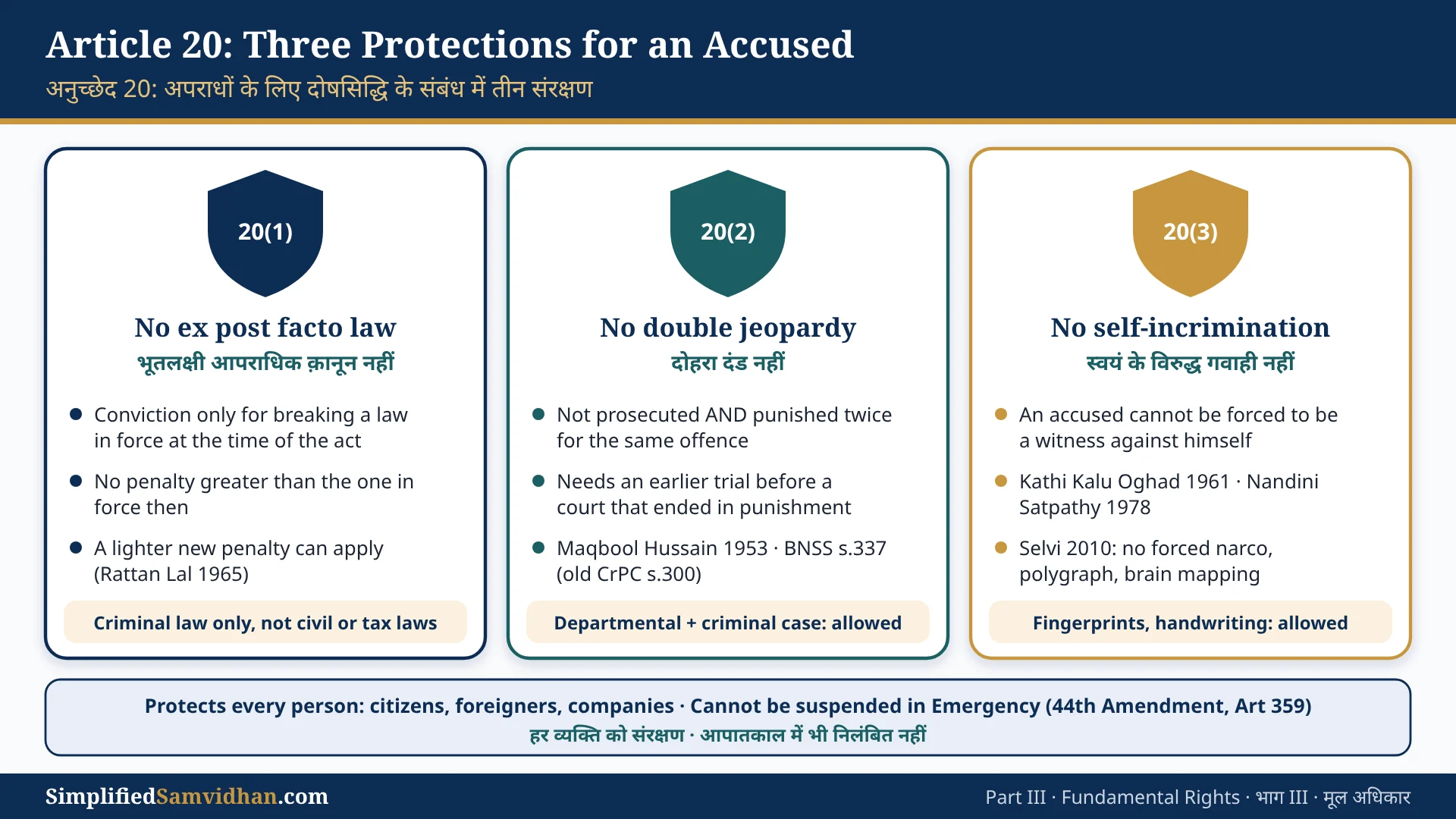
20(1): if something was legal when you did it, a new law cannot make you a criminal for it later. And if the punishment is increased after your act, the old, lighter punishment applies to you.
20(2): once a court has prosecuted and punished you for an offence, the State cannot try and punish you again for the same offence.
20(3): an accused person cannot be forced to be a witness against himself. Police cannot beat or trick a confession out of you, and you may stay silent.
Article 20 protects every person: citizens, foreigners and even companies. It works only in criminal matters.
🏠 Everyday Analogy
Think of a cricket match. The umpire cannot change the rules after the ball is bowled and then give you out (20(1)). Once you are given out and walk back, you are not given out again for the same ball (20(2)). And no one can force the batsman to appeal against himself (20(3)).
🇮🇳 Real Indian Example
In 2024 the new criminal laws (BNS, BNSS, BSA) replaced the IPC, CrPC and Evidence Act from 1 July. A theft committed in May 2024 is still tried and punished under the IPC, because 20(1) looks at the law in force on the day of the act. If a new law raises the punishment for an offence, it cannot be applied to acts done before it came into force.
Three ProtectionsArticle 20 of Indian Constitution: Three Protections for an Accused
| Clause | Protection | Simple meaning |
|---|---|---|
| 20(1) | No ex post facto criminal law | You can be punished only under a law that existed when you acted, and not with a heavier penalty than that law allowed |
| 20(2) | No double jeopardy | If a court has already prosecuted and punished you for an offence, you cannot be prosecuted and punished for it again |
| 20(3) | No self-incrimination | An accused cannot be forced to give evidence against himself; he can stay silent |
Who is protected and when
- The word used is "person", so citizens, foreigners and legal persons such as companies are covered.
- It applies only to criminal proceedings: conviction, penalty, prosecution. It does not cover civil suits, tax demands or purely departmental matters.
- Under Article 359(1), as changed by the 44th Amendment 1978, the enforcement of Articles 20 and 21 cannot be suspended during a National Emergency. All other Fundamental Rights in Part III can be.
Ex Post Facto LawArticle 20(1) of Indian Constitution: Protection against Ex Post Facto Law
- Ex post facto means "after the fact". An ex post facto law makes an act a crime, or raises its punishment, after the act was done.
- 20(1) has two limbs: (i) no conviction except for breaking a law in force at the time of the act; (ii) no penalty greater than the one that law allowed. In Kedar Nath Bajoria v. State of West Bengal (1953) an extra fine added by a later law could not be imposed for an earlier offence.
- A lighter new punishment can be given retrospectively, because it helps the accused. In Rattan Lal v. State of Punjab (1965) a boy convicted before the Probation of Offenders Act 1958 applied in the area still got its benefit.
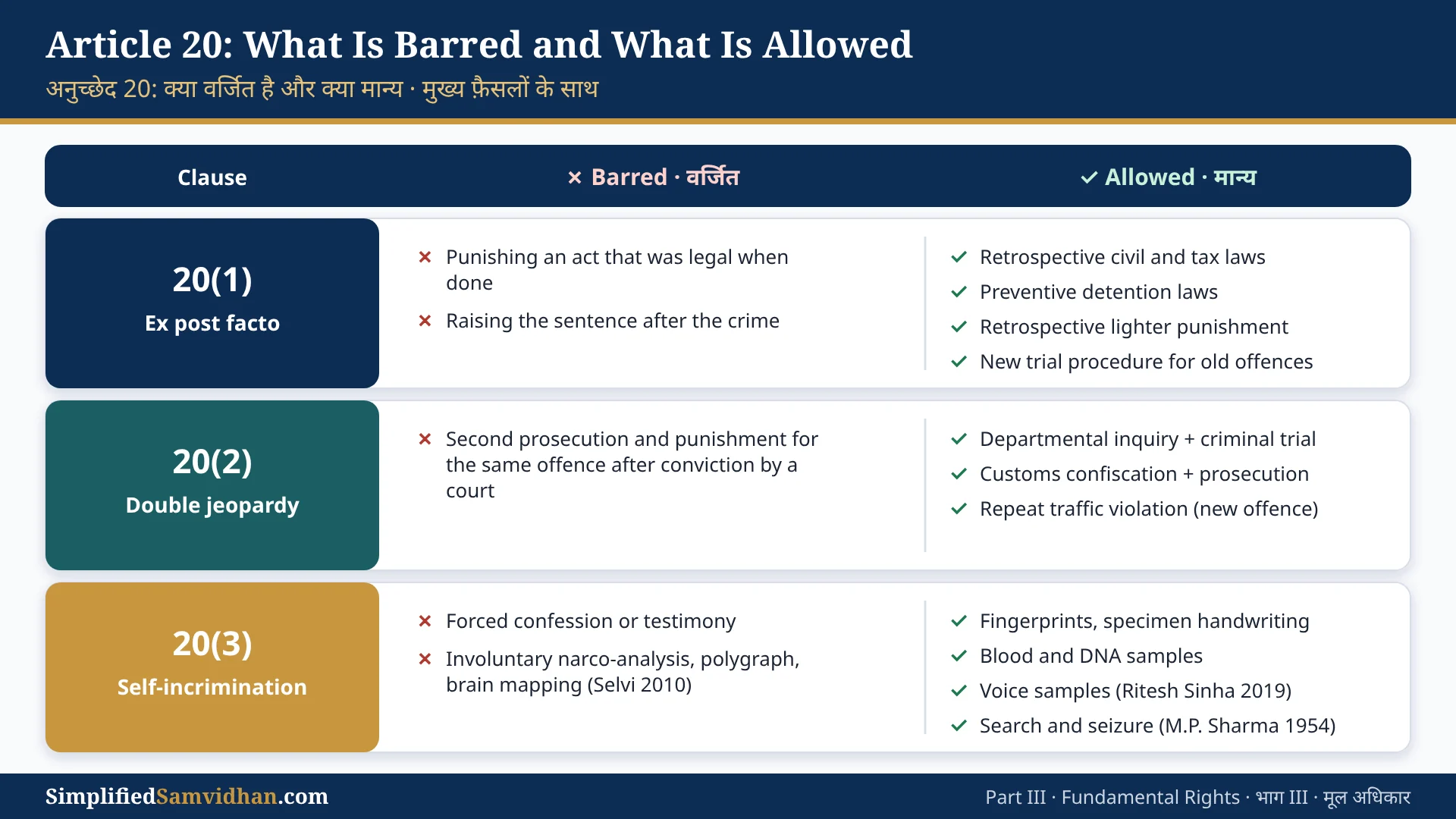
- 20(1) bars only conviction and sentence. A person has no vested right in a procedure, so a new trial procedure or a new court can be used for old offences.
- It does not bar retrospective civil or tax laws, and it does not bar preventive detention, which is not a conviction.
- Your notes rightly say: this protection is for criminal law only.
Double JeopardyArticle 20(2) of Indian Constitution: Double Jeopardy
- The idea comes from the US Constitution (5th Amendment) and the English common law, but India adopted it in a narrower form.
- The US rule protects against a second trial even after an acquittal. Article 20(2) applies only when the person was both prosecuted and punished.
- The first proceeding must be before a court or judicial tribunal. In Maqbool Hussain v. State of Bombay (1953), confiscation of gold by customs authorities was not "prosecution", so a later criminal trial was allowed. S.A. Venkataraman v. Union of India (1954) said the same of a departmental inquiry.
- It must be the same offence. If one act breaks two different laws with different ingredients, both can be prosecuted.
The traffic-rules example, explained correctly
- Your notes say civil and administrative wrongs can be punished twice, for example breaking traffic rules again and again. The correct way to put it: each repeat violation is a new offence, so a fine each time is not double jeopardy.
- Also, departmental action (like suspension of a government servant) and a criminal trial for the same act can go on together.
The statutory rule
- The Code of Criminal Procedure gave a wider rule in section 300: a person once convicted or acquitted cannot be tried again for the same offence. Since 1 July 2024 this is section 337 of the Bharatiya Nagarik Suraksha Sanhita (BNSS) 2023.
Self-IncriminationArticle 20(3) of Indian Constitution: Right against Self-Incrimination and Narco Tests
- 20(3) protects a person accused of an offence from being compelled to be a witness against himself. Its roots lie in the old rule that nobody should be forced to accuse himself.
- State of Bombay v. Kathi Kalu Oghad (1961, 11 judges): being a "witness" means giving personal knowledge (testimony). Giving fingerprints, palm prints or specimen handwriting is not testimony, so the police can take them.
- Nandini Satpathy v. P.L. Dani (1978): the protection starts at police questioning, not only in court. A person may refuse to answer questions that would expose him to a criminal charge: the right to silence.
- Selvi v. State of Karnataka (2010, 3 judges): involuntary narco-analysis, polygraph (lie-detector) and brain-mapping (BEAP) tests violate Article 20(3) and Article 21. They are allowed only with the person's free consent, recorded before a magistrate, and the results alone are not evidence.
- Ritesh Sinha v. State of Uttar Pradesh (2019): a magistrate can order a person to give a voice sample. Like blood or DNA samples, it is physical evidence, not testimony.
- Search and seizure is not "compulsion to be a witness" (M.P. Sharma, 1954).
Quick RevisionKey Points to Remember
- 20(1): no conviction under a later law, and no penalty greater than the one in force at the time.
- 20(2): no second prosecution and punishment for the same offence; needs an earlier court trial.
- 20(3): no compelled testimony; fingerprints and handwriting samples are allowed (Kathi Kalu Oghad 1961).
- Selvi (2010): involuntary narco, polygraph and brain-mapping tests are unconstitutional.
- Protects every person, in criminal matters only; cannot be suspended in Emergency.
TimelineArticle 20: Key Cases and Dates
| Year | Event |
|---|---|
| 1950 | Article 20 comes into force with the Constitution. |
| 1953 | Maqbool Hussain: customs confiscation is not prosecution; Kedar Nath Bajoria: no higher penalty later. |
| 1961 | Kathi Kalu Oghad: fingerprints and handwriting samples are not testimony. |
| 1965 | Rattan Lal: a lighter new law can help the accused. |
| 1978 | 44th Amendment: Articles 20 and 21 cannot be suspended in Emergency; Nandini Satpathy: right to silence. |
| 2010 | Selvi: involuntary narco, polygraph and brain-mapping tests unconstitutional. |
| 2019 | Ritesh Sinha: magistrate can order voice samples. |
| 2024 | BNSS s.337 replaces CrPC s.300 from 1 July. |
UPSC · State PSC · JudiciaryArticle 20: UPSC Exam Corner
- Prelims trap: "Article 20 is available only to citizens." False. It protects every person, including foreigners and companies.
- Prelims trap: "Article 20(2) bars a departmental inquiry after a criminal trial." False. Only a second prosecution and punishment by a court is barred.
- Prelims fact: Articles 20 and 21 cannot be suspended during a National Emergency (44th Amendment 1978, Article 359).
- Mains (150 words): "The right against self-incrimination must be balanced with the needs of investigation." Discuss with reference to the Selvi case.
Practice MCQTest Yourself: Article 20
Which of the following violates Article 20(3)? 1. Taking an accused's fingerprints 2. A narco-analysis test on an accused without consent 3. Ordering an accused to give a specimen handwriting
Doubts ClearedFrequently Asked Questions
What is Article 20 of Indian Constitution?
Article 20 gives three protections to a person accused of a crime: no punishment under an ex post facto law or with a heavier penalty, no double jeopardy, and no compulsion to be a witness against himself.
What is double jeopardy in Indian Constitution?
Under Article 20(2), no person can be prosecuted and punished for the same offence more than once. It applies only when an earlier prosecution before a court ended in punishment. BNSS section 337 (old CrPC section 300) also bars a retrial after acquittal.
Is a narco test legal in India?
Only with the free consent of the person, recorded before a magistrate, and with safeguards. In Selvi v. State of Karnataka (2010) the Supreme Court held that involuntary narco, polygraph and brain-mapping tests violate Articles 20(3) and 21.
Can Article 20 be suspended during an Emergency?
No. Since the 44th Amendment 1978, Article 359 does not allow the President to suspend the enforcement of Articles 20 and 21 during a National Emergency.