Preventive Detention Law in India: Article 22 Safeguards Against Repeated Police Detention
Why can the police pick someone up before any crime is committed, and how long can they hold them? Here is the law on preventive detention under Article 22, the difference from punitive arrest, and what the Supreme Court said in 2026 about detaining peaceful citizens.
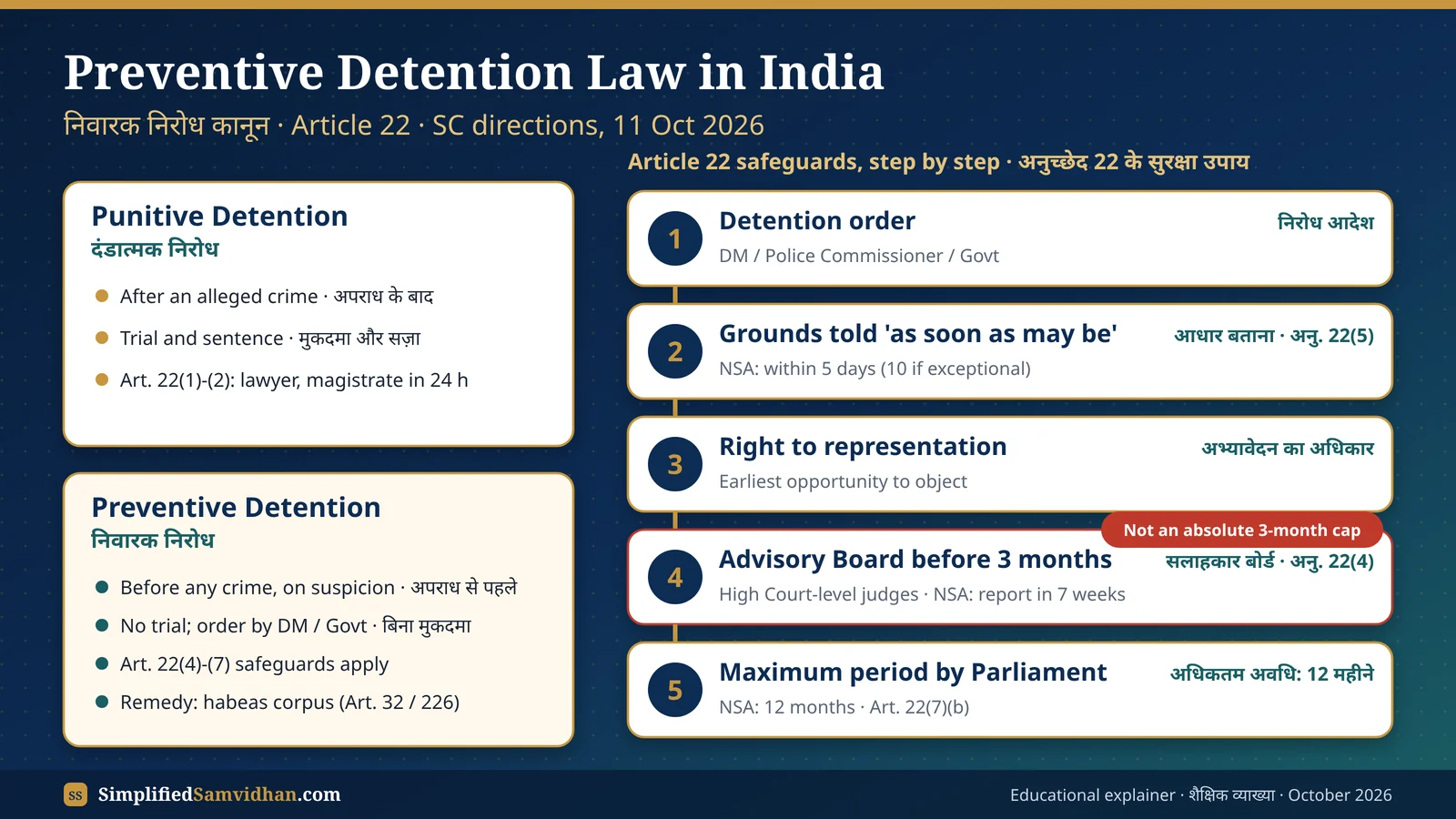
What happened in October 2026
During the protests in New Delhi in the second week of October 2026, petitioners told the Supreme Court that thousands of people had been detained by the Delhi Police (one petition put the figure above 6,000; senior counsel told the Court about 7,000). On Sunday, 11 October 2026, a bench of Justice Joymalya Bagchi and Justice V. Mohana held a special sitting in Shailendra Mani Tripathi v. Govind Mohan and directed that "there shall be no detention of any person except in accordance with the procedure established by law", especially for peaceful, unarmed gatherings outside the area covered by the Section 163 BNSS order. It also ordered normal metro and rail services, free movement, a review of barricades, undisturbed internet, and no obstruction of advocates.
Important for readers: these are interim directions in a pending case about Delhi. As of 15 October 2026 we could not find a new, separate set of nationwide "guidelines" on preventive detention. The binding rules are still Article 22, the detention statutes and the Supreme Court's settled case law, all explained below. We will update this page if the Court issues a final judgment.
The BasicsWhat Is Preventive Detention in India?
Preventive detention means holding a person in custody not because they have committed a crime, but to stop them from doing something harmful in the future. The order is made by the executive (a District Magistrate, Police Commissioner or the Government) on its own "subjective satisfaction". There is no trial and no conviction.
Most democracies use this power only in war or emergencies. India is unusual: the Constitution itself permits preventive detention even in peacetime, through Article 22, and Entry 9 of List I and Entry 3 of List III let Parliament and State Legislatures make such laws. Dr. B.R. Ambedkar accepted it in the Constituent Assembly as a necessary evil for a newly independent country, but insisted on the safeguards in clauses (4) to (7).
Ordinary arrest is like a referee showing a red card after a foul. Preventive detention is like the coach benching a player before the match because he fears the player may start a fight. No foul has happened yet, so the law demands very strong reasons and strict checks on the coach.
🏠 Everyday analogy
A school principal keeps a student out of the annual function because of rumours that he plans to disrupt it. He has done nothing yet. Fair play demands that the principal tells him why, lets him explain, and that a neutral teacher reviews the decision.
🇮🇳 Real Indian example
A State Government detains a man under its Goonda Act because several bootlegging cases are pending against him. In Vidyawant v. State of Maharashtra (13 May 2026) the Supreme Court quashed such an order: where ordinary criminal law can deal with the person, preventive detention is not justified.
Key DifferencePunitive vs Preventive Detention: The Core Difference
🔒 Punitive Detention (Arrest for a crime)
- Happens after an offence is alleged.
- Purpose: punish through trial and sentence.
- Based on evidence; guilt proved beyond reasonable doubt in court.
- Article 22(1) and (2) apply fully: grounds, lawyer, magistrate in 24 hours.
- Governed by BNSS, 2023 and the Bharatiya Nyaya Sanhita, 2023.
- Bail is the rule, jail the exception.
🛡️ Preventive Detention (to stop a future act)
- Happens before any offence, on suspicion of future conduct.
- Purpose: prevent harm to public order or security.
- Based on the authority's satisfaction; no trial, no conviction.
- Article 22(1) and (2) do not apply (Article 22(3)(b)); clauses (4) to (7) apply instead.
- Governed by special laws: NSA 1980, COFEPOSA 1974, PITNDPS 1988, State Goonda Acts.
- No bail under the Act; the remedy is representation, Advisory Board and habeas corpus.
The Supreme Court explained this in Haradhan Saha v. State of West Bengal (1975): preventive detention is not a punishment, so a person can be detained even while a criminal case on the same facts is pending. But in Rekha v. State of Tamil Nadu (2011) the Court added the balancing rule: if ordinary criminal law is enough to deal with a person, using preventive detention is illegal.
Know the DifferenceWhy Citizens Are Detained Without a Crime and Then Released
When people say "the police detained me at a protest and let me go in the evening", that is usually not preventive detention under Article 22. Three very different powers get mixed up:
| Type | Law | How long | What it looks like |
|---|---|---|---|
| 1. Arrest for an offence | BNSS ss. 35, 47, 58; Article 22(1)-(2) | Max 24 hours before a magistrate; longer only by court order | FIR registered, person accused of a crime |
| 2. Police preventive action | BNSS s. 170 (arrest to prevent a cognizable offence), s. 172 (persons resisting lawful police directions), ss. 126-129 (security bonds) | s. 170: not beyond 24 hours unless another law allows; s. 172: release or produce before a magistrate within 24 hours | Protesters bundled into buses, held at a police station or stadium, released the same day |
| 3. Formal preventive detention | NSA 1980, COFEPOSA 1974, PITNDPS 1988, State Goonda/MPDA-type Acts; Article 22(4)-(7) | Up to 3 months on the order; longer only with Advisory Board approval; NSA maximum 12 months | Written detention order with grounds, person sent to jail |
Section 170 BNSS (old Section 151 CrPC) lets a police officer arrest without warrant a person who is designing to commit a cognizable offence, if the offence cannot otherwise be prevented. Section 172 BNSS (a new provision in 2023) obliges everyone to follow lawful police directions and lets the police detain or remove a person who resists, and then produce him before a magistrate or, in petty cases, release him within 24 hours. These short detentions still have to be lawful, recorded and proportionate. That is exactly what the Supreme Court's 11 October 2026 direction protects: no detention except in accordance with the procedure established by law.
Think of three doors. Door 1 is for people accused of a crime. Door 2 is a short waiting room the police may use for a few hours to stop trouble on the spot. Door 3 is a long-stay room, opened only by a written order from a senior officer, with a judge-level board checking it. Being taken through Door 2 again and again, with no record and no reason, is not allowed.
🏠 Everyday analogy
A traffic constable can stop your car for a few minutes to clear a VIP convoy. He cannot keep you parked by the road all day, every week, without any reason. Short, lawful and necessary is the test.
🇮🇳 Real Indian example
On 13 October 2026, protest leaders who crossed barricades at Jantar Mantar were taken into custody by the Delhi Police, as reported by international media. Such action falls under the police's BNSS powers, not under the National Security Act.
Official TextArticle 22(4) to 22(7): Preventive Detention Safeguards
22. Protection against arrest and detention in certain cases.
(4) No law providing for preventive detention shall authorise the detention of a person for a longer period than three months unless—
(a) an Advisory Board consisting of persons who are, or have been, or are qualified to be appointed as, Judges of a High Court has reported before the expiration of the said period of three months that there is in its opinion sufficient cause for such detention:
Provided that nothing in this sub-clause shall authorise the detention of any person beyond the maximum period prescribed by any law made by Parliament under sub-clause (b) of clause (7); or
(b) such person is detained in accordance with the provisions of any law made by Parliament under sub-clauses (a) and (b) of clause (7).
(5) When any person is detained in pursuance of an order made under any law providing for preventive detention, the authority making the order shall, as soon as may be, communicate to such person the grounds on which the order has been made and shall afford him the earliest opportunity of making a representation against the order.
(6) Nothing in clause (5) shall require the authority making any such order as is referred to in that clause to disclose facts which such authority considers to be against the public interest to disclose.
(7) Parliament may by law prescribe—
(a) the circumstances under which, and the class or classes of cases in which, a person may be detained for a period longer than three months under any law providing for preventive detention without obtaining the opinion of an Advisory Board in accordance with the provisions of sub-clause (a) of clause (4);
(b) the maximum period for which any person may in any class or classes of cases be detained under any law providing for preventive detention; and
(c) the procedure to be followed by an Advisory Board in an inquiry under sub-clause (a) of clause (4).
Clause (4): The Government can hold a person under a preventive detention law for up to three months on its own. To go beyond three months it needs a green signal from an Advisory Board of High Court-level judges, given before the three months end. Even then, it cannot cross the maximum period fixed by Parliament (12 months under the NSA).
Clause (5): The detained person must be told the grounds quickly, in a language he understands, along with the documents relied on, and must get the earliest chance to make a representation (a written objection).
Clause (6): The Government may hold back facts that are against public interest, but never the grounds themselves.
Clause (7): Parliament decides the maximum period, the procedure of the Advisory Board, and special cases where longer detention without the Board is allowed.
🏠 Everyday analogy
A hostel warden can suspend a student for up to three months. To extend it, a committee of senior professors must agree before the three months are over, and no suspension can cross the university's maximum limit.
🇮🇳 Real Indian example
Under the National Security Act, 1980, the case must reach the Advisory Board within 3 weeks of detention, the Board must report within 7 weeks, and the total detention cannot exceed 12 months.
Myth buster: Is three months an absolute limit? No. Article 22(4) says detention beyond three months is not allowed unless an Advisory Board reports sufficient cause, or Parliament's law under clause (7) permits it. So three months is the limit for detention without independent review, not an absolute ceiling. The 44th Amendment (1978) tried to cut this to two months, but that part was never brought into force, so the three-month rule still applies.
Official TextArticle 22(1) to 22(3): Rights on Arrest and the Preventive Detention Exception
(1) No person who is arrested shall be detained in custody without being informed, as soon as may be, of the grounds for such arrest nor shall he be denied the right to consult, and to be defended by, a legal practitioner of his choice.
(2) Every person who is arrested and detained in custody shall be produced before the nearest magistrate within a period of twenty-four hours of such arrest excluding the time necessary for the journey from the place of arrest to the court of the magistrate and no such person shall be detained in custody beyond the said period without the authority of a magistrate.
(3) Nothing in clauses (1) and (2) shall apply—
(a) to any person who for the time being is an enemy alien; or
(b) to any person who is arrested or detained under any law providing for preventive detention.
If you are arrested for a crime, you have three guaranteed rights: to know why, to talk to a lawyer of your choice, and to be taken to a magistrate within 24 hours. Clause (3) switches off these two clauses for enemy aliens and for people held under a preventive detention law. That is why clauses (4) to (7) exist: they are the replacement safety net for preventive detainees.
🏠 Everyday analogy
A shop must give a bill for every sale (clauses 1 and 2). For a special category of goods, a different rulebook applies (clause 3), but that rulebook has its own strict receipts and inspections (clauses 4 to 7).
🇮🇳 Real Indian example
The BNSS repeats these rights in detail: grounds of arrest (s. 47), informing a relative or friend (s. 48), meeting an advocate during interrogation (s. 38), medical examination (s. 53) and the 24-hour rule (s. 58).
The Statute BookPreventive Detention Laws in India: NSA and Other Acts
| Law | Who can order | Key limits |
|---|---|---|
| National Security Act, 1980 | Central or State Government; a District Magistrate or Police Commissioner if empowered | DM/CP order lapses in 12 days unless the State approves; grounds within 5 days (10 in exceptional cases); Board reference in 3 weeks, report in 7 weeks; maximum 12 months |
| COFEPOSA, 1974 | Central or State Government | Smuggling and foreign-exchange racketeering |
| PITNDPS Act, 1988 | Central or State Government | Illicit drug trafficking |
| State laws (e.g. Maharashtra MPDA Act 1981, Tamil Nadu Act 14 of 1982, Telangana Act 1986, Gujarat PASA 1985) | State Government / District Magistrate / Commissioner | Bootleggers, goondas, drug offenders, land grabbers and similar categories |
History in one line: Preventive Detention Act 1950 (upheld in A.K. Gopalan, 1950) → Maintenance of Internal Security Act (MISA) 1971, misused during the Emergency and repealed in 1978 → National Security Act 1980 (upheld in A.K. Roy v. Union of India, 1982).
Courts as WatchdogsSupreme Court Safeguards Against Misuse of Preventive Detention
There is no single "guidelines" judgment. Instead, over 75 years the Supreme Court has built a checklist that every detention order must pass. Fail one test and the order is quashed through a habeas corpus petition under Article 32 or 226.
- 1Real material, not stock phrases
Grounds must show live facts. Copy-paste of the statute's words is not enough (Vidyawant, 2026; Ameena Begum, 2023).
- 2Public order, not mere law and order
An ordinary crime affecting a few people is "law and order"; detention needs a threat to the community at large (Ram Manohar Lohia, 1966; Banka Sneha Sheela, 2021).
- 3Ordinary law first
If regular criminal law, bail conditions or an appeal against bail can handle the person, detention is not allowed (Rekha, 2011; Vidyawant, 2026).
- 4Live link, no stale cases
Old incidents with no recent connection cannot justify detention today (Sama Aruna v. State of Telangana, 2017).
- 5All documents supplied
Every document relied on must be given in a language the detenu understands; otherwise Article 22(5) is violated (Jaseela Shaji v. Union of India, 2024).
- 6Representation decided quickly
Unexplained delay in deciding the detenu's representation makes the detention illegal (Kamleshkumar Ishwardas Patel, 1995).
- 7Fair procedure under Article 21
Any law taking away liberty must be just, fair and reasonable (Maneka Gandhi, 1978). The Emergency-era ADM Jabalpur (1976) view was overruled in K.S. Puttaswamy (2017).
Think of a detention order as a pressure cooker with seven safety valves. If even one valve is blocked (vague grounds, old cases, missing papers, slow reply), the court releases the pressure and frees the person.
🏠 Everyday analogy
A teacher who wants to stop a student from writing an exam must show fresh, specific proof, give him copies of every complaint, and answer his appeal quickly. A vague "he looks like trouble" will not do.
🇮🇳 Real Indian example
In Ameena Begum v. State of Telangana (2023) the Supreme Court set aside a detention under the Telangana Act and warned that preventive detention must not become a shortcut around regular criminal law.
Practical HelpWhat To Do If You or a Family Member Is Detained
- Ask which law is being used: arrest for an offence, BNSS s. 170/172, or a detention order under NSA or a State Act.
- Ask for grounds in writing and copies of the documents relied on. This is your right under Article 22 and BNSS s. 47.
- Insist that a relative or friend is informed (BNSS s. 48) and note the name and police station.
- Contact a lawyer immediately. Free legal aid is available to anyone in custody through the District Legal Services Authority (NALSA helpline 15100).
- Production within 24 hours: an arrested person must be produced before a magistrate within 24 hours, excluding travel time.
- Make a written representation against a detention order to the detaining authority and the Government without delay.
- File habeas corpus in the High Court (Article 226) or the Supreme Court (Article 32) if the detention is illegal.
This page is legal education, not legal advice. For a real case, speak to a lawyer or your District Legal Services Authority.
UPSC CornerPreventive Detention for UPSC Prelims and Mains
- Prelims fact: Article 22 is the only Fundamental Right that expressly allows a law to take away liberty without trial.
- Prelims fact: Advisory Board members must be persons who are, have been, or are qualified to be High Court judges.
- Prelims fact: Parliament (List I, Entry 9: defence, foreign affairs, security of India) and both Parliament and States (List III, Entry 3: security of a State, public order, essential supplies) can make preventive detention laws.
- 44th Amendment (1978): reduced the period to two months, but this provision has not been notified, so three months remains in force.
- Mains (250 words): "Preventive detention is a necessary evil in a democracy." Discuss with reference to Article 22, the NSA and recent judicial trends.
- Value addition: quote Justice Bagchi's 11 October 2026 direction and Vidyawant (2026) to show the current judicial approach.
Practice MCQTest Yourself: Preventive Detention & Article 22
Consider the following statements about preventive detention in India: (1) Article 22(4) forbids detention beyond three months in every situation. (2) Clauses (1) and (2) of Article 22 do not apply to a person detained under a preventive detention law. (3) Under the National Security Act, 1980, the maximum period of detention is 12 months. Which of the statements given above is/are correct?
Doubts ClearedFrequently Asked Questions
What is preventive detention under Article 22?
It is detention of a person without trial to prevent a future act harmful to public order, security or essential supplies. Article 22(4) to (7) lays down the safeguards: a three-month limit without Advisory Board review, communication of grounds, and the right to make a representation.
Can the police detain me without committing any crime?
Only under a law. The police can briefly detain a person under BNSS Section 170 (to prevent a cognizable offence) or Section 172 (resisting lawful directions), usually for no more than 24 hours. Longer detention needs a formal order under a preventive detention law such as the NSA, with Article 22 safeguards.
Is three months the maximum period of preventive detention?
No. Three months is the maximum without Advisory Board approval. With a favourable Board report, detention can continue up to the maximum fixed by Parliament, which is 12 months under the National Security Act.
What did the Supreme Court order on 11 October 2026?
In Shailendra Mani Tripathi v. Govind Mohan, a bench of Justices Joymalya Bagchi and V. Mohana directed that no person shall be detained except in accordance with the procedure established by law, especially peaceful and unarmed protesters, and ordered normal metro and rail services, free movement and undisturbed internet in Delhi.
What is the difference between punitive and preventive detention?
Punitive detention follows an alleged offence and aims to punish after a trial. Preventive detention happens before any offence, on the authority's satisfaction, to prevent future harm; there is no trial or conviction.
Sources and further readingSources We Checked
News facts on this page were checked against the reports below on 15 October 2026. Court cases are pending and may change.
- LiveLaw, 11 Oct 2026: Supreme Court directs no illegal detention of peaceful protesters (Shailendra Mani Tripathi v. Govind Mohan)
- LawBeat, Jun 2026: Vidyawant v. State of Maharashtra (13 May 2026)
- Supreme Court of India: Ameena Begum v. State of Telangana (4 Sep 2023)
- The Week, 12 Oct 2026: When does apprehension become a valid ground to curb liberty?
- Al Jazeera, 13 Oct 2026: Police detain protest leaders at Jantar Mantar
- Legislative Department, Government of India: The Constitution of India (official text)