Bare ActOfficial Text of Article 39A
39A. Equal justice and free legal aid.—
The State shall secure that the operation of the legal system promotes justice, on a basis of equal opportunity, and shall, in particular, provide free legal aid, by suitable legislation or schemes or in any other way, to ensure that opportunities for securing justice are not denied to any citizen by reason of economic or other disabilities.
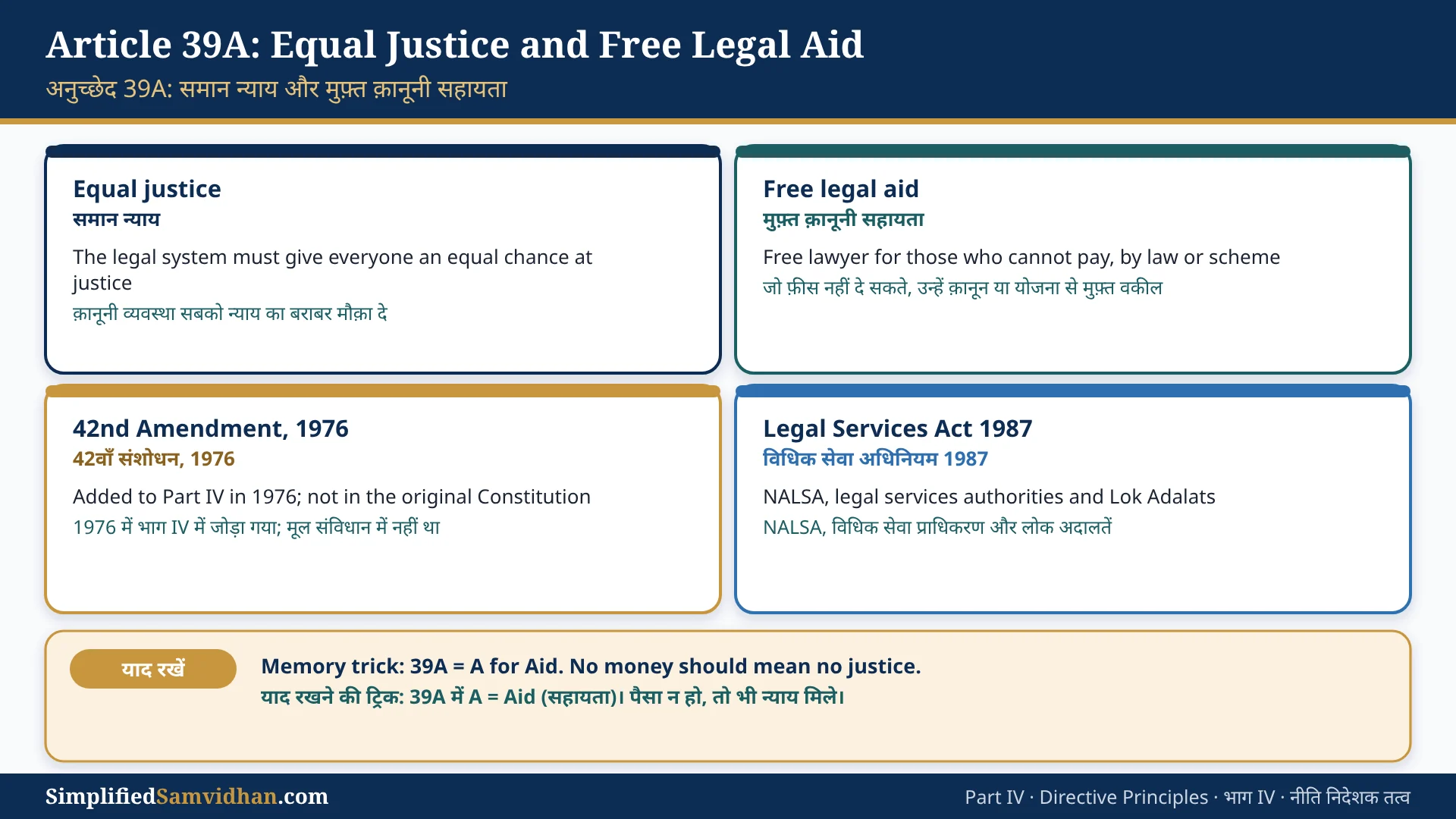
The legal system must work so that everyone gets an equal chance at justice.
The State must give free legal aid to people who cannot afford a lawyer.
It can do this by law, by schemes or in any other way.
No citizen should lose a case just because of poverty or any other disability.
🏠 Everyday Analogy
A cricket match is not fair if one team has bats and the other has none. Free legal aid hands a bat to the poor player, so the match in court is fair.
🇮🇳 Real Indian Example
Ramu, a daily wage worker in a Bihar village, is arrested and cannot pay a lawyer. Under the Legal Services Authorities Act, 1987, the District Legal Services Authority gives him a lawyer free of cost. That is Article 39A at work.
How It WorksArticle 39A in Action: Free Legal Aid System in India
Parliament passed the Legal Services Authorities Act, 1987 to carry out Article 39A. It came into force on 9 November 1995, now marked as National Legal Services Day.
| Who | What they do |
|---|---|
| NALSA (National Legal Services Authority) | Makes legal aid policy for the whole country |
| State and District Legal Services Authorities | Give free lawyers and advice in each State and district |
| Lok Adalat (people's court) | Settles disputes by compromise, quickly and with no court fee |
Key cases
- M.H. Hoskot v State of Maharashtra (1978): a poor prisoner must get free legal help to file an appeal.
- Hussainara Khatoon v State of Bihar (1979): thousands of undertrial prisoners were in jail for years without trial. The Court said free legal aid is part of Article 21 (fair procedure).
Quick RevisionKey Points to Remember
- Article 39A: equal justice and free legal aid.
- Added by the 42nd Amendment, 1976.
- Applied by the Legal Services Authorities Act, 1987 (NALSA, Lok Adalats).
- Hussainara Khatoon (1979): free legal aid is part of Article 21.
- Category: Socialist principle.
UPSC · State PSC · JudiciaryArticle 39A: Exam Corner
- Prelims trap: "Article 39A was part of the original Constitution of 1950." False. It came with the 42nd Amendment, 1976.
- Fact (SSC/school): National Legal Services Day is 9 November; NALSA works under the Legal Services Authorities Act, 1987.
- Mains (150 words): "Justice delayed for the poor is justice denied." How has Article 39A helped undertrial prisoners?
Practice MCQTest Yourself: Article 39A
Article 39A (equal justice and free legal aid) was added to the Constitution by which amendment?
Doubts ClearedFrequently Asked Questions
What is Article 39A of Indian Constitution?
Article 39A is a Directive Principle that asks the State to make the legal system fair for all and to give free legal aid, so that no citizen is denied justice because of poverty or any other disability.
Which law gives effect to Article 39A?
The Legal Services Authorities Act, 1987. It set up NALSA, State and District Legal Services Authorities, and gave legal backing to Lok Adalats.
Can I go to court if I am denied free legal aid?
Article 39A itself cannot be enforced in court (Article 37). But the Supreme Court has read free legal aid into Article 21, so a person accused of a crime who gets no lawyer can go to court under Article 21.