Constituent Assembly of India and the Making of the Indian Constitution
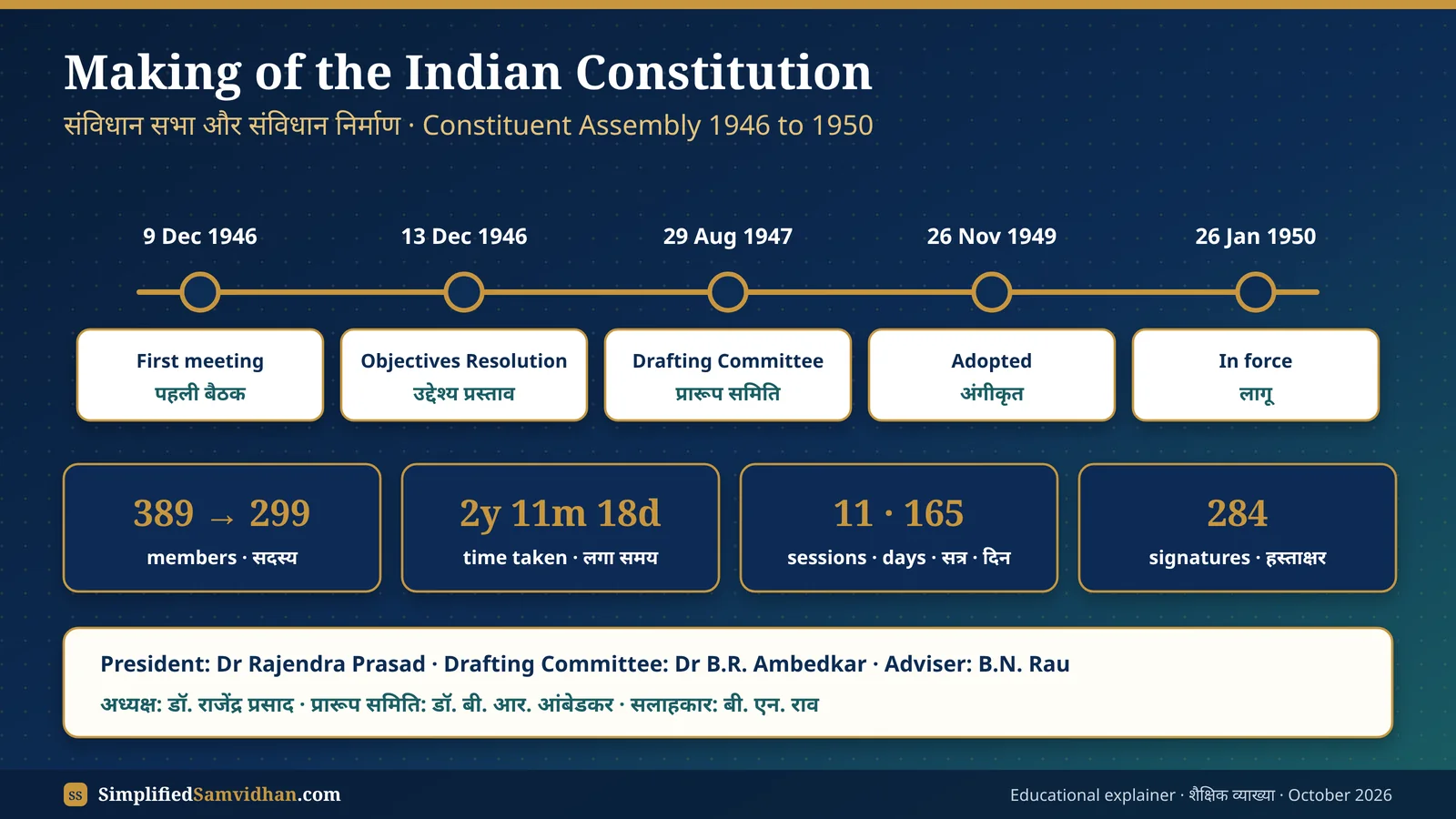
From the Cabinet Mission Plan to 26 January 1950: how the Constituent Assembly was formed, who drafted the Constitution, the committees and their chairmen, and every date and number that exams ask.
Articles 393 and 394Making of Indian Constitution: Adopted 26 November 1949, in Force 26 January 1950
393. Short title. This Constitution may be called the Constitution of India.
394. Commencement. This article and articles 5, 6, 7, 8, 9, 60, 324, 366, 367, 379, 380, 388, 391, 392 and 393 shall come into force at once, and the remaining provisions of this Constitution shall come into force on the twenty-sixth day of January, 1950, which day is referred to in this Constitution as the commencement of this Constitution.
These two Articles near the end of the Constitution give it its name and its birthday. The Constitution was adopted on 26 November 1949, but most of it waited two months and came into force on 26 January 1950. A few urgent parts started at once on 26 November 1949: citizenship (Articles 5 to 9), the President's oath (Article 60), the Election Commission (Article 324), definitions, and the transitional provisions. Why? Because India needed to know who its citizens were and needed an Election Commission ready before the new Republic began.
26 January was chosen on purpose: on that day in 1930 the Congress had celebrated Purna Swaraj Day after the Lahore Session resolution of December 1929.
🏠 Everyday analogy
A new school building is inaugurated in November, but classes start only in the new session in January. The guard, the admission register and the timetable committee start work right away, so that everything runs on day one.
🇮🇳 Real Indian example
That is why India celebrates two days: Constitution Day (Samvidhan Divas) on 26 November, observed since 2015, and Republic Day on 26 January, with the parade on Kartavya Path.
CompositionConstituent Assembly of India: Composition under the Cabinet Mission Plan 1946
| Category | Seats in 1946 | How chosen |
|---|---|---|
| Governors' Provinces (British India) | 292 | Indirectly elected by Provincial Legislative Assemblies |
| Chief Commissioners' Provinces | 4 | Delhi, Ajmer-Merwara, Coorg, British Baluchistan: one each |
| Princely States | 93 | Nominated by the rulers of the States |
| Total | 389 | Partly elected, partly nominated; not directly elected by adult franchise |
- Method: seats in each Province were divided among Muslims, Sikhs and General (all others) in proportion to population; members were elected by the single transferable vote system of proportional representation.
- Election result (July-August 1946): Congress won 208 seats, the Muslim League 73, and small groups and independents 15. The League boycotted the Assembly.
- After Partition: members from areas that went to Pakistan left; strength fell to 299 (229 from Provinces, 70 from princely States).
- Two roles: from 1947 the Assembly was also the Dominion's first Parliament. As a legislature it was chaired by G.V. Mavalankar; as the constitution-making body, by Rajendra Prasad.
- 15 women were members, including Sarojini Naidu, Hansa Mehta, Durgabai Deshmukh, Rajkumari Amrit Kaur, Sucheta Kripalani and Dakshayani Velayudhan (the only Dalit woman member).
TimelineMaking of the Indian Constitution: Timeline from 1934 to 1950
| Date | Event in the making of the Constitution |
|---|---|
| 1934 | M.N. Roy first puts forward the idea of a Constituent Assembly for India. |
| 1940 | The British accept the demand in principle in the August Offer. |
| 16 May 1946 | Cabinet Mission Plan lays down how the Assembly will be formed. |
| 9 Dec 1946 | First meeting (211 members). Dr Sachchidananda Sinha, the oldest member, is temporary President. |
| 11 Dec 1946 | Dr Rajendra Prasad elected permanent President; H.C. Mookherjee and V.T. Krishnamachari Vice-Presidents; Sir B.N. Rau constitutional adviser. |
| 13 Dec 1946 | Nehru moves the Objectives Resolution (adopted 22 Jan 1947); it later became the Preamble. |
| 22 Jul 1947 | National Flag adopted. |
| 29 Aug 1947 | Drafting Committee set up under Dr B.R. Ambedkar. |
| Feb 1948 | Draft Constitution published; people got about eight months to suggest changes. |
| 4 Nov 1948 to 26 Nov 1949 | Three readings: first (4 to 9 Nov 1948), second clause by clause (15 Nov 1948 to 17 Oct 1949), third (14 to 26 Nov 1949). |
| 26 Nov 1949 | Constitution adopted: 395 Articles, 22 Parts, 8 Schedules. Now Constitution Day. |
| 24 Jan 1950 | Last session: 284 members sign; 'Jana Gana Mana' adopted as National Anthem and 'Vande Mataram' as National Song; Rajendra Prasad elected first President. |
| 26 Jan 1950 | Constitution comes into force; India becomes a Republic. Now Republic Day. |
Drafting CommitteeDrafting Committee of the Constituent Assembly: Members and Work
The Drafting Committee was set up on 29 August 1947 with seven members. It worked on the first draft prepared by the constitutional adviser Sir B.N. Rau.
Dr B.R. Ambedkar (Chairman)
Piloted the Draft through the Assembly; called the 'chief architect' of the Constitution.
N. Gopalaswamy Ayyangar
Former Diwan of Kashmir; later Union Minister.
Alladi Krishnaswamy Ayyar
Leading lawyer and former Advocate-General of Madras.
K.M. Munshi
Lawyer, writer and founder of the Bharatiya Vidya Bhavan.
Syed Mohammad Saadullah
Former Premier of Assam.
N. Madhava Rau and T.T. Krishnamachari
Madhava Rau replaced B.L. Mitter (resigned); T.T. Krishnamachari replaced D.P. Khaitan (died in 1948).
- About 7,600 amendments were proposed to the Draft, and roughly 2,400 were actually discussed.
- The Draft was considered for 114 days out of the 165 days of sittings.
- T.T. Krishnamachari noted in the Assembly that most members were busy elsewhere, so the burden of drafting fell largely on Ambedkar.
CommitteesCommittees of the Constituent Assembly and Their Chairmen
| Committee | Chairman |
|---|---|
| Union Powers Committee | Jawaharlal Nehru |
| Union Constitution Committee | Jawaharlal Nehru |
| States Committee (negotiating with princely States) | Jawaharlal Nehru |
| Provincial Constitution Committee | Sardar Vallabhbhai Patel |
| Advisory Committee on Fundamental Rights, Minorities and Tribal and Excluded Areas | Sardar Vallabhbhai Patel |
| Fundamental Rights Sub-Committee | J.B. Kripalani |
| Minorities Sub-Committee | H.C. Mookherjee |
| North-East Frontier Tribal Areas and Assam Excluded Areas Sub-Committee | Gopinath Bardoloi |
| Excluded and Partially Excluded Areas (other than Assam) Sub-Committee | A.V. Thakkar |
| Rules of Procedure Committee | Rajendra Prasad |
| Steering Committee | Rajendra Prasad |
| Ad hoc Committee on the National Flag | Rajendra Prasad |
| Drafting Committee | B.R. Ambedkar |
| Committee on the Functions of the Constituent Assembly | G.V. Mavalankar |
| Credentials Committee | Alladi Krishnaswamy Ayyar |
| House Committee | B. Pattabhi Sitaramayya |
| Order of Business Committee | K.M. Munshi |
Key factsConstitution Day 26 November vs Republic Day 26 January, and Other Facts
Constitution Day: 26 November
- Constitution adopted on 26 Nov 1949
- Observed since 2015 (notified 19 Nov 2015, Ambedkar's 125th birth anniversary year)
- Earlier observed as National Law Day
- Preamble reading in schools and offices
Republic Day: 26 January
- Constitution came into force on 26 Jan 1950
- Recalls Purna Swaraj Day, 26 Jan 1930
- India became a sovereign democratic republic
- Parade on Kartavya Path; President unfurls the flag
| Fact | Detail |
|---|---|
| Original handwritten copy | Calligraphed in flowing italic by Prem Behari Narain Raizada of Delhi; the Hindi copy by Vasant Krishan Vaidya. |
| Illustrations | Nandalal Bose and artists of Santiniketan decorated each Part with scenes from Indian history (Mohenjo-daro, Ramayana, Buddha, Akbar, Gandhi's Dandi March). The Preamble page was decorated by Beohar Rammanohar Sinha. |
| Where it is kept | In special helium-filled cases in the Library of Parliament. |
| Symbol (seal) of the Assembly | The elephant. |
| Total cost | About ₹64 lakh. |
| Constitution in Hindi | The authoritative Hindi text was given legal status by Article 394A (58th Amendment, 1987). |
Famous comments on the Assembly, asked often in exams:
Ivor Jennings
Called the Constitution too long and rigid: a 'lawyer's paradise'.
Granville Austin
Called the Constitution 'first and foremost a social document' and praised the Assembly's method of consensus and accommodation.
Lord Viscount Simon
Called the Assembly 'a body of Hindus'; Churchill said it represented only one major community. Both were critics' views.
Connect the dotsHow the Constituent Assembly Connects to the Rest of the Constitution
- The Objectives Resolution became the Preamble of the Indian Constitution: read its full text and keywords.
- Where did the Assembly take its ideas from? See the sources of the Indian Constitution.
- The 8 Schedules of 1949 have grown to 12: read the 12 Schedules of the Indian Constitution.
- Citizenship (Articles 5 to 9) came into force on 26 Nov 1949; Fundamental Rights start with Article 12 and the Part III overview.
- What the Assembly made, Parliament can change, within limits: important amendments and the basic structure doctrine.
- Practise these dates in the daily polity MCQ quiz.
Quick revisionOne-Line Revision Points (Exam Ready)
- Constituent Assembly formed under the Cabinet Mission Plan, 1946: 389 seats, 299 after Partition.
- Members were indirectly elected by Provincial Assemblies (single transferable vote).
- First meeting 9 Dec 1946; temporary President Sachchidananda Sinha.
- Permanent President Rajendra Prasad (11 Dec 1946); constitutional adviser B.N. Rau.
- Objectives Resolution: moved 13 Dec 1946, adopted 22 Jan 1947.
- Drafting Committee: 29 Aug 1947, 7 members, chairman B.R. Ambedkar.
- Time taken: 2 years 11 months 18 days; 11 sessions; 165 days.
- Adopted 26 Nov 1949 (Constitution Day since 2015); in force 26 Jan 1950 (Republic Day).
- 24 Jan 1950: 284 signatures, National Anthem and National Song adopted, Prasad elected President.
- Handwritten by Prem Behari Narain Raizada; illustrated by Nandalal Bose.
Practice MCQPractice MCQs (with Answers): Constituent Assembly
Who was the temporary President of the Constituent Assembly at its first meeting?
The Constituent Assembly was set up under:
Who among the following was NOT a member of the Drafting Committee?
Who chaired the Advisory Committee on Fundamental Rights, Minorities and Tribal and Excluded Areas?
On which date did the members of the Constituent Assembly sign the Constitution?
Doubts ClearedFrequently Asked Questions
When was the Constituent Assembly of India formed?
It was formed under the Cabinet Mission Plan of 1946. Elections were held in July-August 1946 and the first meeting took place on 9 December 1946.
How many members did the Constituent Assembly have?
389 under the Cabinet Mission Plan (296 from British India, 93 from princely States). After Partition the number fell to 299.
How long did it take to make the Indian Constitution?
2 years, 11 months and 18 days, from 9 December 1946 to 26 November 1949, in 11 sessions spread over 165 days.
Why is Constitution Day celebrated on 26 November?
Because the Constituent Assembly adopted the Constitution on 26 November 1949. The Government notified it as Constitution Day in 2015.
Who wrote the original Constitution by hand?
Prem Behari Narain Raizada wrote the English original in calligraphy; Nandalal Bose and Santiniketan artists illustrated it.
Sources and further readingSources We Checked
Text of Articles 393 and 394 from the Constitution of India (Legislative Department); dates from the Constituent Assembly Debates. Facts checked on 18 October 2026.