Important Amendments of the Indian Constitution: Complete Exam List and Article 368
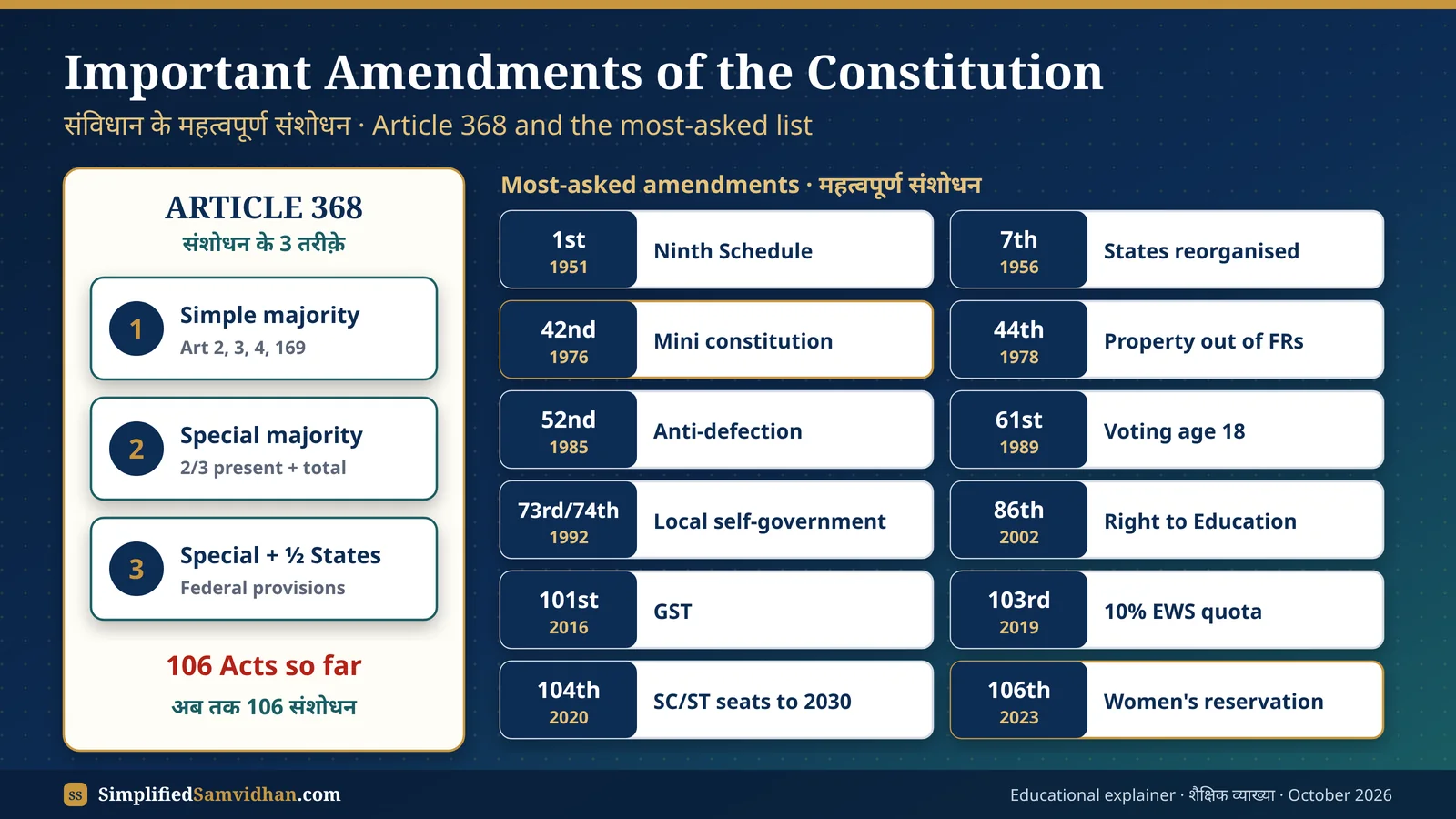
106 Amendment Acts in 76 years. Learn how Article 368 works (simple, special and ratification), the most-asked amendments from the 1st to the 106th in one table, the 42nd vs 44th story, and where the 2024 to 2026 Bills stand, including the 131st Bill defeated in April 2026.
Official textAmendment of Indian Constitution: Article 368 Text
368. (2) An amendment of this Constitution may be initiated only by the introduction of a Bill for the purpose in either House of Parliament, and when the Bill is passed in each House by a majority of the total membership of that House and by a majority of not less than two-thirds of the members of that House present and voting, it shall be presented to the President who shall give his assent to the Bill and thereupon the Constitution shall stand amended in accordance with the terms of the Bill:
Provided that if such amendment seeks to make any change in (a) article 54, article 55, article 73, article 162, article 241 or article 279A; or (b) Chapter IV of Part V, Chapter V of Part VI, or Chapter I of Part XI; or (c) any of the Lists in the Seventh Schedule; or (d) the representation of States in Parliament; or (e) the provisions of this article, the amendment shall also require to be ratified by the Legislatures of not less than one-half of the States by resolutions to that effect passed by those Legislatures before the Bill making provision for such amendment is presented to the President for assent.
An amendment is a change in the Constitution's text: adding, changing or deleting a provision. India's Constitution is neither too rigid nor too flexible. Ordinary laws need a simple majority, but most constitutional changes need a special majority in both Houses, and changes touching the federal balance also need the approval of half the States. Since 1950 Parliament has passed 106 Amendment Acts.
🏠 Everyday analogy
A housing society's bye-laws: the committee can fix the parking timing by itself (simple), changing the maintenance rules needs two-thirds of members (special), and selling the common park needs every wing to agree too (ratification).
🇮🇳 Real Indian example
The GST (101st Amendment, 2016) changed the taxing powers of the Centre and the States, so after both Houses passed it, more than half the State Assemblies had to ratify it before the President signed.
ProcedureTypes of Constitutional Amendment: Simple, Special and Ratification
| Type | Majority needed | What can be changed this way |
|---|---|---|
| 1. Simple majority (outside Art 368) | Majority of members present and voting, like an ordinary law. Not counted as an 'amendment' under Art 368. | New States and changes in State names or borders (Art 2, 3, 4); creating or abolishing a Legislative Council (Art 169); citizenship law (Art 11); Fifth and Sixth Schedules; MPs' salaries, quorum, rules of procedure. |
| 2. Special majority (Art 368(2)) | In each House: majority of total membership and two-thirds of members present and voting. | Most of the Constitution, including Fundamental Rights and the Directive Principles, and everything not in rows 1 and 3. |
| 3. Special majority + ratification by half the States | Special majority in Parliament, then resolutions by at least half the State Legislatures (simple majority there, no time limit). | Election of the President (Art 54, 55); extent of Union and State executive power (Art 73, 162); Supreme Court and High Courts; Seventh Schedule Lists; GST Council (Art 279A); States' representation in Parliament; Art 368 itself. |
- 1Introduce
A Bill can start in either House, by a minister or a private member. No prior permission of the President is needed. State Legislatures cannot start an amendment.
- 2Pass in each House separately
Each House must pass it by special majority. There is no joint sitting for an amendment Bill: if one House rejects it, the Bill dies.
- 3Ratify if needed
For federal matters, half the States must ratify.
- 4President's assent
Since the 24th Amendment (1971) the President must give assent; he cannot withhold it or return the Bill.
The big listImportant Amendments of the Indian Constitution: List from 1st to 106th
| Amendment | Year | What it did (exam points) |
|---|---|---|
| 1st | 1951 | Added the Ninth Schedule (Art 31B) to protect land reform laws; Art 31A; Art 15(4) (special provisions for backward classes); new restrictions in Art 19(2): public order, friendly relations with foreign States, incitement to an offence. |
| 7th | 1956 | States reorganised on linguistic lines: Part A, B, C, D classification abolished; 14 States and 6 Union Territories; common High Court for two or more States. |
| 24th | 1971 | Undid Golaknath: Parliament can amend any part including Fundamental Rights; Art 13(4) and 368(3) added; President bound to assent to amendment Bills. |
| 36th | 1975 | Sikkim made a full State of India. |
| 42nd | 1976 | The 'mini constitution': 'Socialist', 'Secular', 'Integrity' in the Preamble; Fundamental Duties (Part IVA, Art 51A); new DPSPs (39A, 43A, 48A); education, forests, wildlife moved to the Concurrent List; tribunals (Part XIVA); Lok Sabha term 5 to 6 years; President bound by Cabinet advice (Art 74). |
| 44th | 1978 | Undid the excesses of 1976: right to property removed from Fundamental Rights (now Art 300A); 'armed rebellion' replaced 'internal disturbance'; written Cabinet advice for Emergency; Art 20 and 21 cannot be suspended; Lok Sabha term back to 5 years; President can send advice back once. |
| 52nd | 1985 | Anti-defection law: Tenth Schedule added; MPs and MLAs who switch parties lose their seats. |
| 61st | 1988 (in force 1989) | Voting age lowered from 21 to 18 (Art 326), in force from 28 March 1989. |
| 69th | 1991 | Special status for Delhi as the National Capital Territory with its own Assembly (Art 239AA, 239AB). |
| 73rd | 1992 | Panchayati Raj: Part IX, Eleventh Schedule (29 subjects); in force 24 April 1993 (National Panchayati Raj Day). |
| 74th | 1992 | Urban local bodies (municipalities): Part IXA, Twelfth Schedule (18 subjects); in force 1 June 1993. |
| 86th | 2002 | Right to Education: Art 21A (free and compulsory education for children aged 6 to 14); Art 45 changed to early childhood care; Fundamental Duty 51A(k) for parents. |
| 91st | 2003 | Size of the Council of Ministers capped at 15% of the Lok Sabha or Assembly (minimum 12 in States); 'split' exception removed from the anti-defection law. |
| 97th | 2011 | Co-operative societies: right to form them in Art 19(1)(c); Art 43B (DPSP); Part IXB. |
| 99th | 2014 | National Judicial Appointments Commission (NJAC); struck down by the Supreme Court on 16 October 2015. |
| 100th | 2015 | India-Bangladesh Land Boundary Agreement: exchange of enclaves (First Schedule changed). |
| 101st | 2016 | Goods and Services Tax (GST): Art 246A, 269A and the GST Council (Art 279A). |
| 102nd | 2018 | Constitutional status to the National Commission for Backward Classes (Art 338B, 342A). |
| 103rd | 2019 | 10% EWS reservation in education and government jobs (Art 15(6), 16(6)); upheld 3:2 in Janhit Abhiyan (2022). |
| 104th | 2019 (in force 2020) | SC/ST seat reservation in Lok Sabha and Assemblies extended to 2030; nomination of Anglo-Indians ended. |
| 105th | 2021 | Restored the power of States to prepare their own list of socially and educationally backward classes (OBCs). |
| 106th | 2023 | Nari Shakti Vandan Adhiniyam: one-third seats for women in the Lok Sabha, State Assemblies and Delhi Assembly (Art 330A, 332A, 334A), for 15 years. Notified in force on 16 April 2026; the quota starts after the next census and delimitation. |
Compare42nd Amendment (Mini Constitution) vs 44th Amendment
42nd Amendment, 1976 (during the Emergency)
- Called the 'mini constitution'; based on the Swaran Singh Committee
- Added 10 Fundamental Duties and three words to the Preamble
- Made DPSPs override some Fundamental Rights (wider Art 31C)
- Barred courts from questioning amendments (Art 368(4), (5))
- Extended the Lok Sabha's term to 6 years
44th Amendment, 1978 (Janata government)
- Kept the Fundamental Duties and the Preamble words
- Removed the right to property from Part III
- Tightened the Emergency: 'armed rebellion', written Cabinet advice
- Protected Articles 20 and 21 at all times
- Restored the 5-year term
LatestLatest Constitutional Amendment Bills 2023 to 2026: 129th, 130th, 131st
| Bill | Subject | Status (October 2026) |
|---|---|---|
| 128th Amendment Bill, 2023 | Women's reservation | Passed; became the 106th Amendment Act. Notified in force 16 April 2026. |
| 129th Amendment Bill, 2024 | One Nation One Election (simultaneous elections) | With a Joint Parliamentary Committee; term extended in 2026. Not passed. |
| 130th Amendment Bill, 2025 | Removal of PM, CMs and Ministers held in custody for 30 days | With a Joint Parliamentary Committee. Not passed. |
| 131st Amendment Bill, 2026 | Bigger Lok Sabha and delimitation on the 2011 Census, to bring women's reservation forward | Defeated in the Lok Sabha on 17 April 2026: 298 for, 230 against; it needed 352 (two-thirds of those voting). |
Connect the dotsHow Constitutional Amendments Connect to Other Topics
- The Preamble has been amended only once, by the 42nd Amendment: Preamble of the Indian Constitution.
- Why some amendments are struck down: the basic structure doctrine (Kesavananda Bharati).
- The 42nd and 86th Amendments built the Fundamental Duties.
- The 1st, 7th, 52nd, 73rd and 74th Amendments added or changed Schedules: see the 12 Schedules.
- The 1st, 97th and 103rd Amendments changed Article 15, Article 16 and Article 19.
- Ladakh and special provisions for States (Art 371 series): Ladakh and Article 371K.
Quick revisionOne-Line Revision Points (Exam Ready)
- Amendment procedure: Article 368, Part XX; idea borrowed from South Africa.
- Amendment Bill: either House, no joint sitting, President must assent (24th Amdt).
- 1st (1951): Ninth Schedule. 7th (1956): States reorganised.
- 42nd (1976): mini constitution, Fundamental Duties, Socialist-Secular-Integrity.
- 44th (1978): right to property out of Part III (Art 300A).
- 52nd (1985): anti-defection, Tenth Schedule. 61st: voting age 18.
- 73rd/74th (1992): Panchayats (11th Schedule) and Municipalities (12th Schedule).
- 86th (2002): Art 21A RTE. 101st (2016): GST. 103rd (2019): 10% EWS.
- 106th (2023): one-third seats for women; latest Act as of Oct 2026.
- 131st Bill (delimitation) defeated in Lok Sabha, 17 April 2026 (298-230).
Practice MCQPractice MCQs (with Answers): Constitutional Amendments
Which amendment is called the 'mini constitution'?
The voting age was reduced from 21 to 18 years by the:
Which of these needs ratification by at least half the State Legislatures?
The anti-defection law (Tenth Schedule) was added by the:
As of October 2026, what is the latest Constitutional Amendment Act?
Doubts ClearedFrequently Asked Questions
How many amendments have been made to the Indian Constitution?
106 Amendment Acts as of October 2026. The latest is the 106th Amendment Act, 2023 on women's reservation.
Which article deals with the amendment of the Constitution?
Article 368 in Part XX. It provides for amendment by special majority, and by special majority plus ratification by half the States for federal provisions.
Why is the 131st Amendment Bill not the 131st amendment?
Bills are numbered when introduced, and many lapse or fail. Only passed Bills become Acts with the next Act number. The 131st Bill was defeated on 17 April 2026, so no new Act was made.
Can the President refuse to sign a constitutional amendment Bill?
No. Since the 24th Amendment (1971) the President must give assent to a duly passed amendment Bill.
Which amendment removed the right to property from Fundamental Rights?
The 44th Amendment (1978). It is now a constitutional (legal) right under Article 300A.
Sources and further readingSources We Checked
Article 368 text from the Constitution of India as on 2026 (Legislative Department); the Hindi text above is a simple rendering. Bill status as reported up to 18 October 2026.