Fundamental Duties (Article 51A): All 11 Duties, History and Cases
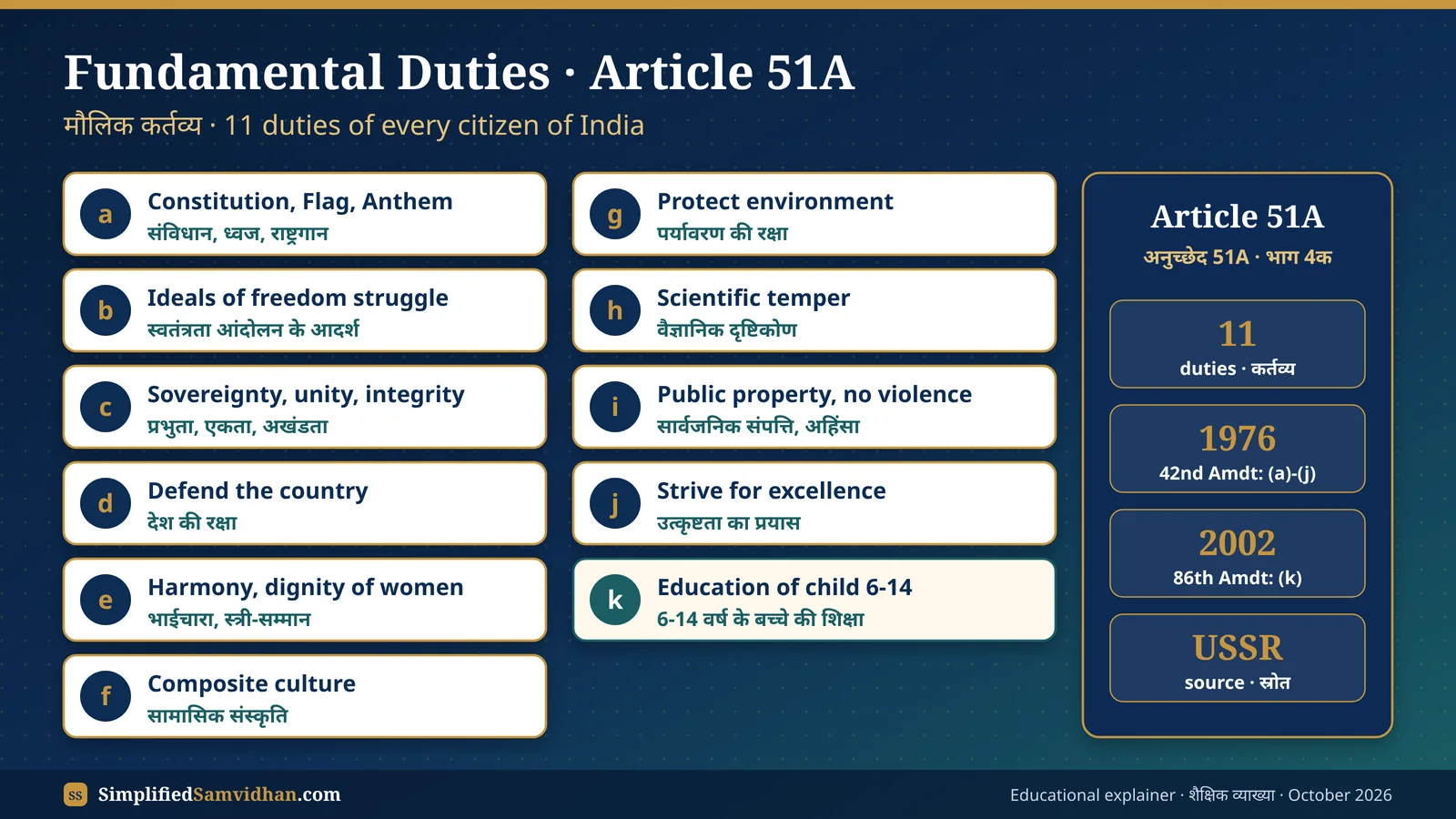
Rights come with responsibilities. Read the full text of Article 51A, each of the 11 Fundamental Duties with a real example, how the Swaran Singh Committee and the 42nd Amendment created them, and what the Supreme Court says about them.
Official textFundamental Duties Article 51A: Full Text of All 11 Duties
PART IVA · FUNDAMENTAL DUTIES
51A. Fundamental duties. It shall be the duty of every citizen of India:
(a) to abide by the Constitution and respect its ideals and institutions, the National Flag and the National Anthem;
(b) to cherish and follow the noble ideals which inspired our national struggle for freedom;
(c) to uphold and protect the sovereignty, unity and integrity of India;
(d) to defend the country and render national service when called upon to do so;
(e) to promote harmony and the spirit of common brotherhood amongst all the people of India transcending religious, linguistic and regional or sectional diversities; to renounce practices derogatory to the dignity of women;
(f) to value and preserve the rich heritage of our composite culture;
(g) to protect and improve the natural environment including forests, lakes, rivers and wild life, and to have compassion for living creatures;
(h) to develop the scientific temper, humanism and the spirit of inquiry and reform;
(i) to safeguard public property and to abjure violence;
(j) to strive towards excellence in all spheres of individual and collective activity so that the nation constantly rises to higher levels of endeavour and achievement;
(k) who is a parent or guardian to provide opportunities for education to his child or, as the case may be, ward between the age of six and fourteen years.
Fundamental Rights tell you what the country owes you. Fundamental Duties tell you what you owe the country. Article 51A lists 11 duties for every citizen: respect the Constitution, the Flag and the Anthem; protect India's unity; keep harmony; respect women; protect the environment; think scientifically; protect public property; work for excellence; and make sure your children aged 6 to 14 go to school. No court will punish you just for breaking a duty, but many laws are built on them and courts use them to judge whether a law is reasonable.
🏠 Everyday analogy
A hostel gives you a room, food and Wi-Fi (your rights). The hostel rule board also asks you to switch off lights, keep the corridor clean and not damage furniture (your duties). If everyone only takes and nobody follows the board, the hostel falls apart.
🇮🇳 Real Indian example
Swachh Bharat Mission, Har Ghar Tiranga and school eco-clubs are everyday forms of duties (a), (g) and (i). Burning a bus during a protest breaks duty 51A(i), and the Prevention of Damage to Public Property Act, 1984 can punish it.
Duty by dutyList of 11 Fundamental Duties with Examples
| Clause | Duty in short | What it looks like in real life |
|---|---|---|
| (a) | Abide by the Constitution; respect its ideals, institutions, National Flag and National Anthem | Standing in attention when Jana Gana Mana plays; not burning or misusing the Tiranga |
| (b) | Cherish the noble ideals of the freedom struggle | Non-violence, truth, unity across castes and regions, as in the Gandhian movement |
| (c) | Uphold sovereignty, unity and integrity of India | Not supporting secessionist calls; reporting threats to security |
| (d) | Defend the country; render national service when called | NCC, Territorial Army, civil defence volunteers during floods or war |
| (e) | Promote harmony and brotherhood beyond religion, language, region; renounce practices against women's dignity | Opposing dowry, eve-teasing and hate messages on WhatsApp groups |
| (f) | Value and preserve our composite culture | Celebrating Diwali, Eid, Christmas and Gurpurab together; not defacing monuments |
| (g) | Protect and improve forests, lakes, rivers, wildlife; compassion for living creatures | Not using single-use plastic, planting trees, not harming street animals |
| (h) | Develop scientific temper, humanism, spirit of inquiry and reform | Checking a viral 'miracle cure' before forwarding it; rejecting superstition |
| (i) | Safeguard public property; abjure violence | Not damaging buses, trains, street lights during protests |
| (j) | Strive for excellence in all spheres | Doing your own work, study or sport with full effort: ISRO's Chandrayaan-3 team is a role model |
| (k) | Parent or guardian to give education opportunities to child or ward aged 6 to 14 (added 2002) | Enrolling your child in school under the RTE Act, 2009 instead of sending them to work |
HistoryHistory of Fundamental Duties: Swaran Singh Committee, 42nd and 86th Amendment
| Year | What happened |
|---|---|
| 1950 | The original Constitution had no Fundamental Duties; only rights (Part III) and directive principles (Part IV). |
| 1976 | During the Emergency the Congress government set up the Sardar Swaran Singh Committee. It recommended a separate chapter of 8 duties. |
| 1976 | The 42nd Amendment Act went further and added 10 duties in a new Part IVA, Article 51A (in force 3 Jan 1977). |
| 1999 | The Justice J. S. Verma Committee on operationalising Fundamental Duties reported which existing laws already enforce some duties and how to teach them. |
| 2002 | The 86th Amendment Act added the 11th duty, clause (k), along with Article 21A (right to education) and a new Article 45. |
Swaran Singh Committee suggested
- 8 Fundamental Duties
- Penalty or punishment by Parliament for not following them
- Duty to pay taxes
- No court case against such a penalty law
What the 42nd Amendment actually did
- Added 10 duties (more than suggested)
- No penalty clause
- No duty to pay taxes
- Duties left non-justiciable
FeaturesFeatures of Fundamental Duties: Non-Justiciable, Citizens Only, Verma Committee
- Only for citizens: unlike some Fundamental Rights (such as Article 14 and Article 21), the duties do not apply to foreigners.
- Non-justiciable: no writ lies to force a citizen to perform them, and the Constitution itself gives no punishment. Parliament may make laws to enforce them.
- Mix of moral and civic duties: 'cherish the ideals of the freedom struggle' is moral; 'respect the Flag and Anthem' is civic.
- Indian values: they codify traditions like respect for nature, composite culture and non-violence.
- Help courts: when testing a law under Article 14 or 19, courts treat a law that gives effect to a duty as 'reasonable'.
| Duty | Existing law that gives it teeth (Verma Committee list) |
|---|---|
| 51A(a) Flag and Anthem | Prevention of Insults to National Honour Act, 1971 |
| 51A(c), (e) unity, harmony | Unlawful Activities (Prevention) Act, 1967; Representation of the People Act, 1951 (disqualification for promoting enmity) |
| 51A(e) dignity, no discrimination | Protection of Civil Rights Act, 1955 (untouchability offences) |
| 51A(g) environment | Wild Life (Protection) Act, 1972; Forest (Conservation) Act, 1980 |
| 51A(k) education | Right of Children to Free and Compulsory Education Act, 2009 |
Supreme CourtImportant Cases on Fundamental Duties
| Case | What the Supreme Court said |
|---|---|
| AIIMS Students' Union v. AIIMS (2001) | Fundamental Duties, though not enforceable by a writ, are as important as Fundamental Rights and can be used to interpret laws. (Struck down an institutional reservation for AIIMS's own students.) |
| M. C. Mehta v. Union of India (1991 order) | Relying on 51A(g), the Court directed that the environment be taught as a subject in schools and colleges. |
| Bijoe Emmanuel v. State of Kerala (1986) | Students who stood respectfully but did not sing the anthem for religious reasons could not be expelled: respect does not require singing. |
| Shyam Narayan Chouksey v. Union of India (2016, modified 2018) | Interim order of 30 Nov 2016 made playing the anthem before films mandatory, citing 51A(a); on 9 Jan 2018 the Court made it optional. |
| Ranganath Mishra v. Union of India (2003) | Asked the Centre to act on the Verma Committee report and spread awareness of the duties, including through education. |
CompareFundamental Rights vs Fundamental Duties: Difference Table
| Point | Fundamental Rights (Part III) | Fundamental Duties (Part IVA) |
|---|---|---|
| Articles | 12 to 35 | Only 51A |
| In the original Constitution? | Yes, from 1950 | No, added in 1976 |
| Borrowed from | USA (Bill of Rights) | USSR |
| Enforceable in court? | Yes, by writs under Articles 32 and 226 | No (non-justiciable) |
| Who benefits or is bound | Some for all persons, some only for citizens | Citizens only |
| Nature | Limits on the State: 'the State shall not…' | Obligations on citizens: 'it shall be the duty of every citizen…' |
| Count today | 6 groups of rights (property removed in 1978) | 11 duties |
Connect the dotsHow Fundamental Duties Connect to the Rest of the Constitution
- Duties sit right after the Directive Principles of State Policy (Part IV), which are the State's duties. Part IV lists what the State must do; Part IVA lists what citizens must do.
- Duty (c) on 'unity and integrity' echoes the Preamble, where the 42nd Amendment also added the word 'integrity'.
- Rights you can enforce, unlike duties: start with the Fundamental Rights overview and the types of writs.
- Both the 42nd (1976) and 86th (2002) Amendments are explained on our important amendments page.
- Duty (h), scientific temper and spirit of inquiry, is what powers the Right to Information: asking questions of those in power.
- Test yourself further in the daily polity MCQ quiz.
Quick revisionOne-Line Revision Points (Exam Ready)
- Fundamental Duties are in Part IVA, in a single Article 51A.
- Total: 11 duties, clauses (a) to (k).
- Recommended by the Sardar Swaran Singh Committee (1976), which suggested 8.
- Added by the 42nd Amendment, 1976: 10 duties.
- 11th duty (k), education of child aged 6-14: 86th Amendment, 2002.
- Idea borrowed from the USSR (Soviet) Constitution.
- They are non-justiciable and apply to citizens only.
- Justice J. S. Verma Committee (1999) listed laws that enforce some duties.
- Paying taxes and voting are not Fundamental Duties.
Practice MCQPractice MCQs (with Answers): Fundamental Duties
Fundamental Duties were added to the Constitution of India by which amendment?
Which of the following is NOT a Fundamental Duty under Article 51A?
The idea of Fundamental Duties in the Indian Constitution was borrowed from:
Which Fundamental Duty was added by the 86th Constitutional Amendment Act, 2002?
How many Fundamental Duties did the Swaran Singh Committee recommend?
Doubts ClearedFrequently Asked Questions
How many Fundamental Duties are there in the Indian Constitution?
There are 11 Fundamental Duties in Article 51A. Ten were added in 1976 by the 42nd Amendment and the 11th, clause (k), in 2002 by the 86th Amendment.
Are Fundamental Duties enforceable in court?
No, not directly. They are non-justiciable, but Parliament can make laws to enforce them, and courts use them to interpret laws and judge reasonable restrictions.
Which committee recommended Fundamental Duties?
The Sardar Swaran Singh Committee in 1976. It suggested 8 duties; Parliament added 10.
Do Fundamental Duties apply to foreigners?
No. Article 51A begins 'It shall be the duty of every citizen of India', so they bind only citizens.
What is maulik kartavya?
'Maulik kartavya' is the Hindi term for Fundamental Duties; the official Hindi text of the Constitution calls them 'mool kartavya'.
Sources and further readingSources We Checked
Text from the Constitution of India as on 2026 (Legislative Department). Facts checked on 18 October 2026.