Preamble of the Indian Constitution: Text, Meaning and Key Cases
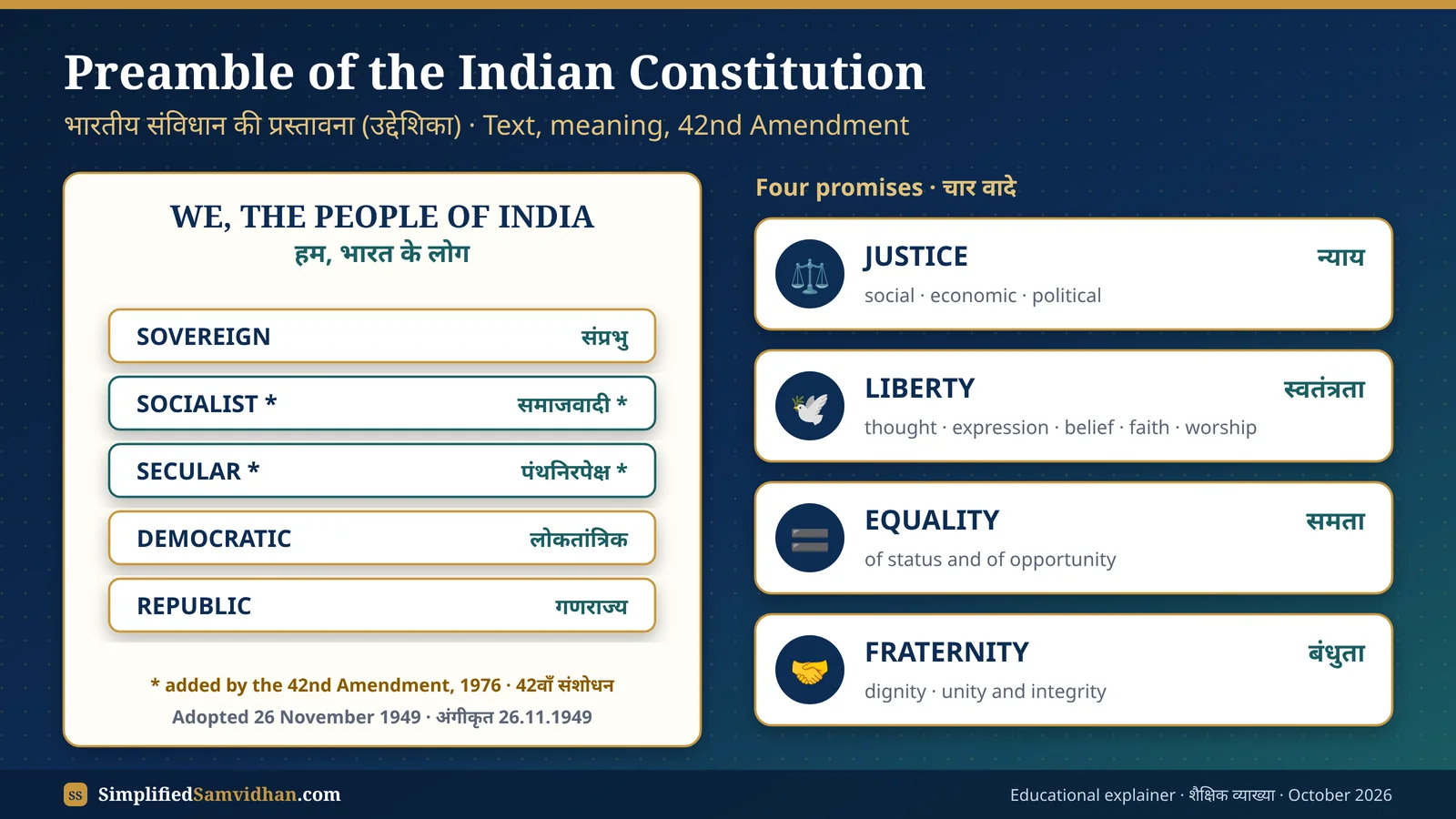
One sentence that holds the whole idea of India. Read the full Preamble, what each keyword means with Indian examples, how the 42nd Amendment changed it, and whether it is a part of the Constitution.
Full textPreamble of the Indian Constitution: Full Text in English
WE, THE PEOPLE OF INDIA, having solemnly resolved to constitute India into a SOVEREIGN SOCIALIST SECULAR DEMOCRATIC REPUBLIC and to secure to all its citizens:
JUSTICE, social, economic and political;
LIBERTY of thought, expression, belief, faith and worship;
EQUALITY of status and of opportunity;
and to promote among them all
FRATERNITY assuring the dignity of the individual and the unity and integrity of the Nation;
IN OUR CONSTITUENT ASSEMBLY this twenty-sixth day of November, 1949, do HEREBY ADOPT, ENACT AND GIVE TO OURSELVES THIS CONSTITUTION.
The Preamble is the introduction or the 'mission statement' of the Constitution. In one sentence it answers three questions: who made the Constitution (we, the people of India), what kind of country India is (sovereign, socialist, secular, democratic republic), and what it promises every citizen (justice, liberty, equality, fraternity). It is the key to open the mind of the makers of the Constitution.
🏠 Everyday analogy
Think of the first page of a school diary: the school's name, its motto and its promise to students. The rules come later, but that first page tells you what the school stands for.
🇮🇳 Real Indian example
When a court decides whether a law is fair, it often reads the Preamble first. In the Kesavananda Bharati case (1973) the Supreme Court used it to find the 'basic structure' of the Constitution.
Line by lineEvery Word of the Preamble Explained, Line by Line
Read the Preamble slowly, phrase by phrase, exactly as it is written. Each step below explains one phrase in plain words and adds the point examiners ask.
- 1
“WE, THE PEOPLE OF INDIA”
The first four words tell us who is the real owner of the Constitution: the people, not a king, not the British Parliament and not any one party. This is called popular sovereignty. Compare it with the Government of India Act, 1935, which was a law made by the British Parliament for India.
Exam point: source of authority of the Constitution = the people of India. - 2
“having solemnly resolved”
'Solemnly resolved' means a serious, deliberate promise made after long thought, like an oath. The Constitution was not written in a hurry: it took almost three years of debate. The words show that the goals that follow are a firm national commitment, not a wish list.
- 3
“to constitute India into a”
'Constitute' means to form or set up. The people are forming a new political order for India. This is why the document is called a 'Constitution': it constitutes, or creates, the State and its organs.
- 4
“SOVEREIGN”
India is supreme inside its territory and independent outside. No foreign country or body can give it orders. It can acquire territory or give it up (as in the 2015 India-Bangladesh Land Boundary Agreement, done by the 100th Amendment). Membership of the UN or the Commonwealth does not reduce sovereignty because India joins and can leave by its own choice.
- 5
“SOCIALIST”
Added in 1976. It means the State will reduce inequality of income, status and opportunity. Indian socialism is democratic socialism: private property and business remain, but the State helps the weak through welfare laws. In Excel Wear (1979) and Dr Balram Singh (2024) the Supreme Court read it as a welfare goal, not a fixed economic model.
- 6
“SECULAR”
Added in 1976, though the idea was already in Articles 25-28. The State has no official religion, does not favour or punish anyone for their faith, and keeps equal distance and equal respect for all religions. In S.R. Bommai (1994) the Supreme Court said secularism is part of the basic structure.
- 7
“DEMOCRATIC”
The government gets its power from the people through regular, free and fair elections on universal adult franchise (Article 326). The word covers both political democracy (one person, one vote) and, as Ambedkar stressed, social and economic democracy.
- 8
“REPUBLIC”
The head of State is elected for a fixed term (the President, 5 years) and not born into the post. It also means every public office is open to every citizen without discrimination.
- 9
“and to secure to all its citizens”
'Secure' means to guarantee and protect. The promise is to all citizens, rich or poor, of every caste, religion, gender and region. The four values that follow are what the State must deliver.
- 10
“JUSTICE, social, economic and political”
Social justice: no discrimination on caste, religion, sex or race; special help for the weaker sections (Articles 15(4), 16(4), 17). Economic justice: no discrimination on the basis of wealth; fair wages and a fair share of resources (DPSP, Article 39). Political justice: equal right to vote, contest elections and hold office. Idea traced to the Russian Revolution.
- 11
“LIBERTY of thought, expression, belief, faith and worship”
Five freedoms in one line: to think for yourself, to say or write it, to believe in ideas, to follow a faith, and to worship in your own way. Liberty is not licence: Article 19(2)-(6) allow reasonable restrictions for public order, decency, security of the State and others.
- 12
“EQUALITY of status and of opportunity”
Equality of status: no one is born higher; titles are abolished (Article 18) and untouchability is abolished (Article 17). Equality of opportunity: equal chance in public jobs and education (Articles 14, 15, 16), with reservation to make the chance real for those left behind.
- 13
“and to promote among them all FRATERNITY”
'Promote' means the State must actively build a feeling of brotherhood and sisterhood among all Indians. Ambedkar warned that liberty and equality cannot survive without fraternity. The single-citizenship rule and Fundamental Duty 51A(e) serve this goal.
- 14
“assuring the dignity of the individual”
Every person has worth just by being human. Courts read this with Article 21 to give the right to live with dignity: food, shelter, privacy (Puttaswamy, 2017), and humane treatment even of prisoners.
- 15
“and the unity and integrity of the Nation”
Unity is emotional togetherness of people; integrity is the territorial wholeness of the country, meaning no part can break away. 'and integrity' was added by the 42nd Amendment in 1976.
- 16
“IN OUR CONSTITUENT ASSEMBLY”
The Constitution was made by the Constituent Assembly, set up in 1946 under the Cabinet Mission Plan, with Dr Rajendra Prasad as President and Dr B.R. Ambedkar as Chairman of the Drafting Committee. 'Our' shows the people own the Assembly's work. Read more in Making of the Constitution.
- 17
“this twenty-sixth day of November, 1949”
The date of adoption. Some provisions (citizenship, elections, provisional Parliament) started that very day; the rest came into force on 26 January 1950, chosen to honour Purna Swaraj Day, first observed on 26 January 1930. 26 November is celebrated as Constitution Day (Samvidhan Divas).
- 18
“do HEREBY ADOPT, ENACT AND GIVE TO OURSELVES THIS CONSTITUTION”
Three verbs, three meanings: adopt = formally accept it; enact = make it law; give to ourselves = it is self-made and self-given, not gifted by anyone else. That last phrase is why India's Constitution is called autochthonous (home-grown).
Keywords at a glanceKeywords of the Preamble: Sovereign, Socialist, Secular, Democratic, Republic
| Keyword | Meaning in simple words | Everyday Indian example |
|---|---|---|
| Sovereign | India takes its own decisions, inside and outside; no foreign power controls it. | India chose to stay in the Commonwealth in 1949 by its own will; it could leave any time. |
| Socialist | The State works to reduce the gap between rich and poor. Indian socialism is 'democratic socialism': a mixed economy, not State ownership of everything. | Free ration under food security, MGNREGA jobs, and progressive income tax. |
| Secular | The State has no religion of its own and treats all religions equally (positive secularism, 'sarva dharma sambhava'). | A government school cannot make one religion's prayer compulsory for all students (Article 28). |
| Democratic | Power belongs to the people, who elect their rulers through free and fair elections with universal adult franchise. | Every citizen aged 18+, rich or poor, has one vote of equal value. |
| Republic | The head of the State (President) is elected, not a hereditary king or queen. | The UK has a King; India's President is elected every 5 years by MPs and MLAs. |
| Justice | Social, economic and political justice: no discrimination, fair share of wealth, equal political rights. Idea taken from the Russian Revolution (1917). | Reservation in jobs, minimum wages, and the right of every adult to vote and contest. |
| Liberty | Freedom of thought, expression, belief, faith and worship, within reasonable limits. | You can criticise the government in a blog post, but you cannot spread hate speech. |
| Equality | Equality of status and of opportunity: no special privileges, equal chance for all. | The son of a minister and the son of a farmer sit the same UPSC exam with the same rules. |
| Fraternity | A sense of brotherhood among all Indians, assuring the dignity of the individual and the unity and integrity of the nation. | Fundamental Duty 51A(e): promote harmony and the spirit of common brotherhood. |
HistoryHistory of the Preamble: Objectives Resolution to the 42nd Amendment
| Date | Event |
|---|---|
| 13 Dec 1946 | Jawaharlal Nehru moves the Objectives Resolution in the Constituent Assembly; the Preamble is based on it. |
| 22 Jan 1947 | The Assembly adopts the Objectives Resolution unanimously. |
| 17 Oct 1949 | The Preamble is debated and adopted last, after the rest of the draft, so that it matches the whole Constitution. |
| 26 Nov 1949 | Constitution adopted (the date written in the Preamble). Celebrated as Constitution Day (Samvidhan Divas) since 2015. |
| 26 Jan 1950 | Constitution comes into force; India becomes a Republic. |
| 1976 | 42nd Amendment adds 'Socialist', 'Secular' and 'Integrity'. The only time the Preamble has been amended. |
Supreme CourtIs the Preamble a Part of the Constitution? Berubari vs Kesavananda
Berubari Union case (1960)
- Advisory opinion on the India-Pakistan (East Pakistan) border deal
- Held: the Preamble is NOT a part of the Constitution
- But it is 'a key to open the mind of the makers'
Kesavananda Bharati case (1973)
- 13-judge Bench, decided 24 April 1973
- Held: the Preamble IS a part of the Constitution
- It can be amended under Article 368, but not its basic features
- LIC of India v. Consumer Education and Research Centre (1995): Supreme Court again said the Preamble is an integral part of the Constitution.
- The Preamble is not enforceable in a court: you cannot file a case only because a Preamble goal is unmet. Courts use it to interpret unclear Articles.
- It is neither a source of power for the legislature nor a limit on it (as held in Berubari).
- Dr Balram Singh v. Union of India (25 Nov 2024): the Supreme Court dismissed petitions to remove 'socialist' and 'secular', holding that Parliament's amending power extends to the Preamble and the 1976 words reflect India's constitutional identity.
Famous descriptionsPreamble Called 'Identity Card', 'Soul' and 'Horoscope': Who Said What
Exams love these one-line descriptions. Remember who said what:
N. A. Palkhivala
Called the Preamble the 'identity card of the Constitution'.
K. M. Munshi
Called it the 'horoscope of our sovereign democratic republic'.
Thakurdas Bhargava
Called it 'the soul of the Constitution'.
Ernest Barker
Called it the 'key-note' of the Constitution and printed it at the start of his book.
Connect the dotsHow the Preamble Connects to the Rest of the Constitution
- The Preamble promises liberty and equality; Part III makes them enforceable: read the Fundamental Rights overview, Article 14 (equality) and Article 19 (freedom of speech).
- 'Economic justice' and 'socialist' are carried out by the Directive Principles of State Policy.
- 'Fraternity' and 'unity and integrity' are echoed in the Fundamental Duties (Article 51A).
- The case that settled the Preamble question, explained in detail: Kesavananda Bharati case (1973).
- Why the Preamble cannot be rewritten at will: see the basic structure doctrine.
- 'India, that is Bharat, shall be a Union of States': the first line after the Preamble is Article 1.
Quick revisionOne-Line Revision Points (Exam Ready)
- The Preamble is based on Nehru's Objectives Resolution (13 Dec 1946, adopted 22 Jan 1947).
- Source of authority: 'We, the People of India'.
- Nature of the State: Sovereign, Socialist, Secular, Democratic, Republic.
- Date of adoption written in it: 26 November 1949.
- Amended only once: 42nd Amendment, 1976 (Socialist, Secular, Integrity).
- Liberty, Equality, Fraternity: French Revolution; Justice (social, economic, political): Russian Revolution.
- Berubari (1960): not a part. Kesavananda (1973): a part, amendable but not its basic structure.
- Not enforceable in court; used to interpret the Constitution.
- 'Identity card of the Constitution': N. A. Palkhivala.
Practice MCQPractice MCQs (with Answers): Preamble
Which words were added to the Preamble by the 42nd Constitutional Amendment Act, 1976?
In which case did the Supreme Court hold that the Preamble is a part of the Constitution?
'Liberty, Equality and Fraternity' in the Preamble were inspired by:
Who described the Preamble as the 'identity card of the Constitution'?
What is the source of authority of the Indian Constitution according to the Preamble?
Doubts ClearedFrequently Asked Questions
What is the Preamble of the Indian Constitution?
It is the introductory statement of the Constitution. It declares India a sovereign, socialist, secular, democratic republic and promises justice, liberty, equality and fraternity to all citizens.
How many times has the Preamble been amended?
Only once, by the 42nd Amendment Act, 1976, which added the words Socialist, Secular and Integrity.
Is the Preamble a part of the Constitution?
Yes. The Supreme Court held so in Kesavananda Bharati (1973), overruling the Berubari view of 1960, and repeated it in LIC (1995).
Can the Preamble be enforced in a court?
No. It is non-justiciable, but courts use it to interpret Articles when their meaning is unclear.
What is the Hindi name of the Preamble?
In the official Hindi text it is called 'Uddeshika' (उद्देशिका); it is also commonly called 'Prastavana' (प्रस्तावना).
Sources and further readingSources We Checked
Text from the Constitution of India as on 2026 (Legislative Department). Facts checked on 18 October 2026.