Sources of Indian Constitution: Borrowed Features from 10 Countries and the GoI Act 1935
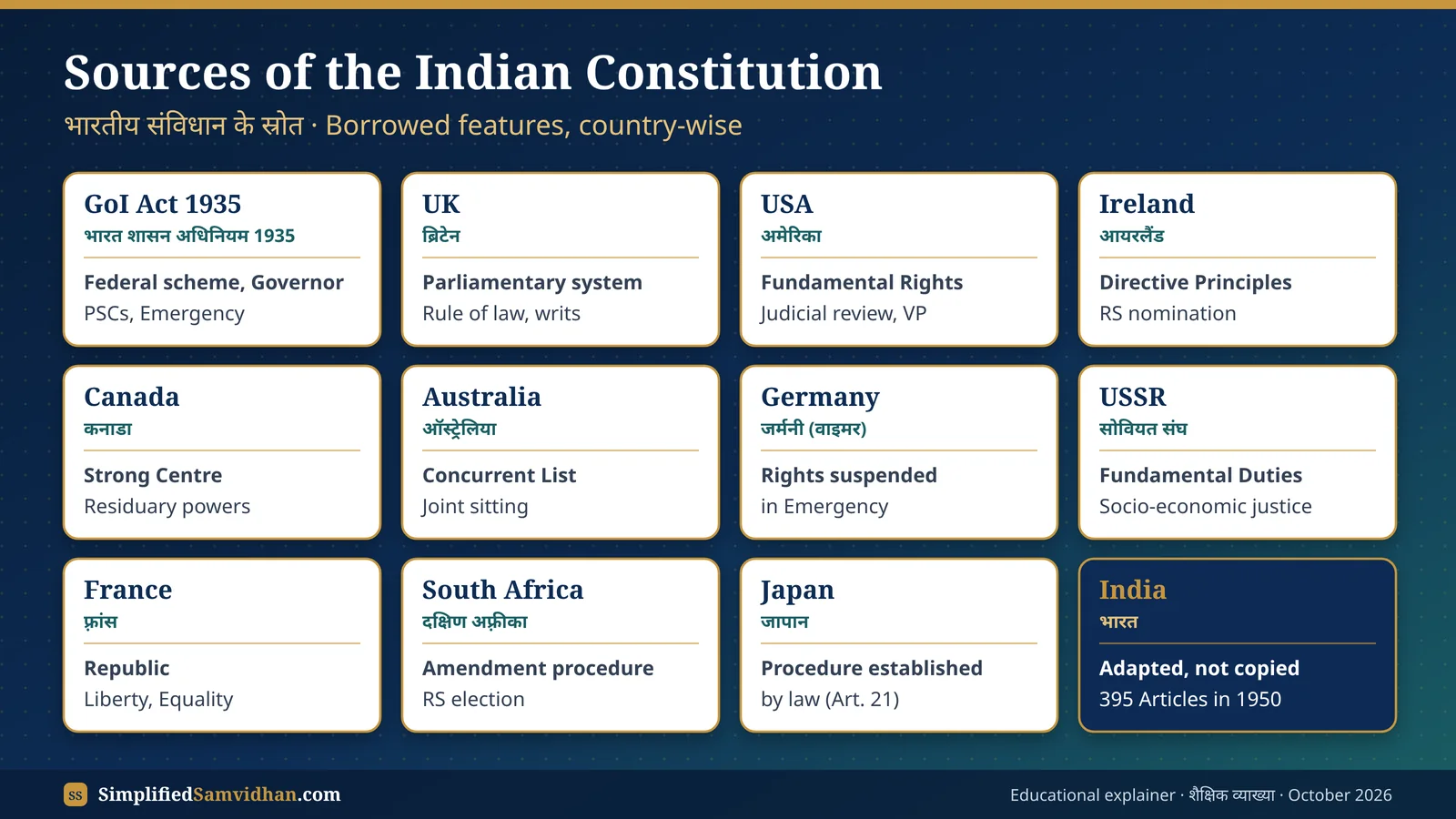
Which feature came from which country? One clean table, the Government of India Act 1935 explained, easy memory tricks, common exam traps and the salient features of the Constitution.
Article 395Sources of Indian Constitution: Why It Is Called a 'Bag of Borrowings'
395. Repeals. The Indian Independence Act, 1947, and the Government of India Act, 1935, together with all enactments amending or supplementing the latter Act, but not including the Abolition of Privy Council Jurisdiction Act, 1949, are hereby repealed.
Article 395 is the last Article of the Constitution. It cancels the two British laws that ran India until 1950: the Government of India Act, 1935 and the Indian Independence Act, 1947. But cancelling a law is not the same as throwing away its ideas. Roughly two-thirds of the machinery of the 1935 Act (Governors, federal lists, emergency powers, the Public Service Commissions) was rewritten into our own Constitution. The makers also studied about 60 constitutions of the world and picked the best working ideas from each. That is why the sources of the Indian Constitution are a favourite exam question.
Borrowing was not blind copying. Every borrowed idea was adapted to Indian needs: the US gave us judicial review, but we kept parliamentary sovereignty too; Canada gave us a strong Centre, but our States have their own Lists and elected governments.
🏠 Everyday analogy
Think of a mother cooking a new family recipe: tadka from her mother, a spice from a neighbour, a trick from a cooking show. The ingredients are borrowed, but the dish is hers and suits her family's taste.
🇮🇳 Real Indian example
When the President's Rule debate comes up in a State, the Governor's report and Article 356 trace straight back to Section 93 of the Government of India Act, 1935. Dr Ambedkar defended this in the Assembly, saying there is nothing to be ashamed of in borrowing.
Country-wise tableBorrowed Features of Indian Constitution: Country-wise Table
| Source | Features borrowed | Where in our Constitution |
|---|---|---|
| Government of India Act, 1935 | Federal scheme, office of Governor, judiciary, Public Service Commissions, emergency provisions, administrative details | Seventh Schedule lists, Articles 153 to 162, 315, 352 to 360 |
| United Kingdom (Britain) | Parliamentary government, rule of law, legislative procedure, single citizenship, cabinet system, prerogative writs, parliamentary privileges, bicameralism | Articles 74, 75, 79, 105; writs in Articles 32 and 226 |
| United States of America | Fundamental Rights, independence of judiciary, judicial review, impeachment of the President, removal of Supreme Court and High Court judges, post of Vice-President, written Preamble | Part III, Articles 13, 61, 63, 124(4) |
| Ireland | Directive Principles of State Policy, nomination of members to Rajya Sabha, method of election of the President | Part IV (Articles 36 to 51), Articles 80(1)(a), 55 |
| Canada | Federation with a strong Centre, residuary powers with the Centre, Centre appoints State Governors, advisory jurisdiction of the Supreme Court | Articles 1, 248, 155, 143 |
| Australia | Concurrent List, freedom of trade, commerce and intercourse, joint sitting of the two Houses of Parliament | List III of Seventh Schedule, Articles 301, 108 |
| Weimar Germany | Suspension of Fundamental Rights during Emergency | Articles 358, 359 |
| USSR (former Soviet Union) | Fundamental Duties, ideal of justice (social, economic and political) in the Preamble | Article 51A (Part IVA), Preamble |
| France | Republic, ideals of liberty, equality and fraternity in the Preamble | Preamble |
| South Africa | Procedure for amendment of the Constitution, election of members of Rajya Sabha | Article 368, Article 80(4) |
| Japan | 'Procedure established by law' | Article 21 (life and personal liberty) |
Biggest sourceGovernment of India Act 1935: The Biggest Source of the Constitution
The Government of India Act, 1935 is the single biggest source of the Indian Constitution. It was the longest Act ever passed by the British Parliament at that time and gave India a detailed administrative framework. Our makers kept what worked and removed what was colonial.
- Federal scheme and three Lists: the 1935 Act had a Federal List, Provincial List and Concurrent List. They became the Union, State and Concurrent Lists of the Seventh Schedule.
- Office of Governor: the Governor as the constitutional head of a Province continued as the head of a State.
- Federal Court to Supreme Court: the Federal Court (set up in 1937) was the model for the Supreme Court's original jurisdiction over Centre-State disputes.
- Public Service Commissions: Federal and Provincial PSCs became UPSC and State PSCs.
- Emergency provisions: Section 93 (failure of machinery in a Province) is the ancestor of Article 356. Read the three types of Emergency.
- What was NOT kept: dyarchy, separate electorates, the Governor-General's special responsibilities and the princely-state federation that never came into being.
Memory tricksTricks to Remember the Sources of Indian Constitution
Use these memory tricks to remember the borrowed features of the Indian Constitution in the exam hall:
UK: 'How Parliament runs'
Everything about how Parliament and the Cabinet run is British: parliamentary system, Cabinet, two Houses (bicameralism), law-making procedure, parliamentary privileges, plus rule of law, single citizenship and writs. Link: 'Westminster model = Parliament Street, New Delhi'.
USA: 'Rights and Judges'
Everything that protects you from the government: Fundamental Rights, judicial review, independent judiciary, impeachment of the President, removal of judges, and the Vice-President.
Ireland: 'DNP'
Directive Principles, Nomination of 12 members to Rajya Sabha, President's election method. Remember: 'Ireland gave India its DNP'.
Canada: 'Strong Centre'
Strong Centre, residuary powers with the Centre, Centre appoints Governors, Supreme Court's advisory role (Article 143). All four make the Centre powerful.
Australia: 'CJT'
Concurrent List, Joint sitting, Trade and commerce freedom. Think of an Australian cricket team sharing the field: everything 'shared'.
The single-feature countries
Japan: procedure established by law. Germany: rights suspended in Emergency. USSR: Fundamental Duties. France: Republic + liberty, equality, fraternity. South Africa: amendment procedure + Rajya Sabha election.
Common traps
- 'Procedure established by law' is from Japan, not the USA (the US has 'due process of law')
- Concurrent List is from Australia; residuary powers are from Canada
- Rule of law is British, but judicial review is American
Remember the twist
- Writs: the idea is British (prerogative writs), but the right to move court under Article 32 is our own Fundamental Right
- Republic and 'Liberty, Equality, Fraternity' are French; 'social, economic and political justice' is Russian
- Rajya Sabha nomination is Irish, but Rajya Sabha election is South African
Salient featuresSalient Features of the Indian Constitution and Their Sources
| Salient feature | What it means | Source link |
|---|---|---|
| Lengthiest written constitution | Originally 395 Articles, 22 Parts and 8 Schedules; today about 470 Articles in 25 Parts and 12 Schedules, with 106 amendments (as of October 2026). | Detailed like the GoI Act, 1935 |
| Federal with a unitary bias | Two levels of government, but a strong Centre: single Constitution, single citizenship, all-India services, Emergency powers. K.C. Wheare called it 'quasi-federal'. | Canada + GoI Act, 1935 |
| Parliamentary form of government | The real power is with the Council of Ministers, which is collectively responsible to the Lok Sabha; the President is the nominal head. | United Kingdom |
| Blend of rigidity and flexibility | Some parts change by simple majority, some by special majority, some also need half the States (Article 368). | South Africa (procedure) |
| Parliamentary sovereignty + judicial supremacy | Parliament can amend, courts can review; the basic structure doctrine keeps the balance. | UK + USA |
| Integrated and independent judiciary | One hierarchy: Supreme Court, High Courts, subordinate courts, enforcing both Central and State laws. | GoI Act, 1935 + USA |
| Fundamental Rights, DPSP and Duties | Enforceable rights (Part III), non-enforceable guidelines (Part IV) and citizens' duties (Part IVA, added in 1976). | USA + Ireland + USSR |
| Secular State, universal adult franchise, single citizenship | No State religion; every citizen aged 18+ votes (lowered from 21 by the 61st Amendment, 1988); one citizenship for the whole country. | Indian choice + UK (citizenship) |
Connect the dotsHow the Sources Connect to the Rest of the Constitution
- The Preamble's ideals have their own sources (France, USSR, USA): read the full Preamble of the Indian Constitution.
- Who did the borrowing and how long it took: making of the Constitution and the Constituent Assembly.
- The American idea of rights lives in Part III: start with the Fundamental Rights overview, Article 14 and Article 19.
- Irish source in detail: Directive Principles of State Policy. Soviet source in detail: Fundamental Duties (Article 51A).
- British writs became Indian remedies: types of writs. The South African amendment idea: important amendments.
- Test yourself on sources and features in the daily polity MCQ quiz.
Quick revisionOne-Line Revision Points (Exam Ready)
- Biggest single source: Government of India Act, 1935 (federal scheme, Governor, PSCs, Emergency).
- UK: parliamentary system, rule of law, single citizenship, cabinet, writs, bicameralism.
- USA: Fundamental Rights, judicial review, impeachment, Vice-President, independent judiciary.
- Ireland: Directive Principles, Rajya Sabha nomination, President's election method.
- Canada: strong Centre, residuary powers, Governor appointed by Centre, advisory jurisdiction of SC.
- Australia: Concurrent List, joint sitting, freedom of trade and commerce.
- Germany (Weimar): suspension of Fundamental Rights during Emergency.
- USSR: Fundamental Duties; France: Republic, liberty-equality-fraternity.
- South Africa: amendment procedure, Rajya Sabha election; Japan: procedure established by law.
- Article 395 repealed the GoI Act 1935 and the Indian Independence Act 1947.
Practice MCQPractice MCQs (with Answers): Sources of the Constitution
The idea of Directive Principles of State Policy in the Indian Constitution was borrowed from:
Which pair is INCORRECTLY matched?
Suspension of Fundamental Rights during an Emergency was borrowed from the Constitution of:
Which source contributed the largest number of provisions to the Indian Constitution?
The procedure for amendment of the Constitution and the election of Rajya Sabha members were borrowed from:
Doubts ClearedFrequently Asked Questions
What are the main sources of the Indian Constitution?
The Government of India Act, 1935 is the biggest source. Others are the constitutions of the UK, USA, Ireland, Canada, Australia, Weimar Germany, USSR, France, South Africa and Japan.
Why is the Indian Constitution called a 'bag of borrowings'?
Because it took many features from other constitutions and the 1935 Act. But the makers adapted each idea to Indian conditions, so it is an original document.
Which features were taken from the British Constitution?
Parliamentary government, rule of law, legislative procedure, single citizenship, cabinet system, prerogative writs, parliamentary privileges and bicameralism.
From where were Fundamental Duties borrowed?
From the Constitution of the former USSR. They were added as Article 51A by the 42nd Amendment, 1976.
Is the Indian Constitution federal or unitary?
It is federal in form with a unitary bias: two levels of government, but a strong Centre, single citizenship and Emergency powers that can make it work like a unitary system.
Sources and further readingSources We Checked
Text of Article 395 from the Constitution of India (Legislative Department). Facts checked on 18 October 2026.