Directive Principles of State Policy (DPSP): Part IV, Articles 36-51 Explained
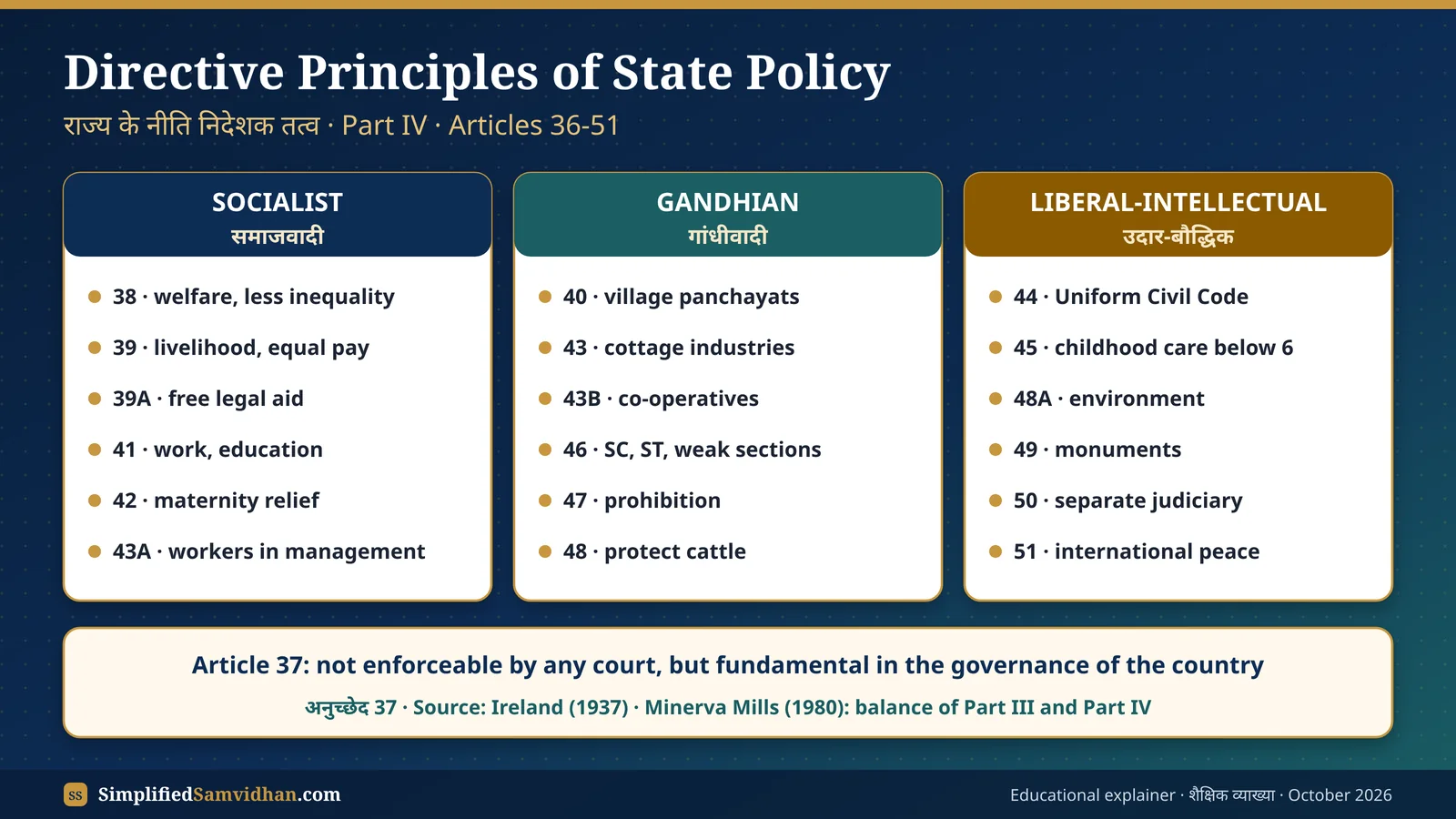
The government's constitutional to-do list. Read Article 37, how the principles are grouped as socialist, Gandhian and liberal, how courts balanced them with Fundamental Rights, and which ones India has actually put into action by 2026.
Official textDirective Principles of State Policy: Article 37 Text and Meaning
PART IV · DIRECTIVE PRINCIPLES OF STATE POLICY
37. Application of the principles contained in this Part. The provisions contained in this Part shall not be enforceable by any court, but the principles therein laid down are nevertheless fundamental in the governance of the country and it shall be the duty of the State to apply these principles in making laws.
Part IV is a to-do list for every government, at the Centre and in the States. It says what kind of India the State must build: jobs and fair wages, free legal aid, village panchayats, free education for children, a clean environment, equal pay for men and women, and more. Article 37 adds two things: you cannot go to court to force the government to do these (they are non-justiciable), but the government is still duty-bound to follow them while making laws. Voters judge it on them at every election.
🏠 Everyday analogy
A family's monthly budget plan says: 'save for the children's fees, buy medicine for grandparents, repair the roof'. Nobody can sue the parents if the roof waits a month, but a good family keeps working through the list as money allows. DPSPs are that plan for the nation.
🇮🇳 Real Indian example
Article 40 asked the State to organise village panchayats. It took until the 73rd Amendment (1992) to make them constitutional bodies; today over 2.5 lakh gram panchayats run local works.
ClassificationClassification of DPSP: Socialist, Gandhian and Liberal-Intellectual (Articles 38-51)
The Constitution does not group the principles, but textbooks (and exams) sort them into three ideologies:
1. Socialist principles (welfare State)
| Article | What the State must do |
|---|---|
| 38 | Secure a social order with social, economic and political justice; 38(2) minimise inequalities in income, status and opportunity (added by 44th Amendment, 1978) |
| 39 | Adequate livelihood for all; resources of the community for the common good (39b); prevent concentration of wealth (39c); equal pay for equal work (39d); protect children's health (39f) |
| 39A | Equal justice and free legal aid (42nd Amendment, 1976) |
| 41 | Right to work, to education and to public assistance in unemployment, old age, sickness, disability |
| 42 | Just and humane conditions of work and maternity relief |
| 43 | Living wage and decent standard of life for workers |
| 43A | Workers' participation in management of industries (42nd Amendment) |
| 47 | Raise the level of nutrition and standard of living; improve public health |
2. Gandhian principles (rural India, self-reliance)
| Article | What the State must do |
|---|---|
| 40 | Organise village panchayats as units of self-government |
| 43 | Promote cottage industries in rural areas |
| 43B | Promote co-operative societies (97th Amendment, 2011) |
| 46 | Promote educational and economic interests of SCs, STs and weaker sections |
| 47 | Prohibition of intoxicating drinks and drugs harmful to health |
| 48 | Prohibit slaughter of cows, calves and other milch and draught cattle |
3. Liberal-intellectual principles (modern State)
| Article | What the State must do |
|---|---|
| 44 | Secure a Uniform Civil Code for citizens throughout India |
| 45 | Early childhood care and education for children below 6 years (substituted by 86th Amendment, 2002) |
| 48 | Organise agriculture and animal husbandry on modern, scientific lines |
| 48A | Protect the environment, forests and wildlife (42nd Amendment) |
| 49 | Protect monuments and places of national importance |
| 50 | Separate the judiciary from the executive |
| 51 | Promote international peace and security; respect international law |
Article by ArticleAll DPSP Articles 36 to 51 Explained One by One
Every Article of Part IV has its own short page with simple meaning, an example, a memory trick and an MCQ:
- Article 36: Definition of State
- Article 37: DPSP not enforceable by courts
- Article 38: Welfare state, social order
- Article 39: Principles of policy (39a-f)
- Article 39A: Equal justice, free legal aid
- Article 40: Village panchayats
- Article 41: Right to work, education, public help
- Article 42: Humane work, maternity relief
- Article 43: Living wage, cottage industries
- Article 43A: Workers in management
- Article 43B: Co-operative societies
- Article 44: Uniform Civil Code
- Article 45: Early childhood care (below 6)
- Article 46: SC, ST and weaker sections
- Article 47: Nutrition, health, prohibition
- Article 48: Agriculture, animal husbandry
- Article 48A: Environment, forests, wildlife
- Article 49: National monuments
- Article 50: Judiciary separate from executive
- Article 51: International peace
HistoryDPSP Added by Amendments: 42nd, 44th, 86th, 97th and the Irish Source
| Amendment | Change in Part IV |
|---|---|
| 42nd, 1976 | Added 39A (free legal aid), 43A (workers in management), 48A (environment) and reworded 39(f) (healthy development of children) |
| 44th, 1978 | Added 38(2): reduce inequalities in income, status, facilities and opportunities |
| 86th, 2002 | Substituted Article 45: early childhood care and education below 6 (education for 6-14 moved to Fundamental Right Article 21A) |
| 97th, 2011 | Added 43B: promote voluntary formation and democratic control of co-operative societies |
Source and famous descriptions
Source: Ireland
Borrowed from the Irish Constitution of 1937, which had taken the idea from Spain.
Ambedkar
Called them a 'novel feature', like the 'Instrument of Instructions' under the 1935 Act.
K. T. Shah
Mocked them as a 'cheque on a bank, payable at the convenience of the bank'.
Granville Austin
Called Parts III and IV together the 'conscience of the Constitution'.
Supreme CourtConflict Between DPSP and Fundamental Rights: Champakam to Minerva Mills
| Case | What it decided |
|---|---|
| State of Madras v. Champakam Dorairajan (1951) | Caste-based seat quota in medical colleges struck down. DPSPs must run subsidiary to Fundamental Rights. Parliament replied with the 1st Amendment (Article 15(4)). |
| Golaknath (1967) | Parliament cannot amend Fundamental Rights even to implement DPSPs. |
| 25th Amendment (1971) | Inserted Article 31C: laws giving effect to 39(b) and 39(c) cannot be struck down for violating Articles 14 and 19. |
| Kesavananda Bharati (1973) | Upheld the first part of 31C; Parliament can amend any part but not the basic structure. |
| Minerva Mills (1980) | Struck down the 42nd Amendment's extension of 31C to all DPSPs. The Constitution rests on the balance and harmony between Parts III and IV; this balance is a basic feature. |
| Property Owners Association v. State of Maharashtra (2024) | Nine-judge Bench (5 Nov 2024): not every private property is a 'material resource of the community' under 39(b). |
Rights (Part III) are the brakes that stop the State from hurting you. Directive Principles (Part IV) are the accelerator that pushes the State to help you. Minerva Mills said a car needs both: remove the brakes and it crashes, remove the accelerator and it never moves.
CompareDifference Between Fundamental Rights and DPSP
| Point | Fundamental Rights (Part III) | Directive Principles (Part IV) |
|---|---|---|
| Articles | 12 to 35 | 36 to 51 |
| Source | USA | Ireland |
| Enforceable in court? | Yes (justiciable), through writs | No (non-justiciable), Article 37 |
| Nature | Negative: stop the State from doing certain things | Positive: ask the State to do certain things |
| Aim | Political democracy | Social and economic democracy, a welfare State |
| Need a law to work? | No, they work automatically | Yes, the State must pass laws or schemes |
| Can a law be struck down for breaking them? | Yes | No, but courts uphold laws that implement them |
| Suspension in emergency | Can be suspended (except Articles 20 and 21) | Nothing to suspend; they are not enforceable anyway |
In actionDPSP Implemented: Panchayati Raj, Rural Jobs, Legal Aid and Uniform Civil Code
| Directive Principle | How it was put into action |
|---|---|
| Art 40: village panchayats | 73rd Amendment, 1992: Part IX, three-tier panchayati raj, one-third seats for women (74th did the same for towns) |
| Art 41: right to work | MGNREGA, 2005 gave 100 days of guaranteed rural work. From 1 July 2026 it is replaced by the VB-G RAM G Act, 2025, guaranteeing 125 days |
| Art 39A: free legal aid | Legal Services Authorities Act, 1987: NALSA, Lok Adalats, free lawyers for the poor |
| Art 39(d), 42, 43: wages, maternity | Maternity Benefit Act, 1961; the four Labour Codes (in force 21 Nov 2025), including the Code on Wages that carries equal pay for equal work |
| Art 45, 47: children, nutrition | Anganwadis under ICDS; PM POSHAN mid-day meals; National Food Security Act, 2013 |
| Art 47: prohibition | Liquor prohibition in States such as Gujarat and Bihar (2016) |
| Art 48A: environment | Environment (Protection) Act, 1986; National Green Tribunal Act, 2010 |
| Art 50: separate judiciary | CrPC 1973 separated judicial magistrates from the executive; carried on by the BNSS, 2023 |
Article 44: the Uniform Civil Code in 2026
Uniform Civil Code so far
- Goa: Portuguese Civil Code continued since 1961
- Uttarakhand: UCC Act, 2024, in force from 27 January 2025; first State to make its own UCC
- Gujarat: UCC Bill passed 24 March 2026, President's assent received (gazetted 1 Oct 2026); start date to be notified
What it covers and the debate
- One law on marriage, divorce, succession, live-in registration for all religions
- Scheduled Tribes are kept outside both State codes
- Supreme Court urged a UCC in Shah Bano (1985) and Sarla Mudgal (1995); critics cite religious freedom (Articles 25-26) and diversity
Connect the dotsHow DPSP Connect to the Rest of the Constitution
- Socialist principles turn the Preamble's promise of 'justice, social, economic and political' into policy.
- Rights you can enforce in court: Fundamental Rights overview; the citizen's side of the deal: Fundamental Duties (Article 51A).
- Why Parliament cannot destroy the balance between Parts III and IV: basic structure doctrine.
- Ireland is one of many borrowed sources: see sources of the Indian Constitution.
- All amendments that touched Part IV (42nd, 44th, 86th, 97th) in one place: important amendments.
- Panchayats made under Article 40 answer to you through the RTI Act.
Quick revisionOne-Line Revision Points (Exam Ready)
- DPSPs are in Part IV, Articles 36 to 51.
- Borrowed from the Irish Constitution (1937).
- Article 37: not enforceable by any court, but fundamental in governance.
- Gandhian: 40 panchayats, 43 cottage industries, 43B co-operatives, 46 SC/ST, 47 prohibition, 48 cattle.
- Article 44: Uniform Civil Code; Article 50: separate judiciary from executive.
- 42nd Amendment added 39A, 43A, 48A; 44th added 38(2); 97th added 43B.
- Champakam Dorairajan (1951): DPSPs subordinate to FRs.
- Minerva Mills (1980): balance between FRs and DPSPs is a basic feature.
- 'Conscience of the Constitution' (Parts III + IV): Granville Austin.
Practice MCQPractice MCQs (with Answers): Directive Principles of State Policy
The Directive Principles of State Policy were borrowed from the constitution of:
Which of the following is a Gandhian principle among the DPSPs?
Which Article declares that the Directive Principles are not enforceable by any court?
Which Directive Principle was added by the 97th Constitutional Amendment Act, 2011?
In which case did the Supreme Court hold that harmony and balance between Fundamental Rights and DPSPs is a basic feature of the Constitution?
Doubts ClearedFrequently Asked Questions
What are Directive Principles of State Policy?
They are guidelines in Part IV (Articles 36-51) that the Centre and States must keep in mind while making laws and policies, aimed at building a welfare State.
Are DPSPs enforceable in court?
No. Article 37 says they are not enforceable by any court, but they are fundamental in governance and courts uphold laws that implement them.
What are the three types of DPSP?
Socialist (welfare, wages, legal aid), Gandhian (panchayats, cottage industries, prohibition) and liberal-intellectual (Uniform Civil Code, environment, separate judiciary). This grouping is by scholars, not in the text.
Which states have a Uniform Civil Code under Article 44?
Goa has followed a common civil code since Portuguese rule. Uttarakhand's UCC came into force on 27 January 2025. Gujarat's UCC Act has received the President's assent in 2026; its start date is to be notified.
What does niti nirdeshak tatva mean?
'Rajya ke niti nirdeshak tatva' is the Hindi name for the Directive Principles of State Policy: principles that direct (guide) the policy of the State.
Sources and further readingSources We Checked
Text from the Constitution of India as on 2026 (Legislative Department). Facts checked on 18 October 2026.
- Constitution of India (Legislative Department, Govt of India)
- Article 37 and Part IV, Directive Principles (constitutionofindia.net)
- Nature of private property: Property Owners Association judgment summary (Supreme Court Observer)
- Gujarat Uniform Civil Code Bill, 2026 (PRS Legislative Research)
- Supreme Court of India: judgments