Election Commission of India: Article 324, Powers, Structure and List of All CECs
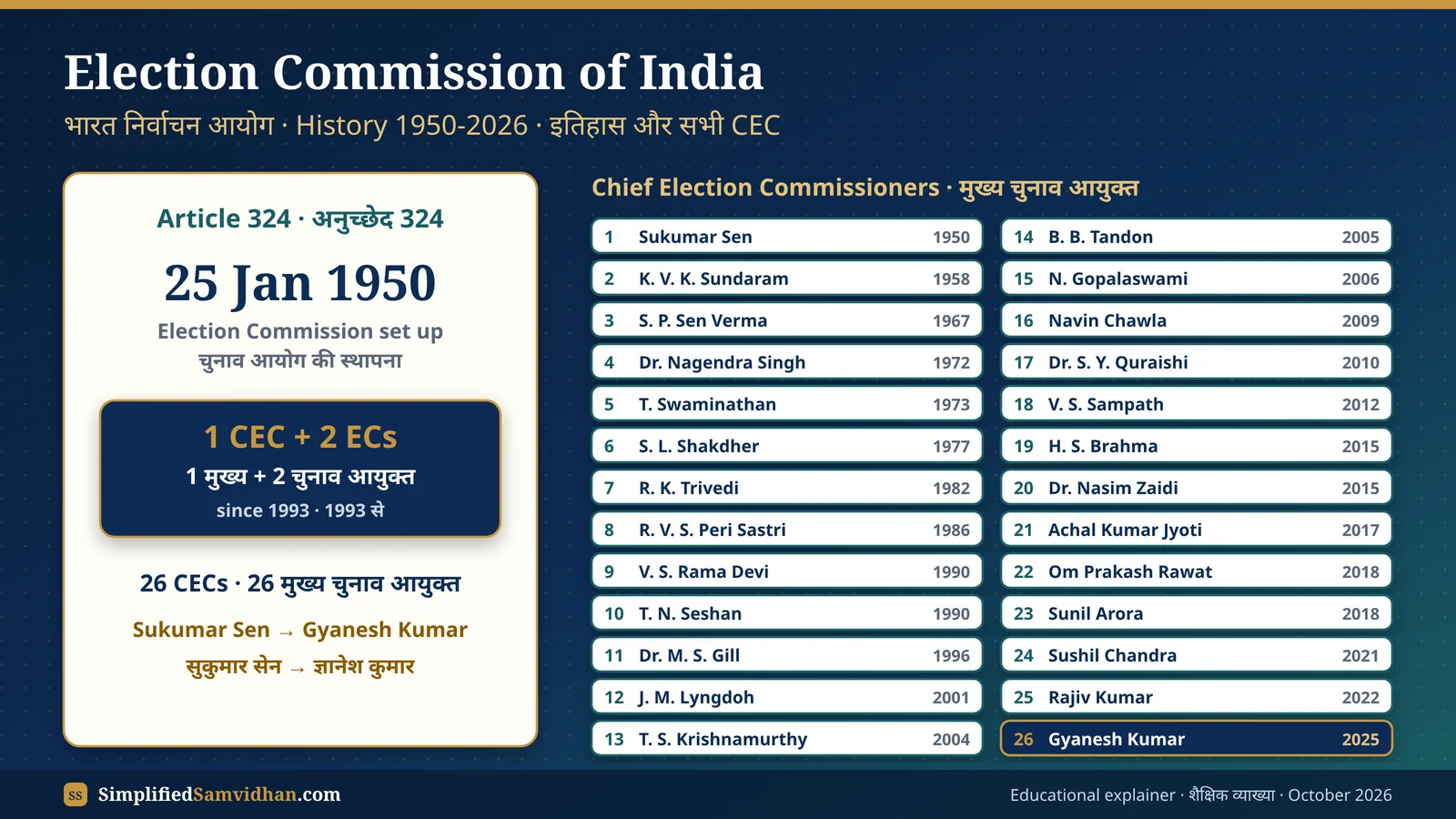
The umpire of the world's largest democracy, explained simply: what the Election Commission is, how it is organised, its story from 1950, and every Chief Election Commissioner from Sukumar Sen to Gyanesh Kumar.
What it isWhat Is the Election Commission of India? Article 324 in Simple Words
The Election Commission of India (ECI) is the constitutional body that conducts elections to Parliament, State Legislatures and the offices of President and Vice-President. It was set up on 25 January 1950, one day before the Constitution came into force, under Article 324. Its office is Nirvachan Sadan, New Delhi.
324. Superintendence, direction and control of elections to be vested in an Election Commission.
(1) The superintendence, direction and control of the preparation of the electoral rolls for, and the conduct of, all elections to Parliament and to the Legislature of every State and of elections to the offices of President and Vice-President held under this Constitution shall be vested in a Commission (referred to in this Constitution as the Election Commission).
(2) The Election Commission shall consist of the Chief Election Commissioner and such number of other Election Commissioners, if any, as the President may from time to time fix and the appointment of the Chief Election Commissioner and other Election Commissioners shall, subject to the provisions of any law made in that behalf by Parliament, be made by the President.
(5) Subject to the provisions of any law made by Parliament, the conditions of service and tenure of office of the Election Commissioners and the Regional Commissioners shall be such as the President may by rule determine:
Provided that the Chief Election Commissioner shall not be removed from his office except in like manner and on the like grounds as a Judge of the Supreme Court and the conditions of service of the Chief Election Commissioner shall not be varied to his disadvantage after his appointment:
Provided further that any other Election Commissioner or a Regional Commissioner shall not be removed from office except on the recommendation of the Chief Election Commissioner.
Think of an election as the biggest exam in the country, where 97 crore people answer one question: who should govern us? The Election Commission is the independent exam board. It prepares the list of candidates who may sit (the voter list), sets the rules, runs every centre, stops cheating and declares the result. The government of the day is itself a candidate in this exam, so the board must not take orders from it.
🏠 Everyday analogy
A cricket umpire does not belong to either team. If the umpire were picked and paid by one captain, nobody would trust the result. That is why the Constitution protects the CEC's job like a judge's.
🇮🇳 Real Indian example
In 2024 the Commission ran the Lok Sabha election in seven phases (19 April to 1 June) for about 96.8 crore voters, with more than 10 lakh polling stations, from Ladakh's high villages to island booths in the Andamans.
StructureStructure of the Election Commission: From Nirvachan Sadan to Your Booth
| Level | Who | Job |
|---|---|---|
| National | Election Commission: CEC + 2 Election Commissioners, with a secretariat of Deputy ECs and officers | Decides schedules, rules, symbols, party recognition; supervises everything |
| State | Chief Electoral Officer (CEO) | Runs the election machinery in the State under ECI |
| District | District Election Officer (usually the Collector / DM) | Polling staff, EVMs, polling stations |
| Constituency | Returning Officer (RO) and Electoral Registration Officer (ERO) | RO: nominations, scrutiny, counting, result. ERO: voter list |
| Booth | Booth Level Officer (BLO) and Presiding Officer | BLO: house-to-house voter list work. Presiding Officer: runs polling day |
HistoryHistory of the Election Commission of India, 1950 to 2026
- 1
🏛️ 25 January 1950: the Commission is born
A one-member body, with Sukumar Sen as the first CEC from 21 March 1950. Since 2011 this date is celebrated as National Voters' Day.
- 2
🗳️ 1951-52: the first general election
From 25 October 1951 (Chini, Himachal Pradesh) to 21 February 1952: 489 Lok Sabha seats, about 17.3 crore voters, picture symbols on separate ballot boxes so that people who could not read could vote.
- 3
🖲️ 1982-1989: the machine arrives
First EVM trial at Paravur (Kerala) in May 1982. The Supreme Court set that result aside in 1984 because no law allowed machines; Parliament added Section 61A to the RP Act, 1951 in 1988.
- 4
👥 1989-1993: from one member to three
Two Election Commissioners were added on 16 October 1989 and removed on 1 January 1990. From 1 October 1993 the Commission became three-member for good; the Supreme Court upheld it in T. N. Seshan v. Union of India (1995), with decisions by majority.
- 5
🪪 1990s: the Seshan years
The Model Code of Conduct was enforced strictly, voter ID cards (EPIC) began in 1993 and observers were sent to every constituency.
- 6
🧾 2004-2019: EVM, NOTA, VVPAT
2004: first general election fully on EVMs. 2013: NOTA (after the PUCL judgment) and the first VVPAT. 2019: VVPAT in every polling station.
- 7
⚖️ 2023: who picks the umpire?
On 2 March 2023 the Supreme Court (Anoop Baranwal) put the CJI on the selection panel until Parliament made a law. Parliament's December 2023 Act replaced the CJI with a Union Minister.
- 8
📋 2025-2026: SIR and the dispute
Gyanesh Kumar became CEC on 19 February 2025. The Special Intensive Revision of voter lists began in Bihar (June 2025) and spread to other States, bringing petitions, protests and a removal notice in Parliament.
All CECsList of Chief Election Commissioners of India (1950-2026)
Here is the complete list of Chief Election Commissioners of India from 1950 to 2026, with tenure and what each is remembered for. Gyanesh Kumar is the 26th and current CEC.
| No. | Name | Tenure | Remembered for |
|---|---|---|---|
| 1 | Sukumar Sen | 21 Mar 1950 – 19 Dec 1958 | ICS officer. Conducted the first two general elections (1951-52 and 1957) when there was no voter list, no model to copy and most voters could not read; also ran Sudan's first election (1953). |
| 2 | K. V. K. Sundaram | 20 Dec 1958 – 30 Sep 1967 | Former Union Law Secretary. Ran the 1962 and 1967 general elections; later chaired the Law Commission of India. |
| 3 | S. P. Sen Verma | 1 Oct 1967 – 30 Sep 1972 | Ran the 1971 mid-term Lok Sabha election, the first held separately from most State elections. |
| 4 | Dr. Nagendra Singh | 1 Oct 1972 – 6 Feb 1973 | Jurist; later a judge and President of the International Court of Justice (1985-88). |
| 5 | T. Swaminathan | 7 Feb 1973 – 17 Jun 1977 | Conducted the March 1977 general election held after the Emergency. |
| 6 | S. L. Shakdher | 18 Jun 1977 – 17 Jun 1982 | Former Secretary-General of the Lok Sabha. Ran the 1980 general election; India's first EVM trial (Paravur, Kerala, May 1982) took place in his term. |
| 7 | R. K. Trivedi | 18 Jun 1982 – 31 Dec 1985 | Ran the 1984-85 general election; later Governor of Gujarat. |
| 8 | R. V. S. Peri Sastri | 1 Jan 1986 – 25 Nov 1990 | Ran the 1989 general election; the Commission first became multi-member (Oct 1989 to Jan 1990) in his term. Died in office. |
| 9 | V. S. Rama Devi | 26 Nov 1990 – 11 Dec 1990 | The first and so far only woman CEC (16 days). Later Governor of Himachal Pradesh and Karnataka. |
| 10 | T. N. Seshan | 12 Dec 1990 – 11 Dec 1996 | Made the Model Code of Conduct bite, pushed voter ID cards (EPIC, from 1993) and curbed booth capturing. Ramon Magsaysay Award, 1996. |
| 11 | Dr. M. S. Gill | 12 Dec 1996 – 13 Jun 2001 | Ran the 1998 and 1999 general elections and widened EVM use; later Union Minister. |
| 12 | J. M. Lyngdoh | 14 Jun 2001 – 7 Feb 2004 | First CEC from the North-East (Meghalaya). Held the 2002 Jammu & Kashmir and Gujarat elections; Ramon Magsaysay Award, 2003. |
| 13 | T. S. Krishnamurthy | 8 Feb 2004 – 15 May 2005 | Ran the 2004 general election, the first held fully on EVMs in all 543 seats. |
| 14 | B. B. Tandon | 16 May 2005 – 29 Jun 2006 | Oversaw the Bihar re-election of October-November 2005 and the 2006 State elections. |
| 15 | N. Gopalaswami | 30 Jun 2006 – 20 Apr 2009 | In January 2009 he recommended the removal of Election Commissioner Navin Chawla; the government did not accept it. |
| 16 | Navin Chawla | 21 Apr 2009 – 29 Jul 2010 | Ran the 2009 general election. |
| 17 | Dr. S. Y. Quraishi | 30 Jul 2010 – 10 Jun 2012 | Started National Voters' Day (25 January, from 2011) and expanded voter-awareness drives. |
| 18 | V. S. Sampath | 11 Jun 2012 – 15 Jan 2015 | NOTA and the first VVPAT (Noksen, Nagaland) came in 2013; ran the 2014 general election. |
| 19 | H. S. Brahma | 16 Jan 2015 – 18 Apr 2015 | From Assam's Bodo community, the second CEC from the North-East. Launched the National Electoral Roll Purification drive (March 2015). |
| 20 | Dr. Nasim Zaidi | 19 Apr 2015 – 5 Jul 2017 | Held the open 'EVM Challenge' (June 2017) inviting parties to prove tampering. |
| 21 | Achal Kumar Jyoti | 6 Jul 2017 – 22 Jan 2018 | Ran the 2017 Gujarat election; the Commission's January 2018 opinion on 20 Delhi MLAs (office of profit) came in his term. |
| 22 | Om Prakash Rawat | 23 Jan 2018 – 1 Dec 2018 | The cVIGIL app for citizens to report Model Code violations was launched in 2018. |
| 23 | Sunil Arora | 2 Dec 2018 – 12 Apr 2021 | Ran the 2019 general election (VVPAT in every booth) and the first big election in the pandemic, Bihar 2020. |
| 24 | Sushil Chandra | 13 Apr 2021 – 14 May 2022 | IRS officer; ran the 2022 elections in Uttar Pradesh, Punjab, Uttarakhand, Goa and Manipur. |
| 25 | Rajiv Kumar | 15 May 2022 – 18 Feb 2025 | Ran the 2024 general election, the world's largest, with about 96.8 crore registered voters. |
| 26 | Gyanesh Kumar | 19 Feb 2025 – Present | IAS (1988, Kerala cadre). First CEC chosen under the 2023 Act; term till 26 January 2029. Led the Special Intensive Revision (SIR) of voter lists from 2025, now under challenge in the Supreme Court. |
TodayCurrent Chief Election Commissioner and Election Commissioners (2026)
| Post | Name | In office since |
|---|---|---|
| Chief Election Commissioner | Gyanesh Kumar | 19 Feb 2025 (EC from March 2024); term till 26 Jan 2029 |
| Election Commissioner | Dr. Sukhbir Singh Sandhu | March 2024 |
| Election Commissioner | Dr. Vivek Joshi | 19 Feb 2025 |
Connect the dotsRead Next: The Election Commission Series
- What the Commission can and cannot do: Powers and functions of the Election Commission.
- Who chooses the CEC: Appointment of the CEC, Anoop Baranwal and the 2023 Act.
- How a CEC can be removed: Removal of the CEC and independence of the Commission.
- Your name on the roll: voter list and SIR, and the 2027 Special Summary Revision.
- Lifelong immunity for CECs, now before the Supreme Court: Section 16 of the 2023 Act.
- Free and fair elections are part of the basic structure of the Constitution.
Quick revisionOne-Line Revision Points (Exam Ready)
- ECI is set up under Article 324, Part XV (Articles 324-329).
- Founded on 25 January 1950: National Voters' Day since 2011.
- First CEC: Sukumar Sen (1950-58), first general election 1951-52.
- Only woman CEC: V. S. Rama Devi (1990, 16 days).
- Multi-member since 1 October 1993; upheld in T. N. Seshan v. UoI (1995).
- Magsaysay Award: T. N. Seshan (1996) and J. M. Lyngdoh (2003).
- Current (26th) CEC: Gyanesh Kumar, from 19 Feb 2025, first under the 2023 Act.
- Panchayat and municipal polls: State Election Commissions, not ECI.
Practice MCQPractice MCQs (with Answers): Election Commission of India
Who was the first Chief Election Commissioner of India?
On which date was the Election Commission of India established?
Who is the only woman to have served as Chief Election Commissioner of India?
Which judgment upheld the multi-member Election Commission?
Consider: 1. The ECI conducts panchayat elections. 2. The ECI conducts the election of the Vice-President. Which is/are correct?
Doubts ClearedFrequently Asked Questions
Who is the current Chief Election Commissioner of India?
Gyanesh Kumar, the 26th CEC, since 19 February 2025. His term ends on 26 January 2029.
How many Chief Election Commissioners has India had?
Twenty-six, from Sukumar Sen (1950) to Gyanesh Kumar (2025).
How many members does the Election Commission have?
Three: the Chief Election Commissioner and two Election Commissioners. The Constitution lets the President fix the number; it has been three since 1993.
When is National Voters' Day?
25 January every year, the foundation day of the Election Commission, celebrated since 2011.
Who was the most famous Chief Election Commissioner?
T. N. Seshan (1990-96) is the best known, for strictly enforcing the Model Code of Conduct and introducing voter ID cards.
Sources and further readingSources We Checked
Facts checked on 21 October 2026. Tenure dates follow the Election Commission's list of former CECs; small differences of a day appear in other lists. Status of court cases is as reported up to 15 October 2026.
- Election Commission of India (official website)
- All India Radio News, 18 Feb 2025: Gyanesh Kumar appointed Chief Election Commissioner
- All India Radio News, 6 Apr 2026: Speaker and Chairman reject notice of motion against CEC
- Bar & Bench, 15 Oct 2026: Supreme Court issues notice to ECI, CEC on pleas challenging SIR
- Supreme Court Observer: challenges to the Election Commissioners Act, 2023
- Constitution of India, Part XV (Legislative Department)