Basic Structure Doctrine and the Kesavananda Bharati Case Explained
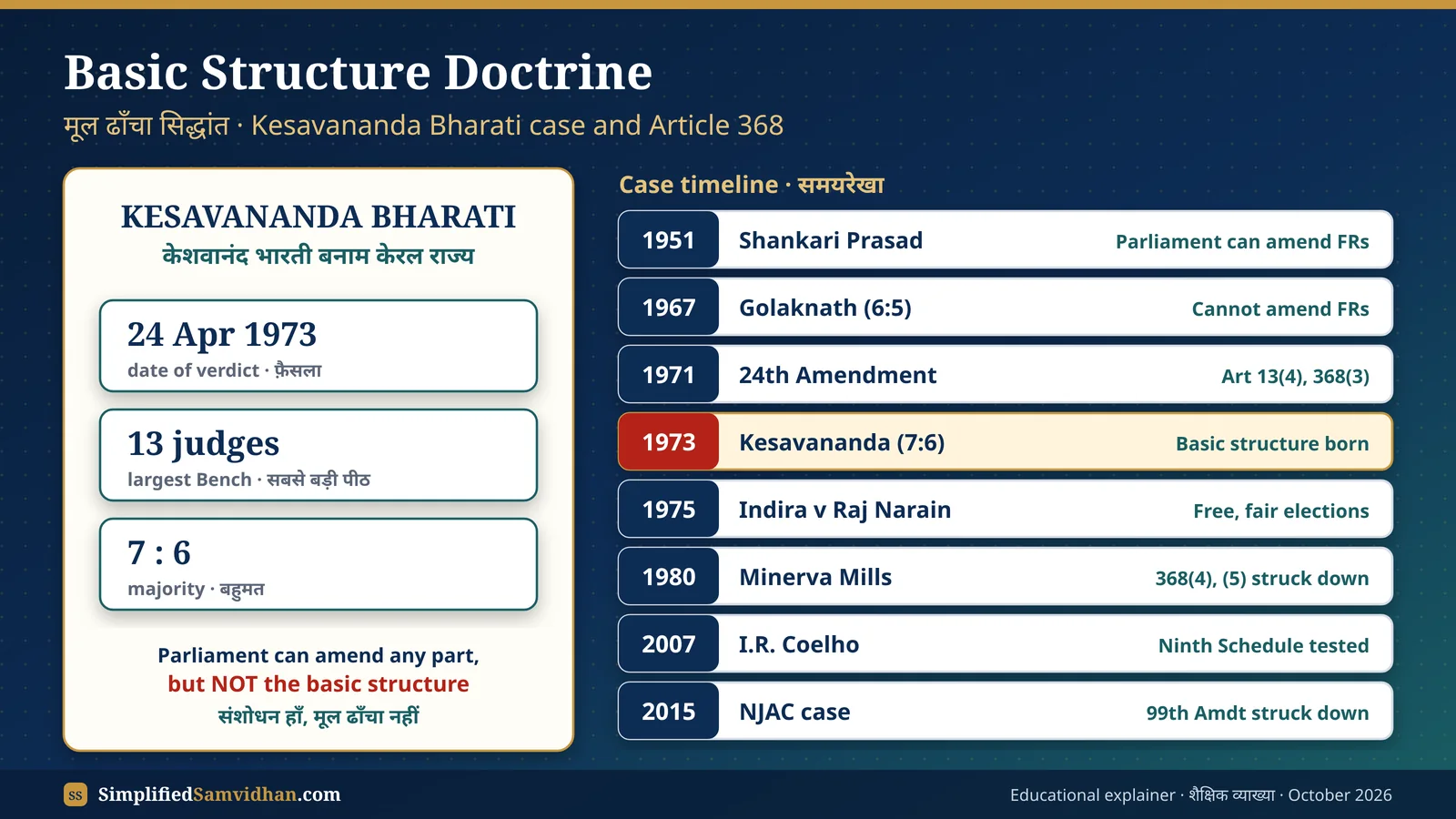
Parliament can amend the Constitution, but can it rewrite everything? Read Article 368, how the Supreme Court moved from Shankari Prasad to Golaknath to the Kesavananda Bharati case of 1973, the list of basic features, and the cases that used the doctrine.
Official textBasic Structure Doctrine Starts Here: Article 368 Text
368. Power of Parliament to amend the Constitution and procedure therefor. (1) Notwithstanding anything in this Constitution, Parliament may in exercise of its constituent power amend by way of addition, variation or repeal any provision of this Constitution in accordance with the procedure laid down in this article.
(2) An amendment of this Constitution may be initiated only by the introduction of a Bill for the purpose in either House of Parliament, and when the Bill is passed in each House by a majority of the total membership of that House and by a majority of not less than two-thirds of the members of that House present and voting, it shall be presented to the President who shall give his assent to the Bill and thereupon the Constitution shall stand amended in accordance with the terms of the Bill:
Provided that if such amendment seeks to make any change in (a) article 54, article 55, article 73, article 162, article 241 or article 279A; or (b) Chapter IV of Part V, Chapter V of Part VI, or Chapter I of Part XI; or (c) any of the Lists in the Seventh Schedule; or (d) the representation of States in Parliament; or (e) the provisions of this article, the amendment shall also require to be ratified by the Legislatures of not less than one-half of the States by resolutions to that effect passed by those Legislatures before the Bill making provision for such amendment is presented to the President for assent.
(3) Nothing in article 13 shall apply to any amendment made under this article.
(4) No amendment of this Constitution (including the provisions of Part III) made or purporting to have been made under this article whether before or after the commencement of section 55 of the Constitution (Forty-second Amendment) Act, 1976 shall be called in question in any court on any ground.
(5) For the removal of doubts, it is hereby declared that there shall be no limitation whatever on the constituent power of Parliament to amend by way of addition, variation or repeal the provisions of this Constitution under this article.
Note: clauses (4) and (5) were struck down by the Supreme Court in Minerva Mills (1980) but are still printed in the official text.
Article 368 gives Parliament the power to amend the Constitution. Read alone, its words look unlimited, and clause (5) even says 'no limitation whatever'. The basic structure doctrine is the Supreme Court's answer: Parliament can change any Article, but it cannot change the identity of the Constitution. It can repair and extend the house; it cannot pull down the pillars that hold it up.
🏠 Everyday analogy
A cricket board can change many rules: powerplay overs, DRS, the number of bouncers. But if it said 'from now on there is no bat and no ball', it would no longer be cricket. Some features make the game what it is.
🇮🇳 Real Indian example
In 2015 Parliament passed the 99th Amendment to set up the NJAC for appointing judges. The Supreme Court struck it down because it hurt the independence of the judiciary, a part of the basic structure.
The ideaWhat Is the Basic Structure Doctrine?
Parliament's argument
- Article 368 has no limit written in it
- Elected MPs speak for the people; judges are not elected
- Land reform and social justice need big changes, even to Fundamental Rights
- An amendment is not 'law' under Article 13, so it cannot be struck down for violating rights
The Court's answer (1973)
- 'Amend' means to improve or change, not to destroy
- Parliament is a creature of the Constitution; it cannot kill its creator
- Fundamental Rights can be amended, but not in a way that destroys the core
- Courts will decide, case by case, what the basic features are
Landmark caseKesavananda Bharati Case (1973): Facts, Bench and Verdict
| Point | Kesavananda Bharati v. State of Kerala |
|---|---|
| Petitioner | Swami Kesavananda Bharati, head of the Edneer Mutt in Kasaragod, Kerala. He challenged Kerala land reform laws that limited the Mutt's land. |
| Also challenged | The 24th, 25th and 29th Constitutional Amendments (1971-72), passed to undo Golaknath and protect land laws. |
| Bench | 13 judges, the largest Bench in the Court's history, led by CJI S.M. Sikri. |
| Hearing | About 68 days (Oct 1972 to Mar 1973). N.A. Palkhivala argued for the petitioner. |
| Verdict date and split | 24 April 1973, by 7:6. Justice H.R. Khanna's opinion tipped the balance. |
| Held | (1) Golaknath overruled: Parliament can amend Fundamental Rights. (2) 24th Amendment valid. (3) But Parliament cannot alter the basic structure. (4) The part of Art 31C that barred courts from checking laws was struck down. (5) The Preamble is a part of the Constitution. |
| Irony | Kesavananda Bharati himself lost on his land claim, yet the case saved the Constitution. He passed away on 6 September 2020. |
TimelineBasic Structure Case Timeline: Shankari Prasad to NJAC
| Year | Case or event | What it decided |
|---|---|---|
| 1951 | Shankari Prasad v. Union of India | 1st Amendment upheld. Parliament can amend Fundamental Rights; an amendment is not 'law' under Art 13. |
| 1965 | Sajjan Singh v. State of Rajasthan | 17th Amendment upheld, same view. But two judges (Hidayatullah, Mudholkar) doubted whether Fundamental Rights should be a 'plaything' of the majority. |
| 1967 | I.C. Golaknath v. State of Punjab (11 judges, 6:5) | U-turn: Parliament cannot take away or abridge Fundamental Rights; an amendment is 'law' under Art 13. Applied only to the future (prospective overruling). |
| 1971 | 24th Amendment | Parliament hits back: added Art 13(4) and 368(3) (Art 13 does not apply to amendments) and made the President's assent to amendment Bills compulsory. |
| 1973 | Kesavananda Bharati v. State of Kerala (13 judges, 7:6) | Middle path: Parliament can amend any part, but not the basic structure. |
| 1975 | Indira Nehru Gandhi v. Raj Narain | First amendment struck down on basic structure: Art 329A(4) of the 39th Amendment, which put the PM's election beyond courts. Free and fair elections are basic. |
| 1976 | 42nd Amendment | Added Art 368(4) and (5): no amendment can be questioned in court; no limit on amending power. |
| 1980 | Minerva Mills v. Union of India | Struck down 368(4) and (5). Limited amending power, judicial review and the balance between Fundamental Rights and DPSP are basic. |
| 1981 | Waman Rao v. Union of India | Laws put in the Ninth Schedule after 24 April 1973 can be tested on basic structure. |
| 2007 | I.R. Coelho v. State of Tamil Nadu (9 judges) | Ninth Schedule is no 'safe locker': post-1973 entries must pass the basic structure test, including the rights in Articles 14, 19 and 21. |
| 2015 | NJAC case (SC Advocates-on-Record Assn, 4:1) | 99th Amendment and NJAC Act struck down on 16 October 2015: independence of the judiciary is basic; collegium restored. |
| 2022 | Janhit Abhiyan v. Union of India (3:2) | 103rd Amendment (10% EWS quota) upheld: it does not violate the basic structure. |
The listElements of the Basic Structure of the Indian Constitution
| Element of basic structure | Recognised in |
|---|---|
| Supremacy of the Constitution | Kesavananda Bharati (1973) |
| Republican and democratic form of government | Kesavananda Bharati (1973) |
| Secular character of the Constitution | Kesavananda (1973); S.R. Bommai (1994) |
| Separation of powers | Kesavananda (1973); Indira Gandhi (1975) |
| Federal character | Kesavananda (1973); S.R. Bommai (1994) |
| Unity, integrity and sovereignty of India | Kesavananda Bharati (1973) |
| Free and fair elections, democracy | Indira Gandhi v. Raj Narain (1975) |
| Rule of law and equality | Indira Gandhi (1975); I.R. Coelho (2007) |
| Judicial review | Minerva Mills (1980); L. Chandra Kumar (1997) |
| Limited amending power of Parliament | Minerva Mills (1980) |
| Harmony between Fundamental Rights and DPSP | Minerva Mills (1980) |
| Parliamentary system of government | Kesavananda (1973); later cases |
| Independence of the judiciary | Judges cases; NJAC case (2015) |
| Freedom and dignity of the individual; welfare State | Kesavananda (1973); later cases |
DebateBasic Structure Doctrine: Merits and Criticism
Supporters say
- It saved democracy during the 1975 Emergency (Raj Narain case)
- A two-thirds majority is temporary; the Constitution's core should be permanent
- Courts in Bangladesh, Kenya and Belize have borrowed the idea
Critics say
- Unelected judges get the final word over elected Parliament
- There is no fixed list, so it is uncertain
- The words 'basic structure' are not written anywhere in the Constitution
Connect the dotsHow the Basic Structure Doctrine Connects to Other Topics
- The full story of the case, the 13 judges, Justice Khanna's swing vote and the aftermath: read the Kesavananda Bharati case explained in detail.
- Kesavananda also held that the Preamble is a part of the Constitution: read the Preamble of the Indian Constitution.
- How amendments are actually passed, and the full list of key amendments: important amendments of the Indian Constitution.
- Golaknath turned on the meaning of 'law' in Article 13; Fundamental Rights are explained in the Part III overview.
- The 1975 Emergency and the 39th and 42nd Amendments: see emergency provisions.
- Minerva Mills balanced rights with the Directive Principles of State Policy.
- Judicial review works through writs: see the types of writs.
Quick revisionOne-Line Revision Points (Exam Ready)
- Basic structure doctrine: propounded in Kesavananda Bharati v. State of Kerala, 24 April 1973.
- Bench: 13 judges, CJI S.M. Sikri; majority 7:6.
- Golaknath (1967), 11 judges, 6:5: Parliament cannot amend Fundamental Rights; reversed in 1973.
- 24th Amendment (1971) added Art 13(4) and 368(3).
- First amendment struck down using basic structure: 39th, in Indira Gandhi v. Raj Narain (1975).
- Minerva Mills (1980) struck down Art 368(4) and (5) added by the 42nd Amendment.
- Ninth Schedule laws after 24 April 1973 are open to challenge: Waman Rao (1981), I.R. Coelho (2007).
- 99th Amendment (NJAC) struck down in 2015: independence of the judiciary.
- The term 'basic structure' is not written in the Constitution; it is judge-made.
Practice MCQPractice MCQs (with Answers): Basic Structure Doctrine
How many judges heard the Kesavananda Bharati case and what was the majority?
Which case held that Parliament cannot amend Fundamental Rights, a view later overruled?
Clauses (4) and (5) of Article 368, added by the 42nd Amendment, were struck down in:
Which of these is NOT recognised as part of the basic structure?
The NJAC case (2015) struck down which Constitutional Amendment?
Doubts ClearedFrequently Asked Questions
What is the basic structure doctrine?
It is the rule laid down by the Supreme Court that Parliament can amend any part of the Constitution under Article 368 but cannot destroy or alter its basic features, such as democracy, secularism, federalism and judicial review.
Who was Kesavananda Bharati?
He was the head of the Edneer Mutt in Kasaragod, Kerala, who challenged Kerala's land reform laws. His case gave India the basic structure doctrine on 24 April 1973.
Is the list of basic structure elements fixed?
No. The Supreme Court decides case by case. Commonly accepted elements include supremacy of the Constitution, democracy, secularism, federalism, separation of powers, judicial review and independence of the judiciary.
Which was the first amendment struck down on the basis of basic structure?
Clause (4) of Article 329A inserted by the 39th Amendment (1975), struck down in Indira Nehru Gandhi v. Raj Narain (1975).
Can Parliament amend Fundamental Rights?
Yes, after Kesavananda Bharati it can, as long as the amendment does not damage the basic structure.
Sources and further readingSources We Checked
Article 368 text from the Constitution of India as on 2026 (Legislative Department); the Hindi text above is a simple rendering. Facts checked on 18 October 2026.