12 Schedules of the Indian Constitution: Complete List with Articles and Amendments
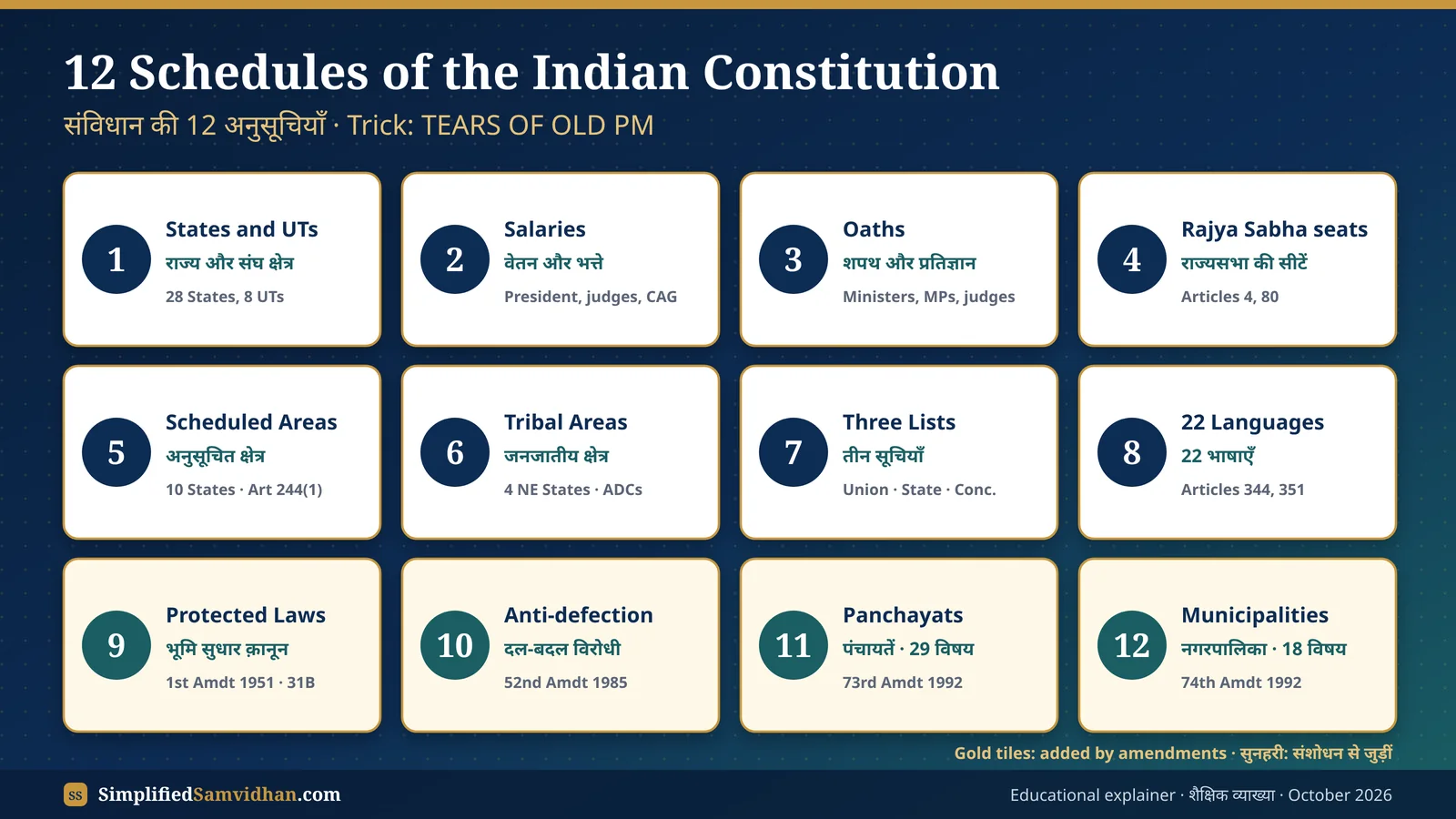
All 12 Schedules in one table, which amendment added the 9th to 12th, the 22 languages of the Eighth Schedule, the anti-defection law, the Fifth vs Sixth Schedule, and a trick to remember them in order.
Article 31BSchedules of Indian Constitution: What a Schedule Is and the Ninth Schedule (Article 31B)
A Schedule is a list or table attached at the end of the Constitution. The Articles lay down the rule; the Schedule holds the long details (names of States, salaries, oath wording, lists of subjects, languages) so that the main text stays readable. The Constitution began with 8 Schedules in 1950; four more were added by amendments, making 12 Schedules today. The most debated of them is the Ninth Schedule, created by Article 31B below.
31B. Validation of certain Acts and Regulations. Without prejudice to the generality of the provisions contained in article 31A, none of the Acts and Regulations specified in the Ninth Schedule nor any of the provisions thereof shall be deemed to be void, or ever to have become void, on the ground that such Act, Regulation or provision is inconsistent with, or takes away or abridges any of the rights conferred by, any provisions of this Part, and notwithstanding any judgment, decree or order of any court or tribunal to the contrary, each of the said Acts and Regulations shall, subject to the power of any competent Legislature to repeal or amend it, continue in force.
Article 31B says: any law placed in the Ninth Schedule cannot be struck down for violating Fundamental Rights, even if a court has already declared it invalid. It was added by the 1st Amendment in 1951 to save the zamindari abolition and land reform laws that courts were cancelling under the right to property.
But the shield is not unlimited. In I.R. Coelho v. State of Tamil Nadu (2007) a nine-judge Bench held that laws added to the Ninth Schedule after 24 April 1973 (the date of the Kesavananda Bharati judgment) can be tested against the basic structure.
🏠 Everyday analogy
Think of a school's 'approved by Principal' file. Anything kept in that file cannot be questioned by class monitors. But if the Principal starts putting everything in that file, the School Board can still check whether it breaks the school's basic rules.
🇮🇳 Real Indian example
Tamil Nadu's 69% reservation law (1994) was placed in the Ninth Schedule by the 76th Amendment to protect it from the 50% ceiling set in Indra Sawhney (1992). After I.R. Coelho, such laws can still be reviewed for basic-structure violations.
All 12 at a glance12 Schedules of Indian Constitution: Table with Articles
| Schedule | What it contains | Related Articles |
|---|---|---|
| First | Names of the States and Union Territories and their territories: today 28 States and 8 UTs. | Articles 1 and 4 |
| Second | Salaries, allowances and privileges of the President, Governors, Speaker and Deputy Speaker, Chairman and Deputy Chairman of Rajya Sabha, State presiding officers, Supreme Court and High Court judges, and the CAG. | Articles 59, 65, 75, 97, 125, 148, 158, 164, 186, 221 |
| Third | Forms of oaths and affirmations for Union and State Ministers, candidates for and members of Parliament and State Legislatures, judges of the Supreme Court and High Courts, and the CAG. (The President's and Vice-President's oaths are in Articles 60 and 69, not here.) | Articles 75, 84, 99, 124, 146, 173, 188, 219 |
| Fourth | Allocation of Rajya Sabha seats to States and UTs (roughly by population; Uttar Pradesh has the most, 31). | Articles 4 and 80 |
| Fifth | Administration and control of Scheduled Areas and Scheduled Tribes in States other than Assam, Meghalaya, Tripura and Mizoram (10 States have such areas). Tribes Advisory Councils; Governor's special powers. | Article 244(1) |
| Sixth | Administration of tribal areas in Assam, Meghalaya, Tripura and Mizoram through elected Autonomous District Councils (10 in all) with law-making, judicial and tax powers. | Articles 244(2), 275(1) |
| Seventh | Division of powers: List I Union, List II State, List III Concurrent (originally 97, 66 and 47 entries). | Article 246 |
| Eighth | 22 languages recognised by the Constitution (originally 14). | Articles 344(1), 351 |
| Ninth (1st Amdt, 1951) | Acts and Regulations (mostly land reforms) protected from challenge on the ground of Fundamental Rights; more than 280 laws today. | Article 31B |
| Tenth (52nd Amdt, 1985) | Anti-defection law: disqualification of MPs and MLAs who defect. | Articles 102(2), 191(2) |
| Eleventh (73rd Amdt, 1992) | Powers of Panchayats: 29 subjects (agriculture, drinking water, rural housing, primary education…). | Article 243G |
| Twelfth (74th Amdt, 1992) | Powers of Municipalities: 18 subjects (urban planning, water supply, public health, fire services…). | Article 243W |
Added laterWhich Amendment Added the 9th, 10th, 11th and 12th Schedules
| Schedule | Added by | Year | Why |
|---|---|---|---|
| Ninth | 1st Amendment | 1951 | Protect land reform and zamindari abolition laws |
| Tenth | 52nd Amendment | 1985 | Stop 'Aaya Ram, Gaya Ram' defections (Rajiv Gandhi government) |
| Eleventh | 73rd Amendment | 1992 | Constitutional status to Panchayati Raj (in force 24 April 1993) |
| Twelfth | 74th Amendment | 1992 | Constitutional status to urban local bodies (in force 1 June 1993) |
Tenth Schedule: key rules
- A member is disqualified for voluntarily giving up party membership or for defying the party whip
- An independent who joins a party, or a nominated member who joins one after 6 months, is disqualified
- Exception: merger backed by two-thirds of the legislature party
Amendments and court rulings
- 91st Amendment (2003) removed the one-third 'split' exception and capped the size of the Council of Ministers at 15%
- Kihoto Hollohan (1992): Tenth Schedule valid; the Speaker's decision is open to judicial review
- The presiding officer (Speaker or Chairman) decides disqualification petitions
Eighth ScheduleEighth Schedule: 22 Languages and When They Were Added
| Year | Amendment | Languages added | Total |
|---|---|---|---|
| 1950 | Original Constitution | Assamese, Bengali, Gujarati, Hindi, Kannada, Kashmiri, Malayalam, Marathi, Oriya (now Odia), Punjabi, Sanskrit, Tamil, Telugu, Urdu | 14 |
| 1967 | 21st Amendment | Sindhi | 15 |
| 1992 | 71st Amendment | Konkani, Manipuri, Nepali | 18 |
| 2003 | 92nd Amendment | Bodo, Dogri, Maithili, Santhali | 22 |
- 2011, 96th Amendment: 'Oriya' was renamed 'Odia'. No new language has been added since 2003; demands for Bhojpuri, Rajasthani, Tulu, Bhoti and others are pending with the Home Ministry (as of October 2026).
- Eighth Schedule is not the 'national language' list: India has no national language. Hindi in Devanagari is the official language of the Union (Article 343).
- Benefits of inclusion: representation on the Official Language Commission (Article 344), use in UPSC exams, and central support for literature through bodies like the Sahitya Akademi.
- Classical language status is different from the Eighth Schedule: it is given by the Ministry of Culture (11 languages, after Marathi, Pali, Prakrit, Assamese and Bengali were added in October 2024).
Tribal areas and ListsFifth vs Sixth Schedule, and the Seventh Schedule Lists
Fifth Schedule
- Scheduled Areas in 10 States (e.g. Jharkhand, Chhattisgarh, Odisha, Madhya Pradesh, Rajasthan)
- Governor can direct that a Central or State law shall not apply, or apply with changes
- Tribes Advisory Council (up to 20 members, three-fourths tribal MLAs)
- PESA Act, 1996 extends Panchayati Raj with Gram Sabha powers to these areas
Sixth Schedule
- Tribal areas of Assam, Meghalaya, Tripura and Mizoram only
- Autonomous District Councils (up to 30 members, 4 nominated by the Governor) can make laws on land, forests, marriage, customs
- 10 councils, e.g. Bodoland Territorial Council (Assam), Garo Hills (Meghalaya)
- Much more autonomy than the Fifth Schedule
| Seventh Schedule List | Who makes laws | Examples |
|---|---|---|
| List I: Union | Parliament only | Defence, foreign affairs, railways, banking, atomic energy |
| List II: State | State Legislature (Parliament only in special cases, e.g. Articles 249, 250, 252) | Police, public order, public health, agriculture, land |
| List III: Concurrent | Both; Central law prevails in a conflict (Article 254) | Criminal law, marriage, education, forests (last two moved here in 1976) |
| Residuary subjects | Parliament (Article 248, idea from Canada) | Anything not in any List, e.g. cyber laws |
Connect the dotsHow the Schedules Connect to the Rest of the Constitution
- The Seventh Schedule's Concurrent List came from Australia and residuary powers from Canada: see sources of the Indian Constitution.
- The Constitution started with 8 Schedules in 1950: the making of the Constitution.
- Four Schedules were added by amendment, and I.R. Coelho limits the Ninth: read important amendments and the basic structure doctrine.
- The Ninth Schedule shields laws from Fundamental Rights such as Article 14 and the right to property; see the Part III overview.
- The First Schedule changes when States are created under Article 4; seat shares in the Fourth Schedule connect to delimitation.
- Practise schedule questions in the daily polity MCQ quiz.
Quick revisionOne-Line Revision Points (Exam Ready)
- Original Constitution: 8 Schedules; today: 12.
- 1st: States and UTs (28 + 8); 2nd: salaries; 3rd: oaths; 4th: Rajya Sabha seats.
- 5th: Scheduled Areas (10 States); 6th: tribal areas of Assam, Meghalaya, Tripura, Mizoram.
- 7th: Union, State and Concurrent Lists (Article 246).
- 8th: 22 languages; last added Bodo, Dogri, Maithili, Santhali (92nd Amendment, 2003).
- 9th: 1st Amendment, 1951, Article 31B; reviewable after I.R. Coelho (2007) for laws added after 24 Apr 1973.
- 10th: anti-defection, 52nd Amendment, 1985; split clause removed by the 91st (2003).
- 11th: Panchayats, 29 subjects (73rd, 1992); 12th: Municipalities, 18 subjects (74th, 1992).
- Trick: TEARS OF OLD PM for Schedules 1 to 12.
Practice MCQPractice MCQs (with Answers): Schedules
Which Schedule of the Constitution contains provisions on disqualification on grounds of defection?
The Ninth Schedule was added to the Constitution by:
Which of these languages was NOT added by the 92nd Amendment, 2003?
The Sixth Schedule applies to tribal areas of which States?
Allocation of seats in the Rajya Sabha is given in which Schedule?
Doubts ClearedFrequently Asked Questions
How many Schedules are there in the Indian Constitution?
There are 12 Schedules today. The original Constitution of 1950 had 8; the 9th, 10th, 11th and 12th were added by amendments.
What is the Ninth Schedule?
A list of laws protected by Article 31B from challenge on the ground of Fundamental Rights. It was added by the 1st Amendment, 1951. Since I.R. Coelho (2007), laws added after 24 April 1973 can be reviewed for basic-structure violations.
How many languages are in the Eighth Schedule?
22. The original 14 were extended by the 21st (1967), 71st (1992) and 92nd (2003) Amendments. None has been added since 2003.
Which Schedule deals with the anti-defection law?
The Tenth Schedule, added by the 52nd Amendment, 1985 and strengthened by the 91st Amendment, 2003.
What is the difference between the Fifth and Sixth Schedules?
The Fifth covers Scheduled Areas in 10 States through the Governor and Tribes Advisory Councils. The Sixth gives much more autonomy, through elected Autonomous District Councils, to tribal areas of Assam, Meghalaya, Tripura and Mizoram.
Sources and further readingSources We Checked
Text of Article 31B from the Constitution of India (Legislative Department). Facts checked on 18 October 2026.