Emergency Provisions in Indian Constitution: Types of Emergency, Articles 352, 356 and 360
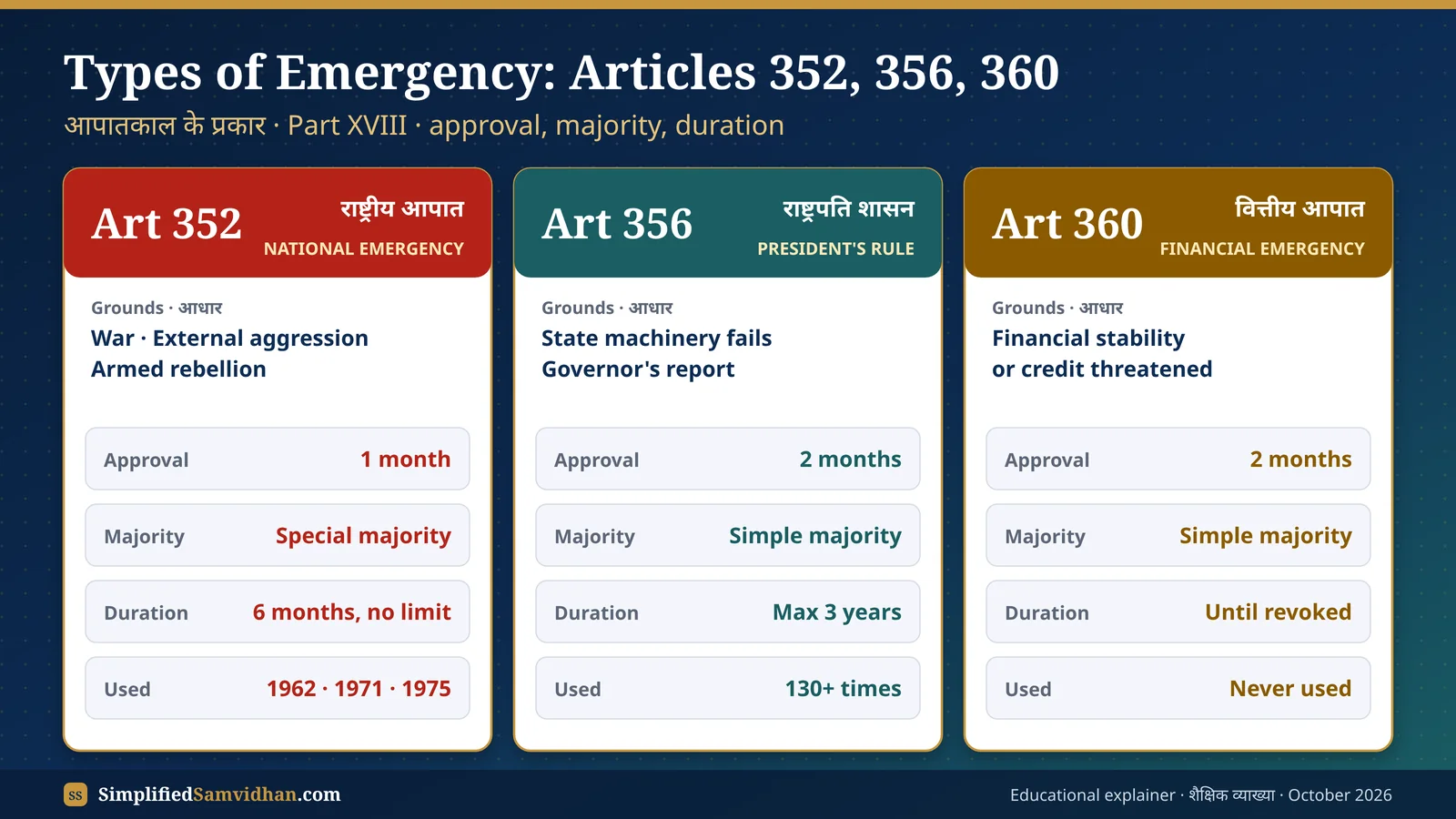
Part XVIII lets the Centre take extra power when India faces war, rebellion, a State breakdown or a money crisis. Learn the three types of emergency in one table, the 44th Amendment safeguards, the 1975 Emergency, President's Rule after S.R. Bommai, and why Article 360 has never been used.
Official textEmergency Provisions in Indian Constitution: Article 352 Text
352. Proclamation of Emergency. (1) If the President is satisfied that a grave emergency exists whereby the security of India or of any part of the territory thereof is threatened, whether by war or external aggression or armed rebellion, he may, by Proclamation, make a declaration to that effect in respect of the whole of India or of such part of the territory thereof as may be specified in the Proclamation.
Explanation. A Proclamation of Emergency declaring that the security of India or any part of the territory thereof is threatened by war or by external aggression or by armed rebellion may be made before the actual occurrence of war or of any such aggression or rebellion, if the President is satisfied that there is imminent danger thereof.
(3) The President shall not issue a Proclamation under clause (1) or a Proclamation varying such Proclamation unless the decision of the Union Cabinet (that is to say, the Council consisting of the Prime Minister and other Ministers of Cabinet rank appointed under article 75) that such a Proclamation may be issued has been communicated to him in writing.
Emergency provisions are the Constitution's fire alarm. In normal times India is a federation: the Centre and the States each run their own subjects. When the country faces war, an armed uprising, a breakdown of a State government or a money crisis, Part XVIII (Articles 352 to 360) lets the Centre take extra power for a limited time, so that India survives as one nation. Since 1978 the alarm can be pulled only by the whole Cabinet in writing, never by the Prime Minister alone.
🏠 Everyday analogy
In a housing society the elected committee decides most things flat by flat. If a fire breaks out, the fire officer takes charge of the whole building for a few hours. Once the fire is out, the committee is back in charge.
🇮🇳 Real Indian example
On 25 June 1975 an Emergency on the ground of 'internal disturbance' was declared on the Prime Minister's word, before the Cabinet even met. Press censorship and mass arrests followed. The 44th Amendment (1978) closed this door by demanding written Cabinet advice.
CompareTypes of Emergency: Article 352, 356 and 360 Compared
| Point | National Emergency | President's Rule (State Emergency) | Financial Emergency |
|---|---|---|---|
| Article | 352 | 356 (+ 365) | 360 |
| Grounds | War, external aggression or armed rebellion (actual or imminent) | State government cannot be run as per the Constitution (Governor's report 'or otherwise'); also failure to obey Union directions (Art 365) | Financial stability or credit of India or any part is threatened |
| Parliament's approval within | 1 month | 2 months | 2 months |
| Majority needed | Special: majority of total membership + 2/3 of members present and voting, in each House | Simple majority | Simple majority |
| Duration once approved | 6 months, renewable every 6 months with no maximum | 6 months at a time, maximum 3 years | Indefinite until revoked; no repeat approval |
| Revocation | President any time; or must revoke if Lok Sabha passes a disapproval resolution by simple majority | President any time (no Parliament approval needed) | President any time |
| Effect on Fundamental Rights | Art 19 suspended (war/aggression only); others by Art 359 order, except Art 20 and 21 | No effect | No effect |
| Used so far | 3 times: 1962, 1971, 1975 | Over 130 times since 1951 | Never |
- Federal becomes unitary: the Centre can give directions to any State on any matter (Art 353) and Parliament can make laws even on State List subjects.
- Money: the President can change the sharing of taxes between the Centre and States (Art 354).
- Life of the House: the Lok Sabha's term can be extended by law one year at a time; it ends six months after the Emergency ends (Art 83(2) proviso). In 1976 the Lok Sabha's term was stretched this way.
- Rights: see Articles 358 and 359 below. State governments are not dismissed in a National Emergency; they keep working under Union control.
Safeguards44th Amendment and Emergency: Article 358 vs Article 359
| Point | Before 1978 | After the 44th Amendment (1978) |
|---|---|---|
| Third ground in Art 352 | 'Internal disturbance' (vague) | 'Armed rebellion' |
| Who advises the President | Prime Minister could advise alone | Union Cabinet, in writing (Art 352(3)) |
| Approval by Parliament | Within 2 months, simple majority | Within 1 month, special majority |
| Continuation | Once approved, lasted as long as the Executive wished | Fresh approval every 6 months |
| Ending it | Only the President | Lok Sabha can force revocation by simple majority |
| Articles 20 and 21 | Could be suspended (ADM Jabalpur, 1976) | Can never be suspended (Art 359) |
| Art 19 under Art 358 | Suspended in every National Emergency | Only for war or external aggression, not armed rebellion |
| Judicial review | 38th Amendment (1975) made the President's satisfaction final | That bar removed; courts can examine mala fides (confirmed in Minerva Mills, 1980) |
Article 358
- Suspends Article 19 only
- Automatic: no separate order needed
- Only when Emergency is on war or external aggression
- Article 19 itself stops working for the period
Article 359
- Suspends the right to move courts for rights named in the order
- Needs a Presidential order
- Works for every ground of National Emergency
- Can never cover Articles 20 and 21
HistoryNational Emergencies in India: 1962, 1971 and 1975
- 1
🏔️ 26 Oct 1962: First National Emergency (China)
Declared during the Chinese aggression on the ground of external aggression. It continued long after the war and was revoked only on 10 January 1968. The 1965 war with Pakistan was fought while it was in force.
- 2
⚔️ 3 Dec 1971: Second National Emergency (Pakistan)
Declared when Pakistan attacked during the Bangladesh liberation war, on the ground of external aggression. Revoked on 27 March 1977.
- 3
🚨 25 Jun 1975: Third National Emergency ('internal disturbance')
Declared while the 1971 Emergency was still running, a few days after the Allahabad High Court set aside Indira Gandhi's election (12 June 1975). Opposition leaders were jailed, the press was censored and the 38th, 39th and 42nd Amendments were passed. Revoked on 21 March 1977 after the Janata Party won the elections.
- 4
⚖️ 1976: ADM Jabalpur v. Shivkant Shukla
The Supreme Court (4:1, Justice H.R. Khanna dissenting) held that during the Emergency a detenu could not file habeas corpus. This 'darkest hour' was expressly overruled in K.S. Puttaswamy (2017).
- 5
🛡️ 1978: 44th Amendment
The Janata government rebuilt the safeguards listed in the table above so that 1975 could not be repeated.
State EmergencyPresident's Rule (Article 356) and the S.R. Bommai Case
356. Provisions in case of failure of constitutional machinery in States. (1) If the President, on receipt of a report from the Governor of a State or otherwise, is satisfied that a situation has arisen in which the government of the State cannot be carried on in accordance with the provisions of this Constitution, the President may by Proclamation (a) assume to himself all or any of the functions of the Government of the State and all or any of the powers vested in or exercisable by the Governor or any body or authority in the State other than the Legislature of the State; (b) declare that the powers of the Legislature of the State shall be exercisable by or under the authority of Parliament; ...
Provided that nothing in this clause shall authorise the President to assume to himself any of the powers vested in or exercisable by a High Court.
President's Rule means the State government is removed and the Centre runs the State through the Governor. The State Assembly is either dissolved or kept in 'suspended animation' (alive but asleep), and Parliament makes the State's laws. The High Court is never touched.
🏠 Everyday analogy
If a class monitor cannot keep order, the principal may take over the class for a while. But the principal must give real reasons, and a teacher committee (the court) can check whether the monitor really failed.
🇮🇳 Real Indian example
Manipur came under President's Rule on 13 February 2025 after the Chief Minister resigned amid ethnic violence; it was revoked on 4 February 2026 when a new government was sworn in.
| Year | Milestone of President's Rule |
|---|---|
| 1951 | First use: Punjab (20 June 1951). |
| 1959 | Kerala's elected EMS Namboodiripad government (India's first elected Communist State government) dismissed. |
| 1977, 1980 | Nine State governments of the opposing party dismissed at once after a change at the Centre, each time. |
| 1988 | Sarkaria Commission (set up 1983) report: use Art 356 only as a 'last resort'; test majority on the floor of the House. |
| 1994 | S.R. Bommai v. Union of India (11 March 1994, 9 judges) changes the game (see below). |
| 2006 | Rameshwar Prasad: dissolution of the Bihar Assembly (2005) held unconstitutional. |
| 2010 | Punchhi Commission (set up 2007) suggests 'localised emergency' for a district or area instead of dismissing a whole State government. |
| 2016 | Courts restore the dismissed governments of Arunachal Pradesh (Nabam Rebia case) and Uttarakhand (floor test ordered). |
| 2025-26 | Manipur: imposed 13 Feb 2025, revoked 4 Feb 2026. Total uses since 1950: over 130. |
- Bommai rule 1: the Proclamation is open to judicial review; the court can ask for the material behind it and strike it down if it is irrelevant or mala fide.
- Bommai rule 2: whether a government has a majority must be tested by a floor test in the Assembly, not in the Governor's office.
- Bommai rule 3: the Assembly can be dissolved only after both Houses approve the Proclamation; until then it is only suspended. If the court strikes the Proclamation down, the old government comes back.
- Bommai rule 4: secularism is a basic feature; a State government acting against it can be removed. See the basic structure doctrine.
- Extension beyond 1 year (44th Amendment): only if a National Emergency is in force and the Election Commission certifies that elections cannot be held. Special amendments were passed to stretch President's Rule in Punjab beyond this in the late 1980s and early 1990s.
Never usedFinancial Emergency (Article 360) and Sources of Emergency Provisions
360. Provisions as to financial emergency. (1) If the President is satisfied that a situation has arisen whereby the financial stability or credit of India or of any part of the territory thereof is threatened, he may by a Proclamation make a declaration to that effect.
A Financial Emergency is for a situation where India is close to going bankrupt or losing its credit. The Centre can then order States to follow strict money rules and can cut the salaries of all government servants, including judges of the Supreme Court and High Courts.
🏠 Everyday analogy
When a family is deep in debt, the head of the family takes everyone's pocket money, cancels holidays and checks every bill until the loans are paid back.
🇮🇳 Real Indian example
In 1991 India had foreign exchange for only about two weeks of imports and pledged gold abroad, yet Article 360 was not used. The crisis was handled by economic reforms. Article 360 has never been used.
- Approval by both Houses within 2 months by simple majority; then it continues until revoked, with no 6-month renewal.
- Money Bills and other financial Bills of States can be reserved for the President's consideration.
- Salaries and allowances of Union and State employees, and of Supreme Court and High Court judges, can be reduced.
| Emergency feature | Borrowed from |
|---|---|
| Suspension of Fundamental Rights during Emergency | Weimar Constitution of Germany (1919) |
| Overall emergency scheme, Governor's report, Centre taking over a province | Government of India Act, 1935 (Section 93) |
Connect the dotsHow Emergency Provisions Connect to the Rest of the Constitution
- Which rights can and cannot be suspended: start with the Fundamental Rights overview and Article 19.
- The 38th, 39th, 42nd and 44th Amendments were all born from the 1975 Emergency: see the important amendments list.
- Why even an Emergency government could not destroy elections or judicial review: the basic structure doctrine and Kesavananda Bharati.
- The Fundamental Duties were added during the Emergency by the 42nd Amendment: read the Fundamental Duties (Article 51A).
- Practise more questions on this topic in the daily polity MCQ quiz.
Quick revisionOne-Line Revision Points (Exam Ready)
- Emergency provisions: Part XVIII, Articles 352 to 360.
- Grounds of National Emergency: war, external aggression, armed rebellion ('armed rebellion' since the 44th Amendment, 1978).
- Approval: 352 in 1 month (special majority); 356 and 360 in 2 months (simple majority).
- President's Rule: maximum 3 years; Financial Emergency: no maximum, never used.
- Articles 20 and 21 cannot be suspended even in an Emergency (Art 359, after 1978).
- Art 358 suspends Art 19 automatically, only for war or external aggression.
- National Emergencies: 1962 (China), 1971 (Pakistan), 1975 (internal disturbance).
- First President's Rule: Punjab, 1951. Landmark case: S.R. Bommai (1994), floor test and judicial review.
- Suspension of rights in Emergency: borrowed from the Weimar Constitution (Germany).
Practice MCQPractice MCQs (with Answers): Emergency Provisions
Which amendment replaced the words 'internal disturbance' with 'armed rebellion' in Article 352?
Which Fundamental Rights cannot be suspended during a National Emergency?
What is the maximum period for which President's Rule can continue in a State?
Which case held that a Proclamation under Article 356 is subject to judicial review and majority must be tested on the floor of the House?
Consider the statements about Financial Emergency (Article 360): 1. It must be approved within two months. 2. It has been declared once, in 1991. Which is/are correct?
Doubts ClearedFrequently Asked Questions
What are the three types of emergency in the Indian Constitution?
National Emergency (Article 352), President's Rule or State Emergency (Article 356) and Financial Emergency (Article 360), all in Part XVIII.
How many times has a National Emergency been declared in India?
Three times: 26 October 1962 (China), 3 December 1971 (Pakistan) and 25 June 1975 (internal disturbance). The last two were revoked in March 1977.
What is President's Rule (राष्ट्रपति शासन)?
Under Article 356 the President takes over a State's government when it cannot be run as per the Constitution. The Governor runs the State for the Centre and Parliament makes its laws, for up to 3 years.
Can the right to life be suspended during an Emergency?
No. Since the 44th Amendment (1978), Articles 20 and 21 cannot be suspended under Article 359, and ADM Jabalpur (1976) was overruled in 2017.
Has Financial Emergency ever been declared in India?
No. Article 360 has never been used, not even in the 1991 economic crisis.
Sources and further readingSources We Checked
Text from the Constitution of India as on 2026 (Legislative Department); the Hindi text above is a simple rendering. Facts checked on 18 October 2026.