Kesavananda Bharati Case (1973): The Judgment That Saved the Constitution
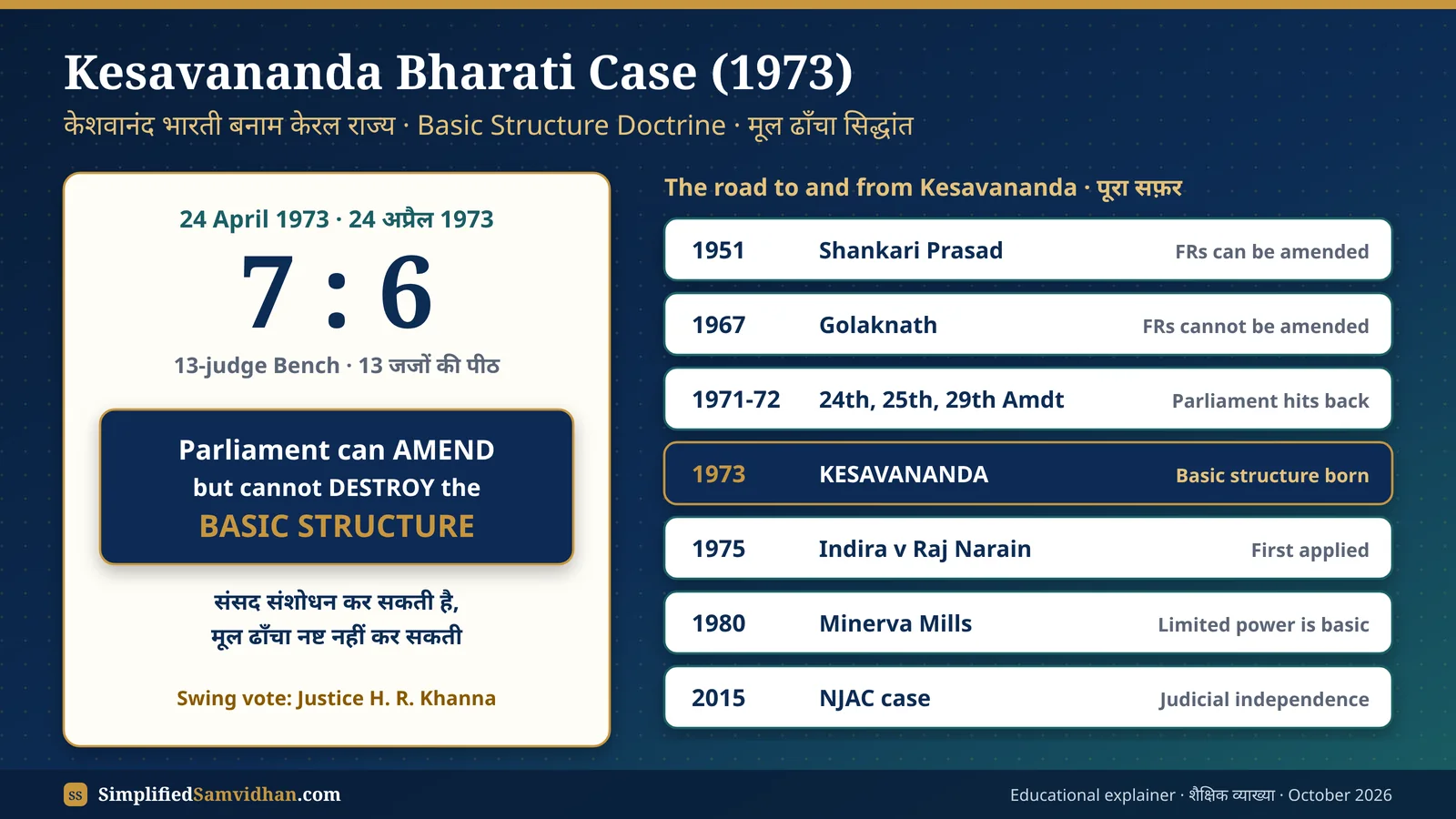
A monk from Kerala went to court to save his mutt's land. He lost the land, but the case gave India the basic structure doctrine. Here is the full story: background, the 13 judges, the 7:6 verdict, what happened next, and why it still matters.
At a glanceKesavananda Bharati Case at a Glance: Bench, Date, Verdict
| Point | Detail |
|---|---|
| Full name | His Holiness Kesavananda Bharati Sripadagalvaru v. State of Kerala and Another |
| Citation | (1973) 4 SCC 225; AIR 1973 SC 1461 |
| Filed | 21 March 1970, under Article 32 (writ petition to the Supreme Court) |
| Decided | 24 April 1973 |
| Chief Justice | S. M. Sikri (he retired the next day, 25 April 1973) |
| For the petitioner | Nani A. Palkhivala |
| For the State and Union | H. M. Seervai (Kerala), Attorney General Niren De (Union of India) |
| Main result | Parliament can amend any part of the Constitution, including Fundamental Rights, but cannot destroy its basic structure. |
BackgroundKesavananda Bharati Case Background: From a Kerala Mutt to Golaknath
Who was Kesavananda Bharati? He was the head (Mathadhipati) of the Edneer Mutt, a Hindu monastery in Kasaragod district of Kerala, from 1961 until his death on 6 September 2020. The mutt owned land that it leased out to farmers. Kerala's land reform laws (the Kerala Land Reforms Act, 1963, as amended in 1969 and 1971) put ceilings on land holdings, so the mutt stood to lose much of its land.
On 21 March 1970 he filed a writ petition under Article 32, saying the laws violated his rights to manage religious property (Articles 25 and 26), to equality (Article 14), to property (Articles 19(1)(f) and 31, which were Fundamental Rights then). A small land dispute soon became the biggest constitutional battle in Indian history, because Parliament changed the Constitution while the case was pending.
- 1
📜 1951: Shankari Prasad
Parliament can amend Fundamental Rights; an amendment is not 'law' under Article 13.
- 2
📜 1965: Sajjan Singh
Same view (3:2), but two judges doubted whether Parliament could change everything.
- 3
⛔ 1967: Golaknath
11 judges (6:5) reversed this: Parliament cannot amend Fundamental Rights at all; an amendment is 'law'.
- 4
🏛️ 1970: Bank nationalisation and privy purses
The Court struck down Indira Gandhi's bank nationalisation law (R.C. Cooper) and the order ending the princes' privy purses (Madhav Rao Scindia). Government and Court were now in open conflict.
- 5
✍️ 1971-72: Parliament hits back
24th Amendment (1971): Parliament can amend any part, including Fundamental Rights; Article 13 does not apply to amendments. 25th Amendment (1971): 'compensation' became 'amount'; new Article 31C protected laws for DPSP 39(b)-(c) and barred courts from checking them. 29th Amendment (1972): put the two Kerala land reform Acts into the Ninth Schedule. - 6
⚖️ 1972-73: Kesavananda Bharati
The petition now challenged these amendments. A 13-judge Bench was formed to decide, once and for all, how far Parliament's amending power goes.
The questionThe Core Question: Can Parliament Amend Any Part of the Constitution?
Article 368(1) (as inserted by the Constitution (Twenty-fourth Amendment) Act, 1971): Notwithstanding anything in this Constitution, Parliament may in exercise of its constituent power amend by way of addition, variation or repeal any provision of this Constitution in accordance with the procedure laid down in this article.
Article 13(4) (also inserted by the 24th Amendment): Nothing in this article shall apply to any amendment of this Constitution made under article 368.
The Court's answer (24 April 1973), in the words of the 'View by the Majority' signed by nine judges: "Article 368 does not enable Parliament to alter the basic structure or framework of the Constitution."
The question was simple to ask and very hard to answer: can the people's elected Parliament change the Constitution in any way it likes? The Court said Parliament holds the pen and can rewrite many chapters, even the chapter on Fundamental Rights, but it cannot tear out the spine of the book. Democracy, judicial review, secularism, federalism and the rule of law are that spine.
🏠 Everyday analogy
A family renovating its house can add rooms, repaint walls and change the kitchen. But if a renovation removes the foundation pillars, it is no longer a renovation: it is demolition. Parliament may renovate the Constitution, not demolish it.
🇮🇳 Real Indian example
Only two years later the doctrine was tested: in 1975 the 39th Amendment tried to put the Prime Minister's election beyond any court. The Supreme Court used Kesavananda to strike that part down, because free and fair elections are part of the basic structure.
JudgmentKesavananda Bharati Judgment: What the 13 Judges Decided (7:6)
| Question | What the Court decided |
|---|---|
| Was Golaknath (1967) right? | No, overruled. An amendment under Article 368 is not 'law' under Article 13, and Parliament can amend Fundamental Rights. |
| 24th Amendment (1971) | Valid. |
| 25th Amendment (1971) | Mostly valid, but the second part of Article 31C, which said no court could question whether a law really gave effect to the DPSP, was struck down. Courts keep the power of review. |
| 29th Amendment (1972) | Valid. The Kerala land laws stayed in the Ninth Schedule, so Kesavananda Bharati personally lost his land case. |
| Is the amending power unlimited? | No. 'Amend' means to change and improve, not to destroy. Parliament cannot alter the basic structure or framework of the Constitution. |
| Is the Preamble a part of the Constitution? | Yes (reversing the Berubari opinion of 1960). It can be amended, but not its basic features. |
Majority: 7 judges
- S. M. Sikri (CJI)
- J. M. Shelat
- K. S. Hegde
- A. N. Grover
- B. K. Mukherjea
- P. Jaganmohan Reddy
- H. R. Khanna
Minority: 6 judges
- A. N. Ray
- D. G. Palekar
- K. K. Mathew
- M. H. Beg
- S. N. Dwivedi
- Y. V. Chandrachud
Basic structureBasic Structure Doctrine: Elements Named in Kesavananda and Later Cases
The judges did not write one fixed list. Each majority judge gave examples, and later Benches added more. Together, these are the features accepted so far as part of the basic structure:
| Feature | First named in | Simple meaning |
|---|---|---|
| Supremacy of the Constitution | Kesavananda (1973) | Every organ of the State works under the Constitution. |
| Republican and democratic form of government | Kesavananda (1973) | Elected rulers, accountable to the people. |
| Secular character | Kesavananda (1973); S.R. Bommai (1994) | The State has no religion of its own. |
| Separation of powers | Kesavananda (1973) | Legislature, executive and judiciary stay in their own lanes. |
| Federal character | Kesavananda (1973) | Powers shared between the Union and the States. |
| Unity, integrity and sovereignty of India | Kesavananda (1973) | No amendment can break up the country or give up its independence. |
| Dignity and freedom of the individual; welfare state | Kesavananda (1973) | The core of Part III and Part IV must survive. |
| Free and fair elections | Indira Gandhi v. Raj Narain (1975) | No law can put an election above challenge. |
| Judicial review; limited amending power; harmony of FR and DPSP | Minerva Mills (1980) | Courts can check amendments; Parliament's power to amend is itself limited. |
| Independence of the judiciary | Judges cases; NJAC case (2015) | Judges' appointments cannot be controlled by the government. |
| Rule of law; equality (Article 14); Article 32 | Various later cases | No one is above the law, and the right to approach the Supreme Court stays. |
After 1973After Kesavananda: Supersession, Emergency, Minerva Mills and NJAC
- 1
👨⚖️ 26 April 1973: judges superseded
Two days after the verdict, the government made Justice A. N. Ray (minority) the Chief Justice, passing over three senior majority judges, Shelat, Hegde and Grover, who resigned. It was widely seen as punishment for the judgment.
- 2
🗳️ 7 November 1975: first test
In Indira Gandhi v. Raj Narain the Court used the doctrine to strike down clause 4 of the 39th Amendment, which had put the Prime Minister's election beyond judicial scrutiny.
- 3
🚫 10-12 November 1975: the review that failed
During the Emergency, CJI Ray set up a new 13-judge Bench to reconsider Kesavananda. After two days of argument, on 12 November 1975, he announced 'This Bench is dissolved'. No review petition had actually been filed. The doctrine survived.
- 4
✍️ 1976: the 42nd Amendment
Parliament added Article 368(4) and (5): no amendment can be questioned in any court, and there is no limit on the amending power.
- 5
🏭 1980: Minerva Mills
The Court struck down clauses (4) and (5): limited amending power is itself a basic feature. Judicial review and the balance between Fundamental Rights and DPSP are basic too.
- 6
📅 1981: Waman Rao
Laws added to the Ninth Schedule after 24 April 1973 (the Kesavananda date) can be tested against the basic structure; earlier ones are safe.
- 7
🗂️ 2007: I.R. Coelho
A nine-judge Bench confirmed it: a Ninth Schedule law added after 24 April 1973 is open to challenge if it violates the basic structure.
- 8
🏛️ 2015: NJAC case
The Court struck down the 99th Amendment and the National Judicial Appointments Commission (16 October 2015) because it hurt the independence of the judiciary, a basic feature.
AnalysisKesavananda Bharati Case Analysis: Praise and Criticism
Why it is praised
- Stopped a temporary majority from rewriting the Constitution
- Protected democracy during and after the Emergency
- Kept judicial review and Fundamental Rights alive
- Balanced Parliament's power with people's rights
Why it is criticised
- 'Basic structure' is not written anywhere in the Constitution
- Unelected judges get the last word over elected Parliament
- The list is open-ended, so it can grow case by case
- Decided by a 7:6 margin with many separate opinions
Connect the dotsRead Next: Topics Linked to the Kesavananda Bharati Case
- The judgment held the Preamble to be a part of the Constitution: read the Preamble of the Indian Constitution, explained word by word.
- The full doctrine with every element and case: Basic Structure Doctrine.
- Golaknath and judicial review start from Article 13; the right to equality is in Article 14.
- How Parliament amends the Constitution and the 24th, 25th, 29th, 39th, 42nd and 44th Amendments: Important Amendments.
- The Ninth Schedule and why I.R. Coelho matters: 12 Schedules of the Constitution.
- The case was filed under Article 32: see the types of writs.
Quick revisionOne-Line Revision Points (Exam Ready)
- Petitioner: Swami Kesavananda Bharati, head of the Edneer Mutt, Kasaragod (Kerala).
- Decided on 24 April 1973 by a 13-judge Bench, majority 7:6.
- Chief Justice: S. M. Sikri; petitioner's counsel: Nani Palkhivala.
- Swing vote: Justice H. R. Khanna.
- Overruled Golaknath (1967); upheld the 24th and 29th Amendments.
- Struck down the part of Article 31C (25th Amendment) that excluded judicial review.
- Gave the basic structure doctrine: Parliament can amend, not destroy.
- Held the Preamble is a part of the Constitution (reversing Berubari, 1960).
- First applied in Indira Gandhi v. Raj Narain (1975); strengthened in Minerva Mills (1980).
- Ninth Schedule laws after 24 April 1973 can be tested: Waman Rao (1981), I.R. Coelho (2007).
Practice MCQPractice MCQs (with Answers): Kesavananda Bharati case
How many judges heard the Kesavananda Bharati case, and what was the majority?
Which earlier judgment did the Kesavananda Bharati case overrule?
Which judge is regarded as the 'swing vote' in the Kesavananda Bharati case?
Consider the statements about the Kesavananda Bharati case: 1. It upheld the 24th Amendment. 2. It held that the Preamble is not part of the Constitution. Which is/are correct?
Laws placed in the Ninth Schedule after which date can be challenged for violating the basic structure?
Doubts ClearedFrequently Asked Questions
What is the Kesavananda Bharati case?
It is the 1973 Supreme Court case, decided by 13 judges, which held that Parliament can amend any part of the Constitution but cannot destroy its basic structure.
Who won the Kesavananda Bharati case?
Kesavananda Bharati lost his land claim, because the 29th Amendment was upheld. But the larger constitutional point went in favour of limits on Parliament, so the case is seen as a win for the Constitution.
When was the Kesavananda Bharati judgment delivered?
On 24 April 1973, after 68 days of hearing between 31 October 1972 and 23 March 1973.
Who argued the Kesavananda Bharati case?
Nani Palkhivala argued for the petitioner. H. M. Seervai appeared for Kerala and Attorney General Niren De for the Union of India.
Is 'basic structure' written in the Constitution?
No. It is a judge-made doctrine. The Supreme Court decides case by case which features belong to it.
Sources and further readingSources We Checked
Facts checked on 18 October 2026. The 'View by the Majority' quotation is from the reported judgment, (1973) 4 SCC 225. Hindi text of Articles 368 and 13(4) is a simple rendering.
- Kesavananda Bharati v. State of Kerala, (1973) 4 SCC 225 (Supreme Court of India)
- Supreme Court Observer: Kesavananda Bharati and the basic structure
- SCC Online Blog: how the doctrine survived the 1975 review attempt (7 Sep 2020)
- Bar & Bench: 50 years of Kesavananda Bharati
- Constitution of India (Legislative Department)