Delimitation Commission India: Seat Freeze, Gerrymandering, Cracking and Packing Explained
Lok Sabha seats are still shared among States on the 1971 Census. That freeze ends once the first census after 2026 is published, setting up the biggest redrawing of India's electoral map in decades. Here is how delimitation works, how gerrymandering is done elsewhere, and how India guards against it.
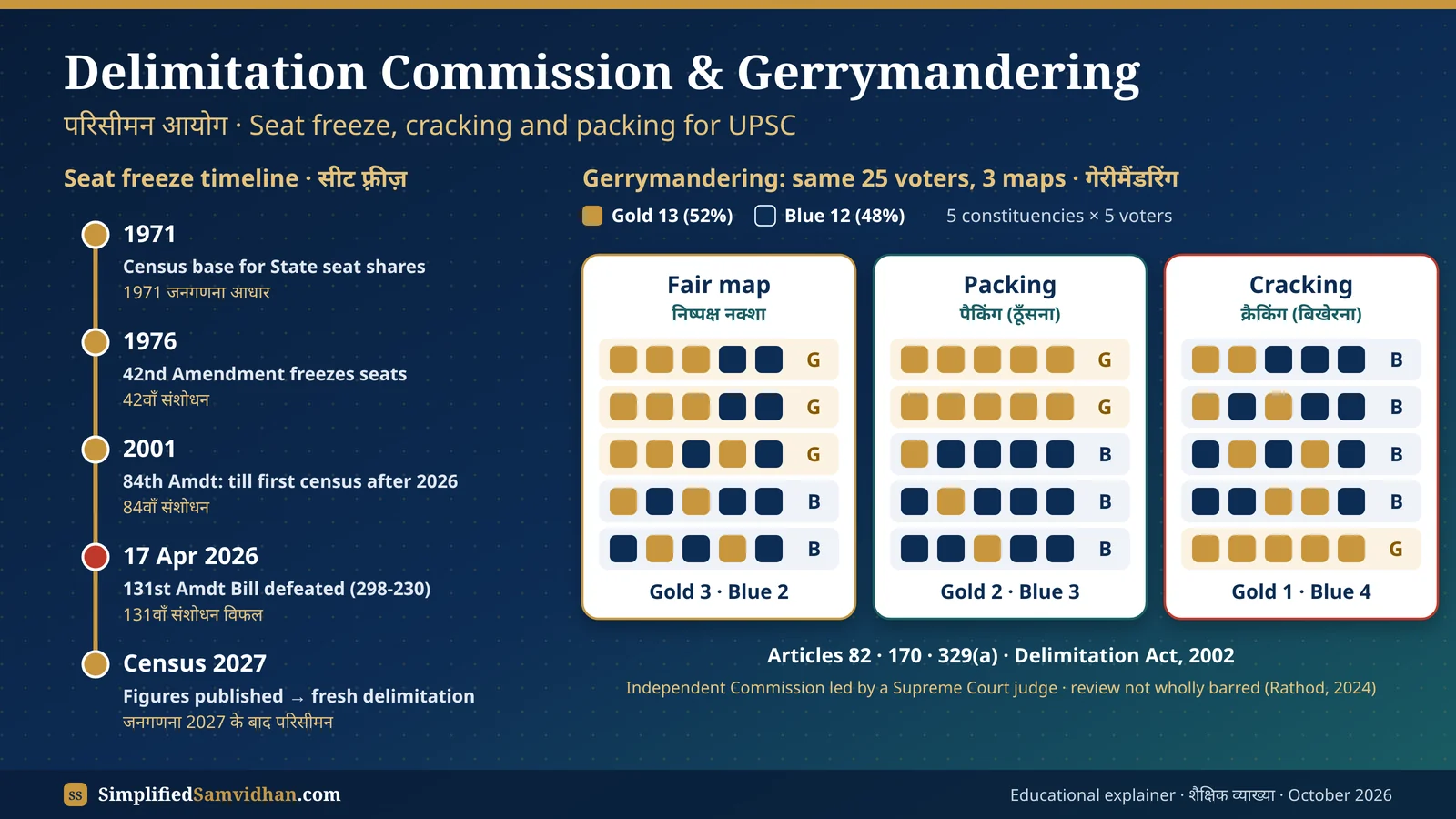
Where things stand in October 2026
In April 2026 the Union Government brought the Constitution (131st Amendment) Bill, 2026 and a Delimitation Bill, 2026 in a special session. The package proposed raising the Lok Sabha from 543 to up to 850 seats, removing the requirement to wait for the first census after 2026, redrawing seats on the 2011 Census, and linking the rollout of women's reservation (Article 334A) to it. On 17 April 2026 the amendment got 298 votes for and 230 against: a majority, but short of the two-thirds of members present and voting needed under Article 368. The Bill fell and the Delimitation Bill was withdrawn.
So the constitutional freeze continues. Seat shares remain on the 1971 Census until the relevant figures of the first census taken after 2026 are published. Census 2027, now under way, is widely expected to be that census, which is why a major delimitation is still on the horizon.
The BasicsWhat Is Delimitation and Who Is the Delimitation Commission?
Delimitation means fixing the number of seats and drawing the boundaries of Lok Sabha and Assembly constituencies so that each represents roughly the same population. It gives life to the idea of "one person, one vote, one value".
Under Article 82 (Lok Sabha) and Article 170 (Assemblies), Parliament decides the authority. It has done so through Delimitation Acts in 1952, 1962, 1972 and 2002, creating commissions in 1952, 1963, 1973 and 2002. The last one, headed by Justice Kuldip Singh, issued its orders in 2008.
| Feature | Delimitation Commission (Delimitation Act, 2002) |
|---|---|
| Chairperson | A retired or serving Supreme Court judge, appointed by the Central Government (s. 3) |
| Ex officio members | Chief Election Commissioner or an Election Commissioner nominated by the CEC, and the State Election Commissioner of the State concerned |
| Associate members | 5 Lok Sabha MPs and 5 MLAs from each State; they advise but cannot vote (s. 5) |
| Criteria (s. 9) | Population; geographically compact areas; physical features, administrative boundaries, communication and public convenience; every Assembly seat wholly inside one Lok Sabha seat; SC/ST seats where their population share is high |
| Transparency | Draft proposals published, public objections and sittings held before final orders |
| Final orders (s. 10) | Published in the Gazette, have the force of law, laid before Parliament/Assembly which cannot modify them |
Imagine a school with one class monitor per section. If one section grows to 80 students and another has 20, a fair principal re-divides sections so that every monitor speaks for about the same number of students. Delimitation does this for MPs and MLAs, and a neutral committee, not the class leaders, draws the lines.
🏠 Everyday analogy
A pizza must be cut into equal slices. The Delimitation Commission is the person holding the knife, and the law tells it to cut fairly, not to give bigger slices to friends.
🇮🇳 Real Indian example
After the 2008 delimitation, some fast-growing urban areas such as Malkajgiri (then in Andhra Pradesh, now Telangana) became huge single constituencies, while hill seats stayed small because of geography. Equal population is the goal, adjusted for terrain.
Official TextArticles 82 and 170: The Seat Freeze Explained
82. Readjustment after each census.— Upon the completion of each census, the allocation of seats in the House of the People to the States and the division of each State into territorial constituencies shall be readjusted by such authority and in such manner as Parliament may by law determine:
Provided that such readjustment shall not affect representation in the House of the People until the dissolution of the then existing House:
Provided further that such readjustment shall take effect from such date as the President may, by order, specify and until such readjustment takes effect, any election to the House may be held on the basis of the territorial constituencies existing before such readjustment:
Provided also that until the relevant figures for the first census taken after the year 2026 have been published, it shall not be necessary to readjust—
(i) the allocation of seats in the House of the People to the States as readjusted on the basis of the 1971 census; and
(ii) the division of each State into territorial constituencies as may be readjusted on the basis of the 2001 census,
under this article.
170(3) [extract, third proviso] Provided also that until the relevant figures for the first census taken after the year 2026 have been published, it shall not be necessary to readjust— (i) the total number of seats in the Legislative Assembly of each State as readjusted on the basis of the 1971 census; and (ii) the division of such State into territorial constituencies as may be readjusted on the basis of the 2001 census, under this clause.
After every census the seats should be re-shared. But the third proviso puts this on pause: until the first census after 2026 is published, how many seats each State gets stays frozen on the 1971 Census, and only the boundaries inside a State could be redrawn (on the 2001 Census, done in 2008). So Uttar Pradesh still has 80 Lok Sabha seats and Kerala 20, although their populations have grown at very different speeds since 1971.
🏠 Everyday analogy
A family divides pocket money by the number of children. The parents promised that a child who chose to have fewer pets would not get less money. The freeze is that promise to States that controlled population.
🇮🇳 Real Indian example
Tamil Nadu (39 seats) and Kerala (20) succeeded early in population control. Re-sharing seats purely by current population would shift seats towards Uttar Pradesh, Bihar, Rajasthan and Madhya Pradesh, which is the root of the north-south debate.
TimelineSeat Freeze History: 1976 to 2026
| Year | Event |
|---|---|
| 1951-1971 | Seats readjusted after the 1951, 1961 and 1971 Censuses. |
| 1976 | 42nd Amendment freezes inter-State seat allocation on the 1971 Census until the 2000 Census, so States promoting family planning are not penalised. |
| 2001 | 84th Amendment extends the freeze until the first census after 2026; allows boundaries within States to be redrawn. |
| 2003 | 87th Amendment: intra-State boundaries to be based on the 2001 Census. |
| 2002-2008 | Delimitation Commission (Justice Kuldip Singh) redraws boundaries; seat numbers unchanged; new map used from 2008-09. |
| 17 Apr 2026 | Constitution (131st Amendment) Bill, 2026 defeated in Lok Sabha (298-230; two-thirds not reached). Delimitation Bill, 2026 withdrawn. |
| 2026-2027 | Census 2027 under way; once its figures are published, the freeze in Articles 81, 82 and 170 lapses and a fresh delimitation can follow. |
UPSC Mains ConceptGerrymandering Definition: The Dark Art of Drawing Lines
Gerrymandering is the deliberate manipulation of constituency boundaries to favour a party or group. The word comes from Elbridge Gerry, Governor of Massachusetts, who in 1812 signed a map with a district so twisted that a cartoonist said it looked like a salamander: a "Gerry-mander". The two basic techniques are cracking and packing.
🔨 Cracking (diluting voter strength)
- Opponent's voters are split across many districts.
- In each district they are a minority, so they lose everywhere.
- Their votes are wasted on losing candidates.
- Used where the opponent is a large, spread-out group.
📦 Packing (concentrating opposition voters)
- Opponent's voters are stuffed into a few districts.
- They win those few seats by huge margins.
- Their surplus votes beyond 50% are wasted.
- The remaining districts become safe for the map-maker.
Gold has more votes and wins more seats. Seats roughly follow votes.
Gold voters are stuffed into 2 districts and win them by huge margins. Their extra votes are wasted, so Blue takes 3 of 5 with fewer votes.
Gold voters are split across 4 districts where they are always a minority (2 of 5). Blue wins 4 of 5 seats with only 48% of the votes.
Same voters, same votes, but by moving the lines the result flips from Gold 3-2 to Blue 3-2 (packing) or Blue 4-1 (cracking). That is why the person who draws the lines can matter more than the voters. Other tricks: hijacking (putting two sitting opponents in one seat) and kidnapping (moving an MP's home base out of his seat).
🏠 Everyday analogy
Five friends split 25 toffees in teams. If one team-maker sorts the players, he can make sure his side wins most games even with weaker players. The fix is to let a neutral person pick the teams.
🇮🇳 Real Indian example
In the United States, state legislatures draw many district maps, and in Rucho v. Common Cause (2019) the US Supreme Court said federal courts cannot decide partisan gerrymandering claims. India avoids this by giving the job to an independent commission headed by a judge.
Indian ModelHow India Guards Against Gerrymandering
- 1Independent body
A commission led by a Supreme Court judge with the Election Commission, not the ruling party, draws the lines.
- 2Fixed legal criteria
Section 9 of the Delimitation Act: population, compactness, physical features, administrative boundaries and public convenience.
- 3No vote for politicians
MPs and MLAs sit only as associate members and cannot vote on decisions.
- 4Public hearings
Draft proposals are published and objections heard in public sittings in each State.
- 5Legislature cannot edit
Final orders are laid before Parliament and Assemblies, which cannot change them.
Live debates for UPSC: critics have raised concerns about some recent exercises, for example the Jammu and Kashmir delimitation (final order 2022) and the Assam delimitation by the Election Commission (2023), arguing that particular communities' voters were concentrated or divided; the authorities rejected these claims. Use such examples carefully and present both sides.
Official TextWhy the Delimitation Commission Is (Almost) Immune From Courts
329. Bar to interference by courts in electoral matters.— Notwithstanding anything in this Constitution—
(a) the validity of any law relating to the delimitation of constituencies or the allotment of seats to such constituencies, made or purporting to be made under article 327 or article 328, shall not be called in question in any court;
Delimitation Act, 2002, Section 10(2): Upon publication in the Gazette of India, every such order shall have the force of law and shall not be called in question in any court.
Elections cannot be held hostage to endless lawsuits about boundaries. So Article 329(a) and Section 10(2) of the Delimitation Act make delimitation orders final and protect them from ordinary court challenges. In Meghraj Kothari v. Delimitation Commission (1967) the Supreme Court treated these orders as having the force of law and refused to examine them.
But the protection is strong, not absolute. In Kishorchandra Chhanganlal Rathod v. Union of India (23 July 2024), a bench of Justices Surya Kant and Ujjal Bhuyan held that Article 329 does not bar review of every delimitation action. If an order is "manifestly arbitrary and irreconcilable to the constitutional values", a constitutional court can step in and give a remedy, though courts will be careful not to delay an election that is already under way.
🏠 Everyday analogy
A cricket umpire's decision is final during the match, so play can go on. But if the umpire was clearly biased or broke the rules of the game, the board can still review it.
🇮🇳 Real Indian example
The Rathod case arose from the reservation of the Bardoli Assembly seat in Gujarat for Scheduled Castes. The Court set aside the Gujarat High Court's view that delimitation orders can never be examined.
Correction to a common claim: the Delimitation Commission does not enjoy "absolute judicial immunity". Its orders are protected by Article 329(a) and Section 10(2), but after Rathod (2024) they can be reviewed when manifestly arbitrary or unconstitutional.
The Big DebateNorth-South Divide: The Coming Delimitation Debate
📈 Case for re-sharing seats
- Article 81 aims for equal population per seat; today one MP may represent far more people in one State than another.
- Freezing seats for 50+ years undermines "one person, one vote, one value".
- Women's reservation (Article 334A) begins only after a delimitation based on a census after the 2023 Act.
⚖️ Concerns of southern and smaller States
- States that controlled population could lose relative share of seats and voice in Parliament.
- Federal balance: a few large States could dominate the Lok Sabha.
- Alternatives proposed: keep State shares frozen and only enlarge the House, cap total seats, or give more weight to the Rajya Sabha.
Both sides have a fair point: equal votes for every citizen, and fair voice for every State. The challenge for Parliament after Census 2027 is to find a formula that respects both, which is exactly what UPSC expects you to discuss.
UPSC CornerDelimitation and Gerrymandering for UPSC Prelims and Mains
- Prelims fact: Delimitation Commissions were set up in 1952, 1963, 1973 and 2002.
- Prelims fact: Inter-State seat allocation is frozen on the 1971 Census; intra-State boundaries use the 2001 Census (87th Amendment, 2003).
- Prelims fact: Article 329(a) bars challenges to delimitation laws made under Articles 327 and 328.
- Prelims fact: The Constitution (131st Amendment) Bill, 2026 failed in the Lok Sabha on 17 April 2026 (298-230).
- Mains (250 words): "Delimitation after Census 2027 must balance democratic equality with federal fairness." Discuss.
- Mains (150 words): Define gerrymandering. Explain cracking and packing, and how India's institutional design guards against them.
Election Commission seriesRead More: Election Commission of India Series
Delimitation is one part of how elections are run. For the Election Commission, election petitions under Article 329 and the full election process, read the series below.
Practice MCQTest Yourself: Delimitation & Gerrymandering
Consider the following statements: (1) Under the third proviso to Article 82, the allocation of Lok Sabha seats to the States remains based on the 1971 Census until the relevant figures of the first census taken after 2026 are published. (2) In gerrymandering, "packing" means spreading the opposition's voters thinly across many constituencies. (3) In Kishorchandra Chhanganlal Rathod v. Union of India (2024), the Supreme Court held that delimitation orders are completely beyond judicial review. Which of the statements given above is/are correct?
Doubts ClearedFrequently Asked Questions
What is the Delimitation Commission of India?
It is a high-powered body set up by Parliament under a Delimitation Act to redraw Lok Sabha and Assembly constituencies. Under the 2002 Act it is chaired by a serving or retired Supreme Court judge, with the Chief Election Commissioner (or nominee) and the State Election Commissioner as members.
When will the next delimitation happen?
The freeze in Articles 82 and 170 lasts until the relevant figures of the first census taken after 2026 are published. Census 2027 is expected to be that census, so delimitation can follow after its figures are out. An attempt to start earlier through the 131st Amendment Bill failed on 17 April 2026.
What is gerrymandering in simple words?
Gerrymandering is drawing constituency boundaries to favour one party or group. The two main methods are cracking, which splits the opponent's voters so they lose everywhere, and packing, which crowds them into a few seats so their extra votes are wasted.
Can delimitation orders be challenged in court?
Article 329(a) and Section 10(2) of the Delimitation Act protect delimitation orders, so ordinary challenges are barred. But in Kishorchandra Chhanganlal Rathod v. Union of India (2024) the Supreme Court held that a constitutional court can intervene if an order is manifestly arbitrary and irreconcilable with constitutional values.
Why was the Lok Sabha seat allocation frozen on the 1971 Census?
The 42nd Amendment (1976) froze it so that States which succeeded in family planning would not lose seats. The 84th Amendment (2001) extended the freeze until the first census after 2026.
Sources and further readingSources We Checked
News facts on this page were checked against the reports below on 15 October 2026. Court cases are pending and may change.
- LiveLaw, 17 Apr 2026: Lok Sabha rejects Constitution (131st Amendment) Bill; Centre withdraws Delimitation Bill
- Newslaundry, 15 Apr 2026: What the Union government's delimitation bills change
- Supreme Court of India: Kishorchandra Chhanganlal Rathod v. Union of India (23 Jul 2024), 2024 INSC 579
- Verdictum: Delimitation matters not beyond judicial review (Rathod, 2024)
- Legislative Department, Government of India: The Constitution of India (official text)