Article 371K Ladakh: Why Ladakh Rejected the Centre's Draft and What Statehood and the Sixth Schedule Mean
Seven years after becoming a Union territory without a legislature, Ladakh is still asking for a say in its own laws. This week the Leh Apex Body and the Kargil Democratic Alliance rejected the Home Ministry's draft for a new Article 371K. Here is what each option means, what the Constitution already gives other regions, and why the talks are stuck.
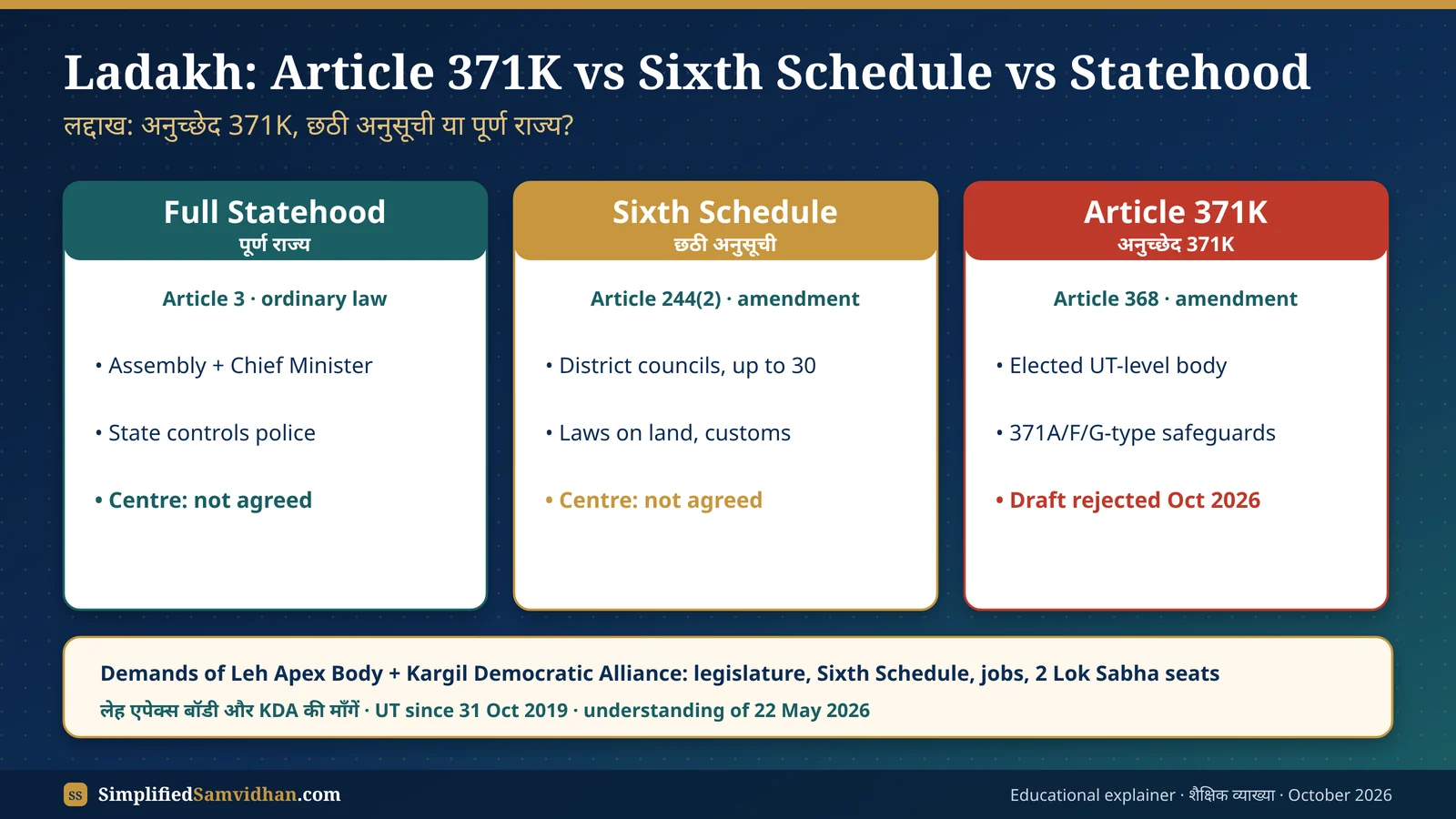
Where the Ladakh talks stand on 17 October 2026
At talks in Leh this week, the Leh Apex Body (LAB) and the Kargil Democratic Alliance (KDA) rejected the draft shared by the Home Ministry's sub-committee. The draft builds on the Centre's September 2026 idea of a new Chapter K under Article 371 of the Constitution, giving Ladakh an elected body and safeguards modelled on Articles 371A, 371F and 371G (Nagaland, Sikkim and Mizoram), instead of statehood or the Sixth Schedule. LAB co-chairman Chering Dorje Lakruk said it departs from the in-principle understanding of 22 May 2026 and does not give a real legislature; KDA's Asgar Ali Karbalai compared it to a 1950s-style administrative unit and asked for a Chief Minister and cabinet.
Ladakh's Chief Secretary Ashish Kundra called the rejection unfortunate. He said the groups' own memorandum wanted the elected body's consent before Parliament's laws apply in Ladakh, which he compared to the abrogated Article 370, and that the draft is open to suggestions. No date for the next round has been announced. No Constitution Amendment Bill has been introduced in Parliament yet.
BackgroundLadakh Statehood Demand: How Ladakh Became a Union Territory and Why It Is Protesting
- 31 October 2019: the Jammu and Kashmir Reorganisation Act, 2019 split the old State. Ladakh (Leh and Kargil districts) became a Union territory without a legislature, run by a Lieutenant Governor under Article 239.
- Before 2019 Ladakh sent four members to the J&K Legislative Assembly. Now it has one Lok Sabha MP and no MLA.
- Hill councils: the Ladakh Autonomous Hill Development Councils of Leh (1995) and Kargil (2003) still exist, but they work under a law made for them, not under the Constitution.
- Four demands of LAB and KDA: (1) statehood, (2) Sixth Schedule protection, (3) a Public Service Commission and jobs for locals, (4) separate Lok Sabha seats for Leh and Kargil.
- 2023: the Home Ministry set up a High Powered Committee for talks. In June 2025 new regulations reserved most government jobs for Ladakh's residents and one-third of hill council seats for women.
- 24 September 2025: a protest in Leh turned violent; four people died. Climate activist Sonam Wangchuk was detained under the National Security Act, and a judicial inquiry by retired Supreme Court judge Justice B.S. Chauhan was ordered.
Imagine a housing society where the residents pay maintenance but every rule is made by an officer sent from head office. They are asking for an elected committee of their own. That is Ladakh's grievance in one line: no elected legislature, so no local say over land, jobs and the fragile mountain environment.
Official TextArticle 244, Article 371A and Article 239: The Constitution's Tools for Ladakh
Article 244. Administration of Scheduled Areas and tribal areas.
(2) The provisions of the Sixth Schedule shall apply to the administration of the tribal areas in the States of Assam, Meghalaya, Tripura and Mizoram.
Article 371A. Special provision with respect to the State of Nagaland.
(1) Notwithstanding anything in this Constitution,—
(a) no Act of Parliament in respect of— (i) religious or social practices of the Nagas, (ii) Naga customary law and procedure, (iii) administration of civil and criminal justice involving decisions according to Naga customary law, (iv) ownership and transfer of land and its resources, shall apply to the State of Nagaland unless the Legislative Assembly of Nagaland by a resolution so decides;
Article 239. Administration of Union territories.
(1) Save as otherwise provided by Parliament by law, every Union territory shall be administered by the President acting, to such extent as he thinks fit, through an administrator to be appointed by him with such designation as he may specify.
The Constitution already has three tools for regions that want to protect their land and culture. Article 244 with the Sixth Schedule creates tribal councils that make their own laws on land and customs, but today it covers only four north-eastern States. Article 371A goes further for Nagaland: Parliament's laws on Naga customs and land do not apply unless the State Assembly agrees. Article 239 is why Ladakh is ruled by the President through a Lieutenant Governor today.
🏠 Everyday analogy
Think of three kinds of locks on a family's ancestral land: a society rule-book that only covers some buildings (Sixth Schedule), a lock that opens only with the family's own key (Article 371A), and a building managed by a caretaker from outside (Article 239).
🇮🇳 Real Indian example
In Nagaland, a central law on land transfer does not automatically apply; the Nagaland Assembly must pass a resolution first. Ladakh's groups want a similar shield for Ladakhi land and jobs.
ComparedStatehood vs Sixth Schedule vs Article 371K for Ladakh
| Question | Full statehood (Article 3) | Sixth Schedule (Article 244(2)) | Article 371K (Centre's idea) |
|---|---|---|---|
| How it is done | Parliament law under Articles 3 and 4 (simple majority) | Constitution amendment, as Article 244(2) and the Schedule name only four States | Constitution amendment under Article 368 adding Chapter K to Article 371 |
| Elected body | Legislative Assembly, Chief Minister and Council of Ministers | Autonomous District Councils (up to 30 members, 26 elected) | An elected UT-level body; its name and powers are disputed |
| Who controls police and officers | State Government | State or UT Government; councils handle local subjects | Unclear; groups want the Chief Secretary and police under the elected head |
| Protection for land and customs | State laws on land | Councils make laws on land, forests, inheritance, marriage, customs | Safeguards on the lines of Articles 371A, 371F and 371G |
| Centre's view | Not agreed | Not agreed | Proposed in September 2026; draft shared in October 2026 |
What LAB and KDA want
- Legislature with a Chief Minister and Council of Ministers
- Elected head to control the bureaucracy, including the Chief Secretary's report card
- Consent of the elected body before central laws apply
- Statehood and Sixth Schedule remain their stated goal
What the Centre's draft offers (as reported)
- A new Chapter K under Article 371
- An elected UT-level body for Ladakh
- Safeguards like Nagaland, Sikkim and Mizoram
- No statehood or Sixth Schedule; no Article 370-type consent rule
Bigger PictureArticle 371 Special Provisions: Which States Have Them
| Article | State | What it protects |
|---|---|---|
| 371 | Maharashtra, Gujarat | Development boards for Vidarbha, Marathwada, Saurashtra, Kutch |
| 371A | Nagaland | Naga customs, customary law, land: central laws need Assembly resolution |
| 371B | Assam | Committee of tribal-area members in the Assembly |
| 371C | Manipur | Hill Areas Committee of the Assembly |
| 371D, 371E | Andhra Pradesh, Telangana | Local cadres in jobs and education; Central University |
| 371F | Sikkim | Old laws continue; seats for Sangha and Bhutia-Lepcha; land |
| 371G | Mizoram | Mizo customs, customary law, land: central laws need Assembly resolution |
| 371H | Arunachal Pradesh | Special responsibility of the Governor for law and order |
| 371I | Goa | Minimum 30 members in the Assembly |
| 371J | Karnataka | Kalyana-Karnataka region board, local reservation (98th Amendment, 2012) |
Article 371 is the Constitution's made-to-measure tailoring shop. Instead of one size for all, it stitches a special provision for each region's history. Ladakh would become the next letter, 371K. The fight is over how much cloth goes into the suit: a real legislature like Nagaland and Mizoram, or a smaller elected body with limited powers.
ExplainedSixth Schedule in Simple Words: Autonomous District Councils
- 1Where it applies
Tribal areas of Assam, Meghalaya, Tripura and Mizoram (Article 244(2), 275(1)). There are 10 Autonomous District Councils today.
- 2Who sits in a council
Up to 30 members: up to 4 nominated by the Governor, the rest elected by adult franchise for five years.
- 3Law-making power
Land, forests (other than reserved forests), water for farming, shifting cultivation, village administration, inheritance, marriage, divorce and social customs.
- 4Courts and taxes
Village and district council courts for cases among tribal people; power to collect land revenue and certain taxes.
- 5Why Ladakh asks for it
Over 90 percent of Ladakh's people are Scheduled Tribes. In 2019 the National Commission for Scheduled Tribes recommended Sixth Schedule status for Ladakh.
- 6The hurdle
The Sixth Schedule has so far been used only in the North-East. Adding Ladakh needs a Constitution amendment, and the Centre has not agreed.
UPSC CornerLadakh, Article 371K and the Sixth Schedule for UPSC Prelims and Mains
- Prelims fact: Ladakh became a Union territory without a legislature on 31 October 2019 under the J&K Reorganisation Act, 2019.
- Prelims fact: Article 371 currently runs from 371 to 371J; 371J (Karnataka) was added by the 98th Amendment Act, 2012.
- Prelims fact: The Sixth Schedule applies to tribal areas of Assam, Meghalaya, Tripura and Mizoram (Article 244(2)); the Fifth Schedule covers Scheduled Areas of other States.
- Prelims fact: Under Article 371A and 371G, Parliament's laws on customs and land apply to Nagaland and Mizoram only if their Assemblies pass a resolution.
- Prelims fact: A new State or a change in a UT's status can be made by an ordinary law under Articles 3 and 4; adding to Article 371 or the Sixth Schedule needs an amendment under Article 368.
- Mains (250 words): "Constitutional asymmetry is a strength of Indian federalism." Discuss with reference to Article 371 and the demands of Ladakh.
- Mains (150 words): Compare the Fifth and Sixth Schedules. Why do regions such as Ladakh seek Sixth Schedule protection?
Practice MCQTest Yourself: Ladakh, Article 371K and the Sixth Schedule
With reference to the Constitution of India, consider the following statements: (1) The Sixth Schedule at present applies to tribal areas of Assam, Meghalaya, Tripura and Mizoram. (2) Under Article 371A, an Act of Parliament on Naga customary law applies to Nagaland only if its Legislative Assembly so decides by resolution. (3) Article 371J, the latest chapter of Article 371, relates to Ladakh. Which of the statements given above is/are correct?
Doubts ClearedFrequently Asked Questions
What is Article 371K for Ladakh?
It is a proposed new chapter of Article 371 that the Home Ministry suggested in September 2026. It would give Ladakh an elected UT-level body and safeguards like those of Nagaland, Sikkim and Mizoram. It is not law yet; it needs a Constitution amendment passed by Parliament.
Why did Ladakh groups reject the Centre's draft?
The Leh Apex Body and the Kargil Democratic Alliance said the draft departs from the 22 May 2026 understanding and does not give a real legislature with a Chief Minister and control over officers. The Centre's side said the groups wanted consent over Parliament's laws, similar to the abrogated Article 370.
What is the Sixth Schedule?
The Sixth Schedule of the Constitution, applied through Article 244(2), creates Autonomous District Councils in tribal areas of Assam, Meghalaya, Tripura and Mizoram. These councils make laws on land, forests, inheritance, marriage and customs.
Does Ladakh have a legislature?
No. Since 31 October 2019 Ladakh is a Union territory without a legislature, run by a Lieutenant Governor. It has one Lok Sabha member and two hill development councils in Leh and Kargil.
Can Ladakh become a State?
Yes, Parliament can create a new State by an ordinary law under Articles 3 and 4 after the President refers the Bill. It is a political decision; the Centre has not agreed to statehood so far.
Sources and further readingSources We Checked
News facts on this page were checked against the reports below on 18 October 2026. The text of the Home Ministry draft has not been made public; details of it are as reported by the Ladakh groups and the UT administration.
- ETV Bharat, 17 Oct 2026: Ladakh groups reject Centre's draft proposal, allege backtracking on legislature and Article 371 safeguards
- ETV Bharat, 17 Oct 2026: Chief Secretary on Ladakh groups' proposed Article 370-type safeguard
- The Wire: Ladakh leaders reject Government's alternative to statehood as talks hit roadblock
- INSIGHTS, 10 Sep 2026: Proposed Article 371(K), Ladakh's new constitutional safeguard
- The Wire, May 2026: Ladakh groups reach 'in-principle understanding' with the Union Government
- Legislative Department: The Constitution of India (Articles 239, 244, 371 to 371J, Sixth Schedule)