Bare ActOfficial Text of Article 13
13. Laws inconsistent with or in derogation of the fundamental rights.—
(1) All laws in force in the territory of India immediately before the commencement of this Constitution, in so far as they are inconsistent with the provisions of this Part, shall, to the extent of such inconsistency, be void.
(2) The State shall not make any law which takes away or abridges the rights conferred by this Part and any law made in contravention of this clause shall, to the extent of the contravention, be void.
(3) In this article, unless the context otherwise requires,—
(a) "law" includes any Ordinance, order, bye-law, rule, regulation, notification, custom or usage having in the territory of India the force of law;
(b) "laws in force" includes laws passed or made by a Legislature or other competent authority in the territory of India before the commencement of this Constitution and not previously repealed, notwithstanding that any such law or any part thereof may not be then in operation either at all or in particular areas.
(4) Nothing in this article shall apply to any amendment of this Constitution made under article 368.
Article 13 has four clauses, and each does one job:
13(1) Old laws: laws that existed before 26 January 1950 stay alive, but any part of them that clashes with a Fundamental Right becomes void.
13(2) New laws: after 1950, the State must not make any law that takes away or cuts down a Fundamental Right. If it does, that law is void to the extent of the violation.
13(3) What is "law": not just Acts of Parliament, but also Ordinances, orders, bye-laws, rules, regulations, notifications, and even custom or usage having the force of law.
13(4) Amendments are different: a constitutional amendment under Article 368 is not "law" for Article 13. But since 1973 it still cannot destroy the basic structure.
🏠 Everyday Analogy
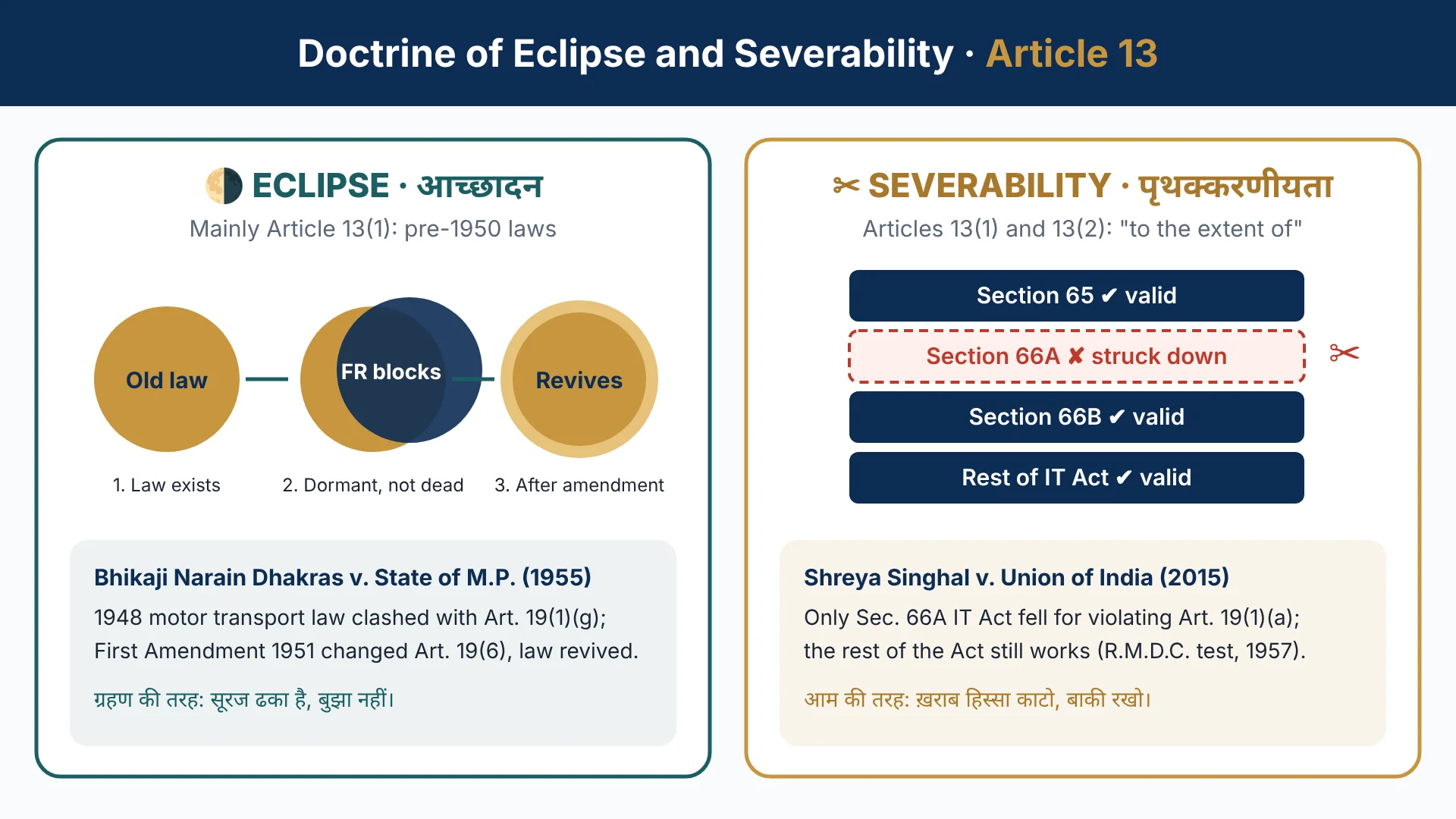
Think of a solar eclipse. The sun is still there, only hidden by the moon. A pre-1950 law that clashes with a Fundamental Right is like that sun: hidden, not dead. If the Fundamental Right is later amended and the shadow moves away, the law shines again. That is the Doctrine of Eclipse. Now think of a mango with one bad spot: you cut out the spot and eat the rest. Courts do the same with a law: remove only the bad section, keep the rest. That is the Doctrine of Severability.
🇮🇳 Real Indian Example
In 2015, in Shreya Singhal v. Union of India, the Supreme Court struck down Section 66A of the IT Act, 2000, which let police arrest people for "offensive" online posts, because it violated free speech under Article 19(1)(a). Only Section 66A died; the rest of the IT Act still works today. That is Article 13(2) and severability in action.
UPSC Core ConceptJudicial Review in India (UPSC): How Article 13 Works
Judicial review is the power of courts to check whether a law or government action is valid under the Constitution, and to strike it down if it is not. The words "judicial review" do not appear in the Constitution, but Article 13 makes it unavoidable: if laws that break Fundamental Rights are "void", someone must declare them void, and that is the courts.
- Article 13 gives the rule: inconsistent laws are void.
- Article 32 (Supreme Court) and Article 226 (High Courts) give the remedy: writs to enforce Fundamental Rights.
- Judicial review is part of the basic structure (Minerva Mills, 1980; L. Chandra Kumar, 1997), so even an amendment cannot remove it.
Two Key DoctrinesDoctrine of Eclipse and Severability under Article 13
1. Doctrine of Eclipse (mainly Article 13(1))
A pre-constitutional law that clashes with a Fundamental Right is not wiped out. It becomes dormant: it cannot be enforced, but it stays on the statute book. If the Fundamental Right is later amended so the clash ends, the law revives on its own.
- Keshavan Madhava Menon v. State of Bombay (1951): a pre-1950 law is not void from the start; acts done before 1950 stay valid.
- Bhikaji Narain Dhakras v. State of M.P. (1955): a 1948 C.P. and Berar motor transport law clashed with Article 19(1)(g). The First Amendment (1951) changed Article 19(6), the shadow lifted, and the law revived. This is the classic example.
- For post-1950 laws, the rule is stricter: a law that breaks a right of everyone is void from birth (Deep Chand, 1959). But a law that breaks a citizens-only right (like Article 19) still works against non-citizens and companies (State of Gujarat v. Ambica Mills, 1974).
2. Doctrine of Severability (Articles 13(1) and 13(2))
Both clauses say "to the extent of" the inconsistency or contravention. So courts cut away only the bad part and keep the rest, as long as the good part can stand on its own (R.M.D. Chamarbaugwalla v. Union of India, 1957).
- A.K. Gopalan (1950): only Section 14 of the Preventive Detention Act, 1950 was struck down; the rest survived.
- Shreya Singhal (2015): only Section 66A of the IT Act fell.
- Navtej Singh Johar (2018): Section 377 IPC (a pre-1950 law) was read down only to the extent it punished consensual adult relations.
Article 13(4) and Basic StructureCan Parliament Amend Fundamental Rights? Article 13 and the Basic Structure
The big fight between Parliament and the Supreme Court was over one question: is a constitutional amendment a "law" under Article 13? If yes, an amendment that cuts a Fundamental Right would be void.
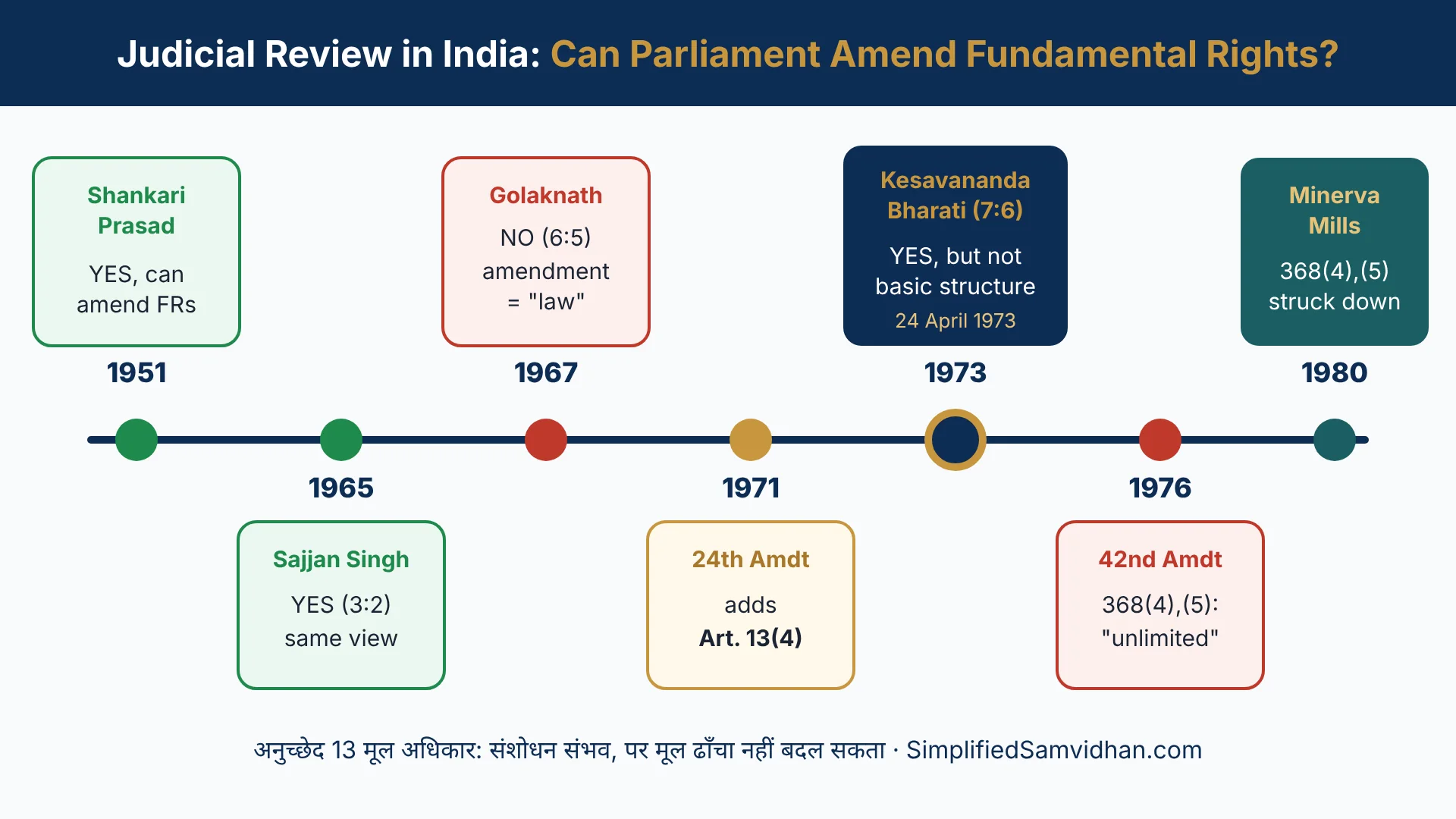
- Shankari Prasad (1951) and Sajjan Singh (1965): No. An amendment is not "law"; Parliament can amend Fundamental Rights.
- Golaknath (1967, 11 judges, 6:5): Yes. An amendment is "law", so Parliament cannot take away Fundamental Rights. The Court used prospective overruling: the ruling applied only to the future, so earlier amendments stayed valid.
- 24th Amendment (1971): Parliament added Article 13(4) and Article 368(3): amendments are not "law" under Article 13.
- Kesavananda Bharati (24 April 1973, 13 judges, 7:6): upheld the 24th Amendment. Parliament can amend any part, including Fundamental Rights, but cannot destroy the basic structure.
- 42nd Amendment (1976) tried to make amending power unlimited (Article 368(4) and (5)). Minerva Mills (1980) struck those clauses down: limited amending power is itself a basic feature.
What is the basic structure?
The Constitution does not define it, and Kesavananda did not give a closed list. The Court adds to it case by case, like the hidden pillars of a building. Recognised features include supremacy of the Constitution, rule of law, judicial review, parliamentary democracy, secularism, federalism, separation of powers, free and fair elections and independence of the judiciary.
Quick RevisionKey Points to Remember
- 13(1): pre-1950 laws void to the extent they clash with Part III.
- 13(2): State cannot make laws that take away or abridge Fundamental Rights.
- 13(3): "law" includes Ordinances, rules, bye-laws, notifications, custom and usage.
- 13(4): added by the 24th Amendment, 1971; amendments under Article 368 are not "law".
- Eclipse = dormant, can revive. Severability = cut the bad part, keep the rest.
- Article 13 is the textual base of judicial review, which is part of the basic structure.
Amendment SagaArticle 13 and the Power to Amend: Timeline
| Year | Case or amendment |
|---|---|
| 1951 | Shankari Prasad: amendment is not "law"; Fundamental Rights can be amended. |
| 1965 | Sajjan Singh: same view (3:2 majority). |
| 1967 | Golaknath: amendment is "law"; Fundamental Rights cannot be taken away (prospective overruling). |
| 1971 | 24th Amendment: Article 13(4) and 368(3) added. |
| 1973 | Kesavananda Bharati (24 April): basic structure doctrine. |
| 1976 | 42nd Amendment: Article 368(4) and (5) claim unlimited power. |
| 1980 | Minerva Mills: those clauses struck down; judicial review is basic structure. |
UPSC · State PSC · JudiciaryJudicial Review in India: UPSC Exam Corner
- Prelims trap: "Basic structure was propounded in Golaknath." False. It came in Kesavananda Bharati (1973); Golaknath gave prospective overruling.
- Prelims trap: "Basic structure means Fundamental Rights cannot be amended." False. They can be amended, but not so as to destroy the basic structure.
- Personal laws: in State of Bombay v. Narasu Appa Mali (1952) the Bombay High Court held uncodified personal law is not "law" under Article 13. This view is still debated.
- Ninth Schedule: laws placed there after 24 April 1973 can be tested on the basic structure (I.R. Coelho, 2007).
- Mains question (150 words): "Indian Fundamental Rights draw largely on the American model and partly on the British." Use Article 13 (written judicial review, US) and parliamentary amending power (UK) as your two pillars.
Practice MCQTest Yourself: Article 13
Consider the statements: (1) The Doctrine of Eclipse applies mainly to pre-constitutional laws. (2) After the 24th Amendment, a constitutional amendment is "law" under Article 13. (3) The basic structure doctrine was laid down in the Golaknath case. Which is/are correct?
Doubts ClearedFrequently Asked Questions
What is Article 13 of Indian Constitution?
Article 13 says that any law, old or new, that is inconsistent with Fundamental Rights is void to the extent of the inconsistency. It defines "law" widely and, since 1971, excludes constitutional amendments under Article 368.
What is the difference between the Doctrine of Eclipse and Severability?
Eclipse makes a clashing pre-1950 law dormant; it can revive if the Fundamental Right is later amended. Severability removes only the invalid part of a law and keeps the valid rest working.
Is judicial review mentioned in the Constitution of India?
The phrase is not used, but Articles 13, 32 and 226 together give courts the power of judicial review, and the Supreme Court has made it part of the basic structure.
Which amendment added Article 13(4)?
The Constitution (Twenty-fourth Amendment) Act, 1971, in response to the Golaknath judgment.