Bare ActOfficial Text of Article 45
45. Provision for early childhood care and education to children below the age of six years.—
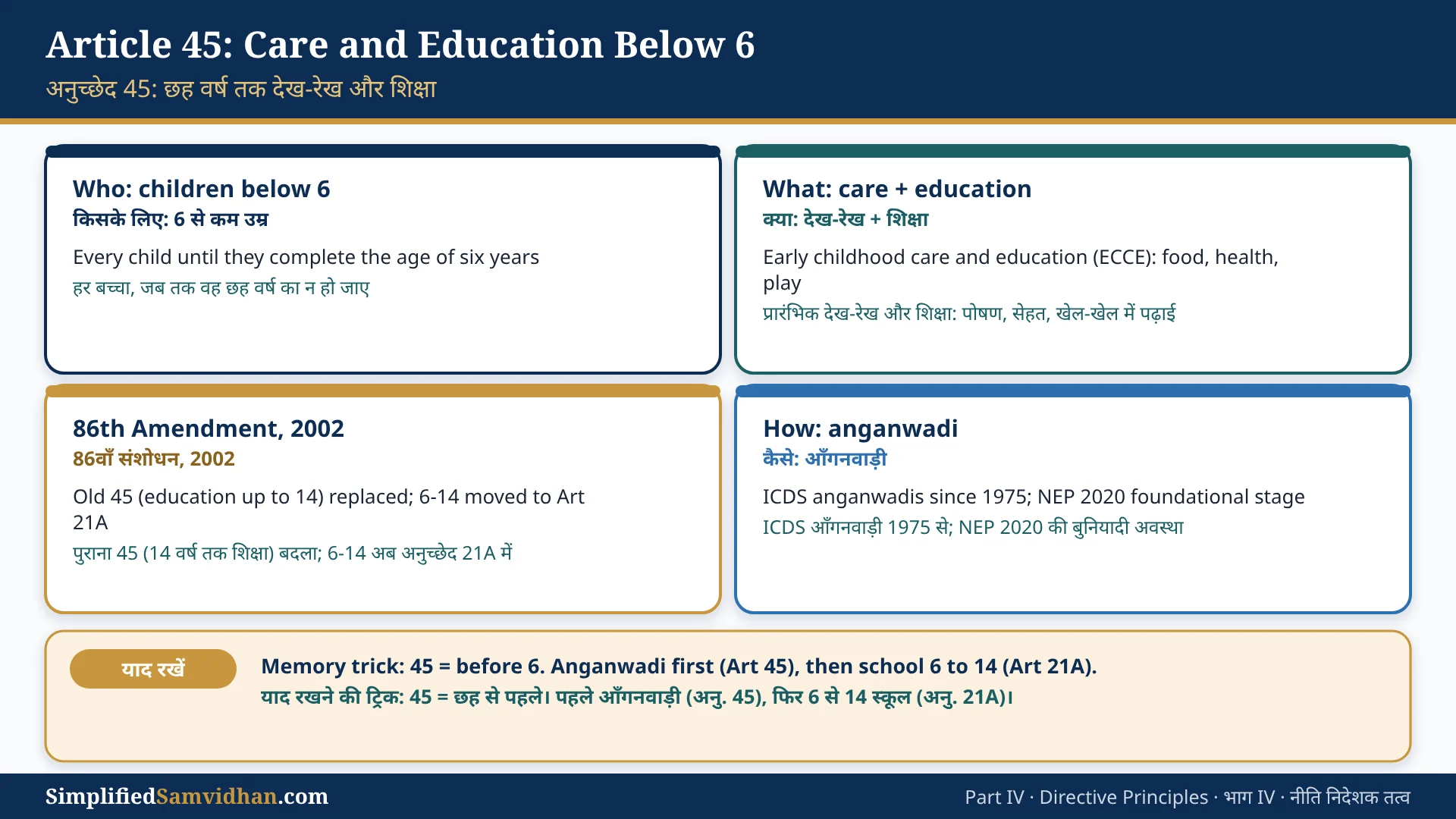
The State shall endeavour to provide early childhood care and education for all children until they complete the age of six years.
The State should try to give care and early education to every child below 6.
"Care" means nutrition, health check-ups and safety; "education" means learning through play.
Until 2002, Article 45 promised free education up to 14. That promise is now a Fundamental Right in Article 21A (ages 6 to 14).
Like every DPSP, Article 45 cannot be enforced in court on its own.
🏠 Everyday Analogy
Think of a house: Article 45 is the foundation laid before the walls. Ages 0 to 6 are the foundation, and school from 6 to 14 (Article 21A) is the building that stands on it.
🇮🇳 Real Indian Example
In a village, three-year-old Pinky goes to the anganwadi every morning. She gets a hot meal, her weight is checked, she gets her vaccines, and she learns rhymes and colours. This is the ICDS scheme (started 1975), the biggest way the State applies Article 45.
Old vs NewArticle 45 of Indian Constitution: Old vs New Early Childhood Education
| Old Article 45 (1950) | New Article 45 (86th Amendment, 2002) | |
|---|---|---|
| Age | Up to 14 years | Below 6 years |
| Promise | Free and compulsory education | Early childhood care and education |
| Time limit | Within 10 years of the Constitution | None |
| Ages 6 to 14 | Inside Article 45 (a DPSP) | Moved to Article 21A (a Fundamental Right) |
How Article 45 is applied
- ICDS and anganwadis (since 2 October 1975): food, health and pre-school for children below 6.
- National Education Policy 2020: the new 5+3+3+4 structure starts with a foundational stage (ages 3 to 8) that includes pre-school.
- Unni Krishnan v. State of A.P. (1993): the Supreme Court read old Article 45 with Article 21 and said children up to 14 have a right to free education. This led to the 86th Amendment.
Quick RevisionKey Points to Remember
- Article 45: State shall endeavour to provide ECCE to all children below 6.
- Substituted by the 86th Amendment, 2002.
- Old Article 45: free and compulsory education up to 14 within 10 years, the only DPSP with a time limit.
- Ages 6 to 14 now a Fundamental Right: Article 21A (RTE Act 2009, in force 1 April 2010).
- Main scheme: ICDS anganwadis. Category: Liberal-intellectual.
UPSC · State PSC · JudiciaryArticle 45: Exam Corner
- Prelims trap: "Article 45 guarantees free education to children aged 6 to 14." False since 2002. That is Article 21A; Article 45 now covers children below 6.
- Fact (SSC / school): the 86th Amendment changed three places: added Article 21A, replaced Article 45, and added the duty in Article 51A(k) for parents of children aged 6 to 14.
- Mains: "The early years decide a child's future." How far has the State met Article 45 through anganwadis?
Practice MCQTest Yourself: Article 45
After the 86th Amendment, 2002, Article 45 deals with:
Doubts ClearedFrequently Asked Questions
What is Article 45 of Indian Constitution?
Article 45 is a Directive Principle. It asks the State to try to provide early childhood care and education for all children until they turn six.
What did the original Article 45 say?
It asked the State to provide free and compulsory education for all children up to 14 within ten years of the Constitution. The 86th Amendment, 2002 replaced it and moved ages 6 to 14 into Article 21A.
Is Article 45 a Fundamental Right?
No. Article 45 is in Part IV and cannot be enforced in court. The right to education for ages 6 to 14 (Article 21A) is the Fundamental Right.