French President vs Indian President: Election in Two Rounds, Removal and Real Power
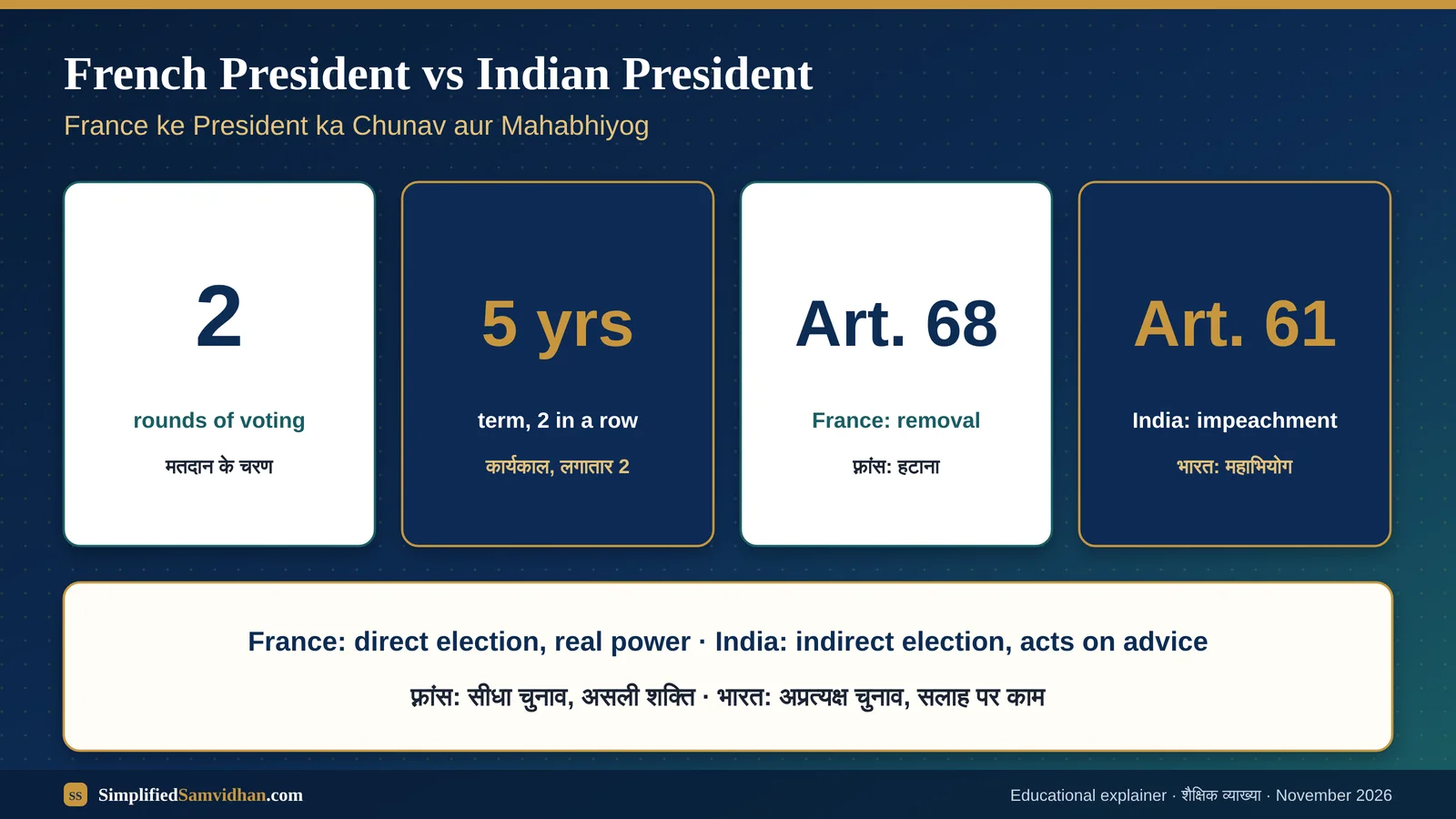
France's President is directly elected, holds real power and can dissolve the Assembly; India's is indirectly elected and acts on advice. Election, removal and cohabitation compared in plain words.
Short answerHow the French President Is Elected and Removed: The Answer in Simple Words
Short answer: the French President is chosen directly by the people in up to two rounds: if no one gets more than half the votes in round one, the top two face a run-off 14 days later. The term is 5 years, with a limit of two consecutive terms. He has real power: he appoints the Prime Minister, can dissolve the National Assembly and takes emergency powers. He can be removed only for a "breach of duties" by Parliament sitting as the High Court (Article 68). India's President is elected indirectly by MPs and MLAs, acts on Cabinet advice, and is removed by impeachment for violating the Constitution (Article 61).
🏠 Everyday analogy
France's two rounds work like a school election with a re-vote: if no one crosses 50%, the class votes again between the top two, so the winner always has majority support.
🇮🇳 Real Indian example
In 2022 Emmanuel Macron got about 28% in round one and won the run-off against Marine Le Pen with about 58.5%. In India, Droupadi Murmu won in 2022 with about 64% of the vote value of 4,809 MPs and MLAs, in one counting.
Articles 6, 7, 68French Constitution on the President: Election Step by Step
Article 6. The President of the Republic shall be elected for a term of five years by direct universal suffrage. No one may hold office for more than two consecutive terms.
Article 7 (extract). The President of the Republic shall be elected by an absolute majority of votes cast. If such a majority is not obtained at the first round of voting, a second round shall be held on the fourteenth day thereafter. Only the two candidates who polled the greatest number of votes in the first round ... may stand in the second round.
Article 68 (extract). The President of the Republic shall not be removed from office during the term thereof on any grounds other than a breach of his duties patently incompatible with his continuing in office. Such removal from office shall be proclaimed by Parliament sitting as the High Court.
- 1Get 500 sponsors
Mayors, MPs and other elected officials from at least 30 departments sign for a candidate.
- 2Round one
All adult citizens vote. More than 50% of valid votes wins outright.
- 3Run-off after 14 days
If no one crosses 50%, only the top two compete; whoever gets more votes wins.
- 4Results checked
The Constitutional Council supervises the election and announces the result.
- 5Next election
Macron's second term ends in May 2027 and he cannot run a third time in a row, so France votes in April 2027.
ComparisonFrench President vs Indian President: 9-Point Comparison
| Point | 🇫🇷 France | 🇮🇳 India |
|---|---|---|
| Election | Direct, by all citizens | Indirect: elected MPs + MLAs (Art. 54) |
| Method | Two-round majority system | Single transferable vote, one ballot with preferences (Art. 55) |
| Term | 5 years, max 2 consecutive terms | 5 years, no limit (Art. 56, 57) |
| Minimum age | 18 | 35 (Art. 58) |
| Power | Real: appoints PM, chairs Council of Ministers, foreign and defence policy | Nominal: acts on Cabinet advice (Art. 74) |
| Dissolving the lower House | Own decision, after consulting PM and Speakers (Art. 12); once a year at most | Only on PM's advice (Art. 85) |
| Emergency powers | Article 16: President acts alone in grave crisis (used 1961) | Articles 352, 356, 360, on Cabinet's written advice (44th Amendment) |
| Removal | Art. 68: "breach of duties"; both Houses as High Court, 2/3 of members | Art. 61: "violation of the Constitution"; each House by 2/3 of total membership |
| Ever removed? | Never | Never; no impeachment has even been moved |
RemovalRemoval of the French President (Article 68) vs Impeachment in India (Article 61)
- 1Proposal in one House
Either the National Assembly or the Senate adopts a proposal to meet as the High Court.
- 2Other House agrees within 15 days
The second House must adopt the same proposal.
- 3High Court votes within one month
Both Houses sit together, chaired by the Speaker of the National Assembly, and need two-thirds of their members.
India: impeachment (Art. 61)
- Ground: violation of the Constitution
- Notice signed by 1/4 of the House, 14 days' notice
- Passed by 2/3 of total membership in one House, investigated and passed by 2/3 in the other
- Nominated members vote too
France: removal (Art. 68)
- Ground: breach of duties incompatible with office (political, not criminal)
- Both Houses sit jointly as the High Court
- 2/3 of the members of the High Court
- Criminal acts are judged only after the term ends (Art. 67)
CohabitationCohabitation: When President and PM Are Rivals
Cohabitation is the French word for a President and a Prime Minister from rival parties. Because the government must keep the National Assembly's confidence, a President who loses the Assembly must appoint a PM from the winning side. It has happened three times: 1986-88 (Mitterrand with Chirac), 1993-95 (Mitterrand with Balladur) and 1997-2002 (Chirac with Jospin). During cohabitation the PM runs home policy and the President keeps foreign affairs and defence.
Since the 2024 snap election, when no bloc won a majority, France has seen frequent changes of Prime Minister. That shows the weak point of the model: a strong President can still be stuck without a stable Assembly. Full model: Semi-presidential system.
Quick revisionOne-Line Revision Points (Exam Ready)
- France: President elected directly, two rounds, absolute majority.
- Term 5 years since 2000 referendum (was 7).
- Two consecutive terms max since 2008.
- Removal: Art. 68, Parliament as High Court, 2/3.
- India: indirect, STV (Art. 55); impeachment Art. 61.
- Cohabitation: 1986-88, 1993-95, 1997-2002.
Practice MCQPractice MCQs (with Answers): French and Indian President
The French President is elected by:
The term of the French President is:
"Cohabitation" in French politics means:
On what ground can India's President be impeached?
Doubts ClearedFrequently Asked Questions
Is the French President more powerful than the Prime Minister?
Usually yes. The President appoints the PM, chairs the Council of Ministers and leads foreign and defence policy. During cohabitation the PM controls home policy.
Has any French President been removed?
No. Article 68 in its present form dates from 2007, and no removal proposal has passed both Houses.
When is the next French presidential election?
In April 2027, as Emmanuel Macron's second term ends in May 2027 and he cannot seek a third consecutive term.
Sources and further readingSources We Checked
Checked against the official English translation of the 1958 French Constitution, the Élysée and the Constitution of India. The Hindi text of the French Constitution is a simple rendering.