Opposition and Shadow Cabinet: India vs Britain and the Leader of Opposition Rules
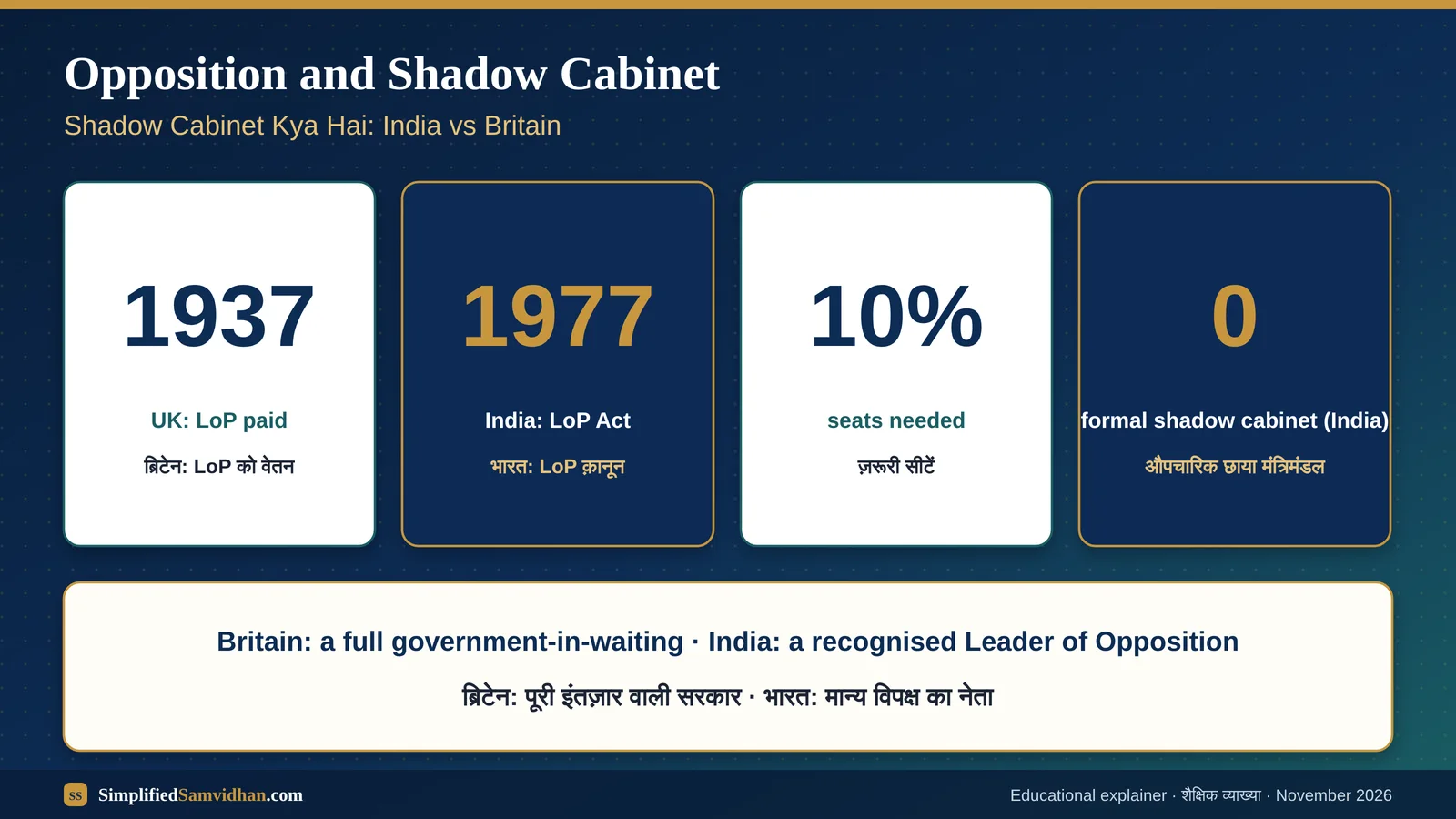
Britain keeps a full government-in-waiting; India often struggles even to have a recognised Leader of Opposition. What a shadow cabinet is, how India's LoP is chosen and why the opposition matters.
Short answerWhat Is a Shadow Cabinet? The Answer in Simple Words
Short answer: a shadow cabinet is a team of opposition leaders, each "shadowing" one minister: a shadow finance minister, a shadow home minister and so on. It is a government-in-waiting that can take over the day the ruling party loses. Britain has a formal shadow cabinet led by the Leader of His Majesty's Most Loyal Opposition, paid by the State since 1937. India recognises a Leader of Opposition by law (1977) but has no formal shadow cabinet; opposition MPs shadow ministers only informally.
🏠 Everyday analogy
Think of a cricket team's playing XI and the reserve XI that trains every day for the same positions. The day the captain is dropped, the reserves are ready. The shadow cabinet is that reserve XI of democracy.
🇮🇳 Real Indian example
From 2014 to 2024 the Lok Sabha had no recognised Leader of Opposition, because no opposition party had 10% of the seats (55). In June 2024 Rahul Gandhi was recognised as Leader of Opposition, and he now sits on panels that select the CBI Director and the Chief Election Commissioner.
LoP in IndiaLeader of Opposition in India: Law and the 10% Rule
Section 2, Salary and Allowances of Leaders of Opposition in Parliament Act, 1977. "Leader of the Opposition", in relation to either House of Parliament, means that member of the Council of States or the House of the People ... who is, for the time being, the Leader in that House of the party in opposition to the Government having the greatest numerical strength and recognised as such by the Chairman of the Council of States or the Speaker of the House of the People, as the case may be.
- 1Largest opposition party
Its leader in the House is the candidate.
- 2Recognition by the presiding officer
The Speaker (Lok Sabha) or Chairman (Rajya Sabha) recognises the leader.
- 3The one-tenth practice
Since Speaker G.V. Mavalankar's time, the party needs at least 10% of the House (quorum strength) to be recognised. The 1977 Act itself does not say 10%.
- 4Status and pay
The LoP gets the salary, allowances and rank of a Cabinet Minister.
ComparisonOpposition in India vs Britain: 7-Point Comparison
| Point | 🇮🇳 India | 🇬🇧 Britain |
|---|---|---|
| Legal status of LoP | 1977 Act; Cabinet rank | Paid since 1937; official title "His Majesty's Most Loyal Opposition" |
| Who qualifies | Largest opposition party with 10% seats (practice) | Largest party not in government, no seat threshold |
| Shadow cabinet | None formally | Yes, one shadow for every Cabinet post |
| Party system | Multi-party; opposition often split | Mainly two-party, so one clear alternative |
| Time given to opposition | No fixed opposition days | 20 Opposition Days a session; PM's Questions every Wednesday |
| Public Accounts Committee | Chaired by an opposition MP (since 1967) | Chaired by an opposition MP |
| Role in appointments | Sits on panels for CBI, CVC, Lokpal, CIC, NHRC, CEC | Consulted by convention on some posts |
Why not in IndiaBenefits of a Shadow Cabinet and Why India Has None
Why a shadow cabinet helps
- Each minister faces a specialist critic, so questioning is sharper
- Voters see a ready alternative team before the election
- Smooth transfer of power: shadows already know their ministry
- Opposition offers policy, not only protest
Why India has not built one
- Many opposition parties; no single party leads them
- Coalitions form after the result, not before
- Long periods with no recognised LoP (1952-69, 1980-89, 2014-24)
- Disruption often replaces debate in the House
Quick revisionOne-Line Revision Points (Exam Ready)
- Shadow cabinet = opposition's government-in-waiting.
- UK LoP paid since 1937 (Ministers of the Crown Act).
- India: LoP Act 1977; Cabinet Minister rank.
- Recognition needs 10% of seats by Speaker's practice, not by the Act.
- PAC chaired by an opposition MP since 1967.
- India has no formal shadow cabinet.
Practice MCQPractice MCQs (with Answers): Opposition and shadow cabinet
The Leader of Opposition in India gets statutory recognition from:
A shadow cabinet is a feature of:
The Public Accounts Committee of Indian Parliament is by convention chaired by:
Doubts ClearedFrequently Asked Questions
Does India have a shadow cabinet?
No formal one. India has a recognised Leader of Opposition in each House when a party qualifies, but no official team shadowing each minister.
How many seats are needed to become Leader of Opposition?
By the Speaker's long practice, the party must have at least one-tenth of the House, which is 55 seats in the Lok Sabha.
Why is the UK opposition called His Majesty's Loyal Opposition?
To show that opposing the government is not disloyalty to the country or the Crown. It opposes the government, not the State.
Sources and further readingSources We Checked
Checked against the Leaders of Opposition Act 1977, UK Parliament publications and Lok Sabha practice. The Hindi text of the Act is a simple rendering.