Separation of Powers in India: Why the CJI Said No to a Meeting With Opposition Leaders
The Leaders of Opposition in both Houses of Parliament asked the Chief Justice of India for a meeting. He refused, saying that discussing pending cases outside the courtroom would break the separation of powers, and told them to file a petition instead. What is this doctrine, where is it in our Constitution, and why does a judge keep such distance? Here is the story in simple words.
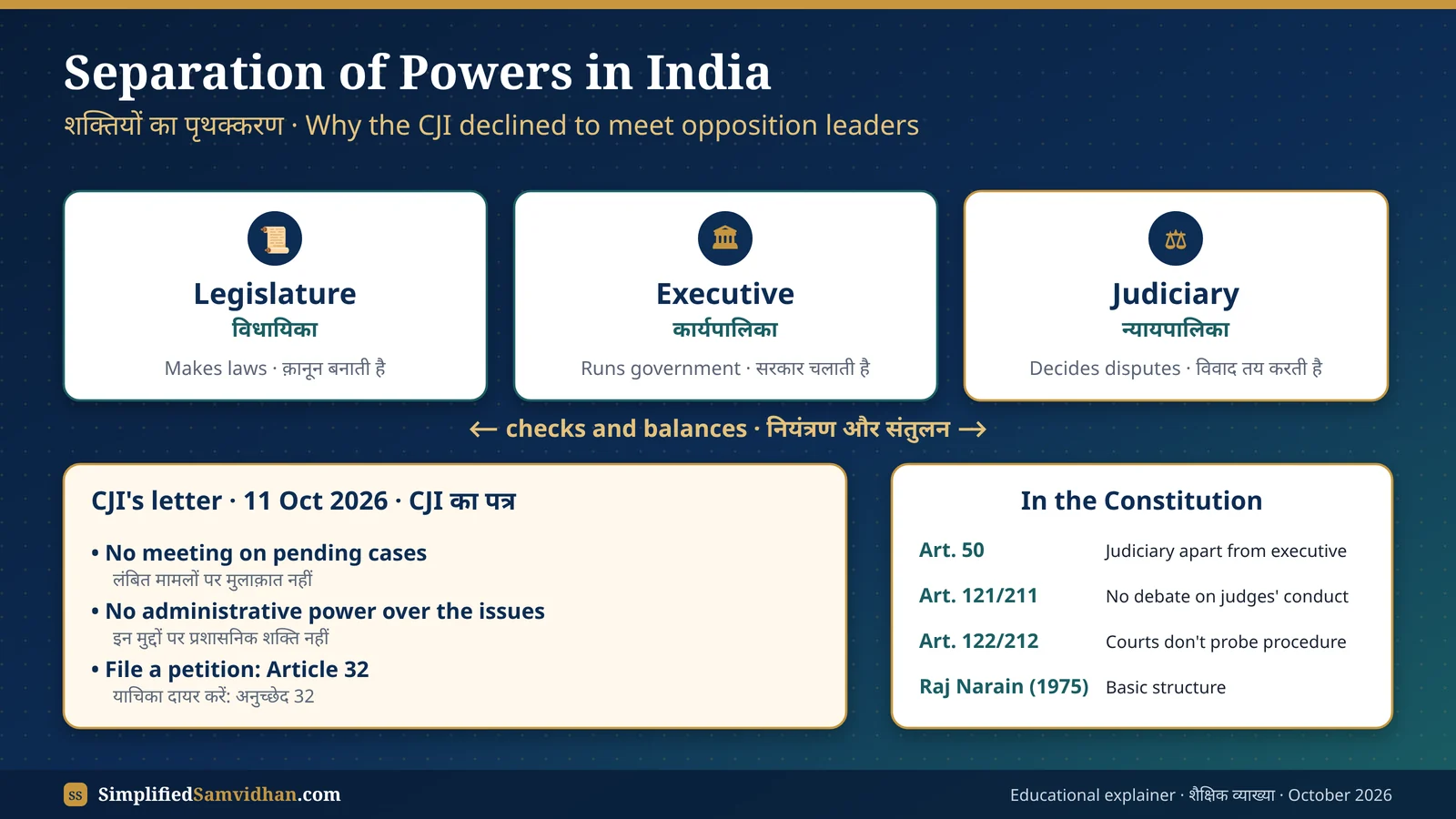
What happened between 10 and 12 October 2026
On 10 October 2026, Mallikarjun Kharge (Leader of Opposition, Rajya Sabha) and Rahul Gandhi (Leader of Opposition, Lok Sabha) wrote to Chief Justice of India Surya Kant seeking a meeting on 12 October to hand over a memorandum on the Election Commission and the Special Intensive Revision of voter lists, arrests of students during protests in Delhi and restrictions on public transport.
In a reply dated 11 October, the CJI declined. He said the issues were already before the Supreme Court, that a meeting to discuss pending cases would "wholly contravene" the separation of powers, and that the Court has no administrative power over such matters. He said the Court is duty-bound to examine citizens' rights through its judicial jurisdiction, including Article 32, and that petitions can be filed physically or online. A day later, on 12 October, the Keralam Assembly passed a resolution seeking the removal of Chief Election Commissioner Gyanesh Kumar.
BasicsWhat Is the Doctrine of Separation of Powers? Meaning With Simple Examples
| Organ | Main job | Checked by |
|---|---|---|
| Legislature (Parliament, State Assemblies) | Makes laws, passes the budget, questions the government | Courts can strike down unconstitutional laws (judicial review) |
| Executive (President, Governors, ministers, officials) | Runs the government and enforces laws | Answerable to the legislature (Article 75(3)); courts review its actions |
| Judiciary (Supreme Court, High Courts, lower courts) | Decides disputes and protects rights | Judges removed only by Parliament with a special majority (Article 124(4)); Parliament can change the law behind a judgment |
The idea comes from the French thinker Montesquieu (The Spirit of the Laws, 1748): if the same person makes the law, enforces it and judges it, liberty is in danger. Think of a cricket match: the players play, the board writes the rules, and the umpire decides. An umpire who sits down for tea with one team to discuss a pending review would lose everyone's trust, even if he means well.
🏠 Everyday analogy
A teacher who sets the exam paper should not also be the one who checks her own child's answer sheet. Separating jobs protects fairness.
🇮🇳 Real Indian example
If the government wants a road built through a village, the Assembly passes the budget, the PWD builds the road, and if a farmer says his land was taken unlawfully, the High Court decides.
Official TextSeparation of Powers in the Indian Constitution: Articles 50, 121, 122 and 32
Constitution of India, Article 50. Separation of judiciary from executive.
The State shall take steps to separate the judiciary from the executive in the public services of the State.
Article 121. Restriction on discussion in Parliament.
No discussion shall take place in Parliament with respect to the conduct of any Judge of the Supreme Court or of a High Court in the discharge of his duties except upon a motion for presenting an address to the President praying for the removal of the Judge as hereinafter provided.
Article 122. Courts not to inquire into proceedings of Parliament.
(1) The validity of any proceedings in Parliament shall not be called in question on the ground of any alleged irregularity of procedure.
Article 32. Remedies for enforcement of rights conferred by this Part.
(1) The right to move the Supreme Court by appropriate proceedings for the enforcement of the rights conferred by this Part is guaranteed.
The Constitution never uses the words "separation of powers", but it is built into many Articles. Article 50 (a Directive Principle) asks the State to keep judges apart from the executive. Articles 121 and 211 stop Parliament and State Legislatures from discussing a judge's conduct, except during removal. Articles 122 and 212 stop courts from questioning the internal procedure of the legislature. Article 32 is the door to the Supreme Court: a citizen reaches the judges through a petition, not a private meeting.
Read more on our page on writs under Articles 32 and 226.
Case LawSeparation of Powers Case Law: Ram Jawaya Kapur to Indira Gandhi v Raj Narain
- Ram Jawaya Kapur v State of Punjab (1955): India does not follow the doctrine in its absolute rigidity, but the functions of the three organs are clearly differentiated, and one organ should not take over the essential work of another.
- Kesavananda Bharati (1973): several judges listed separation of powers among the basic features of the Constitution that Parliament cannot destroy. See our basic structure page.
- Indira Nehru Gandhi v Raj Narain (1975): the Court struck down a constitutional amendment that tried to decide an election dispute itself; it held separation of powers and judicial review to be part of the basic structure.
- State of Tamil Nadu v State of Kerala (2014, Mullaperiyar): a legislature cannot simply overrule a court's judgment; it can only change the law on which the judgment rests.
- Restatement of Values of Judicial Life (1997): judges should not express views in public on political matters or on matters pending or likely to come before them.
Was the refusal needed? Commentators in The Wire argued that judicial propriety alone was enough to say no, and that invoking separation of powers went further than the occasion needed. Others say the letter rightly reminds every party, ruling or opposition, that judges are reached only through the courtroom.
Related StoryCan a State Assembly Remove the Chief Election Commissioner? The Keralam Resolution
What the Keralam Assembly did (12 Oct 2026)
- Passed a resolution, moved by Chief Minister V.D. Satheesan, seeking the CEC's removal
- Raised concerns about the voter roll revision and disenfranchisement
- Asked for the CEC selection panel to include the Chief Justice of India
What the Constitution says
- Article 324(5): the CEC can be removed only in the same manner and on the same grounds as a Supreme Court judge
- That needs a motion in Parliament with a special majority in both Houses
- A State resolution is a political message, not a legal step
- Earlier attempt: on 6 April 2026 the Lok Sabha Speaker and the Rajya Sabha Chairman refused to admit a notice of motion against CEC Gyanesh Kumar.
- Selection panel: under the Chief Election Commissioner and Other Election Commissioners Act, 2023, the panel is the Prime Minister, the Leader of Opposition in the Lok Sabha and a Union Cabinet Minister (see how the CEC is appointed). Read our page on Election Commissioners' immunity.
- Protests in Delhi: the right to protest and its limits are explained in our Jantar Mantar page.
In simple words: an Assembly resolution is like a loud letter of complaint. It can show the public mood, but only Parliament holds the key to remove a CEC, just as only Parliament can remove a judge.
UPSC CornerSeparation of Powers and Judicial Independence for UPSC Prelims and Mains
- Prelims fact: Article 50 (separation of judiciary from executive) is a Directive Principle in Part IV, not a Fundamental Right.
- Prelims fact: Article 121 bars discussion in Parliament on a judge's conduct except on a removal motion; Article 211 does the same for State Legislatures.
- Prelims fact: Indira Nehru Gandhi v Raj Narain (1975) held separation of powers part of the basic structure.
- Prelims fact: Article 324(5): the CEC is removable only like a Supreme Court judge; other Election Commissioners only on the CEC's recommendation.
- Prelims fact: Justice Surya Kant became the 53rd Chief Justice of India on 24 November 2025.
- Mains (250 words): "The Indian Constitution follows a separation of functions rather than a rigid separation of powers." Examine with examples.
- Mains (150 words): How do judicial propriety and accessibility to citizens reinforce each other? Discuss with reference to the CJI's letter of October 2026.
Practice MCQTest Yourself: Separation of Powers: CJI's Letter
Consider the following statements regarding separation of powers in India: (1) Article 50 of the Constitution directs the State to separate the judiciary from the executive in the public services of the State. (2) Article 121 bars discussion in Parliament on the conduct of a Supreme Court or High Court judge except upon a motion for removal. (3) In Indira Nehru Gandhi v Raj Narain (1975), the Supreme Court held that India follows separation of powers in its absolute rigidity. Which of the statements given above is/are correct?
Doubts ClearedFrequently Asked Questions
Why did the CJI refuse to meet Rahul Gandhi and Mallikarjun Kharge?
In his letter of 11 October 2026, CJI Surya Kant said the issues they wanted to raise were pending before the Supreme Court, that discussing pending cases in a meeting would wholly contravene the separation of powers, and that the Court had no administrative power over them. He asked them to file petitions, which the Court would hear.
Is separation of powers written in the Indian Constitution?
Not in those words. It is built into the structure through Articles such as 50, 121, 122, 211, 212 and the independence of judges, and the Supreme Court has held it to be part of the basic structure (Indira Nehru Gandhi v Raj Narain, 1975).
Does India follow strict separation of powers?
No. India follows a separation of functions with checks and balances. Ministers sit in Parliament, Parliament can impeach judges, and courts can strike down laws. In Ram Jawaya Kapur (1955) the Supreme Court said the doctrine is not followed in its absolute rigidity.
Can a State Assembly remove the Chief Election Commissioner?
No. Under Article 324(5), the CEC can be removed only in like manner and on like grounds as a Supreme Court judge, which requires a motion passed by both Houses of Parliament with a special majority. The Keralam Assembly's resolution of 12 October 2026 is a political demand.
How can an ordinary citizen take a rights issue to the Supreme Court?
By filing a writ petition under Article 32 (or under Article 226 in a High Court), physically or through the e-filing portal. Free legal aid is available through the Legal Services Authorities for those who qualify.
Sources and further readingSources We Checked
News facts on this page were checked against the reports below on 19 October 2026. The CJI's letter was reported by the media; its full text was not officially published. Constitutional text is quoted from the Constitution of India.
- SCC Online, 12 Oct 2026: Why CJI Surya Kant declined to meet Rahul Gandhi and Mallikarjun Kharge
- Deccan Herald: CJI Surya Kant rejects Rahul Gandhi, Kharge's request for meeting over CEC
- WION: CJI cites separation of powers doctrine in declining meeting with Rahul Gandhi
- The Wire: No meeting for Rahul Gandhi: what the CJI's two-page letter tells the executive
- ThePrint: Keralam Assembly passes resolution for removal of CEC Gyanesh Kumar
- All India Radio News, 6 Apr 2026: RS Chairman and LS Speaker reject notice of motion against CEC
- Constitution of India (Legislative Department)