India vs US Election System: Two Giant Democracies Compared
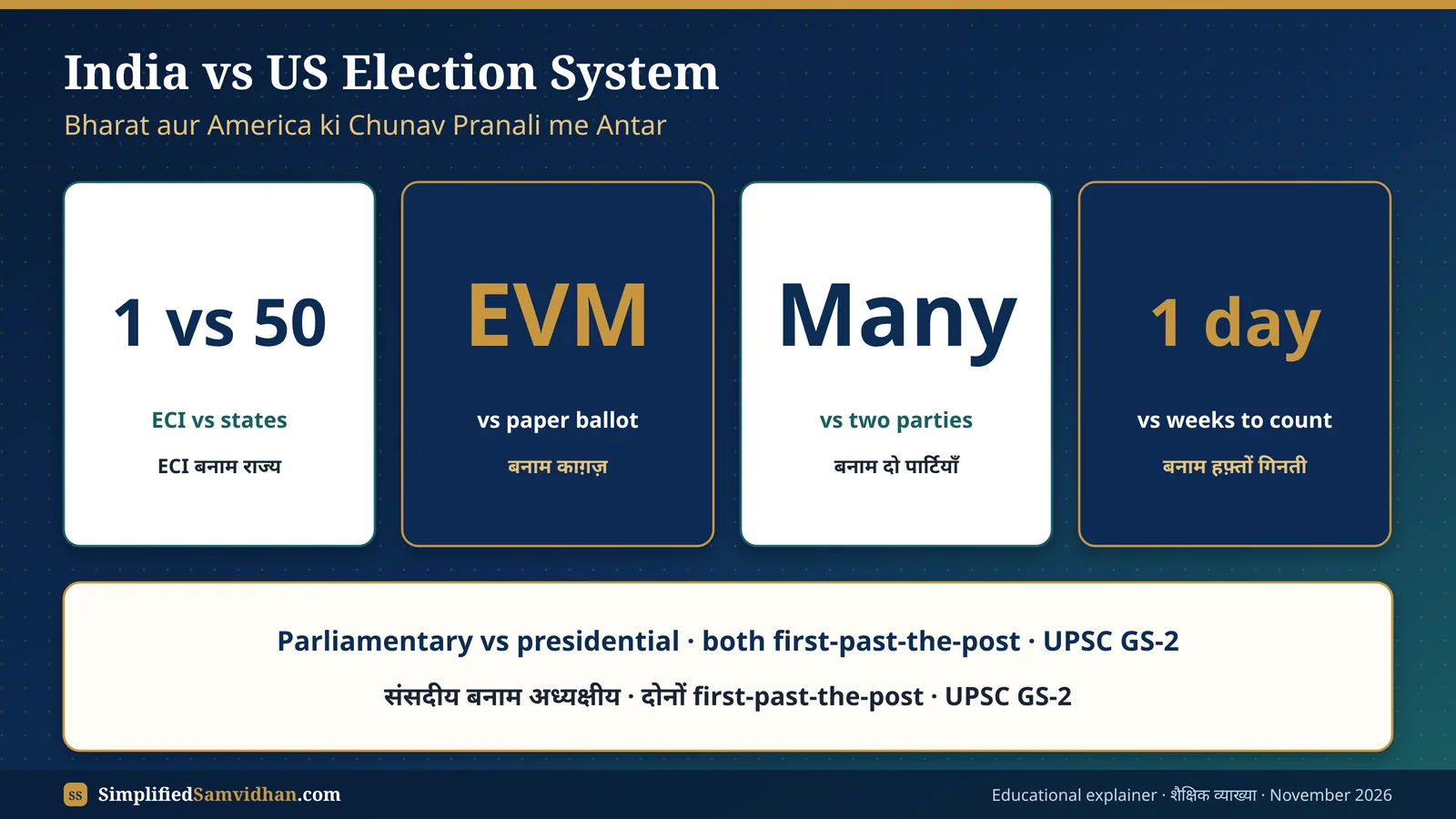
Parliamentary vs presidential, one Election Commission vs 50 states, EVMs vs paper ballots, many parties vs two. A 13-point table, the Article that makes India different, and a ready answer frame for UPSC.
Big pictureIndia vs US Election System: The Big Picture
Both India and the USA are huge democracies that elect their lower Houses by first-past-the-post. But almost everything else is different. India is parliamentary: we elect MPs, and the party or alliance with a Lok Sabha majority forms the government and picks the Prime Minister. The US is presidential: the President is elected separately and cannot be removed by Congress for losing a vote. India has one Election Commission for the whole country; the US leaves elections to 50 states.
🏠 Everyday analogy
India is like one national exam board (CBSE) running the same exam everywhere; the US is like 50 state boards, each with its own paper, rules and result dates.
🇮🇳 Real Indian example
In 2024 India counted about 64 crore Lok Sabha votes on one day (4 June). In 2026 some US House seats were still being counted days after the 3 November vote.
Comparison tableIndia vs US Elections: 13-Point Comparison Table
| Point | 🇮🇳 India | 🇺🇸 USA |
|---|---|---|
| System | Parliamentary | Presidential |
| Head of government | Prime Minister, from Lok Sabha majority | President, separately elected |
| Who runs elections | Election Commission of India (Art. 324) | States and counties; FEC for money only |
| Lower House | Lok Sabha 543, 5 years (can be dissolved) | House 435, 2 years (fixed) |
| Upper House | Rajya Sabha, elected by MLAs | Senate, elected by people |
| Election dates | Announced by ECI, in phases | Fixed by law: Tuesday after first Monday in November |
| Candidate selection | By party leaders | By voters in primaries |
| Parties | Multi-party; coalitions common | Two-party |
| Voting machine | EVM + VVPAT | Paper ballots + scanners |
| Code of conduct | Model Code of Conduct enforced by ECI | None; free-speech protections |
| Spending limits | Limit per candidate (₹95 lakh for big Lok Sabha seats) | No limit on independent spending (Citizens United); 2024 cycle about $15.9 billion |
| Voters (2024) | About 96.8 crore registered; 65.8% turnout | About 15.5 crore voted; about 64% of eligible |
| Counting | One day | Days to weeks |
Article 324The Biggest Difference: Article 324 and the Election Commission
324. Superintendence, direction and control of elections to be vested in an Election Commission.
(1) The superintendence, direction and control of the preparation of the electoral rolls for, and the conduct of, all elections to Parliament and to the Legislature of every State and of elections to the offices of President and Vice-President held under this Constitution shall be vested in a Commission (referred to in this Constitution as the Election Commission).
(2) The Election Commission shall consist of the Chief Election Commissioner and such number of other Election Commissioners, if any, as the President may from time to time fix and the appointment of the Chief Election Commissioner and other Election Commissioners shall, subject to the provisions of any law made in that behalf by Parliament, be made by the President.
(5) Subject to the provisions of any law made by Parliament, the conditions of service and tenure of office of the Election Commissioners and the Regional Commissioners shall be such as the President may by rule determine:
Provided that the Chief Election Commissioner shall not be removed from his office except in like manner and on the like grounds as a Judge of the Supreme Court and the conditions of service of the Chief Election Commissioner shall not be varied to his disadvantage after his appointment:
Provided further that any other Election Commissioner or a Regional Commissioner shall not be removed from office except on the recommendation of the Chief Election Commissioner.
This single Article is the biggest difference. It puts the superintendence, direction and control of all Parliament, State Assembly, President and Vice-President elections in one independent body. The US Constitution has no such clause; Article I, Section 4 hands the job to each state.
Lessons and UPSCWhat Each Democracy Can Learn from the Other (UPSC Answer Frame)
What India could learn from the US
- Primaries: intra-party democracy in ticket selection
- Fixed election dates reduce uncertainty
- Paper trail and easy postal voting
- Public debates between candidates
What the US could learn from India
- One independent Election Commission
- Fast, uniform counting
- Universal adult franchise from day one
- Spending limits and a Model Code of Conduct
- Next: President election: India vs USA and Impeachment: US vs India.
- India's system in 16 notes: Indian Election System.
Quick revisionOne-Line Revision Points (Exam Ready)
- India parliamentary; US presidential.
- India: ECI (Art. 324); US: states (Art. I, s.4).
- Both use first-past-the-post for the lower House.
- India EVM+VVPAT; US paper + scanners.
- US candidates chosen by primaries.
- No Model Code of Conduct in the US.
Practice MCQPractice MCQs (with Answers): India vs US elections
Which is common to both India and the US?
Which Article of the Indian Constitution vests elections in the Election Commission?
Which statement is NOT correct?
Doubts ClearedFrequently Asked Questions
What is the main difference between Indian and US elections?
India elects a Parliament from which the government is formed, under one Election Commission; the US elects the President separately and leaves elections to the states.
Which country has more voters?
India, by far: about 97 crore registered voters in 2024, against about 24 crore eligible voters in the US.
Is this topic asked in UPSC?
Yes. GS-2 includes comparison of the Indian constitutional scheme with other countries, and parliamentary vs presidential questions are common in Prelims and Mains.
Sources and further readingSources We Checked
Indian figures from the Election Commission of India (2024 Lok Sabha); US figures from USA.gov, US Census turnout estimates and OpenSecrets. Checked on 4 November 2026.