US Supreme Court and Elections: The Nine Judges Who Can Decide a Presidency
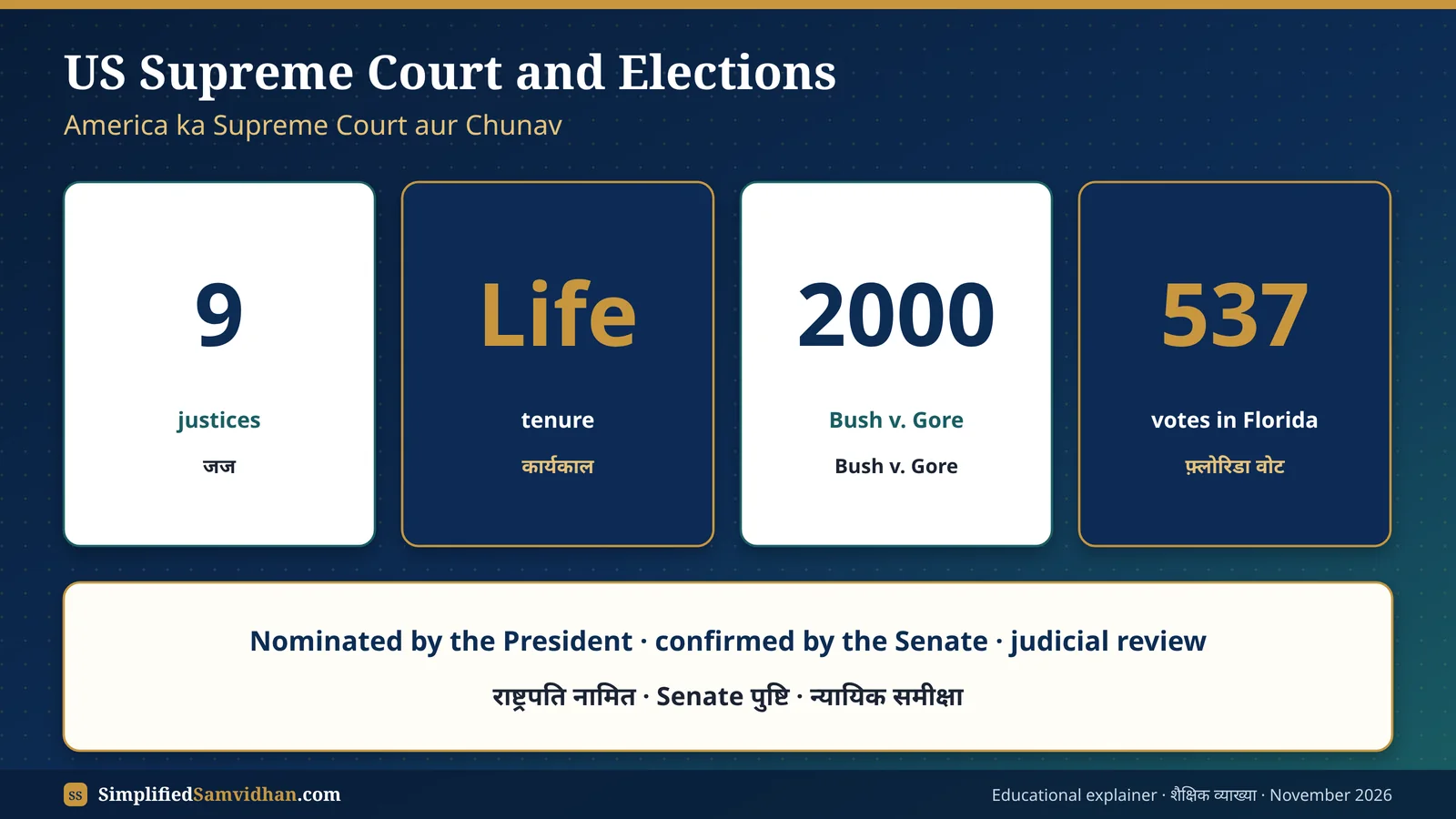
Nine justices, appointed for life after Senate confirmation, have shaped US elections, from "one person, one vote" to Bush v. Gore (2000), which settled a presidency by 537 votes.
The CourtUS Supreme Court: 9 Justices, Life Tenure and Senate Confirmation
The US Supreme Court has 9 judges (called justices), one of whom is the Chief Justice, now John Roberts (since 2005). The President nominates them and the Senate confirms them by a simple majority. They serve for life, until they die, retire or are impeached. That is why every Senate election matters: the party that controls the Senate decides which nominees get through. Today 6 of the 9 were appointed by Republican Presidents and 3 by Democratic Presidents.
🏠 Everyday analogy
Like an umpire panel appointed for life by one team captain and approved by the league council. Once seated, they cannot be sacked for unpopular decisions.
🇮🇳 Real Indian example
India's Supreme Court has up to 34 judges, including the Chief Justice of India. They retire at 65, and appointments come through the collegium of senior judges, not through a Senate-style political vote.
Article III, Section 1. The judicial Power of the United States, shall be vested in one supreme Court, and in such inferior Courts as the Congress may from time to time ordain and establish. The Judges, both of the supreme and inferior Courts, shall hold their Offices during good Behaviour.
Election casesLandmark US Supreme Court Cases on Elections
| Case | Year | What the Court decided |
|---|---|---|
| Marbury v. Madison | 1803 | Courts can strike down laws that violate the Constitution (judicial review). India adopted this idea. |
| Reynolds v. Sims | 1964 | "One person, one vote": districts must have roughly equal population. |
| Bush v. Gore | 2000 | By 5-4 stopped the Florida recount. George W. Bush won Florida by 537 votes and became President. |
| Citizens United v. FEC | 2010 | Companies and unions can spend unlimited money independently in elections (led to 'Super PACs'). |
| Shelby County v. Holder | 2013 | Struck down the formula that made some states get federal approval before changing voting rules. |
| Rucho v. Common Cause | 2019 | Partisan gerrymandering cannot be challenged in federal courts. |
| Trump v. Anderson | 2024 | States cannot remove a presidential candidate from the ballot under the 14th Amendment's insurrection clause; only Congress can act. |
India vs USUS Supreme Court vs Supreme Court of India on Elections
US Supreme Court
- 9 justices, life tenure
- President nominates, Senate confirms (political)
- Hears about 60 cases a year
- Election rules mostly left to states and Congress
Supreme Court of India
- Up to 34 judges, retire at 65 (Art. 124)
- Collegium recommends, President appoints
- Hears tens of thousands of cases
- Has shaped elections strongly: NOTA (2013), candidate disclosure (2002), electoral bonds struck down (2024), CEC selection (2023)
- India's election cases: Election petitions and Article 329 and How the CEC is appointed (Anoop Baranwal).
- Gerrymandering and delimitation compared: Delimitation and gerrymandering.
Quick revisionOne-Line Revision Points (Exam Ready)
- US Supreme Court: 9 justices (since 1869).
- Life tenure; President nominates, Senate confirms.
- Chief Justice John Roberts (2005).
- Bush v. Gore (2000): Florida recount stopped, 5-4.
- Marbury v. Madison (1803): judicial review.
- India: up to 34 judges, retire at 65.
Practice MCQPractice MCQs (with Answers): US Supreme Court
How many judges sit on the US Supreme Court?
Which case established judicial review in the US?
Bush v. Gore (2000) was about:
Doubts ClearedFrequently Asked Questions
Who appoints US Supreme Court judges?
The President nominates; the Senate confirms by majority vote.
What happened in Bush v. Gore?
In December 2000 the Court, 5-4, stopped the Florida recount. Bush kept a 537-vote lead in Florida, won its electors and the presidency.
Do US Supreme Court judges retire?
There is no retirement age. They serve for life unless they choose to retire or are impeached and removed.
Sources and further readingSources We Checked
Facts checked on 4 November 2026 from the Supreme Court of the United States and Oyez. Hindi text is a simple rendering.