Indian Parliament vs British Parliament: Sovereignty, Two Houses and 10 Key Differences
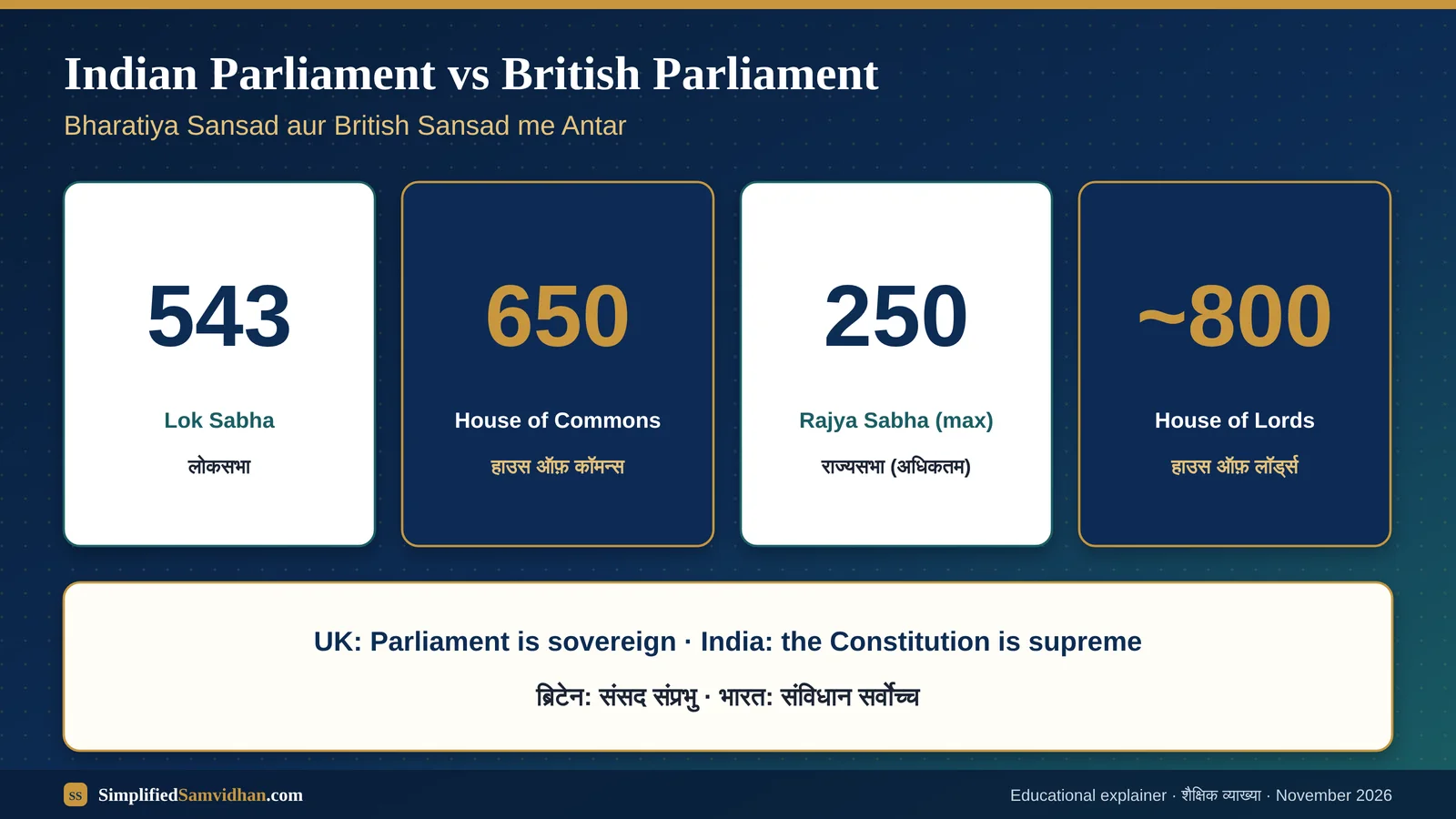
India took its parliamentary model from Westminster, but its Parliament is not sovereign the way Britain's is. Here is what is the same, what is different and why the Supreme Court can strike down what Parliament passes.
Short answerIndian Parliament vs British Parliament: The Answer in Simple Words
Short answer: India copied the shape of the British Parliament (two Houses, a Cabinet responsible to the lower House, a Speaker, question time) but not its supremacy. The British Parliament is sovereign: it can make or unmake any law and no court can strike an Act down. The Indian Parliament is supreme only within the Constitution: courts can strike down its laws (Articles 13, 32) and even its amendments if they break the basic structure.
🏠 Everyday analogy
The British Parliament is a family elder whose word is final. The Indian Parliament is a powerful elder too, but the family has a written will (the Constitution) and a referee (the Supreme Court) who can say "this decision breaks the will".
🇮🇳 Real Indian example
In 2015 the Supreme Court struck down the 99th Amendment (NJAC), passed by both Houses and ratified by States. Such a thing cannot happen to an Act of the British Parliament.
Article 79Article 79: What Makes Up Parliament in India and Britain
Article 79. There shall be a Parliament for the Union which shall consist of the President and two Houses to be known respectively as the Council of States and the House of the People.
Both Parliaments have three parts. India: President + Rajya Sabha + Lok Sabha. Britain: the Crown (King) + House of Lords + House of Commons. In both, the head of State is part of Parliament because no bill becomes law without his assent, but in both he acts on ministers' advice. The British monarch has not refused assent since 1708.
Difference tableDifference Between Indian and British Parliament: 10 Points
| Point | 🇮🇳 Indian Parliament | 🇬🇧 British Parliament |
|---|---|---|
| Source of power | Written Constitution | Conventions, statutes, common law (no single written constitution) |
| Supremacy | Limited: laws can be struck down | Sovereign: courts cannot strike down an Act |
| Lower House | Lok Sabha: 543 elected, 5-year term | House of Commons: 650 elected, up to 5 years |
| Upper House | Rajya Sabha: up to 250 (238 elected by MLAs + 12 nominated); permanent, 1/3 retire every 2 years | House of Lords: about 800 life peers, some hereditary peers and 26 bishops; none elected |
| Upper House on money bills | Can delay only 14 days (Art. 109) | Can delay only one month (Parliament Act 1911) |
| Upper House on other bills | Equal power; deadlock goes to joint sitting (Art. 108) | Can delay about one year; Commons then passes alone (Parliament Act 1949) |
| Federal role | Rajya Sabha represents States; Arts. 249, 312 powers | None (unitary country) |
| Amending the Constitution | Special majority, sometimes States too (Art. 368) | Ordinary Act of Parliament is enough |
| Speaker | Stays a party member; elected by the House | Leaves party; by convention not opposed in own seat |
| Highest court | Supreme Court, separate from Parliament since 1950 | UK Supreme Court since 2009; before that Law Lords sat in the House of Lords |
SovereigntyParliamentary Sovereignty vs Constitutional Supremacy
Why the UK Parliament is sovereign
- No written constitution above it
- One Parliament cannot bind the next one
- Courts can only declare a law "incompatible" with rights (Human Rights Act 1998), not void
- Unitary country: no States to share power with
Why the Indian Parliament is not
- Written, supreme Constitution
- Fundamental Rights limit it (Art. 13)
- Federal division: cannot make laws on the State List in normal times
- Judicial review and basic structure (Kesavananda Bharati, 1973)
BorrowedWhat India Borrowed from the British Parliament, and What It Added
- Indian additions: Zero Hour (since 1962), joint sitting, nominated members for art and science, reserved seats for SC/ST, anti-defection law (Tenth Schedule, 1985).
- What India could learn: more sitting days (the Commons sits about 150 days a year; Lok Sabha often under 70), stronger committees and a neutral Speaker convention.
- Full list of borrowed features: Sources of the Indian Constitution. Opposition and shadow cabinet: Opposition and shadow cabinet.
Quick revisionOne-Line Revision Points (Exam Ready)
- UK: parliamentary sovereignty (Dicey); India: constitutional supremacy.
- Parliament of India: President + Rajya Sabha + Lok Sabha (Art. 79).
- House of Lords is not elected; Rajya Sabha is elected by MLAs.
- Joint sitting: Art. 108, only in India.
- Zero Hour: Indian innovation, 1962.
- UK Supreme Court since 2009.
Practice MCQPractice MCQs (with Answers): Indian and British Parliament
The doctrine of parliamentary sovereignty is associated with:
Which provision exists in India but not in the UK Parliament?
How long can the Rajya Sabha hold a money bill?
Zero Hour in Indian Parliament began in:
Doubts ClearedFrequently Asked Questions
Is the Indian Parliament sovereign?
No. It is supreme within the limits of the Constitution. Courts can strike down its laws and amendments that violate Fundamental Rights or the basic structure.
What is the House of Lords?
Britain's upper House. Its members are appointed for life, plus some hereditary peers and 26 Church of England bishops. It can only delay most bills.
Why is Rajya Sabha stronger than the House of Lords?
It is elected, represents the States, has equal power on ordinary and constitutional amendment bills, and has special powers under Articles 249 and 312.
Sources and further readingSources We Checked
Checked against the Constitution of India, UK Parliament publications and the Parliament Acts 1911 and 1949. Hindi text of Article 79 is from the official Hindi version.