How the President Is Elected in India vs USA: The Simple Difference
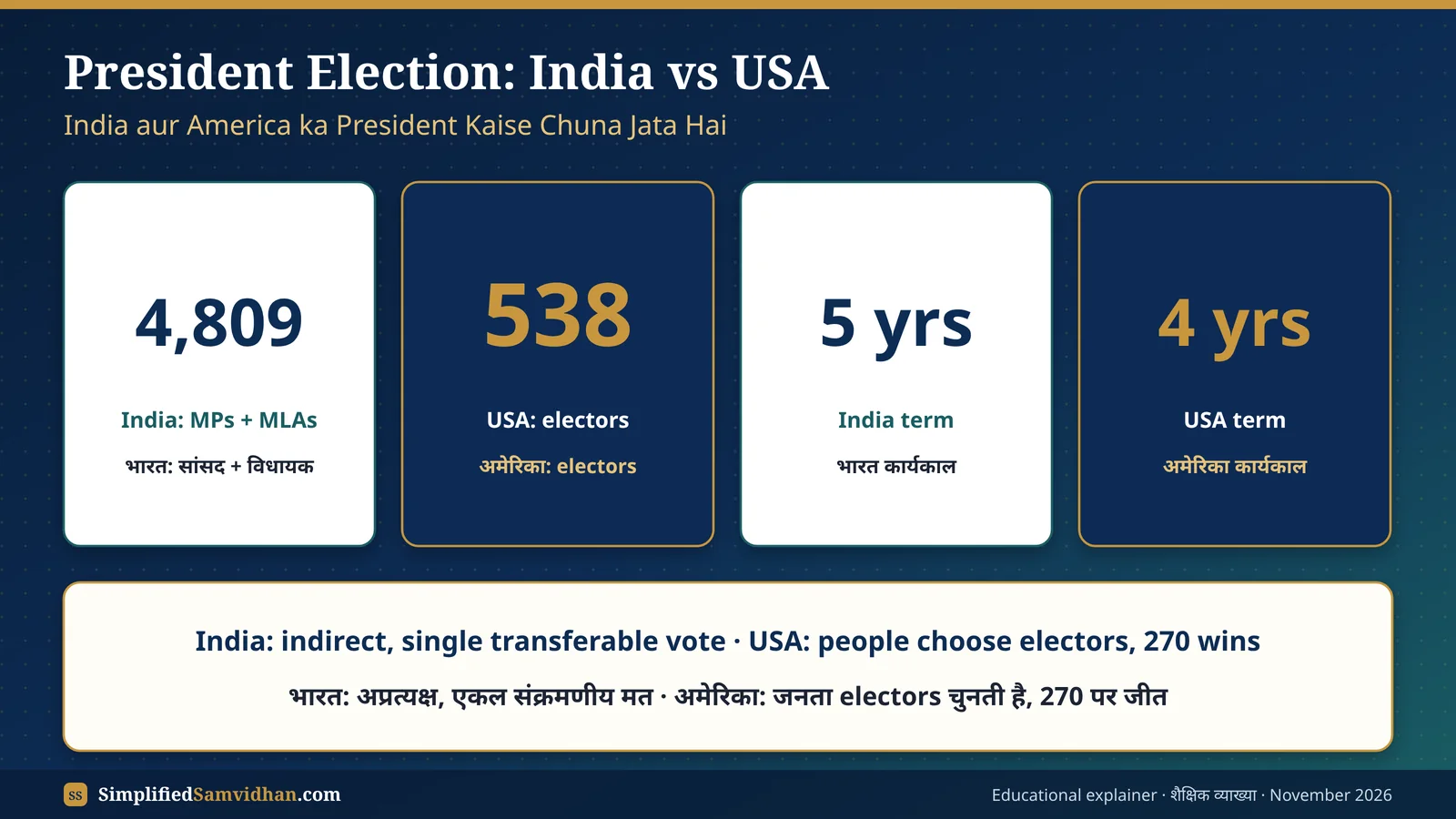
In India, 4,809 MPs and MLAs elect the President by ranking candidates. In the USA, crores of citizens vote state by state and 270 of 538 electors decide. One table, two step-by-step processes and the reason behind each system.
DifferenceIndia vs USA President Election: The Difference in Simple Words
In one line: in India, the people do not vote for the President; the MPs and MLAs we elected choose the President. In the USA, the people do vote, state by state, and those votes decide the electors who formally choose the President.
The bigger difference is power. India's President is the head of the State who acts on the advice of the Prime Minister and the Cabinet (Article 74). America's President is head of State and head of government: he runs the government himself. That is why the US makes the whole country take part, while India keeps the President's election indirect and quiet.
🏠 Everyday analogy
India's President is like the head of a family whose name is on the house, while the eldest son (Prime Minister) runs the business. The US President is the owner who also runs the shop every day.
🇮🇳 Real Indian example
In July 2022, 4,809 MPs and MLAs voted and Droupadi Murmu won with about 64% of the vote value. In November 2024, about 15.5 crore Americans voted and Donald Trump won 312 of 538 electoral votes.
| Point | 🇮🇳 India | 🇺🇸 USA |
|---|---|---|
| Who votes | Elected MPs + elected MLAs (Art. 54) | All registered citizens, through electors |
| Number of voters | 4,809 (2022) | About 15.5 crore voted (2024) |
| Voting method | Single transferable vote: rank 1, 2, 3... | Tick one candidate; state winner takes all electors |
| To win | More than half of valid vote value (quota) | 270 of 538 electoral votes |
| Run by | Election Commission of India (Art. 324) | Each state's election officials |
| Term | 5 years (Art. 56); can be re-elected | 4 years; maximum 2 terms (22nd Amendment) |
| Minimum age | 35 (Art. 58) | 35, natural-born citizen, 14 years resident |
| Real power | Nominal head; PM and Cabinet govern | Real executive; runs the government |
| Removal | Impeachment for violation of the Constitution (Art. 61) | Impeachment for treason, bribery, high crimes (Art. II, s.4) |
| Election disputes | Only the Supreme Court (Art. 71) | State courts, then federal courts (Bush v. Gore, 2000) |
IndiaHow the President of India Is Elected (Articles 54 and 55)
Article 54. Election of President. The President shall be elected by the members of an electoral college consisting of— (a) the elected members of both Houses of Parliament; and (b) the elected members of the Legislative Assemblies of the States.
Explanation.—In this article and in article 55, "State" includes the National Capital Territory of Delhi and the Union territory of Pondicherry.
Article 55(3). The election of the President shall be held in accordance with the system of proportional representation by means of the single transferable vote and the voting at such election shall be by secret ballot.
- 1Who is in the electoral college
776 elected MPs (543 Lok Sabha + 233 Rajya Sabha) and about 4,033 elected MLAs. Nominated MPs and MLCs cannot vote.
- 2Every vote has a value
An MLA's vote value = state population (1971) ÷ (elected MLAs × 1,000). UP MLA = 208, Sikkim MLA = 7. Each MP's vote = 700.
- 3Rank the candidates
Each elector writes 1, 2, 3 against candidates on a secret ballot.
- 4Reach the quota
A candidate needs more than half the valid vote value. If no one has it, the lowest is eliminated and his votes move to the second choice, until someone crosses the quota.
- 5Oath
The Chief Justice of India administers the oath (Art. 60).
USAHow the US President Is Elected (Article II)
Article II, Section 1, Clause 1. The executive Power shall be vested in a President of the United States of America. He shall hold his Office during the Term of four Years, and, together with the Vice President, chosen for the same Term, be elected, as follows:
Clause 2. Each State shall appoint, in such Manner as the Legislature thereof may direct, a Number of Electors, equal to the whole Number of Senators and Representatives to which the State may be entitled in the Congress: but no Senator or Representative, or Person holding an Office of Trust or Profit under the United States, shall be appointed an Elector.
- 1Party primaries
Citizens choose each party's candidate (January to June).
- 2People vote in November
Voters pick a President + Vice President pair.
- 3State winner takes the electors
A state's electors = its House seats + 2. Total 538.
- 4270 wins
Electors vote in December; Congress counts on 6 January; oath on 20 January.
- Full detail: Electoral College explained.
Why differentWhy the Two Countries Chose Different Systems
Why India chose indirect election
- The President is a constitutional head; a direct vote would create a rival power centre to the PM
- A nationwide poll for a ceremonial post would be very costly
- MLAs give States a voice, so the President represents the Union and the States
Why the US uses electors
- 1787 compromise between election by Congress and by the people
- Gives weight to states, not just population
- The President is the real executive, so people want a direct say
- Removal compared: Impeachment in US vs India. Whole systems compared: India vs US election system.
Quick revisionOne-Line Revision Points (Exam Ready)
- India: President elected by elected MPs + elected MLAs (Art. 54).
- Method: proportional representation, single transferable vote, secret (Art. 55(3)).
- MP vote value 700; UP MLA 208, Sikkim MLA 7.
- USA: 538 electors, 270 wins.
- India 5 years, no term limit; USA 4 years, 2-term limit.
- Disputes in India go only to the Supreme Court (Art. 71).
Practice MCQPractice MCQs (with Answers): President election: India vs USA
Who among the following does NOT vote in India's presidential election?
India's President is elected by which system?
What is the term of the US President compared with India's President?
Election disputes about India's President are decided by:
Doubts ClearedFrequently Asked Questions
Do Indian citizens vote for the President?
No, not directly. We elect MPs and MLAs, and they elect the President.
Is the US President elected directly?
Almost. People vote, but formally for electors; the 538 electors then vote, and 270 wins.
When is India's next presidential election?
By July 2027, because President Droupadi Murmu's five-year term ends on 24 July 2027.
Who is more powerful, India's President or America's?
America's. India's President normally acts on the advice of the Council of Ministers (Art. 74); the US President heads the government himself.
Sources and further readingSources We Checked
Indian figures from the Election Commission of India for the 2022 presidential election; US figures from the National Archives. Hindi text of the Constitution of India is from the official Hindi version; the US text is a simple rendering.