Salient Features of the Swiss Constitution: Direct Democracy, Federal Council and Comparison with India
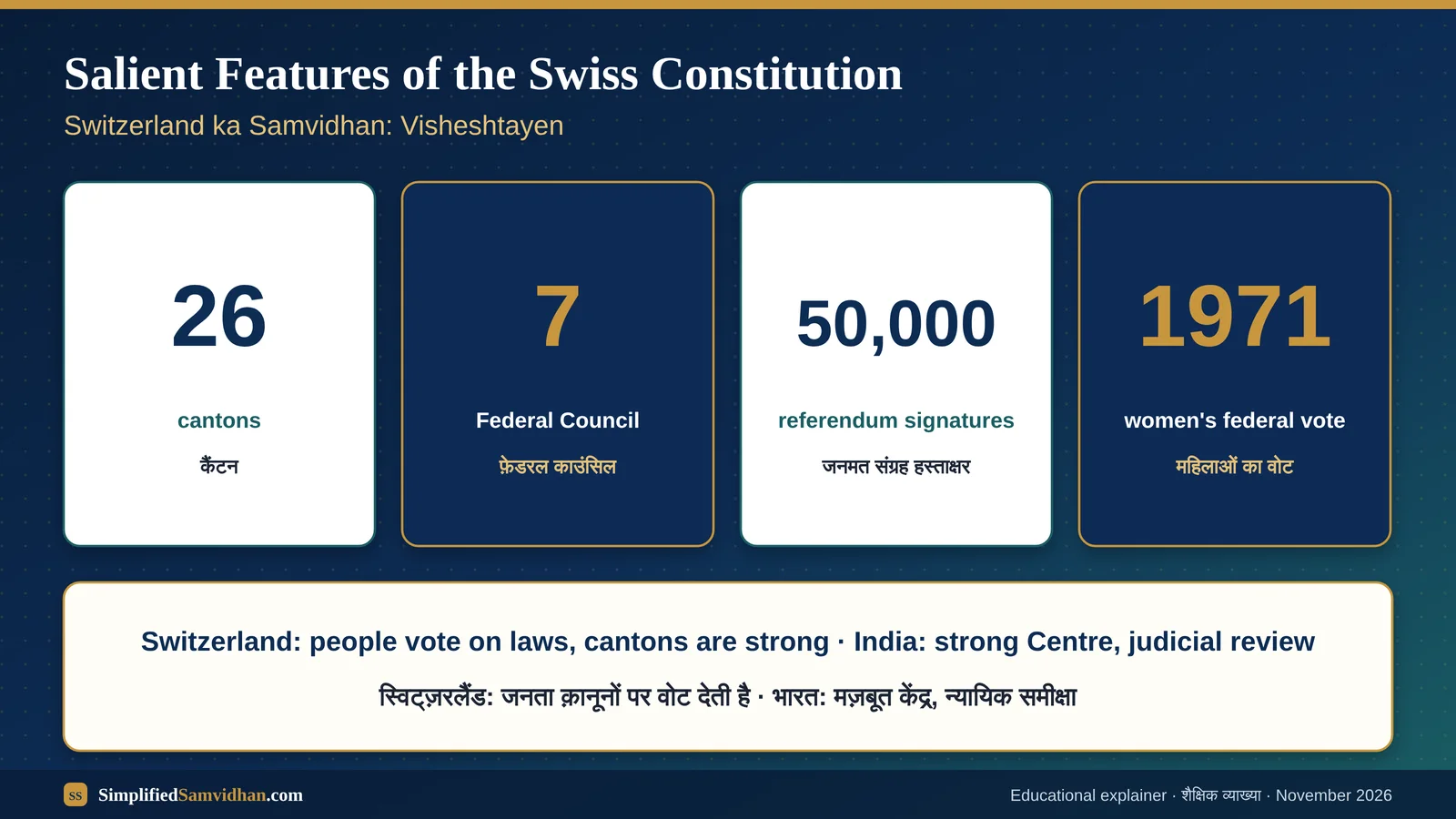
A country where citizens vote on laws, the executive has seven equal heads and judges cannot strike down federal laws. Switzerland's seven key features and how they compare with India.
Short answerFeatures of the Swiss Constitution: The Answer in Simple Words
Short answer: Switzerland is the world's best example of direct democracy and strong units. Its main features are: 26 cantons that keep all powers not given to the Centre; a seven-member Federal Council as a collective executive, with a President who changes every year; two Houses with equal power; and the people's right to veto laws by referendum and to propose constitutional amendments by collecting signatures. Unlike India, its Supreme Court cannot strike down federal laws.
🏠 Everyday analogy
Swiss democracy is like a housing society where the committee runs daily work, but any 50 flat owners can force a general vote on a committee decision, and any 100 can put a new rule to the vote of all members.
🇮🇳 Real Indian example
Swiss citizens vote on national questions about four times a year. Imagine Indian voters directly deciding on GST rates or a new law by ballot: in Switzerland, that is normal. Indian Gram Sabhas, where villagers decide together, are the closest Indian example.
Articles 3 and 190Swiss Constitution: Sovereign Cantons and No Review of Federal Laws
Article 3. The Cantons are sovereign except to the extent that their sovereignty is limited by the Federal Constitution. They exercise all rights that are not vested in the Confederation.
Article 190. The Federal Supreme Court and the other judicial authorities apply the federal acts and international law.
Article 3 is the opposite of India's Article 248: in Switzerland the cantons hold residuary power, in India the Centre does. Article 190 means Swiss judges must apply a federal law even if they think it is unconstitutional; the people, through referendums, are the final guard of the Constitution, not the judges.
7 featuresSalient Features of the Constitution of Switzerland
- 1Federal with very strong cantons
26 cantons (6 of them counted as half-cantons) have their own constitutions, parliaments, courts and taxes. Name: "Swiss Confederation", though legally a federation since 1848.
- 2Collegial executive
The Federal Council of 7 equal members runs the country. Parliament elects them for 4 years and cannot remove them by a no-confidence vote. Since 1959 the big parties have shared seats (the "magic formula").
- 3A one-year President
One councillor becomes President of the Confederation for one year: first among equals, with no extra power.
- 4Two equal Houses
National Council: 200 members by population. Council of States: 46 members, 2 per canton (1 per half-canton). A law needs both.
- 5Direct democracy
Mandatory referendum on amendments; optional referendum on laws (50,000 signatures); popular initiative for amendments (100,000 signatures). Two cantons still hold open-air assemblies (Landsgemeinde).
- 6No judicial review of federal laws
The Federal Supreme Court at Lausanne can review cantonal laws but must apply federal acts (Article 190).
- 7Armed neutrality and multilingualism
Permanent neutrality, a citizen militia army, four national languages.
ComparisonSwiss Constitution vs Indian Constitution: 9-Point Comparison
| Point | 🇨🇭 Switzerland | 🇮🇳 India |
|---|---|---|
| Units | 26 cantons, sovereign except as limited | 28 States + 8 UTs; Parliament can redraw them (Art. 3) |
| Residuary powers | Cantons (Art. 3) | Centre (Art. 248) |
| Executive | 7-member Federal Council, collective; rotating President | PM-led Council of Ministers; President as nominal head |
| Removal of executive | Not possible during the 4-year term | No-confidence motion in Lok Sabha |
| Upper House | Equal seats per canton; equal power | Seats by population; weaker on money bills |
| Amending the Constitution | Referendum with double majority | Parliament (and sometimes half the States), no referendum (Art. 368) |
| Direct democracy | Referendum and initiative at national level | Only Gram Sabha at village level (Art. 243A) |
| Judicial review | Not of federal laws | Of all laws and amendments (Arts. 13, 32, basic structure) |
| Citizenship | Triple: commune, canton, federal | Single |
LessonsWhat India Can Learn from Switzerland, and Its Limits
What India can learn
- Consensus government: all major parties share executive power
- Real voice for citizens between elections
- Strong local self-government with own taxes
- Respect for linguistic diversity
Why India cannot copy it fully
- Size: about 90 lakh Swiss vs about 145 crore Indians
- Frequent national referendums would be very costly and slow
- Referendums can be used against minorities (e.g. 2009 minaret ban vote)
- India's makers wanted a strong Centre for unity
Quick revisionOne-Line Revision Points (Exam Ready)
- Present Swiss Constitution: 1999, in force 2000.
- Executive: Federal Council of 7; President rotates yearly.
- Residuary power with cantons (Art. 3).
- Referendum 50,000; initiative 1,00,000 signatures.
- No judicial review of federal laws (Art. 190).
- Federal vote for women only in 1971.
Practice MCQPractice MCQs (with Answers): Swiss Constitution
The executive of Switzerland is:
In which country do people use the popular initiative and referendum most at the national level?
In Switzerland, residuary powers lie with:
Doubts ClearedFrequently Asked Questions
Who is the head of Switzerland?
The seven-member Federal Council is the collective head. One member serves as President of the Confederation for one year, only as first among equals.
What is direct democracy in Switzerland?
Citizens can force a public vote on a new law with 50,000 signatures, propose constitutional amendments with 100,000 signatures, and must approve every amendment in a referendum.
Is Switzerland a confederation or a federation?
Its official name is the Swiss Confederation, but since 1848 it has been a federation with a central government and very strong cantons.
Sources and further readingSources We Checked
Checked against the official English translation of the Swiss Federal Constitution (Fedlex) and the Federal Chancellery's guide. The Hindi text is a simple rendering.