Impeachment in US vs India: How a President Can Be Removed
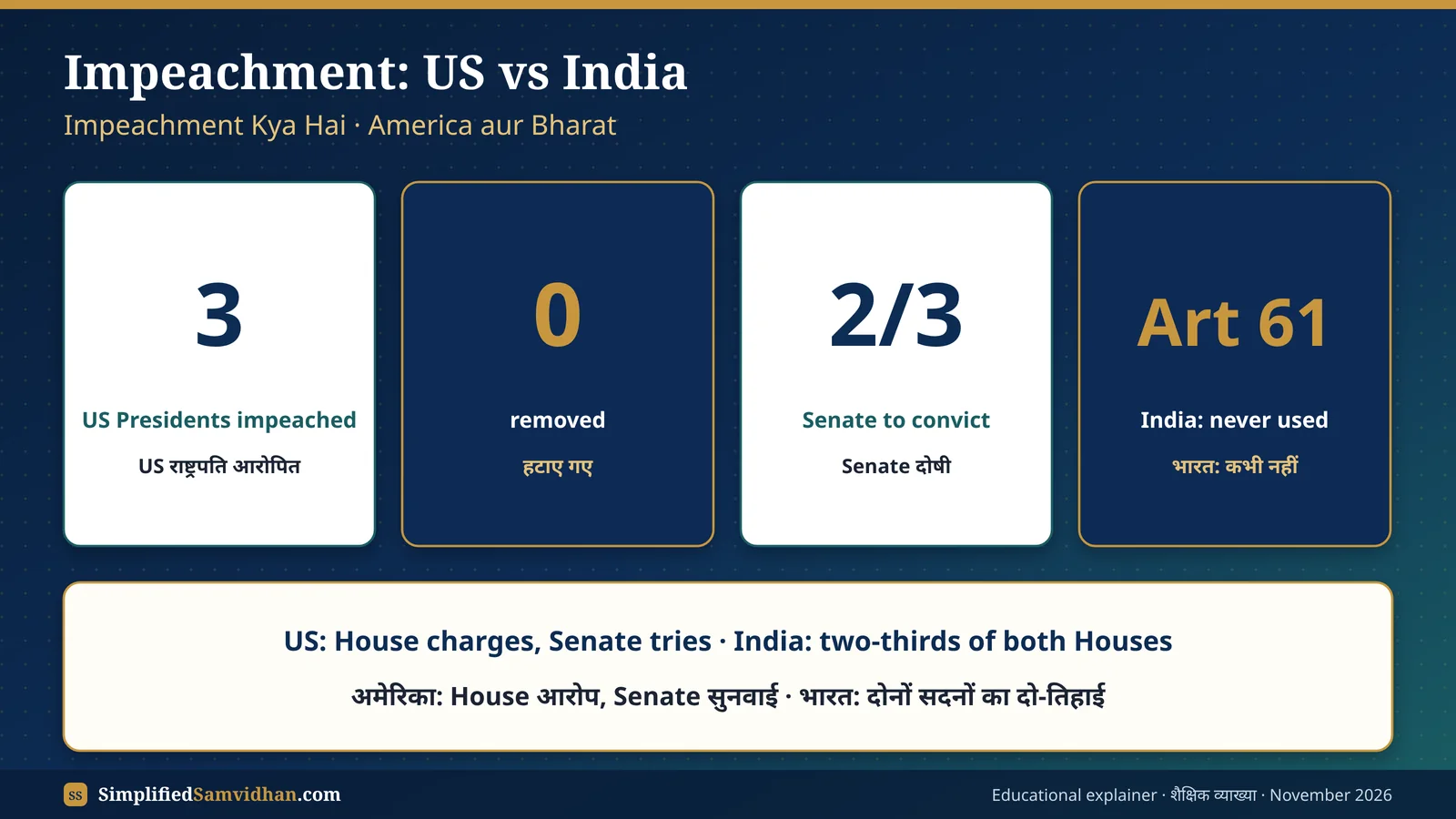
In the US, the House charges and the Senate tries: three Presidents were impeached, none removed. In India, Article 61 needs two-thirds of both Houses and has never been used against a President.
MeaningImpeachment Kya Hai? The Meaning in Simple Words
Impeachment is how a legislature removes a President (or a judge) before the term ends. In both countries it is a two-step process: one House brings the charges, the other tries them. The word 'impeached' only means charged, not removed. Three US Presidents have been impeached (Andrew Johnson, Bill Clinton, and Donald Trump twice), and all were acquitted by the Senate. No President of India has ever been impeached.
🏠 Everyday analogy
Like a school where the teachers' council files charges against the principal, and the management board holds the hearing and decides whether to remove him.
🇮🇳 Real Indian example
India has used the removal process only against judges: the motion against Justice V. Ramaswami failed in the Lok Sabha in 1993, and Justice Soumitra Sen resigned in 2011 after the Rajya Sabha voted to remove him.
USAImpeachment of the US President: Constitution and History
Article II, Section 4. The President, Vice President and all civil Officers of the United States, shall be removed from Office on Impeachment for, and Conviction of, Treason, Bribery, or other high Crimes and Misdemeanors.
Article I, Section 2, Clause 5. The House of Representatives shall chuse their Speaker and other Officers; and shall have the sole Power of Impeachment.
Article I, Section 3, Clause 6. The Senate shall have the sole Power to try all Impeachments. When sitting for that Purpose, they shall be on Oath or Affirmation. When the President of the United States is tried, the Chief Justice shall preside: And no Person shall be convicted without the Concurrence of two thirds of the Members present.
| President | Impeached by House | Senate result |
|---|---|---|
| Andrew Johnson | 1868 | Acquitted by one vote (35-19, 36 needed) |
| Richard Nixon | Not impeached | Resigned on 9 August 1974 (Watergate) before the House vote |
| Bill Clinton | 1998 | Acquitted in 1999 |
| Donald Trump | 2019 | Acquitted in 2020 |
| Donald Trump | 2021 | Acquitted 57-43, ten short of 67 |
IndiaImpeachment of the President of India: Article 61 Step by Step
Article 61(1). When a President is to be impeached for violation of the Constitution, the charge shall be preferred by either House of Parliament.
Article 61(2). No such charge shall be preferred unless— (a) the proposal to prefer such charge is contained in a resolution which has been moved after at least fourteen days' notice in writing signed by not less than one-fourth of the total number of members of the House has been given of their intention to move the resolution, and (b) such resolution has been passed by a majority of not less than two-thirds of the total membership of the House.
- 1Notice
At least one-fourth of the members of either House sign a notice; 14 days must pass.
- 2First House passes
The resolution needs two-thirds of the total membership of that House.
- 3Other House investigates
The President can appear or be represented.
- 4Second House passes
Again two-thirds of the total membership; the President is removed from that date.
ComparisonImpeachment in US vs India: Comparison Table
| Point | 🇺🇸 USA | 🇮🇳 India |
|---|---|---|
| Ground | Treason, bribery, other high crimes and misdemeanors | Only 'violation of the Constitution' (Art. 61) |
| Who starts | Only the House | Either House |
| Majority to charge | Simple majority of the House | Two-thirds of total membership |
| Trial | Senate, Chief Justice presides | The other House investigates |
| To remove | Two-thirds of Senators present | Two-thirds of total membership of the second House |
| Ever removed? | No President removed; 3 impeached | Never used against a President |
| Also applies to | Vice President, judges, civil officers | Judges have a separate removal process (Art. 124(4)) |
- Why the US version is used more: the President is a political, real executive, and the House needs only a simple majority. In India the President acts on ministers' advice, so there is rarely a reason, and the bar is very high.
- After the 2026 midterms the House has a Democratic majority, so in theory it could impeach President Trump again by a simple majority, but removal would still need 67 Senators, which no party has. See Senate results 2026.
- Related: How the CEC can be removed, President election: India vs USA.
Quick revisionOne-Line Revision Points (Exam Ready)
- US: House impeaches (majority), Senate convicts (2/3 present).
- Impeached: A. Johnson 1868, Clinton 1998, Trump 2019 and 2021; all acquitted.
- Nixon resigned in 1974 before impeachment.
- India Art. 61: only ground violation of the Constitution.
- India: 1/4 notice, 14 days, 2/3 of total membership.
- Nominated MPs vote; MLAs do not.
Practice MCQPractice MCQs (with Answers): Impeachment
The only ground for impeaching India's President is:
Who presides over the Senate trial when a US President is impeached?
Which US President resigned before he could be impeached?
Who can take part in the impeachment of India's President?
Doubts ClearedFrequently Asked Questions
Has any Indian President been impeached?
No. The Article 61 process has never been used.
How many US Presidents have been impeached?
Three: Andrew Johnson (1868), Bill Clinton (1998) and Donald Trump (2019 and 2021). All were acquitted.
Does impeachment mean removal?
No. In the US, impeachment is only the charge by the House; removal needs conviction by two-thirds of the Senate.
Sources and further readingSources We Checked
Facts checked on 4 November 2026 from the US House and Senate historical offices and the Constitution of India. Hindi text of the US Constitution is a simple rendering.