Parliamentary vs Presidential vs Semi-presidential System: Difference with Examples
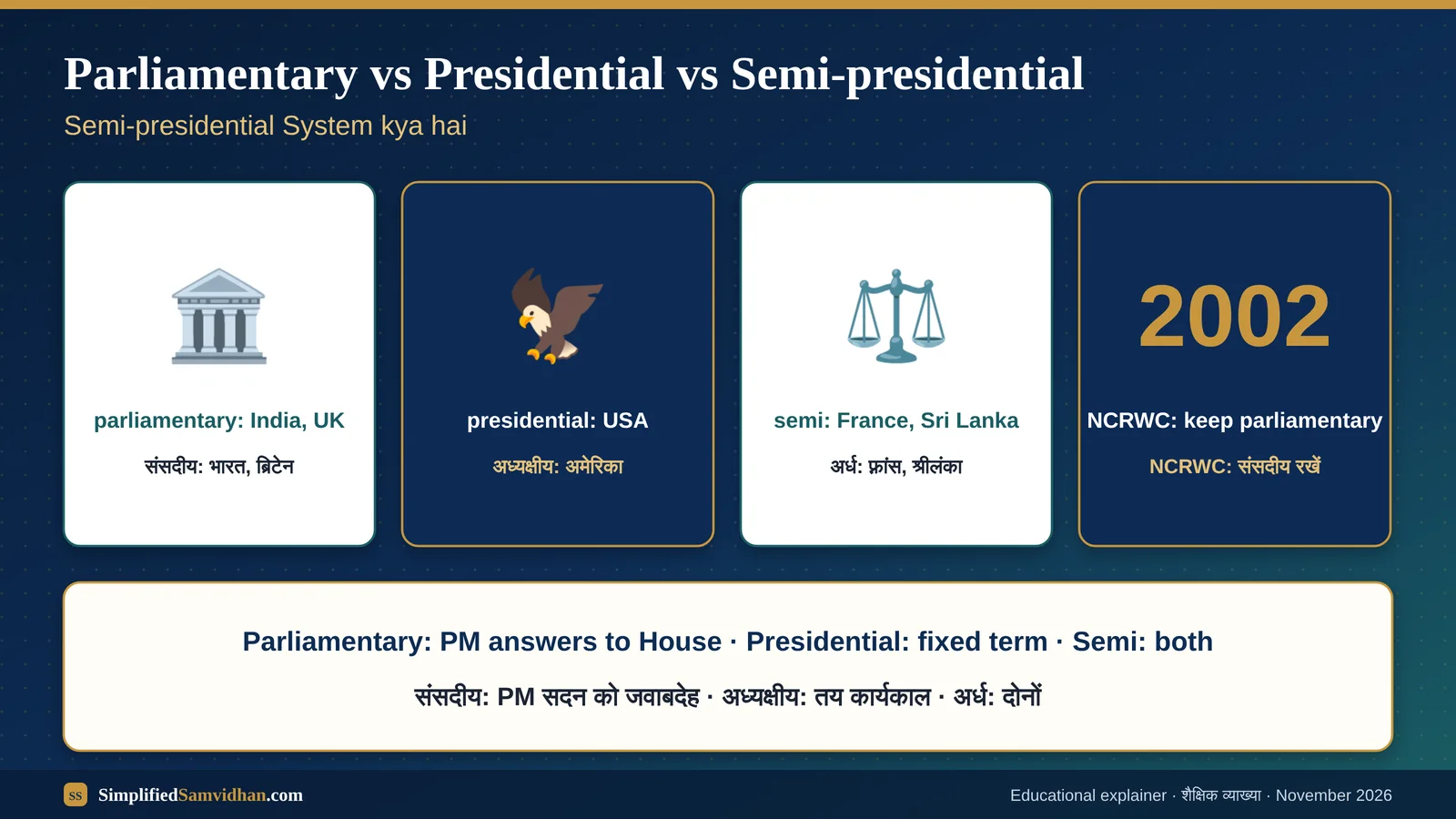
Not every democracy is either India-style or US-style. France, Sri Lanka and many others use a third model with an elected President and a PM. All three systems, side by side, with examples and India's debate.
Short answerSemi-presidential System: The Answer in Simple Words
Short answer: In a parliamentary system (India, UK) the real executive, the PM and Cabinet, comes from the legislature and can be removed by it. In a presidential system (USA) an elected President is the real executive, sits outside the legislature and serves a fixed term. A semi-presidential system (France, Sri Lanka, Portugal) mixes the two: a directly elected President with real powers plus a Prime Minister and Cabinet answerable to Parliament. Two people share the executive, hence the term "dual executive".
🏠 Everyday analogy
Think of a cricket team. Parliamentary: the captain (PM) is chosen by the team and can be replaced by it. Presidential: the owner (President) runs the team for a fixed season. Semi-presidential: the owner picks strategy and appoints the captain, but the captain needs the team's support to stay.
🇮🇳 Real Indian example
In France, President Macron is elected by the people and leads foreign policy, while the Prime Minister runs daily government and can be removed by the National Assembly. India's President, by contrast, is indirectly elected and acts on the Cabinet's advice (Article 74).
3-way tableParliamentary vs Presidential vs Semi-presidential: 10-Point Table
| Point | 🏛️ Parliamentary | 🦅 Presidential | ⚖️ Semi-presidential |
|---|---|---|---|
| Examples | India, UK, Japan, Canada | USA, Brazil, Mexico | France, Portugal, Sri Lanka, Poland |
| Head of State | Nominal President or monarch | President (also head of government) | Elected President with real powers |
| Head of Government | Prime Minister | President | Prime Minister (appointed by President) |
| Executive | Dual: nominal + real | Single | Dual, both with real power |
| How the leader is chosen | Majority in the Lower House | Direct (US: Electoral College) | President direct; PM needs Assembly support |
| Removal | No-confidence motion, any time | Only impeachment | PM by no-confidence; President fixed term |
| Ministers in legislature? | Yes, must be members | No | France: no (must leave seat) |
| Dissolution of Lower House | Yes, on PM's advice | No | Yes, by the President |
| Main strength | Accountability, flexibility | Stability, clear separation | Stable head + accountable government |
| Main risk | Unstable coalitions | Deadlock between President and Congress | Clash between President and PM |
Two typesTwo Types of Semi-presidential System
The second type gives the President much more power, because the PM survives only with the President's trust. That is why scholars warn it can slide towards one-person rule, as in Russia.
CohabitationCohabitation: When President and PM Are Rivals (France, Sri Lanka)
- 1France, 1986-88
Socialist President Mitterrand had to work with right-wing PM Jacques Chirac after the Assembly election.
- 2France, 1993-95
Mitterrand again, now with PM Edouard Balladur.
- 3France, 1997-2002
Gaullist President Chirac with Socialist PM Lionel Jospin. In 2000 the term was cut from 7 to 5 years so that both elections fall together, making cohabitation rare.
- 4Sri Lanka, 2001-04
President Chandrika Kumaratunga and rival PM Ranil Wickremesinghe; she dissolved Parliament in 2004.
India's debateShould India Switch to a Presidential or Semi-presidential System?
Arguments for a presidential or semi-presidential shift
- Stable fixed-term executive, no fall of governments mid-way
- Leader chosen directly by all voters, less horse-trading
- Ministers chosen for skill, not only from MPs
- Coalition instability of 1989-1999 (five general elections in ten years)
Arguments for keeping the parliamentary system
- Daily accountability through question hour and no-confidence motion
- A diverse country needs a Cabinet that can represent many groups
- Risk of one-person rule in a vast country
- Parliamentary form is part of the basic structure debate; a shift may not survive judicial review
Dr. B.R. Ambedkar told the Constituent Assembly that the makers chose more responsibility over more stability. The NCRWC (2002), headed by Justice M.N. Venkatachaliah, also advised against switching and suggested reforms inside the parliamentary system instead, such as a constructive vote of no-confidence and a stronger anti-defection law.
Quick revisionOne-Line Revision Points (Exam Ready)
- Semi-presidential = elected President + PM answerable to Parliament.
- Term popularised by Maurice Duverger (1980).
- Model: France, Fifth Republic (1958).
- Cohabitation: President and PM from rival parties.
- Sri Lanka: 19th (2015) and 21st (2022) Amendments cut presidential power.
- India: NCRWC (2002) said keep the parliamentary system.
Practice MCQPractice MCQs (with Answers): Forms of government
Which country is the classic model of the semi-presidential system?
'Cohabitation' in politics refers to:
Which body advised in 2002 that India should keep the parliamentary system?
Doubts ClearedFrequently Asked Questions
What is a semi-presidential system?
A system with a directly elected President who has real powers, and a Prime Minister and Cabinet who need the confidence of Parliament. France is the best-known example.
Is India semi-presidential?
No. India is parliamentary: its President is indirectly elected and must act on the advice of the Council of Ministers (Article 74).
Which South Asian country has a semi-presidential system?
Sri Lanka, since its 1978 Constitution, with an elected executive President and a Prime Minister answerable to Parliament.
Sources and further readingSources We Checked
Based on standard political science sources (Duverger 1980; Shugart and Carey 1992), the French and Sri Lankan Constitutions and the NCRWC report (2002).