US Constitution vs Indian Constitution: The Shortest and the Longest
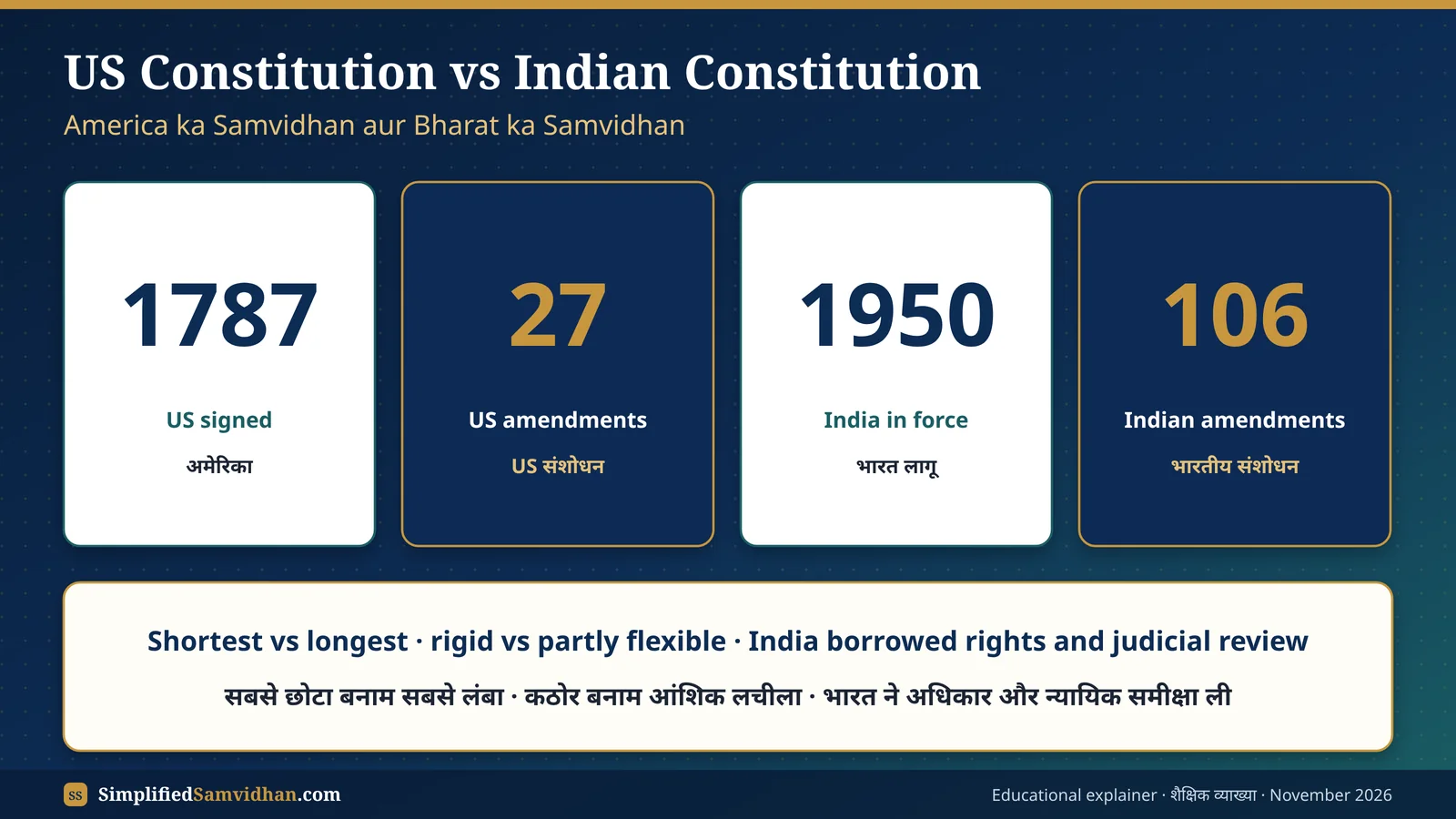
The US Constitution (1787) has 7 Articles and 27 amendments; India's (1950) is the longest in the world with 106 amendments. One table with every key difference, and the features India took from America.
US ConstitutionWhat Is the US Constitution? 1787, 7 Articles, 27 Amendments
The US Constitution was signed on 17 September 1787 in Philadelphia and came into force in 1789. It is the oldest written national constitution still in use and one of the shortest: just 7 Articles and about 4,400 words in the original. Article I creates Congress, Article II the President, Article III the Supreme Court; the rest deal with states, amendments and the supremacy of the Constitution. In 237 years it has been amended only 27 times.
🏠 Everyday analogy
The US Constitution is like a short family rulebook written by the grandparents: few rules, hard to change, and judges explain how it applies today. India's Constitution is a detailed household manual that the family updates often.
🇮🇳 Real Indian example
Dr B.R. Ambedkar's Drafting Committee studied the US Constitution closely. Our Fundamental Rights and the power of courts to strike down laws (judicial review) come from the American model.
Preamble. We the People of the United States, in Order to form a more perfect Union, establish Justice, insure domestic Tranquility, provide for the common defence, promote the general Welfare, and secure the Blessings of Liberty to ourselves and our Posterity, do ordain and establish this Constitution for the United States of America.
ComparisonUS Constitution vs Indian Constitution: Side-by-Side Table
| Point | 🇺🇸 US Constitution | 🇮🇳 Indian Constitution |
|---|---|---|
| Adopted / in force | 1787 / 1789 | 26 Nov 1949 / 26 Jan 1950 |
| Length | 7 Articles; shortest major constitution | Longest written constitution (395 Articles originally, 22 Parts, 12 Schedules) |
| Amendments | 27 in 237 years | 106 in 76 years |
| How to amend | 2/3 of Congress + 3/4 of states (38 of 50): very rigid | Special majority of Parliament; some need half the States (Art. 368): partly flexible |
| System of government | Presidential | Parliamentary (borrowed from Britain) |
| Federalism | Dual: states have their own constitutions | Quasi-federal: one Constitution, strong Centre |
| Citizenship | Dual (US + state) | Single |
| Rights | Bill of Rights: first 10 amendments (1791) | Fundamental Rights in Part III (Arts. 12-35) |
| Courts | Separate federal and state courts | Single integrated judiciary |
Borrowed featuresWhat India Borrowed from the US Constitution (UPSC)
- Fundamental Rights (Part III), modelled on the US Bill of Rights.
- Judicial review and the independence of the judiciary (US case Marbury v. Madison, 1803).
- Impeachment of the President (Art. 61) and removal of Supreme Court and High Court judges (Art. 124(4), 217).
- Vice President as chairman of the upper House (Art. 64).
- The Preamble and the idea of a written, supreme constitution.
- All sources in one place: Sources of the Indian Constitution.
Not borrowed from the US
- Presidential system
- Dual citizenship
- Separate state constitutions
- Equal representation of states in the upper House
Why India chose differently
- Wanted a government answerable to Parliament every day
- Feared division after Partition; wanted unity
- Princely states and diversity needed a strong Centre
- Population-based Rajya Sabha
AmendmentHow the US Constitution Is Amended (Article V)
Article V (amendment). The Congress, whenever two thirds of both Houses shall deem it necessary, shall propose Amendments to this Constitution, or, on the Application of the Legislatures of two thirds of the several States, shall call a Convention for proposing Amendments, which, in either Case, shall be valid to all Intents and Purposes, as Part of this Constitution, when ratified by the Legislatures of three fourths of the several States, or by Conventions in three fourths thereof...
- That is why only 27 amendments have passed. The voting-rights amendments are on their own page: US Constitution amendments on voting.
- India's way: Important amendments of the Indian Constitution.
Quick revisionOne-Line Revision Points (Exam Ready)
- US Constitution signed 17 September 1787; in force 1789.
- 7 Articles, 27 amendments; Bill of Rights = first 10 (1791).
- Amendment needs 2/3 Congress + 3/4 states.
- India borrowed: Fundamental Rights, judicial review, impeachment, VP as RS chairman.
- US: dual citizenship; India: single.
Practice MCQPractice MCQs (with Answers): US vs Indian Constitution
Which feature of the Indian Constitution is borrowed from the US?
How many amendments does the US Constitution have?
The first ten amendments of the US Constitution are called:
Doubts ClearedFrequently Asked Questions
Which is the oldest written constitution in the world?
The US Constitution (1787) is the oldest written national constitution still in use.
What did India borrow from the US Constitution?
Fundamental Rights, judicial review, independence of the judiciary, impeachment of the President, removal of judges, the Vice President as chairman of the upper House and the Preamble.
Is the US Constitution rigid or flexible?
Very rigid: an amendment needs two-thirds of both Houses and three-fourths of the states. India's is partly rigid and partly flexible.
Sources and further readingSources We Checked
Facts checked on 4 November 2026 from the National Archives and the Constitution of India (Legislative Department). Hindi text of the US Constitution is a simple rendering.