Powers and Functions of the Election Commission of India (Article 324)
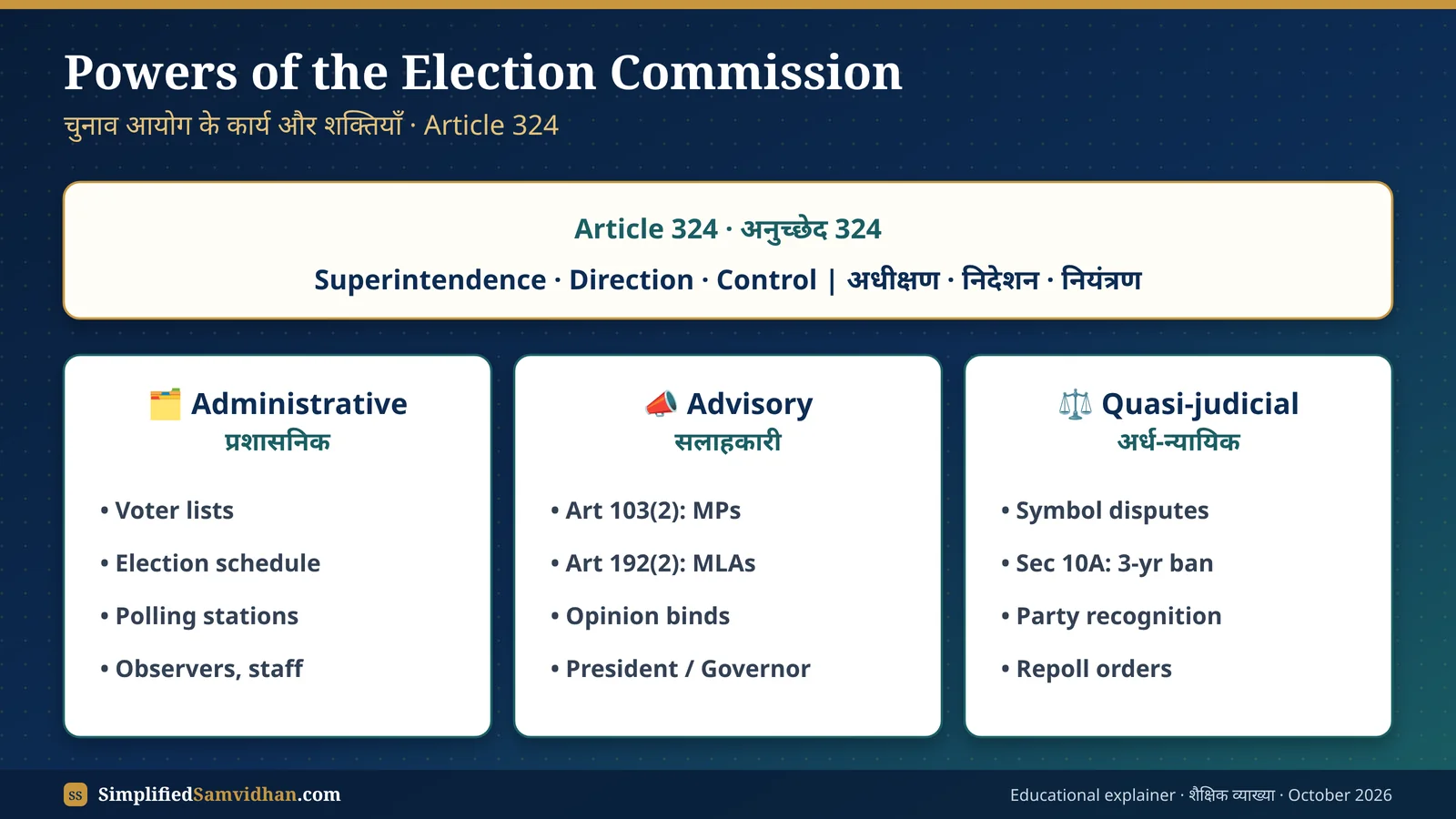
Three words in Article 324 make the Election Commission one of the most powerful bodies during an election. Here is what it can do, what it cannot, and what the Supreme Court has said.
The sourceArticle 324: Source of the Election Commission's Powers
324. (1) The superintendence, direction and control of the preparation of the electoral rolls for, and the conduct of, all elections to Parliament and to the Legislature of every State and of elections to the offices of President and Vice-President held under this Constitution shall be vested in a Commission (referred to in this Constitution as the Election Commission).
324. (6) The President, or the Governor of a State, shall, when so requested by the Election Commission, make available to the Election Commission or to a Regional Commissioner such staff as may be necessary for the discharge of the functions conferred on the Election Commission by clause (1).
103. (2) Before giving any decision on any such question [whether a member of either House has become subject to any disqualification], the President shall obtain the opinion of the Election Commission and shall act according to such opinion.
Three words in Article 324 carry all the power: superintendence, direction and control. Superintendence means watching over everything; direction means giving orders; control means having the final say. Parliament makes the detailed election laws (the Representation of the People Acts of 1950 and 1951), and where those laws are silent, the Commission can fill the gap under Article 324 itself.
🏠 Everyday analogy
A school principal runs the annual exam. The education board's rule book covers most things, but if a storm hits on exam day and the book says nothing, the principal can reschedule. The principal cannot, however, tear up the rule book.
🇮🇳 Real Indian example
When booth capturing or violence is reported, the Commission orders a repoll at that booth (Sections 58 and 58A, RP Act 1951). It has done this in many States, often within 48 hours of polling.
FunctionsFunctions of the Election Commission of India: Administrative, Advisory, Quasi-Judicial
| Type of power | What the Commission does | Source |
|---|---|---|
| Administrative | Prepares and revises voter lists; fixes the election schedule; sets up polling stations; deploys staff, observers and forces; issues EVM and counting rules | Art. 324; RP Acts 1950 and 1951 |
| Parties and symbols | Registers political parties, recognises national and State parties, allots symbols, decides symbol disputes between rival groups | Sec. 29A RP Act 1951; Symbols Order, 1968 |
| Model Code | Enforces the Model Code of Conduct from the day the schedule is announced | Art. 324 (code is not a statute) |
| Advisory | Gives its opinion to the President on disqualification of MPs, and to the Governor on MLAs; the President and Governor must follow it | Arts. 103(2), 192(2) |
| Quasi-judicial | Disqualifies a candidate for three years for not filing election expense accounts; decides party-split symbol cases after hearing both sides | Sec. 10A RP Act 1951; Para 15, Symbols Order |
| Emergency on polling day | Adjourns or countermands a poll, orders a repoll, or cancels a poll vitiated by booth capturing | Secs. 57, 58, 58A RP Act 1951 |
Key casesSupreme Court on the Powers of the Election Commission
| Case | What the Supreme Court said |
|---|---|
| Mohinder Singh Gill v. Chief Election Commissioner (1978) | Article 324 is a reservoir of power: where no law covers a situation, the Commission may act, but fairly and within the law. |
| A. C. Jose v. Sivan Pillai (1984) | The Commission cannot override an existing law. Using EVMs at Paravur without a law was invalid, so the result was set aside. |
| Kanhiya Lal Omar v. R. K. Trivedi (1985) | The Election Symbols Order, 1968, made under Article 324, is valid. |
| INC v. Institute of Social Welfare (2002) | The Commission registers parties but has no general power to de-register them, except in narrow cases such as fraud. |
LimitsWhat the Election Commission Can and Cannot Do
The Commission CAN
- Fix dates and phases of elections
- Transfer officers on election duty
- Ban a leader from campaigning for some hours or days for MCC breaches
- Order repolls and countermand polls
- Freeze a party symbol during a split
The Commission CANNOT
- Override a law made by Parliament
- De-register a party for its ideology or conduct (no such power)
- Itself unseat an MP or MLA: it only gives an opinion
- Decide election disputes after the result: that is for the High Court
- Run panchayat or municipal elections
Connect the dotsRead Next: Related Election Commission Notes
- The full story and every CEC: Election Commission of India.
- The code it enforces: Model Code of Conduct.
- Its advisory role on disqualification: Disqualification of MPs and MLAs.
- Why courts stay out until results: Election petition and Article 329.
Quick revisionOne-Line Revision Points (Exam Ready)
- Article 324 vests superintendence, direction and control of elections in the ECI.
- Mohinder Singh Gill (1978): Article 324 is a reservoir of power.
- ECI cannot act against a law made by Parliament (A. C. Jose, 1984).
- Advisory role: Articles 103(2) and 192(2), opinion binding on President / Governor.
- Party symbols: Election Symbols (Reservation and Allotment) Order, 1968.
- Party registration: Section 29A, RP Act 1951; no general power to de-register.
- Not filing expense accounts: disqualification for 3 years (Section 10A).
- Repoll and booth capturing: Sections 58 and 58A, RP Act 1951.
Practice MCQPractice MCQs (with Answers): Powers of the Election Commission
Which case called Article 324 a 'reservoir of power'?
Whose opinion must the President follow on the disqualification of an MP under Article 103?
Under which order does the Election Commission allot party symbols?
For how long can the Election Commission disqualify a candidate who fails to lodge election expense accounts?
Consider: 1. The ECI can de-register any party for violating the Model Code. 2. The ECI can order a repoll at a booth. Which is/are correct?
Doubts ClearedFrequently Asked Questions
What are the main functions of the Election Commission of India?
Preparing voter lists, fixing election schedules, conducting polls and counting, registering and recognising parties, allotting symbols, enforcing the Model Code, and advising the President and Governors on disqualification of legislators.
Is the Election Commission a quasi-judicial body?
It has quasi-judicial functions, such as deciding symbol disputes and disqualifying candidates under Section 10A, but it is mainly an administrative constitutional body.
Can the Election Commission cancel an election?
It can countermand or adjourn a poll and order repolls at booths. Once the result is declared, only an election petition in the High Court can set an election aside.
Who gives staff to the Election Commission?
The President and the Governors, when the Commission asks (Article 324(6)). During elections these officers work under the Commission's control.
Sources and further readingSources We Checked
Facts checked on 21 October 2026. Hindi text of Articles 324(6) and 103(2) is a simple rendering; the English text is authoritative.