Municipal Corporation vs Municipal Council vs Nagar Panchayat, and How Your Parshad Is Elected
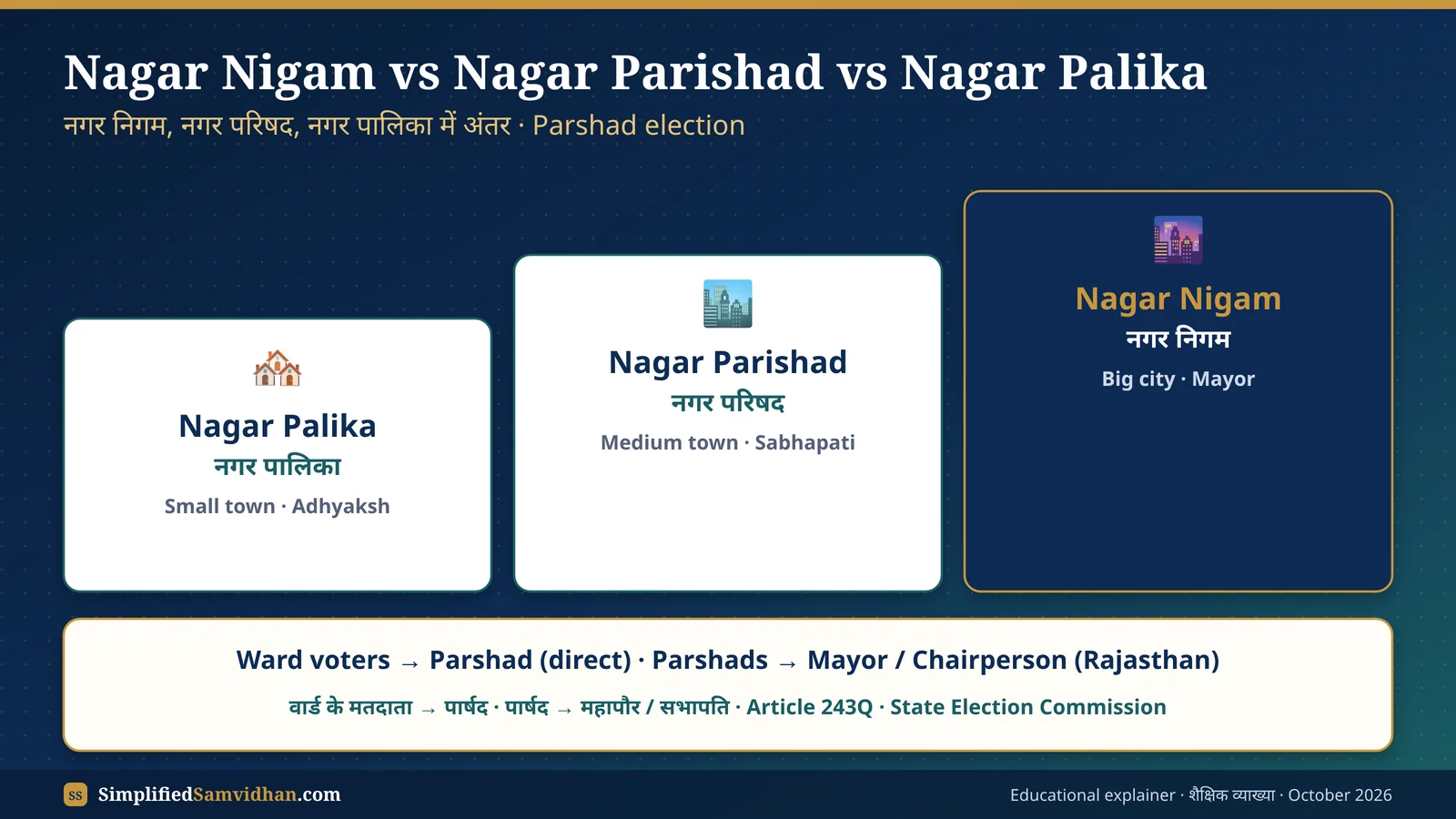
Why does Jaipur have a Nagar Nigam but Tonk a Nagar Parishad? Who chooses the mayor? And what can your parshad actually do? The town side of local democracy, in plain words.
The ConstitutionMunicipalities in the Constitution: 74th Amendment and Article 243Q
243Q. Constitution of Municipalities.— (1) There shall be constituted in every State,— (a) a Nagar Panchayat (by whatever name called) for a transitional area, that is to say, an area in transition from a rural area to an urban area; (b) a Municipal Council for a smaller urban area; and (c) a Municipal Corporation for a larger urban area, in accordance with the provisions of this Part.
243R. Composition of Municipalities.— (1) Save as provided in clause (2), all the seats in a Municipality shall be filled by persons chosen by direct election from the territorial constituencies in the Municipal area and for this purpose each Municipal area shall be divided into territorial constituencies to be known as wards.
243U. Duration of Municipalities, etc.— (1) Every Municipality, unless sooner dissolved under any law for the time being in force, shall continue for five years from the date appointed for its first meeting.
The 74th Amendment (1992) did for towns what the 73rd did for villages. It says every State must have three kinds of urban bodies, by size: a Nagar Panchayat for a place turning from village to town, a Municipal Council for a smaller town and a Municipal Corporation for a big city. Each town is cut into wards, and the people of each ward directly elect one parshad (councillor) for five years.
🏠 Everyday analogy
Like clothes sizes S, M and L: same shirt, different size. A Nagar Palika, a Nagar Parishad and a Nagar Nigam all do the same basic jobs (water, roads, garbage, streetlights), just for towns of different size.
DifferenceNagar Nigam vs Nagar Parishad vs Nagar Palika: Difference Explained
| Point | Nagar Palika (Municipal Board / Nagar Panchayat) | Nagar Parishad (Municipal Council) | Nagar Nigam (Municipal Corporation) |
|---|---|---|---|
| For | Small town / area in transition | Medium town | Big city |
| Article | 243Q(1)(a) | 243Q(1)(b) | 243Q(1)(c) |
| Head (Rajasthan name) | Adhyaksh (Chairperson) | Sabhapati (Chairperson) | Mahapaur (Mayor) |
| Head chosen by (Rajasthan 2026) | Elected parshads | Elected parshads | Elected parshads |
| Chief officer (not elected) | Executive Officer | Commissioner | Commissioner (often an IAS officer) |
| Rajasthan examples | Most of the 253 smaller towns | District towns such as Tonk | Jaipur, Jodhpur, Kota, Udaipur, Ajmer, Bikaner |
Parshad electionHow a Parshad (Ward Councillor) and Mayor Are Elected
- 1Wards and reservation
The town is divided into wards of roughly equal population. Wards are reserved by rotation for SC, ST, OBC and women (at least one-third; 50 per cent in Rajasthan), Art. 243T.
- 2Who can contest
A voter of that town, aged 21 or more, not disqualified under the State municipal law. Rajasthan removed the two-child bar in 2026.
- 3Party fight
Unlike sarpanch polls, parshad polls are fought on party symbols, so BJP, Congress, AAP and independents all field candidates.
- 4Voting
One vote per voter, for the parshad of your ward, usually on an EVM, conducted by the State Election Commission.
- 5Counting
At district centres on a fixed day; in Rajasthan's 2026 polls, on 14 September.
- 6Mayor or chairperson
In Rajasthan the elected parshads then vote to choose the Mahapaur, Sabhapati or Adhyaksh (held from 21 September 2026). In States such as Uttar Pradesh and Madhya Pradesh the mayor is elected directly by all voters, giving city people a fourth vote.
Your parshad is the elected person closest to your street in a town: the one you call for a broken drain, a dark streetlight or a missing garbage pickup. The mayor or chairperson runs the council meetings, while the Commissioner or Executive Officer runs the office staff.
🇮🇳 Real Indian example
In Tonk Nagar Parishad's chairperson election in September 2026, the Congress candidate won with 38 parshad votes against 21 for the BJP candidate (as reported). Voters had only chosen the parshads; the parshads chose the Sabhapati.
FunctionsWhat Your Nagar Nigam or Nagar Palika Does: 12th Schedule
Water and drains
Water supply, sewerage and storm drains (12th Schedule).
Cleanliness
Garbage collection, public toilets, solid waste management.
Roads and lights
Local roads, bridges, streetlights, parking.
Certificates
Birth and death registration, trade licences, building permissions.
Parks and planning
Parks, urban planning, slum improvement, fire services.
Taxes
House tax (UD tax in Rajasthan), fees and charges, as State law allows (Art. 243X).
Connect the dotsRead Next: Local Elections and Constitution Notes
- City voter vs village voter, full story: How many times can you vote in India.
- Who runs municipal polls: State Election Commission vs ECI.
- The village version: Sarpanch election process.
- The 73rd and 74th Amendments among others: Important Amendments of the Constitution.
- The 12th Schedule in context: 12 Schedules of the Constitution.
Quick revisionOne-Line Revision Points (Exam Ready)
- 74th Amendment, 1992: Part IXA, Arts. 243P to 243ZG, 12th Schedule.
- Three bodies: Nagar Panchayat, Municipal Council, Municipal Corporation (Art. 243Q).
- Seats filled by direct election from wards (Art. 243R).
- Term: 5 years (Art. 243U).
- Wards Committees for population 3 lakh+ (Art. 243S).
- Polls by the State Election Commission (Art. 243ZA).
- Rajasthan mayor/chairperson: elected by parshads.
Practice MCQPractice MCQs (with Answers): Municipal bodies
Which Article provides for Nagar Panchayat, Municipal Council and Municipal Corporation?
A Nagar Panchayat is meant for:
Which Schedule lists the functions of municipalities?
Wards Committees are compulsory in municipalities with a population of:
In Rajasthan's 2026 urban polls, the Mayor was chosen by:
Doubts ClearedFrequently Asked Questions
What is the difference between Nagar Nigam and Nagar Palika?
Size. A Nagar Nigam (Municipal Corporation) is for a big city and is headed by a Mayor; a Nagar Palika is for a small town and is headed by a chairperson (Adhyaksh). A Nagar Parishad sits in between.
Who elects the parshad?
All voters of the ward, directly, for five years, in a poll conducted by the State Election Commission.
Is the mayor directly elected in India?
It depends on the State. Uttar Pradesh and Madhya Pradesh elect mayors directly; Rajasthan, Maharashtra and many others have councillors elect the mayor.
What is the minimum age to become a parshad?
21 years, and the person must be a voter of that municipality.
Sources and further readingSources We Checked
Facts checked on 25 October 2026. Rajasthan 2026 urban poll details are from news reports; check sec.rajasthan.gov.in for official results. Hindi text of the Articles is a simple rendering.